Introduction
Recent events such as the war in Ukraine and the COVID-19 pandemic have heightened public awareness of the challenges posed by mass casualty events (MCEs) and mass casualty disasters (MCDs). MCEs and MCDs are marked by a period of mismatch (disproportion) between supply and demand for patient care. Actions must follow the principles of disaster medicine, the primary goal of which is to do the greatest good for the greatest number of patients, even if it means postponing care for individuals. After resolving the mismatch between supply and demand as soon as possible, the principles of individual medicine can then be restored. How long the disaster lasts depends in part on readiness, to include the existence of a valid disaster plan and the education and training levels of healthcare personnel.
MCD preparedness begins with measures aimed at disaster prevention, such as building codes. These measures must continuously be adapted based on the latest experience. For example, at the Grenfell Towers, flammable and hazardous construction materials were used with deadly consequences. Evacuation procedures also have to be evaluated and updated.
Under everyday circumstances, healthcare should be based on the state of the art in medical science. However, during a disaster, treatment with the best available means may actually decrease the quality of care for individuals. Furthermore, in MCDs, a region’s or a country’s infrastructure may be unable to cope while maintaining the standard of care. Even a small number of victims from one event can push a burn treatment system to its limits. Help from other jurisdictions must therefore be planned and coordinated.
The purpose of this chapter is to introduce concepts of disaster medicine as applied to burn patients. A collection of disaster medicine terms is provided with examples of major burn disasters, and lessons learned are described. Finally, humanitarian crisis response is discussed. Every disaster we have studied is somewhat different. There is, however, a common theme running through all of them: prior planning and realistic training are essential to success.
Definitions
The following is a basic vocabulary for burn MCD response:
-
An MCE is an emergency in which there are more victims than can be accommodated by rescue forces and their resources. Infrastructure in the affected area is intact. With force mobilization, the crisis can be mastered. The period of mismatch between supply and demand is brief. The goal is to reestablish treatment according to principles of individual medicine as quickly as possible and without transferring the supply-demand mismatch from the scene to hospitals.
-
An MCD is an event in which infrastructure is at least partly destroyed, degraded, or overwhelmed, and the event cannot be handled by regional means alone. The first goal is to reestablish the minimal level of infrastructure required to provide basic medical care. The maximum treatment possible locally is determined by the degree of infrastructure and resources present in, or brought to, the disaster area. Although MCEs remain in the purview of local organizations, disasters MCDs are for regional or national authorities.
-
Burn MCD is defined by the American Burn Association (ABA) as “any catastrophic event in which the number of burn victims exceeds the capacity of the local burn center to provide optimal burn care.” The ABA Plan was developed for the management of burn casualties resulting from MCDs and terrorist acts.
-
Capacity includes the availability of burn beds, burn surgeons, burn nurses, other support staff, operating rooms, equipment, supplies, and related resources.
-
Triage is the process of sorting individual patients into categories according to priority of treatment. Several factors influence triage decisions; these include available resources, number of patients, the severity of injury of each patient, and the time frame during which the injuries must be addressed. Triage is not a one-time event but should be repeated throughout the event (see later).
-
Basic capacity is the number of patients who can be treated under normal circumstances, based on the availability of burn beds, burn surgeons, burn nurses, other support staff, operating rooms, equipment, supplies, and related resources.
-
Capacity utilization is the degree of utilization of burn beds in a center over a certain time. This should be expressed as use of intensive care burn beds and other beds. The average value over a year gives an overview of a burn center’s disaster capacity.
-
Actual capacity is the number of burn patients that a center can admit on a given day. It varies daily, can depend on the season, and is likely to fluctuate with presence or absence of critically ill patients.
-
Surge capacity is the increased capacity available during MCDs. In burns, it is defined by the ABA as the capacity to handle, in a disaster, 50% more than the normal maximum number of patients. Surge capacity must be developed and maintained, requiring action by health systems. It must include continued care for all other patients. Elective medical and surgical care can be postponed temporarily to maintain surge capacity. When surge capacity is breached, patients must be transferred safely to other treatment facilities.
-
Sustained capacity is the maximum capacity that a burn center can sustain over a longer time without lowering treatment quality.
-
The burn capacity of a health system is the total number of burn patients that can be treated in a regional/national healthcare system. This capacity should take into account the various requirements of burn treatment, such as the number of victims needing intensive care. The average capacity utilization over the year is part of resource planning for a healthcare system.
-
Time to establish surge capacity is how much time a burn center needs to rise to surge capacity.
-
The medical disaster system coordinates a country’s healthcare response to an MCD. The key functions are (1) medical response at the disaster site, (2) transport of patients to unaffected areas, and (3) definitive medical care in unaffected areas. In the United States, this role is played by the National Disaster Medical System (NDMS) in collaboration with other federal agencies. In the UK, this is done by the National Health System (NHS) Incident Response. In Germany, it is performed by the National Crisis Management of the Federal Office of Civil Protection and Disaster Assistance in cooperation with the EU.
-
Burn rapid-response teams, burn specialty teams (BSTs), and burn assessment teams (BATs) are deployable to a disaster area to provide burn expertise and augmentation. In the United States, a BST consists of 15 burn-experienced medical and nonmedical staff. In the EU, BAT teams are partly available, partly under development. Such teams can be formed only when burn experts are numerous enough and not already engaged in other aspects of disaster response.
-
Technical relief is the nonmedical “civil defense” response to a disaster and includes lighting, debris removal, search and rescue, flood mitigation, electricity, water supply, sewage disposal, catering, command center support, communications, logistics, equipment repair, and transportation of supplies. In Germany, these functions are performed by the Bundesanstalt Technisches Hilfswerk and in the US by the Federal Emergency Management Agency (FEMA) or by equivalent agencies at the state and local levels.
Resources
The ABA has provided guidelines for the treatment of burns under austere conditions. The European Burn Association (EBA) published a European Response Plan within the EU Civil Protection Mechanism. The British Burns Association (BBA) published guidelines for MCEs.
New technologies
The use of unmanned aerial vehicles or “drones” in disaster response is becoming more widely explored. Current applications being studied include delivery of equipment, of blood in response to trauma, and of rescue medications. Drones are also being used in search and rescue (SAR) operations and MCD response. Jain et al. performed a simulation trial of using drones to augment field triage and casualty evacuation and found statistically faster triaging of patients, without a sacrifice in accuracy, in both day and night conditions.
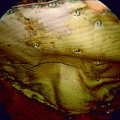
Smart glasses and digital remote assistance platforms can connect field personnel to a burn expert in real time. Annotated images can be sent back to the field user’s heads-up display for view ( Figs. 4.1 and 4.2 ). These technologies can be used to support BATs and to identify burn victims by photos with geotags.
New York, 2001. Triage station set up by Burn Specialty Team 1 from Boston, Massachusetts.
(Reprinted with permission from Sheridan R, Barillo D, Herndon D, et al. Burn specialty teams. J Burn Care Rehabil . 2005;26:170-173.)
Ufa, Russia, 1989: US and Russian teams perform burn wound care.
(Photo courtesy of U.S. Army.)
The historical record
Recent burn MCDs are summarized in Table 4.1 . Recurring issues include the following:
-
■
Communication problems
-
■
Need to send major burn patients to burn centers within the “transportation window”
-
■
Central incident command post
-
■
Movement of patients to hospitals by private vehicles; importance of traffic control and coordination of patient evacuation from the scene
-
■
Triage and retriage
-
■
Infection control
-
■
Lack of experience in burns by nonburn providers
-
■
Psychological support for providers
-
■
International teamwork
Table 4.1
Burn Mass Casualty Disasters, 2000–2020
| Location(s)Year | Type | Total Injured | Fatalities | Burn Injuries | Comments |
|---|---|---|---|---|---|
|
Terrorist attack: aircraft vs. buildings | Thousands | 2996 |
|
|
|
Terrorist attack: bombing of 2 nightclubs and US consulate | 209 | 202 | Unknown; 60 of the 66 repatriated Australian patients were redistributed to burn centers |
|
|
Terrorist attack: bombing of 4 trains | 2051 | 193 | 45 of the 312 patients taken to Marañón hospital | High rate of concomitant injuries |
|
Terrorist attack: bombing of 3 trains and a bus | 775 | 56 | 5 burns and 8 inhalation injury of the 27 patients admitted to Royal London Hospital | |
|
Café fire (De Hemmel) | 245 | 14 | 245 burns, of whom 96 had inhalation injury | 182 patients admitted, of whom 78 secondarily transported to 36 hospitals in 3 countries |
|
|
215 | 100 |
|
Toxic smoke, heat, and human rush were the main causes of death |
|
|
744 | 194 | 74 patients to Argerich Hospital, all inhalation injury; 18 dead on arrival | Main cause of death: carbon monoxide and cyanide |
|
Nightclub fire (Kiss) | More than 700 | 242 | Most injured had inhalation injury | 54 patients transferred to other hospitals in the region |
|
Nightclub fire (Colectiv) | 184 | 64; 26 at the scene, 38 in hospitals | High late-death rate from multidrug-resistant organism infections | |
|
Ignition of clouds of colored cornstarch at a water park | 499 | 12 | Mean TBSA reported as 44% | 437 patients admitted to 46 hospitals |
|
Rollover of an LPG tanker | At least 69 | 35 |
|
|
|
Fire in a 24-story apartment building (Grenfell Tower) | Over 70 | 72 | Not reported | Long-term psychological and physical health effects reported |
|
Explosion of 2750 tons of ammonium nitrate | 8643 | 218 | Infrequent | Large percentage of blast injuries, including penetrating, primary blast, and blunt trauma |
LPG, Liquefied petroleum gas; TBSA, total body surface area.
Phases of mass casualty disasters
Chaos and alarm
Initially, information about the event is unavailable; even those involved often cannot verify the incident’s dimensions and sometimes cannot even describe the location. Questions to be answered include the exact time, place, and type of accident; the estimated number of casualties and expected pattern of injuries; hazards (e.g., contamination, toxic smoke); and the number of persons potentially exposed.
Immediately after the accident, victims often flee to the nearest hospitals, overcrowding them before any official alert. This influences the execution of emergency plans because everyone is busy with arriving victims, and there may be no resources available to carry out those plans. Contaminated victims can bring severe risks to hospitals.
Organization
After verification, the incident command system and the in-field command post must be established and must coordinate the work of rescue, security, medical, and technical-relief teams.
Medical care at the scene should be established. First, the scene must be cleared of further hazards, or rescue workers must be outfitted for the risk. A cordon should be established to control victims’ departure to hospitals and to prevent onlookers’ and news media’s interference in rescue work.
Traffic regulation must begin, and all teams must understand it: it must include movement and assembly of ambulances, fire trucks, and police cars; landing and take-off of helicopters; decontamination areas; areas for triage, treatment, and minor injuries; and a temporary morgue.
In this phase, cooperation among teams is crucial. Local command, control, and communication (C3) structures must be established; they form the coordination hub for preclinical treatment. A central C3 structure coordinates preclinical and clinical treatment and transport and disseminates up-to-date information. At hospitals, disaster plans are implemented, and staff is called in.
Triage
Triage is a process whereby patients are sorted according to treatment priority, the purpose of which is to do the greatest good for the greatest number. Several schemes exist to define levels of triage. The Advanced Disaster Medical Response manual describes the following levels:
-
■
Primary triage occurs at the scene
-
■
Secondary triage occurs upon arrival at the hospital
-
■
Tertiary triage occurs in the intensive care unit (ICU)
The ABA approach is burn-center oriented and describes the following:
-
■
Primary triage is that occurring at the disaster scene or in the emergency department of the first receiving hospital.
-
■
Secondary triage is the selection for transfer of burn patients from one burn center to another when surge capacity is reached.
Triage is not a one-time operation but has to be repeated at each step of the way. There are several different algorithms for triage. Paramedics may use simple triage and rapid treatment (START) in both emergency medicine and mass casualties. The sensitivity for START varies from 85% to 62%. The New York Fire Department uses another approach for medic in-field triage. This is done in an established triage area by medics assisted by teams of helpers. It consists of a brief history (time of accident, mechanism of injury, condition, how the patient was found, primary measures taken, actual discomfort, preexisting condition, medications, and allergies) and a quick head-to-toe examination.
Triage classifies patients according to treatment urgency groups ( Table 4.2 ). An easy-to-remember acronym is DIME, which stands for delayed, immediate, minimal, and expectant. The main factors to consider in burn-patient triage are total body surface area (TBSA) and age.
Table 4.2
Triage Color Code and Urgency
| Group | START | Medic Triage |
|---|---|---|
| 1 | Immediate | Immediate |
| 2 | Urgent | Urgent (2a and 2b) |
| 3 | Delayed | Delayed |
| 4 | Expectant | |
| 4 | Expectant or dead | |
| No number, no color | Dead |
Emergency treatment at the scene is done in a treatment area by appropriately trained providers. Burns needing rapid intervention for shock or airway compromise should be classified for urgent treatment. Because of the need to resuscitate as soon as possible, resuscitation should begin here.
Triage group 4 (e.g., in Austria, Germany, Switzerland) includes the unsalvageable, who deserve “expectant” treatment. This may be controversial because the duration of the disparity between supply and demand should be short and, when the period is over, this group’s priority may change to 1 or 2. Group 4 needs staff at least for comfort care. In MCDs, cardiopulmonary resuscitation (CPR) is not performed as it uses up resources for largely futile efforts. Dead victims need neither staff nor transport in the acute phase.
If available, tags are attached to each patient. When possible, photos with geotagging should be taken. Tags are used not only to indicate triage category but also to provide each patient with a unique number. These tags facilitate victim identification and registration; record patients’ history, medical treatment, injuries, urgency of treatment, and classification of injury; and specify the hospital for treatment. The tags must not be removed until all the following have occurred: hospital arrival, patient identification, and registering the tag number and treatment data.
Initial transport
For burn-patient transport from the scene to the hospital, ambulance heating should be maximized to avoid hypothermia. Warming pads and extra blankets should be prepared and intravenous (IV) fluids warmed up. Ambulance doors should be kept closed to retain heat. The transport order must accord with urgency status determined in triage.
Transporting the dead diverts resources from the living. The dead, and where they are found (important for identification), should be registered; when they have to be removed, they should be taken to a temporary morgue.
One strategy for distributing patients from an MCE is based on proximity to the scene and classifies hospitals as first, second, or third line. As much as possible, first-line hospitals (those closest to the scene) should be avoided. They will be overcrowded with people arriving as walking wounded or by private vehicles who have been neither triaged nor registered. , Second-line hospitals are the main destinations for those in need of emergency treatment. Third-line hospitals, those far from the incident, are ideal for patients in triage group 3 (“delayed treatment,” “walking wounded” with only minor burns). Mass-transport means (e.g., buses) can be used.
Related posts:



Stay updated, free articles. Join our Telegram channel

Full access? Get Clinical Tree


