Sourcing bulk peptides means buying through a supplier’s wholesale channel rather than the retail cart, where the price per milligram falls as the order grows and the terms move from a checkout page to an application. Research laboratories are the core market for wholesale peptides, along with resellers, peptide brands, and clinics.
The per-milligram price is the easiest thing to compare and the least useful on its own. Lot continuity is what costs money when it slips, because a second lot arriving mid-study means revalidation. It is also the cleanest way to separate suppliers.
Kylo Peptides, one of the three scored here, publishes a lot-matched certificate for every released batch in a public library, so you can confirm which lot a quote covers before committing to a minimum.
This guide covers the seven checks that decide a volume order, how bulk pricing tiers are built, and three suppliers scored on the same factors.
Research peptides at any volume are supplied for laboratory use only. They are not for human or veterinary use.
What Are Bulk Peptides?
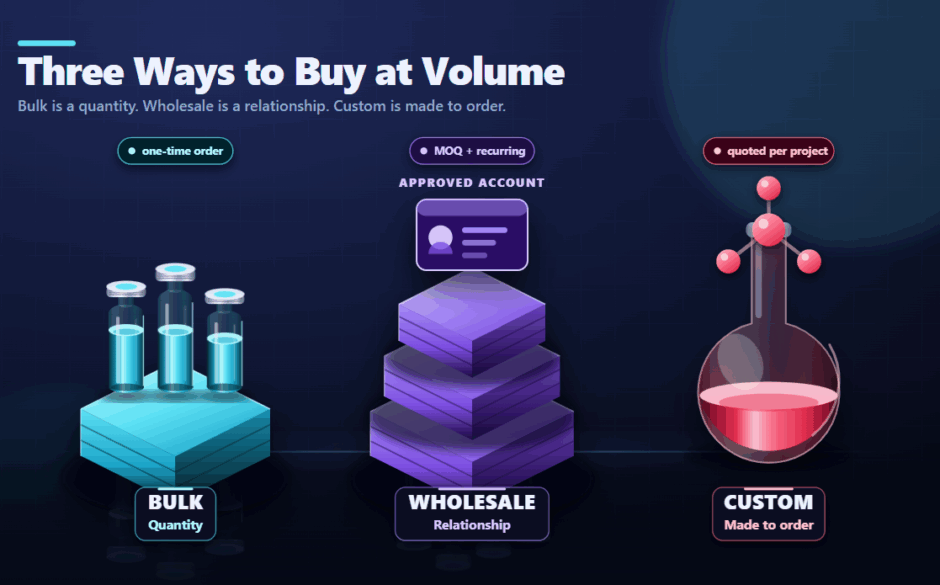
Research peptides in bulk are compounds sold in quantities large enough to reach volume pricing, typically dozens to hundreds of vials of one compound or a mixed set. The term refers only to quantity; purity, documentation, and origin are separate questions.
What Does Bulk Mean When Buying Peptides?
Bulk refers to volume, and each supplier draws the line where it wants. Once an order reaches that threshold, tier pricing applies to the whole order so that the same 40-vial purchase can count as bulk at one company and retail at the next.
What Does Wholesale Peptides Actually Mean?
Wholesale describes the relationship, and it begins with paperwork. You apply, the supplier checks your credentials, and an account with its own price list follows within 1 to 2 business days.
Bulk Peptides vs. Wholesale Peptides
| Bulk Peptides | Wholesale Peptides |
|---|---|
| Refers to quantity | Refers to purchasing relationship |
| Larger-volume purchase | Business or account-based purchasing |
| Volume pricing may apply | Wholesale pricing may apply |
| Can be a one-time order | Often recurring purchasing |
| May have an MOQ | Usually has an MOQ |
Bulk Peptides vs. Individual Peptide Orders
An individual order ships from whichever lot is on the shelf, so two orders a month apart may be different batches. A bulk order can be filled from a single lot, keeping multi-timepoint work such as the KLOW blend research comparable.
Bulk Peptides vs. Custom Peptide Synthesis
Custom peptide synthesis makes material that doesn’t exist yet, built to your sequence and specifications. Bulk custom production is quoted per project, and you must schedule the run before anything ships.
Why Do Buyers Purchase Peptides in Bulk?
Two separate problems push buyers toward research peptides in bulk, and they pull in the same way. Commercially, the unit price falls as an order grows. Scientifically, one large lot removes the batch-to-batch variation that makes results from separate vials hard to compare.
Lower Per-Unit Costs
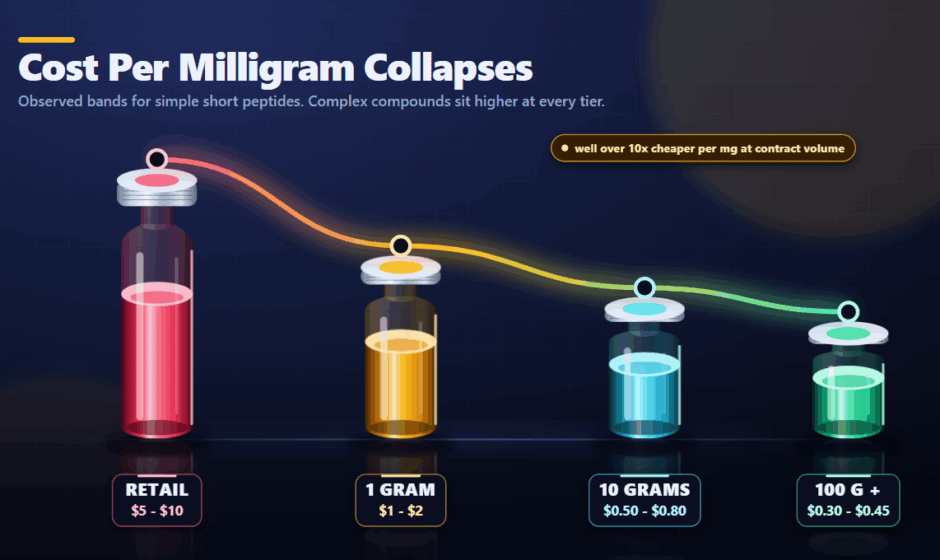
The unit price falls steeply, and at contract volume it can land well over ten times below retail per milligram. That gap is why volume buying exists.
Volume Pricing
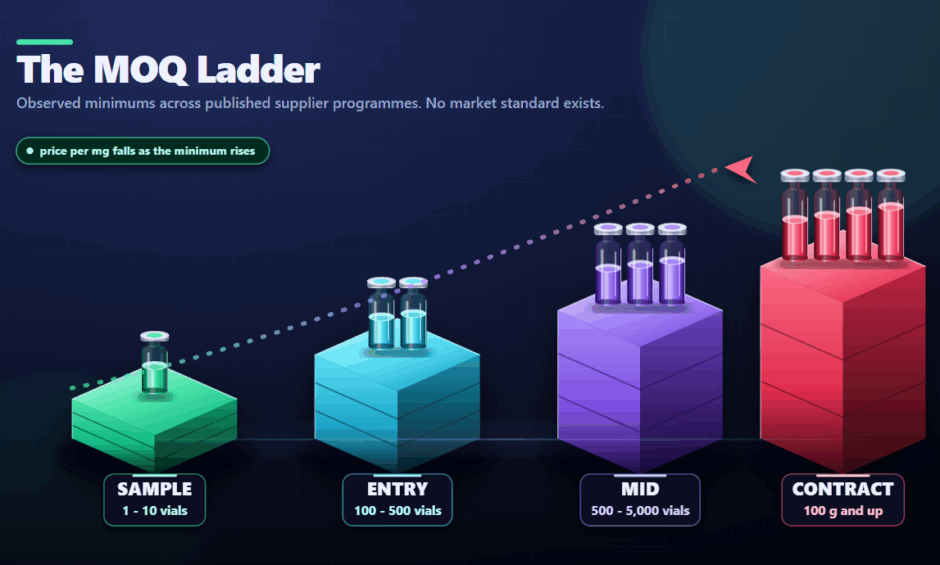
Discounts arrive in bands, one published program stepping from about 40% off retail at 10 vials to roughly 58% at 100, with custom pricing above 500.
Consistent Research Supply
Reordering mid-project means a new lot, and a new lot brings new variables. Holding stock removes the dead time before a restock lands.
Fewer Individual Orders
One purchase order replaces twelve, which shows up in the time spent reconciling receipts against study records.
Simplified Procurement
A single approval, one invoice, one shipment to log, with payment terms letting finance handle the spend on its normal cycle.
Better Batch and Lot Management
Lyophilized material, meaning freeze-dried powder in a sealed vial, holds at -20°C long term. Once reconstituted with a sterile diluent, it moves to 2°C to 8°C and gets used promptly. Buying by the lot keeps that schedule predictable, which months-long work like the hair-specific evidence reviews needs.
Bulk Peptide Suppliers: What Should You Compare?
Comparing suppliers works better as a scorecard than a ranking, because the right answer depends on your volume and your documentation needs. Eleven factors cover it. Score every candidate on the same eleven before committing to a minimum order quantity.
| Factor | What to Compare |
|---|---|
| MOQ | Minimum quantity, and whether it applies per compound |
| Pricing | Published volume breaks or quote-only |
| COA | Lot-specific availability |
| HPLC | Purity testing and reported percentage |
| MS | Identity confirmation |
| Additional testing | Endotoxin, heavy metals, sterility |
| Manufacturing | Source and production route |
| Lead time | Stock versus production |
| Lot tracking | Batch traceability and records |
| Shipping | Options, thresholds, refrigeration |
| Support | Wholesale or account handling |
#1. Kylo Peptides
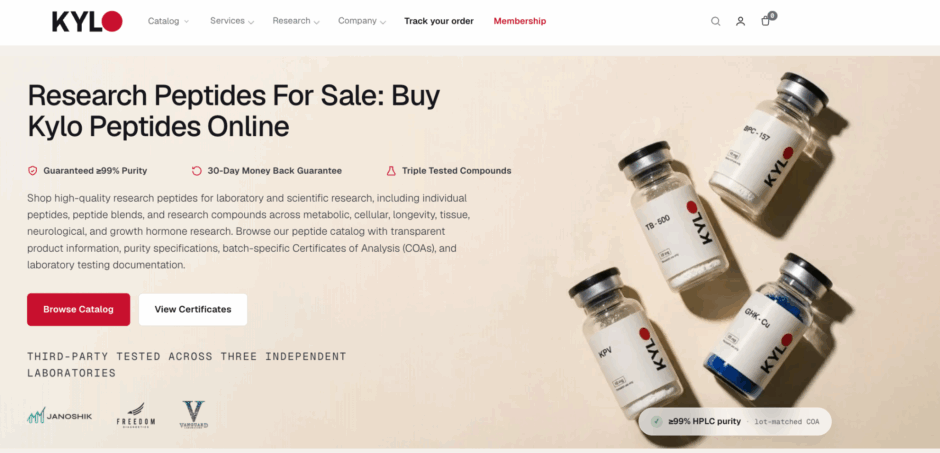
When a bulk peptide order must stay comparable from the first time point to the last, Kylo Peptides is the only one of these three to publish a lot-reservation option, holding a specific lot for the length of the order. Therefore, there is no batch drift between time points.
Bulk program: The minimum is 50 vials per product, with volume tiers at 50, 100, 250, and 500 vials. The top tier is about 34% below list price and includes custom blends, custom doses, and a quarterly supply agreement. The tier structure and discount depth are published, while the per-compound unit price is issued after credential review.
Documentation: Every lot carries an audit-ready certificate with chromatograms and measured net content, prepared for regulatory review or publication. Kylo Labs LLC tests each lot across seven assays at three independent ISO/IEC 17025 laboratories: Janoshik, Freedom Diagnostics, and Vanguard Laboratory. The purity target is 99% or better, with a 99.6% running average across released lots.
Fulfilment. Credential review takes two business days, and accounts are generally operational within five. Verified accounts get Net-30 terms, meaning payment falls due 30 days after invoice, plus a named research account manager. Lot numbers print on every vial, so batches stay distinguishable on the shelf.
#2. American Peptides
American Peptides is the supplier here where the bulk discount is readable before you commit, because the quantity breaks sit on the product page and apply automatically at checkout.
Bulk program. No wholesale application is required, and no vial minimum is published. On BPC-157 5mg at $60.00 per unit, 3 to 4 units run $55.80 (7% off), 5 to 9 units run $53.40 (11% off), and 10 or more units run $50.40 (16% off).
Documentation. A lot-matched certificate is published for every product and every batch, with Bioviridian named as the independent laboratory. The panel covers HPLC purity, mass spectrometry identity, LAL endotoxin, ICP-MS heavy metals, sterility with 14-day incubation, and batch consistency, averaging 99.7% purity across the last 50 batches.
Fulfilment. Orders placed by 2 PM EST ship the same day from GMP-compliant US facilities on a fully domestic supply chain, and we replace any broken or incorrect item reported within 72 hours at no cost. Free shipping starts at $300, the highest threshold of the three, and the catalog runs 68 compounds, narrower than breadth-led suppliers.
#3. PS Peptides
PS Peptides answers a question many bulk buyers forget to ask: whether a posted certificate describes the batch actually leaving the warehouse, since its stated policy is to post results for shipping batches.
Bulk program. Nothing is published. The site has no stated minimum or tier table and no wholesale route, so volume terms must be agreed directly with the company.
Documentation. Certificates sit on a dedicated certifications page, with a stated minimum purity threshold of 99%, verified by HPLC and mass spectrometry. The laboratories are described only as independent, and none is named, so transparency cannot be checked. Endotoxin, heavy metals, and sterility results are not published.
Fulfilment. Orders placed before 2 PM EST ship the same business day; later orders ship the next day, with UPS or USPS tracking and free shipping over $200. Delivery reaches the US, US territories, Canada, the EU, the UK, and Australia, and support runs 9 AM to 10 PM EST daily. No returns or guarantee terms are published.
What Does the Bulk Peptide Market Look Like?
The bulk and wholesale peptides market has no published standard. Every figure here comes from a specific supplier’s published program. Minimums, tiers, and lead times can differ by an order of magnitude between vendors, so direct comparison is essential.
Demand for Bulk Research Peptides
Supplier re-qualification became a live problem in March 2026, when Peptide Sciences, reported as the largest US grey-market research peptide vendor, shut down. Supply continuity now sits alongside price.
Common Bulk Purchasing Models
- Per-vial volume orders at a published tier
- Single-compound orders priced per gram
- Mixed-compound orders pooling toward one minimum
- Recurring supply on an approved account
- Custom production quoted per project
How Bulk Peptide Pricing Is Structured
Two structures dominate: published tiers that show the breakpoints up front, and quote-based pricing that reveals them only after approval. Quotes become the norm above the 100-gram mark.
Why Bulk Pricing Varies Between Suppliers
Synthesis difficulty, vial filling, testing depth, and who made the material all move the number. A supplier running its own synthesis prices differently from one reselling a contract batch, so the evidence-led approach behind evidence-ranked sleep peptides applies to suppliers too.
How Much Do Bulk Peptides Cost?
Bulk peptide pricing is quoted per milligram or per vial and falls steeply with volume. Observed bands run from about $5 to $10 per milligram at retail to $0.30 to $0.45 above 100 grams on simple compounds, with complex compounds higher at both ends.
What Determines Bulk Peptide Pricing?
- Compound and sequence difficulty
- Total quantity ordered
- Vial size and fill volume
- Purity specification
- Analytical testing included
- Production route, in-house or contract
- Packaging and labeling
- Customization or blending
- Shipping method, refrigerated where needed
- Stock availability or a fresh synthesis run
Bulk Peptide Price Tiers
| Order Size | Pricing Model |
|---|---|
| Smaller bulk order | Standard volume pricing |
| Medium-volume order | Lower unit price |
| Large-volume order | Negotiated pricing |
| Custom production | Quote-based |
Is Buying Peptides in Bulk Cheaper?
Per unit, yes, and substantially. In total outlay, no. A 10-unit order at 16% off still costs more than one vial, so the savings apply only if you use the material.
What Should Be Included in a Bulk Peptide Quote?
Ask for the unit price at each tier, the lot it applies to, testing included, lead time, shipping, and payment terms. A quote missing the lot and testing cannot be compared with one that includes both, and compounds like retatrutide can be sourced at different prices at every tier.
What Is the MOQ for Bulk Peptides?
Minimum order quantity on peptides is the smallest order a supplier accepts at bulk pricing, and no single figure applies across the market. Some programs count vials and others grams, some apply it per compound, and others let a mixed basket qualify.
What Does MOQ Mean?
Think of a peptide MOQ as the supplier’s floor. Below it, you pay retail pricing; at or above it, you enter the tier.
How Bulk Peptide MOQs Work
The unit decides as much as the number. Fifty grams of a cheap peptide and fifty of a complex one are very different invoices, so confirm which the quote uses.
Minimum Vials vs. Minimum Order Value
A vial minimum stays fixed, no matter what the compound costs. A minimum set as order value flexes, since an expensive compound clears it on fewer vials.
Can You Mix Peptides to Meet the MOQ?
Sometimes. Mix-and-match minimums exist, and one observed program sets a 100-vial mixed threshold across compounds. Other suppliers apply the minimum to each compound separately, which changes the arithmetic completely.
Does the MOQ Apply Per Compound?
Often, yes. A per-SKU minimum, meaning per individual product, is common because each compound is its own synthesis and lot. Check multi-compound stacks such as GHK-Cu and GLOW on this.
Why Suppliers Set Bulk Order Minimums
Setup, purification, and quality control carry costs that do not scale down with a smaller run. Suppliers already running a compound in volume offer lower minimums.
7 Things to Check Before Buying Bulk Peptides
Seven checks separate bulk peptide suppliers worth a volume order from those worth a single vial. Work through them before money moves, since each is answerable from published material or one direct question, and a supplier who will not answer has told you enough.
1. Lot-Matched COAs
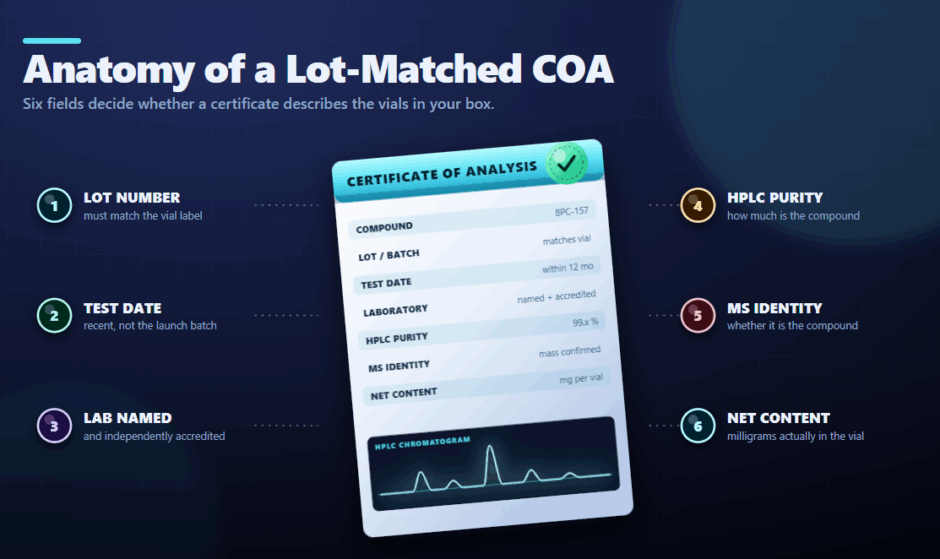
A lot-matched certificate carries the lot number from the vial, the assay results, the test date, and the laboratory that ran it. A generic document shows a typical result, leaving your vials undocumented. Request the lot-specific version before payment, when choosing a KPV source.
2. Analytical Testing
Purity and identity answer two questions: how much of the powder is the compound, and whether it is the right compound. A complete panel answers both, then screens for contamination.
HPLC Purity Testing
High-performance liquid chromatography, or HPLC, separates a sample and measures each component. This test provides the purity percentage.
| Peptide manufacturer AAPPTEC states plainly in its technical guidance: “The gross weight of dry peptide doesn’t consist of peptide only, but includes non-peptide components such as water, absorbed solvents, counter ions and salts.” The same guidance places typical net peptide content between 50 and 90 percent, depending on sequence, synthesis route, and purification.That range is why the two figures belong together on a certificate. HPLC purity tells you the material is the right compound; net peptide content tells you how much of the powder it is. A supplier reporting both is describing exactly what a milligram buys, and at volume that clarity is worth more than a decimal place. |
Mass Spectrometry and Identity Testing
Mass spectrometry weighs the molecule against its expected mass, then breaks it apart to read back the amino acid sequence. Purity without identity answers half the question.
Additional Applicable Testing
Endotoxins are bacterial breakdown products, tested under USP General Chapter. ICP-MS measures heavy metals under USP chapters USP <85>, USP <232>, USP <233>. Sterility, defined in 21 CFR 610.12, and leftover solvents follow where the process calls for them.
3. Testing Laboratory Transparency
Four questions settle this: who ran the test, is the laboratory named, is it independent, and can you verify the certificate? ISO/IEC 17025 is the accreditation recognizing a laboratory’s competence.
| ISO describes ISO/IEC 17025 as the standard that lets a laboratory “demonstrate that they operate competently and generate valid results,” and notes it generates “wider acceptance of results between countries. Test reports and certificates can be accepted from one country to another without the need for further testing.”That portability is the practical value for a volume buyer. A certificate from an accredited laboratory keeps its meaning in front of a collaborator, a journal reviewer, or an auditor who has never heard of your supplier, which is exactly the situation a bulk order creates once the material outlives the person who ordered it. |
4. Transparent Bulk Pricing
Published tiers let you model an order before applying. Quote-based pricing keeps the numbers behind a credential check, delaying comparison by a day or two.
5. Supplier and Business Transparency
Look for a legal entity name, a real address, contact routes reaching a person, and plain research-use-only positioning, the wording the FDA set in 21 CFR 809.10.
6. Lead Times and Supply Capacity
Separate in-stock from production. Bulk peptide lead times run three to seven business days for stocked compounds at one published program; rarer peptides need weeks of synthesis first.
7. Lot Traceability and Documentation
Lot traceability means the batch number, certificate, order record, and shipment record all point at each other six months later. Retention samples, archived material kept back from each batch, let a shipped lot be re-tested.
How to Verify a Bulk Peptide COA
Verifying a peptide COA means cross-checking the document against the vial in front of you. Match the lot number, read the test date, confirm the laboratory name, and check that both a purity percentage and an identity result appear.
What Information Should a Bulk Peptide COA Include?
- Compound name and lot or batch number
- Test date
- Laboratory name and accreditation
- HPLC purity percentage
- Mass spectrometry identity confirmation
- Measured net peptide content per vial
- Contamination screens where applicable
How to Match a COA to Your Bulk Order
Read the lot number off the vial and find that exact string on the certificate. If one document covers a multi-lot shipment, ask for the others.
HPLC vs. Mass Spectrometry
HPLC reports how much of a sample is the target compound; mass spectrometry confirms it matches the label. The remaining fraction needs separate analysis, which is why related-impurity work uses high-resolution MS.
Third-Party Testing vs. In-House Testing
In-house screening is fast and catches problems early. An independent laboratory removes the conflict of interest in grading your own work.
Common COA Red Flags
- A lot number that does not match the vial
- A test date predating the batch it describes
- Results reported with no method named
- A net content figure copied from the label
How to Order Bulk Peptides
Buying peptides in bulk comes down to ten steps, whether an order runs 50 vials or 5,000. Sequence changes the outcome, because requesting pricing before you have written down your specifications produces a quote you cannot compare with anything.
Step 1: Determine Your Required Quantity
Let planned use set the number. Calculate what the project consumes, add a margin for repeats, then stop. Material that degrades unopened has cost you money.
Step 2: Define Your Specifications
Compound, vial size, purity threshold, and the testing you need reported. Write it down first, since the list makes two quotes comparable.
Step 3: Compare Bulk Suppliers
Run each candidate through all eleven comparison factors, from minimum and pricing model through certificate policy and testing depth to lead time, traceability, shipping, and support.
Step 4: Request Volume Pricing
Ask for the unit price at every tier, not only the one you expect to reach. Break points reshape the math, and the next tier up sometimes costs less overall.
Step 5: Request the Relevant COA
Ask for a certificate from a recent lot of the exact compound. Stacks like the Wolverine stack sourcing question need one each.
Step 6: Confirm MOQ and Lead Time
Confirm whether the minimum applies per compound and whether material is in stock. Dispatch and lead time differ: all three suppliers here dispatch stocked items the same or next business day, while one bulk program quotes three to seven days end to end.
Step 7: Confirm Shipping and Payment Terms
Settle refrigeration, carrier, cost, and who carries loss in transit. Ask about payment terms too, since Net-30 changes how finance handles the order.
Step 8: Place an Initial Order
Order at or just above the minimum first, because a trial order at bulk pricing reveals more than any amount of correspondence.
Step 9: Verify the Shipment and Lot Documentation
Check the lot on each vial against the certificate, confirm the count, and log every batch number on arrival, while a discrepancy is still the supplier’s problem.
Step 10: Establish a Repeat-Ordering Process
Record lot numbers, certificates, and dates against each order, ask whether a lot can be reserved, and move recurring volume onto a standing agreement.
Bulk Peptide Red Flags
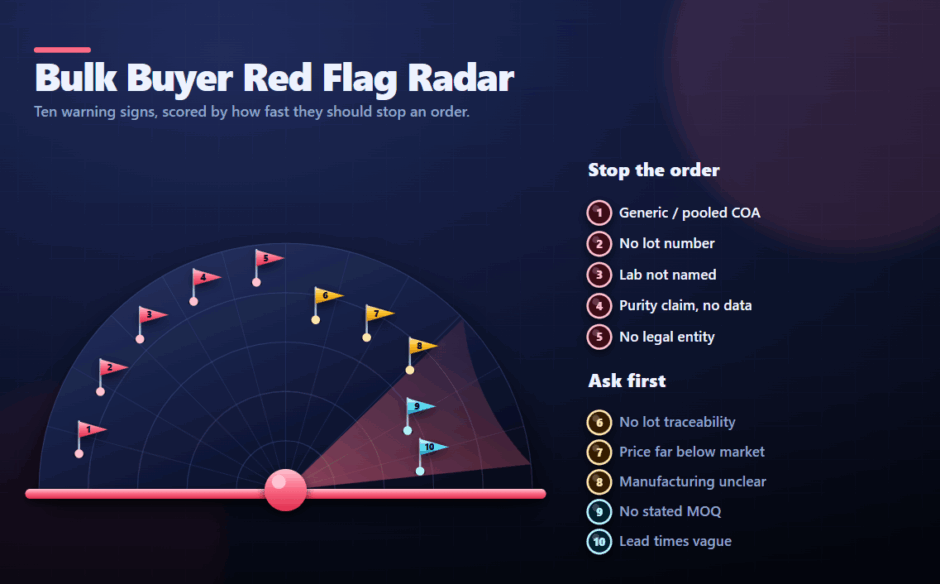
Some warning signs on bulk peptide suppliers are worth a question, and some are worth walking away from. None of the ten here needs an expert to spot, and every one of them shows up in published material or in a first reply to an email.
Generic or Pooled COAs
A certificate showing a typical result for the compound instead of your lot. This is the most common substitution and the easiest to overlook.
No Lot Number
Neither the vial nor the certificate carries an identifier, so you can’t match, retest, or recall it later.
Unclear Testing Laboratory
The supplier calls the laboratory independent but will not name it, which leaves the report impossible to confirm with anyone.
Unsupported Purity Claims
The certificate quotes a purity percentage but shows no chromatogram and names no method. Purity assessment depends on which analytical method was used, so the method belongs beside the number.
No Clear MOQ
A supplier that won’t state a minimum is usually pricing by who asks, which makes it impossible to compare quotes.
Pricing Far Below Comparable Suppliers
Synthesis, purification, and testing have real cost floors, so a price well under everyone else usually means one of them got skipped.
Unclear Manufacturing Source
Nobody will say who made the material or where. Resellers can be good suppliers, but they should still state the route upon request.
No Lot Traceability
Orders that cannot be traced to a batch make a later problem unfixable. Archived retention samples are the clearest sign a supplier planned for that.
Unclear Lead Times
In stock should mean shipping this week. A supplier that won’t separate stocked material from a synthesis run is managing your expectations rather than your order.
Poor Supplier Transparency
The site lists no legal entity, address, reachable person, or research-use-only statement. Any one of those raises a question, and all four together answer it. Matching a supplier to goal-specific selection needs requires a company willing to talk.
Frequently Asked Questions
What is the difference between bulk and wholesale peptides?
One is a basket size, the other an account. The difference that bites is timing: a bulk order can be placed today, while a wholesale account needs credential review first, usually one to two business days.
How do I choose a bulk peptide supplier?
Score every candidate against the same eleven factors, treating headline price as one input among them. The tie-breaker is usually certificate policy or whether the laboratory is named, rarely the unit cost.
Are bulk peptides available for research use only?
Yes. Every supplier here sells for laboratory research only, with no human or veterinary application. The FDA set that wording for diagnostic products, and peptide suppliers mirror it, so expect it on both the listing and the vial.
How long does a bulk peptide order take?
Count three stages: credential approval in one to two business days, then tier pricing issued, then dispatch. At one published bulk program, the stocked-compound window runs three to seven business days end to end, and fresh synthesis adds weeks.
Can bulk peptides be custom manufactured?
Yes. Custom synthesis builds material to your sequence, purity specification, and fill, quoted per project. Plan around a synthesis timeline rather than a shipping one, and expect a separate certificate per batch.
Can bulk peptides be purchased with private labeling?
Some suppliers offer white-label, private-label peptides and drop shipping alongside bulk vials. These are commercial arrangements for identical material, so the documentation questions don’t change when you put your name on the label.
Final Takeaway
Bulk peptides reward patience more than speed, and the best supplier is rarely the cheapest one. A low unit price sitting behind a generic certificate and an unnamed laboratory costs more than it saves the first time a batch gets questioned.
Before committing to volume, weigh seven things: minimum order quantity, volume pricing, lot-specific certificates, analytical testing, supplier transparency, lead times, and lot traceability. A supplier who answers all seven in writing has already shown how the relationship will run.
Start at or just above the minimum, check the documentation against the vials that arrive, then scale. Reserve a lot when the work spans months.
Then keep the records. Lot numbers, certificates, and dates logged against every order make the second purchase easier than the first, and the fifth easier again.
Disclaimers
Research use only. The peptides discussed are supplied for laboratory research, not for human or veterinary use.
The U.S. Food and Drug Administration has not evaluated these statements. These products are not intended to diagnose, treat, cure, or prevent any disease.
Affiliate disclosure: this page may contain affiliate links, which can earn a commission at no extra cost to you.
Related posts:







Stay updated, free articles. Join our Telegram channel

Full access? Get Clinical Tree


