Research-use-only educational overview. Last reviewed August 2026.
GHK-Cu vs Glow Stack is a choice between a single copper peptide and a three-peptide blend; which one fits best depends entirely on what you are studying.
- GHK-Cu is one of the most researched peptides for skin and collagen, studied on its own for its ability to signal cells to rebuild structure.
- The Glow Stack keeps GHK-Cu as its base and adds BPC-157 and TB-500.
For researchers considering a documented research-grade source, Kylo Peptides offers these peptides with lot-matched certificates of analysis and third-party purity testing, which can help with material verification before an experiment.
So a single experiment can reach skin, connective tissue, and repair pathways at once.
Neither approach is better across the board. The right choice depends on the research objective, not on which one sounds more advanced. This overview covers what each side actually studies, and it links to the primary papers so you can check the original figures yourself.
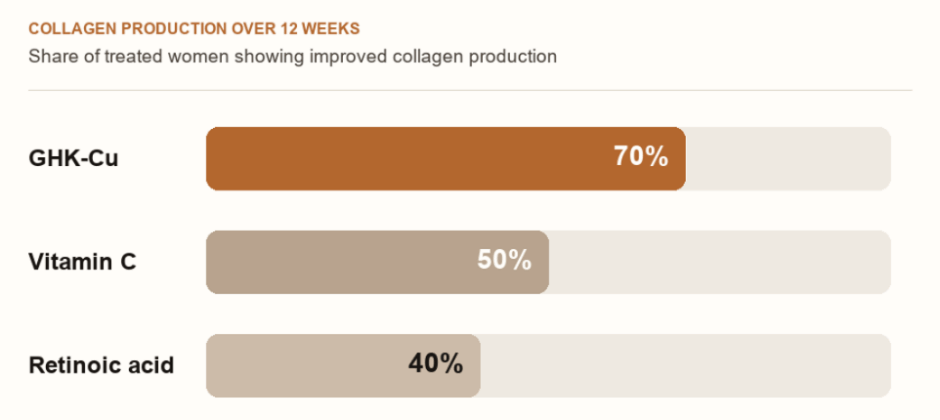
In a 12-week study, GHK-Cu improved collagen production in 70% of treated women, compared with 50% for vitamin C and 40% for retinoic acid (Pickart & Margolina, 2018).
GHK-Cu vs Glow Stack: Quick Comparison Table
Before the details, here is the whole comparison on a single screen. Both approaches share GHK-Cu as their foundation; the difference lies in what is built on top of it.
| Category | GHK-Cu | Glow Stack |
|---|---|---|
| Type | Single peptide | Peptide combination |
| Main components | GHK-Cu | GHK-Cu + BPC-157 + TB-500 |
| Primary research area | Skin remodeling, collagen, cellular signaling | Skin, connective tissue, recovery pathways |
| Mechanism | Copper-dependent signaling | Multiple regenerative pathways |
| Complexity | Simple | Advanced |
| Research focus | Isolated peptide effects | Combined peptide interactions |
What Is GHK-Cu Peptide?
GHK-Cu is a very small peptide made of just three amino acids, glycine, histidine, and lysine, bound to a single copper ion. The body produces it naturally, so it appears in human plasma, saliva, and urine, and the amount a person carries falls steadily with age. Most of the research around it looks at skin remodeling, collagen, and cellular signaling.
How It Works
The copper is really the whole story, because GHK binds copper tightly and carries it wherever it goes, and most of the research follows that copper-carrying behavior. Since the peptide occurs naturally in the body, studies tend to frame it as restoring a signal that fades over time rather than introducing something foreign.
That framing is where the age angle comes from, and it is one of the reasons GHK-Cu appears so often in aging research.
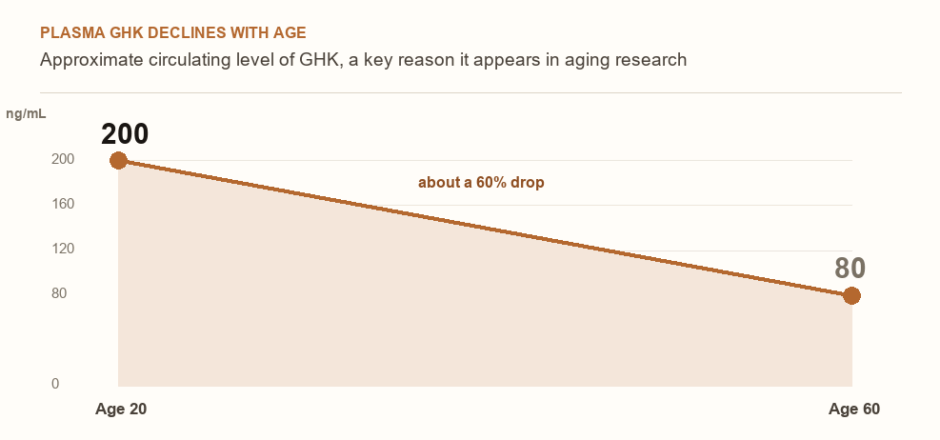
Plasma GHK measures around 200 ng/mL at age 20 and falls to roughly 80 ng/mL by age 60, which works out to close to a 60% drop across adult life, according to a peer-reviewed review of the gene data.
In laboratory models, GHK-Cu is studied for how it signals the extracellular matrix, which is the structural mesh that holds skin and tissue together. It works closely with fibroblasts, the cells that produce collagen and elastin, and researchers track how it prompts those cells to build and maintain structure.
Copper matters here because it is a cofactor in enzymes that build and repair connective tissue. By carrying copper into the right place, GHK is studied as a way to support those processes rather than simply switching a single receptor on or off, and that is the mechanistic reason it turns up across so many different tissue models.
There is an antioxidant side to it as well, since GHK completely blocked copper-driven oxidation of LDL in one test while the enzyme SOD1 managed only about 20% protection in the same setup. That result is often cited to argue that GHK helps manage oxidative stress, a factor tied to both skin aging and tissue damage in research models.
The researchers behind the most-cited review, Loren Pickart and Anna Margolina, summarized the peptide’s range of effects, noting that GHK has multiple biological actions that all appear to be health-promoting.
Why GHK-Cu Became Popular in Skin and Hair Research
Several research threads pushed GHK-Cu into the spotlight, and each one built on the last. Cosmetic science noticed it first because collagen and elastin directly shape skin firmness and texture, and wound-repair research took an interest because GHK appears naturally in wound fluid rather than acting as an external agent.
Aging research then adopted it as a way to ask what a declining GHK level does within a study model, and hair research followed, focusing on the follicular environment and the signals around it. The steady shift from pure cosmetics to broader biology has made GHK-Cu a reference compound rather than a niche skincare ingredient.
For a closer look at the reported changes associated with GHK-Cu, see our guide to GHK-Cu before and after results.
Research Areas Associated With GHK-Cu
The peptide’s footprint is broad but well organized, and each area below is studied for a specific reason.
| Research area | Why it is studied |
|---|---|
| Skin aging | Extracellular matrix support and collagen signaling |
| Collagen | Fibroblast activity and matrix synthesis |
| Hair | Follicle environment and local signaling |
| Wound models | Tissue remodeling and repair signaling |
| Inflammation | Cellular response regulation and antioxidant activity |
Across all five areas, the through-line remains the same: GHK-Cu is consistently studied for how it signals cells to rebuild and protect structure, with copper as the mechanism that sets it apart from other repair peptides.
What Is the Glow Stack?
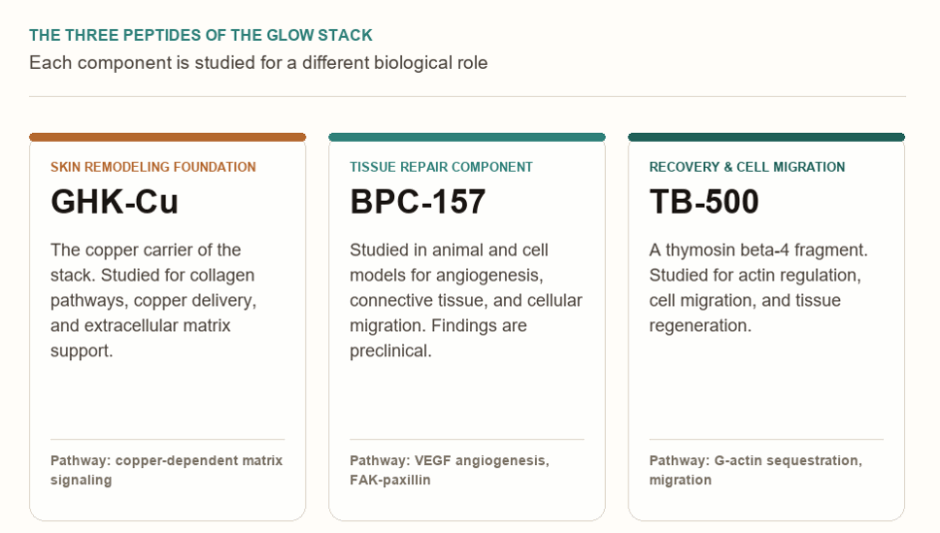
The Glow Stack is not a single peptide but a combination built around three distinct peptides: GHK-Cu, BPC-157, and TB-500. Each is studied for a different biological role, so the stack is used to examine several pathways together rather than one in isolation. Understanding it means looking at the three parts and why they share a protocol.
GHK-Cu: The Skin Remodeling Foundation
Within the stack, GHK-Cu retains the same role it plays on its own, serving as the copper carrier studied for collagen-related pathways, copper delivery, and extracellular matrix support. It also has the longest and best-documented research history of the three peptides, which is why it anchors the whole combination. The other two peptides are added around this base rather than in its place.
BPC-157: The Tissue Repair Research Component
BPC-157 is a synthetic peptide studied mainly in animal and cell models, with research interest clustered around angiogenesis (the growth of new blood vessels), connective tissue, cellular migration, and gastrointestinal research. It is the peptide that pushes the stack past skin and into structural repair.
A couple of findings show the flavor of that work. In a tendon cell study, BPC-157 promoted tendon cell proliferation and migration, and the authors linked this movement to the FAK-paxillin pathway, a route that governs how cells move and attach. Separate animal research reported that it stimulated blood vessel growth by increasing VEGF, a key vessel-growth signal, and later work found that it increased growth hormone receptor expression in tendon fibroblasts.
BPC-157 is not FDA-approved and does not appear on the agency’s 503A compounding list, and reviewers who examined it pointed to short, underpowered studies.
None of these findings should be interpreted as human outcomes, which is why research framing matters more with BPC-157 than with most peptide topics.
TB-500: The Recovery and Cell Migration Peptide
TB-500 is a fragment related to thymosin beta-4, a peptide found in nearly all nucleated cells and concentrated in wound fluid and platelets. Its main molecular role in research is G-actin sequestration, which, in plain terms, means it manages the pool of actin building blocks that cells use to assemble their internal scaffolding and move, as described in a 2026 scoping review.
That single mechanism connects it to several areas of study, including cell migration, tissue regeneration, and muscle and connective tissue research. Because moving cells into a repair site is one of the most basic steps in healing, TB-500 is studied as a way to probe that step directly, and it gives the stack a dedicated cell-migration angle that neither GHK-Cu nor BPC-157 covers as squarely.
Why Are These Peptides Combined?
The logic behind the stack is not to push harder on a single pathway but to study several simultaneously. Rather than combining three compounds that all do the same job, the design pairs three that each perform distinct functions: GHK-Cu handles extracellular matrix signaling, BPC-157 covers repair and blood-vessel pathways, and TB-500 addresses cellular movement and tissue remodeling.
Taken together, they allow a single research model to address matrix building, vessel growth, and cell migration in a single experiment. That breadth is the whole reason to build a stack, and the added complexity is the price you pay for it.
Comparing Their Role in Skin Remodeling and Collagen Research
Skin remodeling and collagen research are where GHK-Cu has its strongest and best-documented record, making this the clearest comparison point between the two approaches. GHK-Cu targets collagen pathways directly through dermal fibroblast signaling, while the Glow Stack keeps that signal and adds BPC-157 and TB-500 to cover connective tissue repair and angiogenesis in the same study.
Why GHK-Cu Has a Strong Connection With Skin Research
GHK-Cu earns its skin reputation through dermal fibroblasts, the cells that produce collagen and elastin, and the peptide is studied for how it signals those cells, which ties it directly to skin structure and firmness.
Collagen synthesis pathways are the most cited part of this record, and the headline result is difficult to ignore, because over twelve weeks GHK-Cu improved collagen production in more women than either a vitamin C cream or retinoic acid did on the same measure.
A second study paired GHK with LED light and measured the results against LED alone; the combination raised three markers sharply at once.
- Cell viability rose more than 12.5-fold.
- Basic fibroblast growth factor, a signaling protein, rose by 230%.
- Collagen synthesis rose by 70%.
These are large, specific effects on the very cells that build skin, which is why GHK-Cu remains a serious collagen reference rather than a passing novelty. It helps to picture the roles involved: fibroblasts are the workers, collagen and elastin are the materials, and GHK-Cu is the signal that tells the workers to build.
Does Adding BPC-157 and TB-500 Change the Research Focus?
Adding the other two peptides does change the focus, and it does so by design. The Glow Stack moves beyond skin-only questions, and while GHK-Cu still carries the collagen angle within the stack, BPC-157 and TB-500 introduce repair-related pathways that a single copper peptide cannot reach, shifting the emphasis from cosmetic signaling toward broader tissue biology.
The trade-off runs in both directions. A researcher studying collagen alone gains nothing from the extra peptides and simply inherits their variables. In contrast, a researcher studying how skin repair interacts with vessel growth and cell migration gains exactly what those peptides provide. The change in focus is an advantage when the question is broad and a distraction when it is narrow.
Which Peptide Is Best for Hair Biology Research?
For hair follicle biology research, GHK-Cu has the more direct and better-documented record. The Glow Stack functions as the broader tool when a study needs to account for the surrounding tissue environment. GHK-Cu is studied for follicle signaling and pigmentation pathways; the Glow Stack adds BPC-157 and TB-500 to probe repair and vascular context in the same model.
How GHK-Cu Is Studied in Hair Follicle Biology
GHK-Cu research in hair centers on the follicular environment, where study models examine signaling around the follicle and pigmentation-related questions. The most cited review notes that GHK-Cu can increase hair growth and thickness and enlarge follicle size in research settings, which keeps it a common starting point for follicle work.
The appeal here is the same as in skin, since GHK-Cu offers a focused, well-documented signal within a clearly defined structure. For a question that is specifically about the follicle and its immediate surroundings, that focus is an advantage rather than a limitation.
Why the Glow Stack Is Considered a Broader Approach
Hair growth depends on more than the follicle itself, because inflammation, the surrounding tissue environment, and repair pathways can all shape how a research model behaves. A follicle never sits in isolation, and the factors around it can matter as much as the follicle does.
By adding BPC-157 and TB-500, the Glow Stack lets researchers probe those wider inputs within the same experiment, since repair signaling, vessel growth, and cell migration all connect to the tissue environment around a follicle. That is why the stack is framed as broader, because it reaches the context around the follicle at the cost of the clean single-peptide signal that GHK-Cu provides.
Exploring Tissue Repair and Recovery Pathways
Tissue repair is where the Glow Stack most clearly differentiates itself, because a single copper peptide only covers part of the picture. In contrast, the combination is designed to cover more of it.
What GHK-Cu Contributes to Tissue Remodeling Studies
GHK-Cu supports the structural side of repair and has been studied for matrix formation, cellular communication, and repair signaling, which together form the groundwork that enables tissue rebuilding. When damaged tissue needs a new structural mesh, matrix signaling is where that rebuild begins, and GHK-Cu speaks directly to that step.
This contribution is real but narrow, because GHK-Cu addresses the matrix and the signals that shape it rather than the full repair cascade. In a remodeling study, it works as a strong single instrument rather than a complete toolkit, which is exactly why the stack pairs it with other peptides.
How BPC-157 and TB-500 Expand Glow Stack Research
The two added peptides widen the frame considerably. BPC-157 has been studied in connective tissue models and in vascular pathways, including the VEGF-linked angiogenesis reported in animal studies, and broader reviews connect its repair activity across tendon, ligament, muscle, and gut models. TB-500 then promotes cell migration through its actin-regulating role, the step in which cells physically move to a repair site.
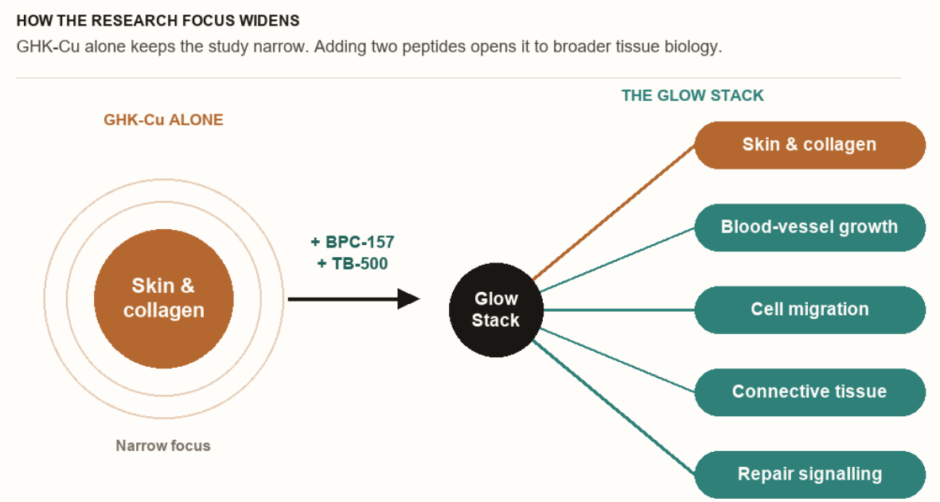
Together, they let a research model address blood-vessel growth, connective tissue, and cell movement within a single design. Since GHK-Cu alone cannot reach all three, that gap is the practical case for using the combination.
How They Differ in Mechanism of Action
Most write-ups stop at the phrase “single versus combination,” but that framing obscures the real difference: how many biological systems each approach studies simultaneously. The matrix below maps that difference pathway by pathway.
| Pathway | GHK-Cu | Glow Stack |
|---|---|---|
| Copper signaling | Strong focus | Included |
| Collagen pathways | Main focus | Included |
| Extracellular matrix | Primary | Supported |
| Tissue repair pathways | Limited | Expanded |
| Cell migration | Limited | TB-500 research |
| Angiogenesis | Limited | BPC-157 research |
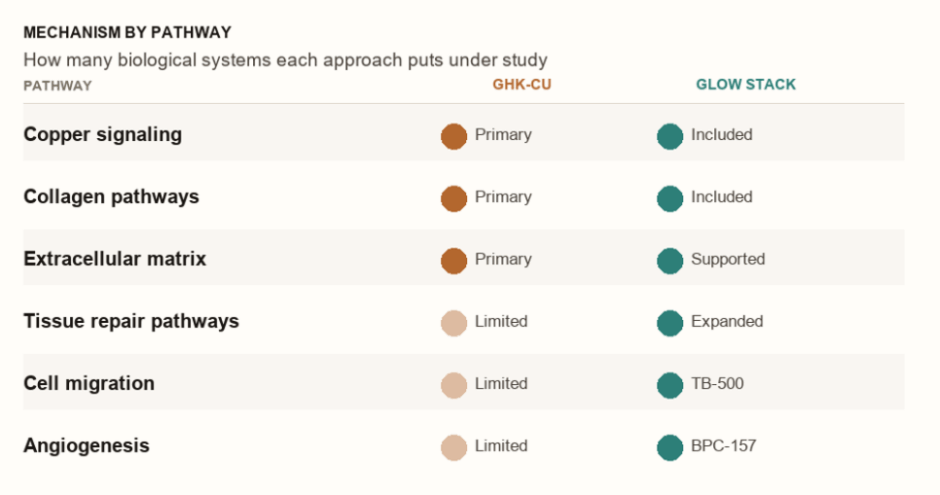
Reading down the columns tells the story clearly, because GHK-Cu concentrates its strength in the top three rows covering the copper, collagen, and matrix pathways, and then thins out below them. The Glow Stack keeps those same three and adds real coverage in the bottom three through its two extra peptides.
It is worth being precise about what “limited” means in that table, since it does not suggest GHK-Cu does nothing for repair or migration. Instead, it means those pathways are simply not where its evidence is strongest, and they are not the reason most researchers reach for it, whereas the stack adds peptides whose primary research lies in exactly those areas, so the coverage shifts from incidental to intentional.
The GHK-Cu mechanism runs surprisingly deep, and gene-expression work is where that becomes obvious.
A striking figure on that depth: GHK stimulated or suppressed 31.2% of human genes by 50% or more in gene work, with roughly 59% increased and 41% suppressed, which is the basis for the popular idea that GHK helps reset a large fraction of the genome.
The takeaway is that the difference between these approaches is not peptide quantity but the number of biological systems under study, since GHK-Cu goes deep on a few while the Glow Stack spreads across more.
Is the Glow Stack Stronger Than GHK-Cu?
No, the Glow Stack is not automatically stronger, and treating it that way is the most common mistake in this comparison.
Myth: more peptides means stronger results.
Reality: more peptides means more pathways under study and more variables to control. Strength depends on whether your question actually needs that extra reach.
Whether the Glow Stack is stronger depends entirely on the goal, because adding more peptides does not automatically produce a better result. It is tempting to read three peptides as three times the value, but research design does not work that way.
A single peptide is often the more rigorous choice when the aim is to measure one clean effect, since any change can then be attributed to it with confidence, while a combination makes more sense when the question spans several pathways and the interactions between them are part of what is being studied.
The hidden cost of a stack is variables, because adding compounds adds effects that overlap, and that overlap makes it harder to say which peptide caused what. For an isolated mechanism, that noise becomes a cost rather than a benefit, so the single peptide is frequently the more careful choice, which is the opposite of what the word “advanced” tends to imply.
Which One Should Researchers Consider?
Rather than argue over which peptide is “better,” it helps to run what we call the Research-Fit Test, a three-question check that points to the right approach for a given study.
- First, ask whether the question targets one mechanism or several.
- Second, ask whether the priority is a clean, low-variable result or broad coverage.
- Third, ask whether the pathways you care about are skin and collagen, or repair, vessels, and migration. The answers usually settle the choice before you look at a single price or supplier.
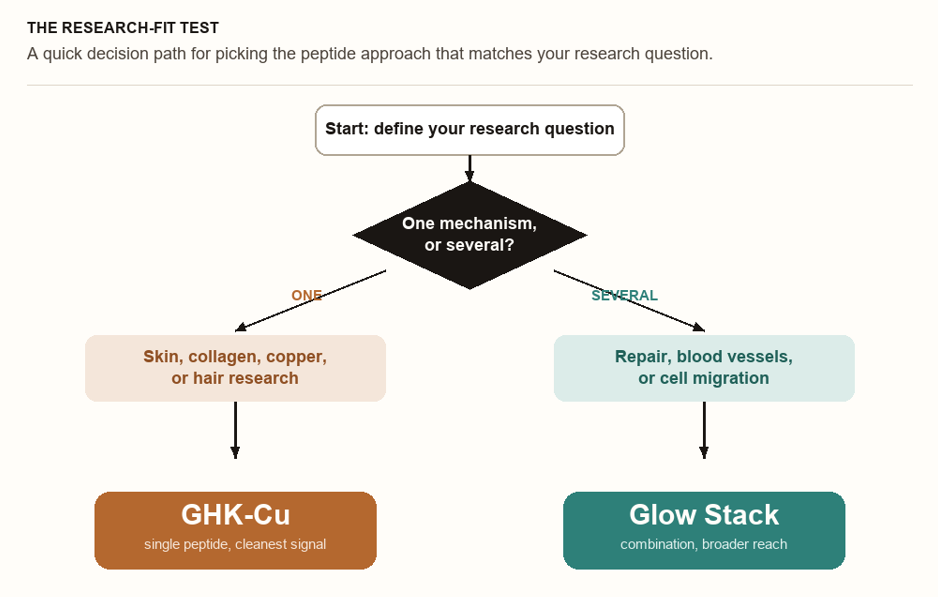
The split below shows how those answers map onto each approach.
GHK-Cu May Be More Suitable for Research Focused On:
- Copper peptide biology and copper-dependent signaling
- Collagen and extracellular matrix pathways
- Skin-focused study models
- Hair-related follicle mechanisms
- Isolating a single effect with the fewest variables
GHK-Cu is the choice when precision matters more than breadth, because its long record, defined mechanism, and clean single-variable behavior all suit questions that need a confident answer about one pathway.
Glow Stack May Be More Suitable for Research Focused On:
- Multi-tissue study models
- Connective tissue and vascular pathways
- Recovery-related mechanisms
- Broader regenerative questions
- How peptides interact rather than act alone
The Glow Stack is the choice when reach matters more than isolation, because its three components cover matrix, repair, and migration together, which suits questions about how several regenerative pathways behave in the same system. Between the two, the deciding factor is rarely which one is more powerful but which one matches the shape of the research, since a narrow question rewards the focused peptide and a broad question rewards the combination.
Factors To Consider Before Choosing Between GHK-Cu and the Glow Stack
Beyond the science itself, a few practical factors shape a sound choice, and weighing them up front prevents a mismatch between the tool and the study.
Research Objective
The first thing to settle is the pathway count, because a single-pathway objective favors the single peptide, which produces a result that is easier to read and defend, while a multi-pathway objective is where a combination earns its complexity. It helps to define the objective in concrete terms first and then let it pick the tool, since choosing the more elaborate option by default is how studies end up with results that nobody can attribute.
Experimental Design
Combination studies carry more variables, and that has real consequences for design, because three peptides mean three sets of effects that can overlap and complicate the controls, the dosing logic, and the interpretation. The added burden is manageable, but it should be a deliberate decision, since a researcher who has not planned for the extra controls can end up with data that is hard to trace back to any single component.
Peptide Quality and Testing
Sourcing matters for both approaches, and it matters even more for a stack, because any weak component can undermine the whole experiment. For research-use-only material, documentation is the difference between a usable result and an unexplained one.
A reputable supplier such as Kylo Peptides is one example of this standard in practice, publishing a lot-matched certificate of analysis for each compound, backed by third-party purity testing. For a stack in particular, that per-peptide documentation is what lets a result trace back to verified material.
A short checklist keeps this practical. It is worth confirming that the certificate of analysis matches the specific lot rather than a generic sample, that purity is reported with a method instead of a bare percentage, that every peptide is documented when you work with the stack, and that the research plan genuinely needs the extra pathways the stack adds. When that last point does not hold, the single peptide is usually the cleaner place to start.
Frequently Asked Questions
Is the Glow Stack just a stronger version of GHK-Cu?
No, it is a different design rather than a higher dose, because it keeps GHK-Cu and adds BPC-157 and TB-500 to study more pathways, so the idea of it being stronger only applies when the research goal actually needs those extra pathways.
Does the Glow Stack contain GHK-Cu?
Yes, GHK-Cu is the foundation of the stack, and the combination builds on it rather than replacing it, which is why GHK-Cu remains the component with the longest research history.
What peptides are included in the Glow Stack?
There are three: GHK-Cu for matrix signaling, BPC-157 for repair-related pathways, and TB-500 for cell migration and tissue remodeling.
Which peptide is better for skin research?
GHK-Cu has the most direct skin and collagen record, including the twelve-week result where it improved collagen production in more women than vitamin C or retinoic acid, so the stack adds breadth without replacing that focused skin signal.
Why combine GHK-Cu with BPC-157 and TB-500?
The point is to study several biological roles at once, since each peptide is examined for a different job and the combination covers matrix, repair, and migration pathways together rather than pushing on a single one.
Does GHK-Cu have more research than the Glow Stack?
As a single compound, GHK-Cu has a long and well-characterized literature, whereas the Glow Stack, as a named combination, appears more often in practitioner writing than in dedicated trials; thus, the strongest evidence lies with the individual peptides.
Are peptide combinations more effective than single peptides?
Not automatically, because combinations study more pathways but also add variables, so for isolating one effect, a single peptide is often the more rigorous choice.
What makes GHK-Cu different from other peptides?
Its copper-binding structure is the difference, because GHK-Cu carries a copper ion that underpins its matrix and collagen signaling and separates it from non-copper repair peptides such as BPC-157 and TB-500.
Final Thoughts
GHK-Cu remains the foundational peptide for copper-related research, since its record in skin, collagen, and gene signaling is the deepest of the three compounds discussed here, and it is the anchor that makes the stack coherent in the first place.
The Glow Stack then expands beyond copper signaling by combining GHK-Cu with BPC-157 and TB-500, which suits multi-pathway questions and repair-focused models at the cost of added complexity and more variables to control.
For most researchers, the question is not which approach is more powerful but whether the study needs one clean variable or several. That answer usually makes the choice obvious.
Studies Referenced
- Pickart L, Margolina A. “Regenerative and Protective Actions of the GHK-Cu Peptide in the Light of the New Gene Data.” Int. J. Mol. Sci. 2018. Read study
- Chang C-H, et al. BPC 157, tendon fibroblasts and the FAK-paxillin pathway. 2011. Read study
- Chang C-H, et al. BPC 157 and growth hormone receptor expression in tendon fibroblasts. 2014. Read study
- Cerovecki T, et al. BPC 157 and angiogenesis via VEGF. 2010. Read study
- Seiwerth S, et al. BPC 157 and standard angiogenic growth factors. 2018. Read study
- Scoping review of thymosin beta-4 / TB-500 mechanisms. Applied Sciences. 2026. Read review
- FDA 503A peptide compounding review coverage. AJMC. Read coverage
Research-use-only notice. This article is educational and written for laboratory research contexts only. GHK-Cu, BPC-157, TB-500, and the Glow Stack are discussed as research compounds. Nothing here is medical advice, a dosing protocol, or a claim of human therapeutic benefit. BPC-157 and TB-500 are not FDA-approved and are not on the 503A bulk-compounding list. Cited studies include in-vitro and animal research that does not transfer directly to humans. Verify the current regulatory status before relying on it, as peptide policy is changing.
Related posts:






Stay updated, free articles. Join our Telegram channel

Full access? Get Clinical Tree


