By Nolan Moore, Peptide Research Writer. Nolan covers peptide science and FDA compounding policy. Fact-checked by Eden Josh, Editor. Last updated: August 2026.
From a research POV, KPV is a tiny peptide with an interesting mechanism around inflammatory signaling. It has a mountain of lab data in mouse models, growing internet attention, and huge scope for human trials. Search interest in KPV has climbed roughly 32x since early 2024, from about 1,600 searches a month to nearly 52,000.
This piece covers what KPV is, how it behaves in cells and mice, what that evidence can and can’t tell us, where the safety questions sit, and what the July 2026 FDA vote really changed. Suppliers like Kylo Peptides list KPV as a research compound sold for lab use only, and we’ll get into why the paperwork behind it matters more than the vial itself.
With no approved KPV product to reference, sourcing is treated as a documentation exercise rather than a purchasing one: the certificate of analysis is the only description of what is actually in the vial. Suppliers selling on research-use-only terms with per-lot third-party testing, such as the KPV peptide listing at NextGenPeps, let a researcher record exactly which lot supported which result. Keeping that record is what makes an unapproved material usable in work that someone else can follow.
Anyone reading KPV in isolation should also note that a good deal of current interest sits in combination work, where it appears alongside GHK-Cu, BPC-157 and TB-500. Researchers designing that kind of comparison sometimes run a blended vial against the single compound, and NextGenPeps documents its KLOW blend listing per lot for the purpose. Either way the same rule applies: whatever enters the study should arrive with paperwork that matches the vial.
KPV Peptide at a Glance
| Category | Current evidence |
| Peptide type | Tripeptide |
| Sequence | Lys-Pro-Val (K-P-V) |
| Parent molecule | Alpha-MSH, residues 11 to 13 |
| Primary research interest | Inflammatory signaling |
| Gut research | Cell and animal models |
| Skin research | Lab and skin models |
| Human clinical evidence | None found in FDA’s 2026 review |
| Registered human trials | Zero on ClinicalTrials.gov |
| FDA-approved treatment | No |
| 503A Bulks List status | Advisory recommendation only, no final FDA decision |
What Is KPV Peptide?
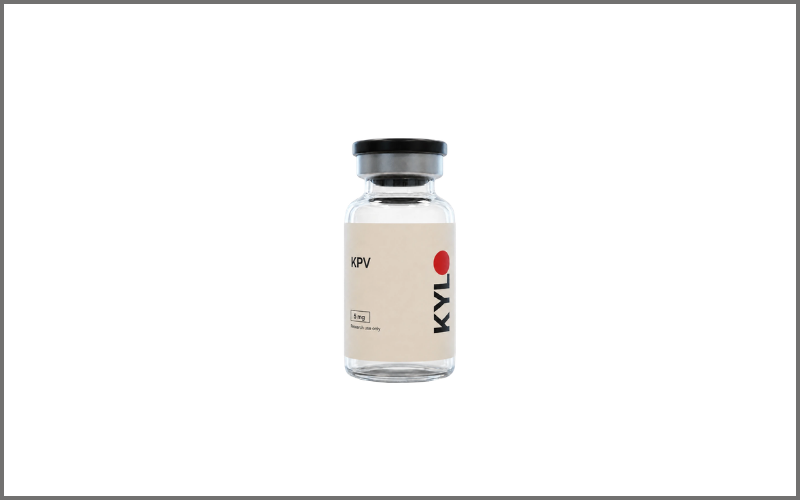
KPV is a peptide made of three amino acids: lysine, proline, and valine, linked in a chain. It’s about as small as a peptide can get.
Where does it come from? KPV comes from the tail end of a bigger molecule your body already makes, called alpha-melanocyte-stimulating hormone, or alpha-MSH for short. It is the tail end of that hormone, and it seems to carry some of its anti-inflammatory signaling potential, which is why researchers got interested in the first place.
Think of a peptide like a train. KPV is a short one, with just three cars. That shortness is an advantage, because the peptide can slip through transporters in the cell wall that bigger proteins can’t fit through. They’re also cheap and fast to make in labs, which is why they turn up on so many research catalogs.
- Relationship to alpha-MSH: Alpha-MSH is a 13-amino-acid hormone studied for pigmentation, appetite signaling, and inflammation. It works by binding to melanocortin receptors throughout the body. KPV is its fragment, broken from positions 11 through 13 of the full hormone.
- Biological rationale for studying the C-terminal fragment: Dalmasso’s team showed KPV enters cells through a transporter called PepT1, raising a key question about how much of its activity occurs inside the cell versus at receptors outside (as in the parent molecule’s case).
- Why peptide size and biological activity matter: Size decides almost everything. How fast enzymes chop it up. Whether it survives the stomach. Which doors it can walk through. A tripeptide is small enough to ride the gut’s peptide transporter, and that one fact shapes most of the research around it. Size also creates manufacturing headaches, because short peptides clump easily.
KPV Research: Evidence by Research Area
KPV research splits into four buckets, all living in cell cultures and animals.
Inflammatory Signaling
The paper everything traces back to is Dalmasso and colleagues, published in Gastroenterology back in 2008. Working with human intestinal cells (Caco2-BBE and HT29-Cl.19A) and human T cells (Jurkat), the team found that nanomolar amounts of KPV turned down NF-κB and MAP kinase signaling (Dalmasso et al., 2008). The cells were treated with inflammatory cytokines first, so the effect was measured in already activated cells.
Intestinal and Gut Research
Gut work is the deepest part of the KPV file. Dalmasso’s team gave KPV to mice by putting it in their drinking water, then ran two chemically induced colitis models: DSS and TNBS. Disease incidence and inflammatory cytokine levels dropped in both.
Immune Modulation
Research on KPV suggests it may help regulate inflammatory immune activity, particularly by reducing the release of pro-inflammatory signals. In cell and animal models, it appears to calm overactive immune responses rather than broadly suppressing immunity.
Skin and Dermatological Research
Skin work looks at keratinocytes, the cells making up most of your outer skin layer, tracking inflammatory signaling and oxidative stress in cultured and 3D skin models.
KPV Mechanism of Action
Let’s walk through the KPV mechanism, then talk about what a good one does and doesn’t buy you.
Alpha-MSH and the KPV Sequence
Start with the family history. Alpha-MSH signals through melanocortin receptors on the cell surface, and its anti-inflammatory potential goes back decades. KPV research is trying to determine how much of that potential the fragment alone carries.
NF-κB Signaling
NF-κB works like a master switch. When a cell senses trouble, it moves into the nucleus and switches on the genes that build inflammatory proteins. Dalmasso’s 2008 work reported that nanomolar KPV kept that switch quieter in stimulated gut and T cells.
Cytokine Regulation
Cytokines are the messengers cells use to call immune cells into action, and TNF-α and IL-1β are two of the loudest. In mouse colitis models, KPV was associated with lower levels of these inflammatory cytokines in gut tissue.
PepT1-Mediated Uptake
PepT1 transports two- and three-amino-acid peptides across the gut cell wall. It is normally present in the small intestine and is upregulated in the colon during inflammatory bowel disease.
Nick Norwitz, MD, PhD, put it this way in July 2026: “The more inflamed intestinal tissue becomes, the more PEPT1 transporters it expresses. And the more PEPT1 that’s expressed, the more KPV gets transported into those inflamed cells” (Stay Curious, July 5, 2026).
Why Mechanistic Evidence Is Not Clinical Evidence
A clean mechanism is a good reason to run a trial, not a substitute for one. Studying mechanisms in animal models tells you a pathway exists in a living organism. Whether that transfers to humans as well needs separate testing.
What Does the KPV Evidence Actually Prove?
Short version: KPV sits on the bottom two rungs of our five-rung evidence ladder.
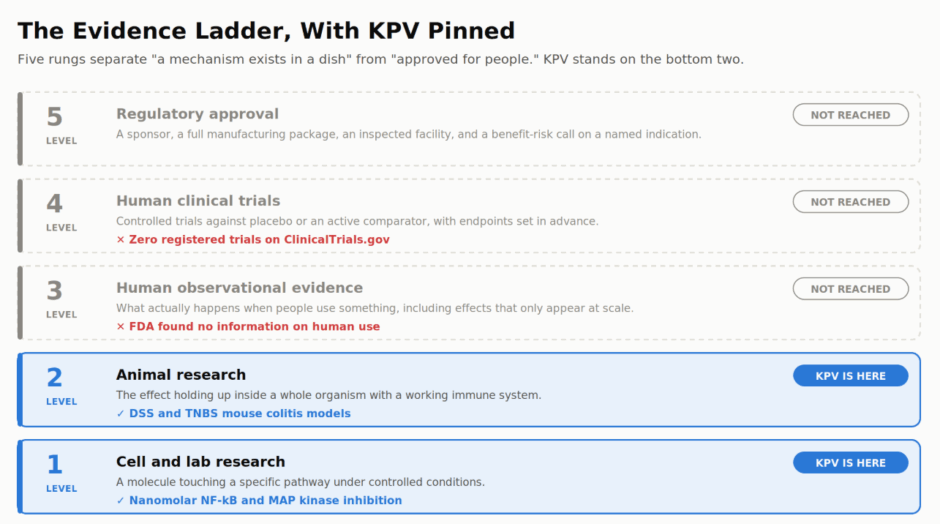
Level 1: Cell and lab research.
Shows a molecule touching a pathway under controlled conditions. Good for plausibility and target identification. Blind to absorption, metabolism, and everything a living body does.
KPV: Yes, including the nanomolar NF-κB and MAP kinase work.
Level 2: Animal research.
Shows the effect holding up inside a living organism with a working immune system. Good for early dose-response and toxicity signals. Can’t confirm that human physiology behaves the same way. Rodent colitis is a chemical injury standing in for human IBD.
KPV: Yes, in DSS and TNBS mouse models.
Level 3: Human observational evidence.
Records what happens when people actually use something, including effects that only show up at scale. Can’t prove cause.
KPV: None. FDA found no human information.
Level 4: Human clinical trials.
These compare a treatment against placebo or an active comparator, with endpoints set in advance; for KPV that would mean human pharmacokinetics, a dose-ranging study, and one properly powered controlled trial.
KPV: None. No registered trials yet.
Level 5: Regulatory approval.
A separate bar from the science. It needs a sponsor, a full manufacturing package, an inspected facility, and a benefit-risk call on a named indication.
KPV: None.
KPV Peptide Research vs. Online Claims
| Topic | Research evidence | Online claims |
| Inflammatory signaling | Preclinical, cell and animal | “Powerful” anti-inflammatory action that calms inflammation at its source |
| Gut inflammation | Preclinical, mouse colitis models | Helps “heal” the gut, calm intestinal inflammation, and support a healthier gut barrier |
| Immune modulation | Preclinical | Balances an overactive immune response without broadly suppressing immunity |
| Skin inflammation | Lab and preclinical | Soothes irritated skin, supports barrier repair, and helps with acne, eczema, and psoriasis |
| Human therapeutic outcomes | Insufficient; no human data found by FDA | Promoted as a versatile anti-inflammatory peptide for gut, skin, immune, and systemic inflammation |
| Long-term safety | Insufficient; no toxicology package submitted | Often portrayed as gentle, natural, and well-tolerated with few meaningful side effects |
KPV Peptide Safety and Research Gaps
KPV’s safety profile isn’t necessarily bad. It’s not yet well established. FDA’s 2026 review found that the nominator hadn’t submitted, and the agency couldn’t find, studies covering acute toxicity, repeat-dose exposure, genotoxicity, developmental and reproductive effects, or carcinogenicity for either salt form.
- Human safety data: FDA found no human exposure data for any route.
- Long-term exposure: There isn’t enough research yet to understand the effects of repeated exposure over time.
- Immunogenicity: FDA noted the “lack of information to assess immunogenicity or aggregation.”
- Peptide impurities: Peptide synthesis can leave behind related compounds, so purity and characterization matter when evaluating KPV products.
- Aggregation: Short peptides can aggregate under certain conditions. FDA notes that aggregation can affect bioavailability and may contribute to immune responses.
- Sterility and microbial quality: FDA noted that the Certificate of Analysis submitted for KPV acetate did not include microbiological testing data for the proposed cream and gel forms.
- Route-specific unknowns: Oral, topical, injectable, and nasal forms can behave differently in the body, so safety can’t necessarily be assumed across routes.
- Product-to-product variability: FDA noted that publicly available literature didn’t provide enough information on product-specific quality factors such as impurities, aggregates, and microbiological testing.
So, the bigger issue isn’t that KPV is unsafe. It’s that there isn’t enough safety research to confidently define how safe it is, especially with repeated or long-term use.
FDA reported that the Certificate of Analysis submitted with the nomination named one substance in the title and listed a different molecular formula, leading the agency to conclude that “Due to inconsistencies in the nomination, it is unclear which KPV-related BDS the nominator intended to nominate.”
If identity gets fuzzy inside a formal regulatory filing, it’s fair to ask how sharp it stays out in the open market.
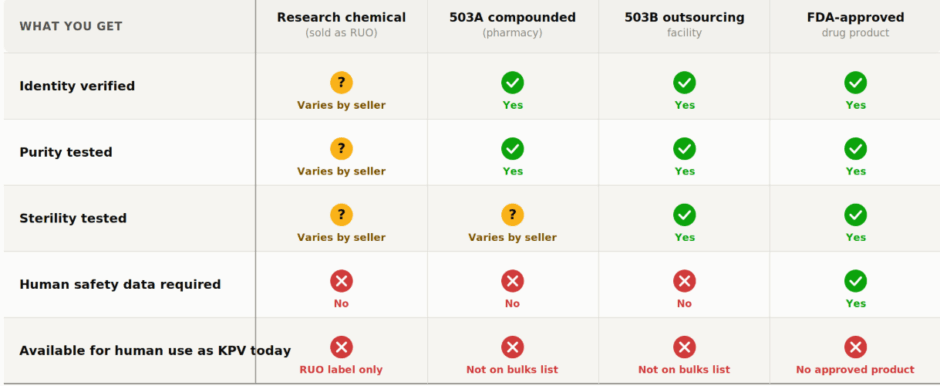
This brings up the relevance of COA. Two vials can hold the same molecule on paper and be very different products in practice, like two cups of coffee from the same bean that taste nothing alike depending on who made them.
Suppliers vary a lot in what they verify. Kylo Peptides, for instance, published a lot-matched Certificate of Analysis from 3 independent ISO/IEC 17025-accredited labs. It confirms 6 assays: ≥99% HPLC purity spec, identity confirmed by mass spectrometry, heavy metals, endotoxins, sterility, and net content. Its paper trail is one of the most transparent in the industry.
KPV Peptide Administration and Formulation: Why the Route Matters
The route decides how much peptide reaches the tissue being studied, and published KPV experiments used delivery setups that off-the-shelf products don’t copy.
- Oral research: The mouse colitis data came from KPV dissolved in drinking water.
- Topical research: Skin research raises questions about permeation. FDA’s review notes that in vitro work found iontophoresis and microneedle abrasion pushed more KPV through the outer layer.
- Injectable formulations: Injection skips the absorption question and replaces it with sterility and endotoxin questions. The FDA found no human data for KPV by any injectable route.
- Nasal delivery: Nasal versions show up in product listings with almost nothing published behind them.
- Why research formulations can’t be compared with commercial products: A concentration of bathing cells in a dish, peptide stirred into mouse drinking water, and a vial on a shelf are three different things.
- Why there’s no standardized dosing framework: No approved KPV product exists, so there’s no approved label, no established amount, and no schedule.
Formulation decisions begin with the diluent, since the fluid used to reconstitute a lyophilized vial becomes part of the prepared material and belongs in the methods record. Published work in this area commonly reports sterile or bacteriostatic water for injectable preparations, with the choice documented alongside concentration and storage temperature. Logging the diluent lot next to the peptide lot is what keeps a preparation reproducible weeks later.
KPV Peptide Regulatory Status in 2026
KPV is not FDA-approved for anything as of August 2026. In July 2026, an advisory committee voted to recommend adding it to the Section 503A Bulks List. The agency still hasn’t decided, and KPV’s legal status remains unchanged from before the vote.
Current FDA position: FDA proposed that both KPV free base and KPV acetate not go on the 503A Bulks List. Its background review concluded there’s “a lack of evidence to evaluate the effectiveness of KPV (free base) and KPV acetate products for the nominated uses of wound healing and inflammatory conditions.”
503A context, and what Category 2 actually means: Section 503A of the Federal Food, Drug, and Cosmetic Act covers compounding pharmacies. Those pharmacies can use a substance on the 503A Bulks List as a starting ingredient, which is very different from FDA approving a finished drug. Category 2 covers “Substances Nominated for the Bulks List That Raise Significant Safety Risks.” FDA’s non-enforcement policy doesn’t extend to Category 2 substances.
Advisory committee developments: The Pharmacy Compounding Advisory Committee met on July 23 and 24, 2026, and reviewed seven peptides, recommending six. KPV passed 8 to 6, with one abstention. Committee member Dr. Elizabeth Rebello said during the meeting: “I’m concerned that we’re responding to a market-induced demand rather than a decision based in solid science” (TIME, July 23, 2026).

Difference between recommendation and approval: Holland & Knight, another committee member, put it simply: “because the committee’s recommendations are nonbinding, they did not result in any change in law.” Scott Brunner, CEO of the Alliance for Pharmacy Compounding, said the same thing from the industry side: “FDA still must formally adopt the advisers’ recommendations before the peptides may be legally compounded.”
So what happens next? FDA decides whether to act, issues a proposed rule, runs a public comment period, then publishes a final rule. Last time, FDA published a proposed rule on ten bulk substances in December 2016 and didn’t publish the final rule until February 2019, more than two years later.
Research-use products: Material sold under research-use-only labeling sits outside this whole framework. It carries no FDA approval, falls outside 503A compounding, and is labeled for lab use only. Kylo Peptides and other research suppliers state that directly on their listings.
Bottom line: KPV’s regulatory status can change, so it needs regular checks. Wells Pharmacy Network withdrew its KPV nomination, but the FDA still reviewed both salt forms. Interestingly, search interest in KPV stayed mostly flat from April through July 2026, even as the regulatory news was being reported. So, if you’re stating KPV’s status, always include the date. As of August 2026, this is the current picture.
KPV vs. Other Peptides Studied for Inflammation
KPV usually gets mentioned in the same breath as BPC-157 and TB-500. Here’s how they compare:
| Peptide | Research focus | Human evidence in the 2026 review | PCAC vote |
| KPV | Inflammatory signaling, gut and skin models | None found by FDA | 8-6, one abstention |
| BPC-157 | Tissue repair, gut models, ulcerative colitis | One meeting abstract, 46 people, enema route | 8-6, one abstention |
| TB-500 | Wound healing, cell migration | Nominated for wound healing | 8-6, one abstention |
Key differences in research focus: KPV work centers on NF-κB signaling and PepT1 uptake in the gut. BPC-157 research is about tissue repair across several organ systems. TB-500 studies look at actin regulation and cell migration in wound models.
Evidence limitations for each: All three lean almost entirely on animal and in vitro work. For BPC-157, the closest human data FDA could find was a meeting abstract covering 46 people who received the peptide as an enema.
Why “more popular” doesn’t mean “better supported”: A peptide can attract a lot of attention without having strong research behind it. Popularity reflects interest, while scientific evidence reflects how well a peptide’s effects and safety have actually been studied. The two aren’t the same.
How to Evaluate KPV Research Yourself
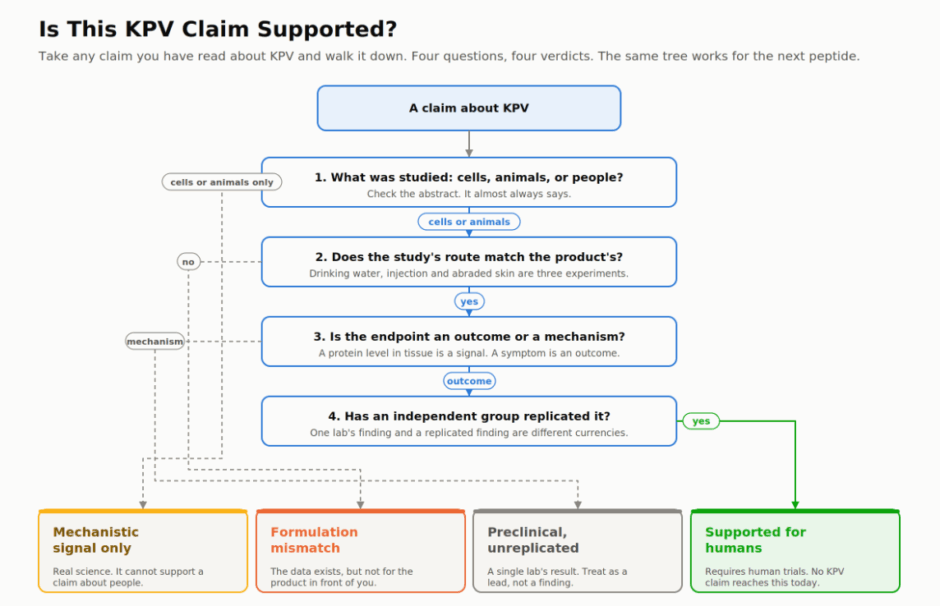
Run any study or claim through our 8-point peptide evidence audit and you’ll know where it stands in about two minutes.
- Study type: Cell culture, animal, observational, or controlled trial? The abstract almost always clarifies it.
- Sample size: How many subjects, cultures, or animals? Forty-six people and four thousand people support very different evidence.
- Cell vs. animal vs. human: Look up the species and cell line by name. Caco2-BBE is a human colon cancer line growing in a dish, a long way from a working gut.
- Route of administration: Drinking water, injection, or abraded skin are three separate experiments. If the study’s route doesn’t match the product’s, the data doesn’t carry over.
- Dose and formulation: Compare the exposure in the study against what a product delivers. Nanomolar in a dish and peptide stirred into an animal’s water are orders of magnitude apart, and neither maps onto a labeled vial.
- Endpoint measured: Symptom, survival, or a protein level in tissue? Expression changes signal a mechanism. They aren’t outcomes.
- Publication quality: Check the journal, the year, and whether it’s original research or a review citing other reviews.
- Replication: Has an independent group gotten the same result? One lab’s finding and a replicated finding are different currencies.
Overall Research Assessment of KPV Peptide
Strong on plausibility, currently thin on proof. Here’s KPV’s assessment card as of August 2026.
- Biological rationale: Strong. The alpha-MSH link is well established, the NF-κB story is coherent, and the PepT1 angle is clever because it predicts the peptide going where the inflammation is.
- Preclinical evidence: Moderate and consistent. Cell and animal work going back to the 2008 Gastroenterology paper still carries most of the weight.
- Human evidence: FDA found no information on KPV use in humans, and the trial registry is yet to host a human trial of its own.
- Safety evidence: No toxicology package exists. Immunogenicity, aggregation, and impurity questions are open, by FDA’s own account.
- Regulatory certainty: An advisory recommendation pointing one way, an FDA recommendation pointing the other, and no final decision.
- Research gaps: Human pharmacokinetics, dose-ranging, controlled trials, long-term exposure, and standardized product characterization are all still missing.
KPV Peptide FAQs
What is KPV peptide?
KPV is a tripeptide made of lysine, proline, and valine. It’s the tail end of alpha-melanocyte-stimulating hormone, positions 11 through 13. Researchers study it for anti-inflammatory signaling in cell and animal models. It isn’t an FDA-approved drug.
What is KPV peptide studied for?
Four areas: inflammatory signaling through NF-κB and MAP kinase, intestinal inflammation in mouse colitis models, immune-cell activity, and skin inflammation in keratinocyte and 3D skin models. All of it is preclinical, meaning cells and animals.
How does KPV work?
In lab models, KPV enters cells through the PepT1 transporter and quiets NF-κB signaling, which lowers inflammatory cytokine output. Dalmasso and colleagues reported this at nanomolar concentrations in gut and T cell lines in 2008. Nobody has confirmed the mechanism in humans.
Do human studies support KPV?
No. FDA’s 2026 review found no information on KPV use in humans, and a ClinicalTrials.gov search in August 2026 returned zero registered studies with KPV as an intervention. The evidence base is in cells and animals.
Is KPV FDA approved?
No. In July 2026, an FDA advisory committee recommended adding KPV to the Section 503A Bulks List by an 8-to-6 vote with one abstention, against FDA staff advice. That recommendation is nonbinding and changed nothing in law.
What are the main safety concerns?
FDA found no human safety data, toxicology studies, or quality-control data on impurities, aggregates, or microbiological quality. Aggregation is a particular concern because it raises immunogenicity risk, and FDA noted peptides as short as two amino acids can aggregate.
What is the relationship between KPV and alpha-MSH?
KPV is the last three amino acids of alpha-MSH, a 13-amino-acid hormone involved in pigmentation, appetite, and inflammation. Research on the fragment asks how much anti-inflammatory signaling survives once the melanocortin receptor machinery is left behind.
Why is KPV being studied for gut inflammation?
The gut carries PepT1, a transporter that pulls tripeptides into intestinal cells, and inflamed tissue appears to carry more of it. Dalmasso’s 2008 study delivered KPV in mouse drinking water and reported lower disease incidence in DSS and TNBS colitis models.
Does KPV have research involving skin inflammation?
Yes, in lab models. Researchers look at keratinocytes, oxidative stress, and inflammatory signaling in cultured and 3D skin models. FDA’s 2026 review also cites an in vitro study finding KPV doesn’t permeate skin well, which limits how far those results travel.
Final Thoughts
From a research angle, KPV is interesting: there’s a solid body of lab research, plenty of interest around the peptide, and a mechanism researchers continue to explore. What’s still missing is human clinical research. The July 2026 vote brought more attention to KPV, but it didn’t add human data or change its legal standing.
If you’re working with KPV in a lab, good documentation matters too. A lot-matched COA and clear purity specifications give you a better starting point and make your results easier to interpret down the line.
Disclaimer: This article is for information and education only. It isn’t medical advice. KPV is not an FDA-approved drug, and nothing here describes human use, dosing, or treatment. Talk to a qualified healthcare professional about any health question.
Related posts:






Stay updated, free articles. Join our Telegram channel

Full access? Get Clinical Tree


