Surgical indications of digital replantation are broadening, though there are controversial, including ischemia time limits, single digit amputated proximal to the flexor digitorum superficialis insertion, and replanting a fingertip. Complex digital replantation indeed pushes the limit of replantation possible by the most skilled of hands. The major energy and resources should be devoted to the vascular anastomosis. The functional results and sensory recovery are the challenges and future targets to get true success of replanted digits. The guiding principle is independence, preservation of function, and prevention of chronic pain that dictates operative candidates for replantation.
Key points
-
•
Indications for digital replantation are expanding, but controversies remain about ischemia time, single digit, and fingertip replantation.
-
•
Success depends on amputation level, surgeon experience, and prioritizing vascular repair; routine antithrombotic use may not be needed.
-
•
Patient selection should focus on preserving function and independence, with functional recovery as the main challenge.
Abbreviations
| FDP | flexor digitorum profundus |
| FDS | flexor digitorum superficialis |
Introduction
This article reviews current techniques, variations, and the authors’ experience of upper limb replantation. We also discuss success rate, function of the replanted upper extremities (arm, hand, and digits), and controversies.
Digital replantation
Indications and Methods
Surgical indications and techniques vary in detail across the globe. We review some of these variations later.
Broadening of indications for digital replantation
The generally considered indications for digital replantation are given in Box 1 . The patients’ desires and surgeons’ skills affect decisions of surgery and the indications. The first author thinks the only absolute contraindications are poor general conditions of the body and severe crush to the digit.
Box 1
Indications for digital replantation used by the first author
-
Absolute indications
-
Any pediatric amputation
-
Thumb proximal to the interphalangeal joint
-
Multiple digits
-
-
Relative indications
-
Patients of advanced age
-
Special needs (eg, musician, craft worker’s dominant hand, young lady, and so on)
-
Amputation distal to the distal interphalangeal joint
-
Single digit amputation proximal to the FDS insertion∗
-
Local crushing or avulsion
-
Ring avulsion injury
-
∗ This indication differs in continents. Asian colleagues (including the authors) regularly perform it, but in western countries it is controversial because a finger replanted proximal to the FDS insertion often does not bend well and loss of one finger does not majorly impact function of the hand.
A classic principle within the hand surgery community describes 12 hours of warm ischemia and 24 hours of cold ischemia as the upper limits for digit replantation. , Ischemia time limits for digit replant survival can certainly be longer for digits that have been stored correctly in cold ischemia. , Xu and colleagues reported successful digital replantation after 14 days of ischemia under 4°C in China. The first author agrees with this view that the ischemia time should not be considered to determine whether or not to perform acute replantation, different from more proximal amputation with the consideration of the muscle preservation.
A single digit amputated proximal to the FDS insertion is believed a relative contraindication to replantation. However, surgeons in many regions perform this surgery regularly. Wong and colleagues reported promising evidence for achieving reasonable outcomes in replantation of single digits amputated proximal to the FDS. Although range of motion is inferior, this practice is common in many regions and countries. Replanting a ring avulsion injury of a finger is also very common in some regions, systematic review of Bonastre Juliá and colleagues indicated an overall survival rate of 80% and generally good outcomes.
Replanting a very distal fingertip (the finger part distal to the flexor digitorum profundus [FDP] insertion) is controversial over the world with Asian colleagues tend to more often perform this surgery, but poor sensory recovery and very small gain in function are recognized by many colleagues. Therefore, many do not perform this surgery or consider it unnecessary. It is done by some when the patient still insists to have replantation after surgeons explain sufficiently the pros and cons of such surgery and the distal part is in a very good conditions for replantation. A slightly shortened finger with better sensation is functionally better than a replanted distal tip with poor sensation, which is a reason many colleagues do not do this surgery.
Surgical techniques and treatment strategy
Anesthesia and replantation sequence
Brachial plexus anesthesia (regional anesthesia) is used in most of these cases with or without the patient wide awake during the entire procedure for the benefit of sympathetic blockade and subsequent vasodilation. Local anesthesia is possible for simple replantation, but most surgeons including the authors do not use it as brachial block with intravenous anesthesia or general anesthesia provides a quiet and undisturbed environment for the microsurgical repairs ( Fig. 1 A–D ). Huang and Matschke reported 51 patients with digital replantation under wide-awake local anesthesia. Finger replantation under wide-awake local anesthesia is a practicable alternative to general anesthesia. , During the operation, we typically use a tourniquet to the upper arm or a vessel loop at the base of a digit if necessary. The first author prefers to keep the tourniquet insufflated as long as possible. Tourniquet and vessel loop also can be alternately used to extend time of no bleeding during the operation.
The digital replantation under wide-awake local anesthesia with vessel loop. ( A ) Before surgery. ( B ) Immediate after surgery. ( C , D ) Three weeks after surgery.
(Copyright of Shu Guo Xing, MD.)
The exact sequence of operative repair in digital replantation varies among surgeons, with 2 variations advocated ( Box 2 ). The first author’s preferred technique order is: débridement, bone fixation, tendon repairs, arterial repair, and venous repair ( Fig. 2 A–H ). Some surgeons preferred reverse sequence: débridement, palmar skin closure, digital artery repair, digital nerve repair, flexor tendon repair, bone fixation, extensor tendon repair, dorsal vein repair, and dorsal skin suture. The first author prefers reverse sequence only when performing fingertip replantation.
Box 2
Two variations of the sequence of operative repair in digital replantation
-
Variation 1
-
Osteosynthesis
-
Dorsal structural repair/reconstruction (extensor tendon and vein)
-
Provisional dorsal skin closure
-
Palmar structural repair/reconstruction (flexor tendon, artery, and nerve)
-
Skin closure and splinting
-
-
Variation 2
-
Osteosynthesis
-
Palmar structural repair/reconstruction (flexor tendon, artery, and nerve)
-
Provisional palmar skin closure
-
Dorsal structural repair/reconstruction (extensor tendon and vein)
-
Skin closure and splinting
-
The sequence of operative repair in digital replantation of a 35-year-old man. ( A , B ) Before the surgery. ( C , D ) The fixation of the phalanx with K-wire after débridement. ( E ) Skin closure after flexor tendon repair and anastomosis of 1 digital artery and 2 nerves. ( F ) Skin closure after extensor tendon repair and anastomosis of two dorsal venous. ( G , H ) Three weeks after the surgery.
(Copyright of Shu Guo Xing, MD.)
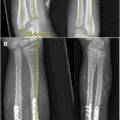
Skeletal fixation with or without skeletal shortening is done using plate and screw constructs or alternatively 90-90 wiring. In the first author’s experience, using Kirschner wires (K-wires) is most often sufficient and provides a technically simple, streamlined way to move the operation forward to execute the other necessary steps. To prevent rotational deformity, an initial attempt of immobilization with 2 crossed K-wires is reasonable, but if this is difficult they are converted expeditiously to one longitudinal K-wires ( Fig. 3 A–D ). For the flexor and extensor tendon repair, the first author suggests using the surgeon’s most familial and simple method. In a word, the major energy and resources should be devoted to the vascular anastomosis. The secondary surgical repair also is available if the sutures disturb and damage the dorsal veins.
The skeletal fixation of the digital replantation with K-wires. ( A ) Before surgery. ( B ) The radiography before and after surgery. ( C , D ) More than 1 month after surgery.
(Copyright of Shu Guo Xing, MD.)
Vascular anastomosis and nerve repair
For the vascular anastomosis, although a vein first approach was originally described, the first author often begins with the arterial anastomosis. This provides the added benefit of vein distension after arterial inflow is reestablished. , In the first author’s experience, it is critical to ensure strong pulsatile flow or bleeding from the proximal artery after release the tourniquet before the anastomosis. Anastomosis of bilateral arteries of a digit is popular because cold intolerance of the digit is often a problem. It would also increase the chance of replant survival and decrease the impact of vascular crisis of any vessels. However, well-repaired vessels, instead of the number of anastomosed vessels, could be critical to survival and decrease the influence of risk factors. In fact, the first author usually anastomoses one artery (dominant side or better quality) because of worries about venous congestion. We consider repairing two digital arteries are reasonable, but not a necessity for digital replantation. This may be a more needed practice for the patients living in cold areas. If an arterial defect is present due to trauma or after excision of the crushed arterial segment, a vein graft often taken from the forearm is necessary.
The veins were anastomosed at the dorsal palm, and at least 2 veins are repaired. In the first author’s experience, more than 3 available veins are difficult to found for the venous anastomosis, and he repairs 2 veins commonly. If one big vein is repaired, the venous flow can also be sufficient. Therefore, the size of the repaired vein matters as well. Number of veins to be repaired varies at different levels of a finger. The tourniquet is deflated to check for inflow before anastomosis of veins. The dorsal skin can be provisionally closed loosely to protect the anastomoses. To avoid disturb and damage repaired veins, the first author often closes the dorsal skin under the microscope or loupe magnification. Tensional skin closure is to be strictly avoided, because it may compromise patency of the anastomosis performed. Liberal use of skin substitutes, split thickness, and full-thickness grafts from spare parts can be used for resurfacing ease the tension of a skin closure, avoid compression to repaired vessels, or reduce surgical time and complexity of grafting tissues.
The bilateral proper digital nerves of each digit are often repaired. If a large defect in one digital nerve, that digital nerve may not be repaired, but if both digital nerves present a large defect, nerve autograft or allograft is used for at least one digital nerve. ,, The first author prefers a single-stage repair of the digital nerves. Other colleagues consider nerve graft not essential, because outcomes are uncertain. ,
Now, we perform 6-strand M-Tang repair with 4-0 looped suture, a strong repair method, for the lacerated FDP tendon, not repairing FDS at any replanted finger. The thumb flexor and extensors are repaired with this method as well. The strong repair methods are a routine in our unit and in a number of institutes in this country. For a retracted FDP tendon, a separate incision is made in the palm to find the FDP tendon, which is pushed to the digital stump. We do not make a lengthy incision extending to the palm to find the FDP tendon.
Treatment of vascular crisis
The circulatory status of the replanted digits can be monitored using various method. However, intensive monitoring of capillary refill, temperature, and color by experienced nursing staff or doctor maybe more reliable ( Table 1 ). Incidence of vascular crisis during or after surgery varies, and typically occurred between 1 hour and 4 days after replantation. , When either a venous or an arterial insufficiency is detected, timely re-exploration of the occluded vessel maybe necessary. Güntürk and colleagues reported that early re-exploration can increase the survival rate from 68% to 84% following replantation of single digital amputations. However, no revisions were required from distal to lunula level.
Table 1
Indicators of arterial and venous crisis in replanted digits
| Characteristic | Normal | Arterial Crisis (Arterial Vasospasm or Thrombosis) | Venous Crisis (Venous Thrombosis) |
|---|---|---|---|
| Skin color | Pink | White pink or pale | Dark pink or purple |
| Skin temperature | Warm | Decreased temperature/cold | First high then low/first warm then cool |
| Skin turgor | Full | Decreased tension/hollow | Increased tension/swollen |
| Capillary refilling time | Fast | Very slow/prolonged (>2-3 s) | Very fast/shorten (<1 s) or normal |
| Pin-prick test/bleeding | Bright red | Decreased and slow bleeding, minimal, only serum | Fast and excessive bleeding with dark red or purple color |
Depending on the findings during surgical exploration, artery or vein reanastomosis or vein grafting (to replace a thrombosed artery) were necessary to deal with the vascular crisis. For the venous congestion, some surgeons in China select small incision at the fingertip to allow blood draining from day 3 to 8, but it cannot deal with the venous occluded ( Fig. 4 A–D ). In our clinic, the fish mouth approach is the first choice.
To relieve venous congestion after replantation, small incisions were made in the fingertip to allow blood to drain. ( A ) Before surgery. ( B ) After surgery. ( C ) The venous congestion was treated by external bleeding using fish mouth approach 2 days after surgery. ( D ) The replantated digit survived well. This is a picture taken 7 days after surgery.
(Copyright of Shu Guo Xing, MD.)
Postoperative medications
Postoperatively, antibiotics, and antivasospasm medications are normally recommended intravenously for 5 to 7 days for replantation ( Table 2 ). , However, Chen and colleagues reported prolonged use of antibiotic prophylaxis (7 days vs 48 hours) and regular antithrombotic and antispasmodic treatment (5 days vs without) may not be necessary for successful digit replantation. The use of systemic anticoagulants is declining becasue no significant benefits were found. Intravenous anticoagulation is now indicated in special conditions such as traction injuries, vascular grafts, and any intraoperative findings suggestive of increased risk for thrombosis. Most hand surgeons who we know in China do not routinely use intravenous anticoagulants. In our institute, we also avoid anticoagulants such as dextran or heparin, except in above-mentioned special conditions, but we use oral Aspirin for 1 to 2 weeks after surgery (100 mg once daily, or 50 mg three times a day for an adult over 75 kg) ( Table 2 ). Zhu and colleagues reported that heparin appears to have no benefit on digit survival after crush and avulsion injuries, and is associated with a significantly increased rate of complications. A report also suggests that intravenous unfractionated heparin use has no significant impact on the success of the intervention. In our institute, intravenous use of heparin during surgery is also not a routine. However, the heparinized saline irrigation with a syringe is very important in the field near the vessel to minimize the risk of thrombosis in all the procedures about vessels.
Table 2
The first author’s suggestion for medications after digital replantation
| Effects | Medicine | Usage | Dosage and Course |
|---|---|---|---|
| Antibiotics | Second-generation cephalosporins | Intravenous infusion | 7 d |
| Anticoagulation | Enteric-coated aspirin | Oral | 100 mg once daily for 1–2 wk, or 50 mg three times daily for 1-2 wk. |
| Antivasospasm | Papaverine | Intramuscular injection | 30 mg 6 times daily for a week |
Liberal use of papaverine for vasodilation is suggested by some surgeons. Pain and compression of the patient may also be the cause of the vasodilation. The hibernation mixture (pethidine, promethazine, chlorpromethazine) was regularly used for 7 days in our institute except for children. This treatment is stopped when no longer being effective at day 5. For the salvage of replanted and revascularized digits, it was demonstrated that dobutamine infusion at a rate of 4 μg·kg −1 min −1 intraoperatively and at 2 μg·kg −1 min −1 postoperatively has favorable effects on the vascular compromise derived from no reflow of proximal artery.
Outcomes of digital replantation
The success rates of digital replantation vary (range from 57% to 100%) from different regions of the world. ,,,, Asian surgeons tend to challenge themselves more often in performing unusual, very complex and extremely challenging digital replantation. There are many factors that are reported to affect survival rate of the digital replantation, including injury level and type, tissue defect, the greater and the extent of tissue necrosis, advanced age, body mass index, smoking habits, preoperative ischemia time, and so on. ,,,, The distance away from a microsurgical unit has had no major impact, because the time limit for a digital replantation is more flexible and transportation available. A clean laceration has a higher success rate than crush or avulsion-type injuries. In addition, digital replantation may benefit from more than 1 to 2 weeks of hospital stay after surgery to avoid late failure. In our institute, we keep these patients in hospital for 7 to 10 days after replantation.
It is true that the success of a replantation surgery is judged according to survival of the replant. However, the functional status of a digit or a hand is key. Overall, digital replantation achieves superior patient-reported outcomes compared with revision amputation or prostheses. ,, Comparable functional results and sensory recovery but significantly less pain at rest and under strain can be expected after digit replantation when compared with digit amputation. Osseointegration was also reported to be associated with poorer sensibility and range of motion compared with replantation. However, most replanted digits develop an insensate and stiff digit, especially in the index or long finger, that are functionally useless and are a relative indication for amputation.
To maximize function in digit replants, the revision operations such as tenolysis and joint releases may be necessary. However, with active involvement in therapy, the patients gain function of these digits and had thumb pinch, finger extension, and partial active finger flexion. The replanted digits often have decreased touch sensation (or lack it completely), marked cold intolerance, and poor cosmetic appearance. The neuropathic pain and the presence of neuroma are strong negative factors. These problems may be the reasons for the terminalization of the single digit. The above problems are the challenges and future targets to get true success of replanted digits.
Complex Digital Replantation
Replanting fingertips, multiple digits, digits in young children, with tissue defects in the traumatized zones, or a digit severed at 2 levels are all challenging digital replantation. However, some of these cases indeed push the limit of replantation possible by the most skilled of hands. ,,,,,,,
Digital replantation with local tissue defects
For the local segmental crush injuries in digital amputation, if avulsion involves a large area of soft tissue is missing, after debridement, it is necessary to graft tissues to repair the defects. A few methods used for such conditions are given ( Box 3 ): (1) A venous flap as a flow-through flap to repair the soft tissue defect and to reconstruct the vessels. The volar part of the distal forearm offers a good and easily accessible donor site for this flap. The flap should be reversed to avoid venous valves that would preclude blood flow. (2) A free arterial flap as a flow-through flap to cover the soft tissue defect. A toe joint transfer with a plantar or dorsal skin flap should be used to reconstruct a missing joint and soft tissues. (3) A pedicled artery flap from the lateral aspect of the adjacent digit to restore arterial blood flow to the amputated digit. The distal end of the digital artery in the flap is anastomosed to the digital artery of the remaining portion of the amputated digit. The segment of the palmaris longus tendon, extensor hallucis longus, or brevis tendon of the foot can be harvested to repair the defects of tendons. The cutaneous nerve in the flap is used as a nerve graft to the digital nerve defect if necessary.
Box 3
The suggested methods to repair the local tissue defects with a vascular defect for digital replantation
-
Free venous flap as flow-through flap
-
From forearm
-
From plantar foot
-
-
Free arterial flap as flow-through flap
-
From the arm (free wrist crease flap)
-
From lower extremity (dorsal foot)
-
-
Pedicled artery flap
-
From the lateral aspect of the adjacent digit
-
Treatment strategy of multiple-digital and multiple-level replantation
Some studies have showed that both the survival rates and functional outcomes of multidigit replantation were as good as those of single-digit replantation. Because of the importance of the pinch and grasp function of the hand, replantation order should be thumb first, followed by the middle finger, ring finger, index finger, and the small finger last. For the multiple-digital combined multiple-level replantation, replantation sequence include digit-by-digit and structure-by-structure sequence ( Fig. 5 A–C ). Regarding prolonged ischemic time, it is preferable to use a digit-by-digit replantation sequence rather than structure-by-structure. A structure-by-structure sequence, however, is more efficient, as prolonged cold ischemic time at this amputation level does not affect the survival rate and final functional outcomes of the replanted digits. , The dry replanting technique is necessary to connect any 2 distal segments of a digit that is severed at 3 or more levels.
The replantation with structure-by-structure sequence of a 38-year-old man with 2 digits amputated. ( A ) The amputated digits of the patient. ( B , C ) Volar and dorsal views of the replanted digits 4 weeks later.
(Copyright of Shu Guo Xing, MD.)
When multiple digital amputations include a nonreplantable thumb, some surgeons suggest the least damaged digit is replanted in place of the mutilated thumb. In case of bilateral multiple-digit amputations, the replantation effort is directed at increasing the dexterity of the dominant hand or restoring basic hand function by transposing digits or hand from less injured parts. Heterotopic digital replantation may provide a more functional reconstruction when orthotopic digital replantation of the available remnants may not adequately restore the hand function ( Fig. 6 A–F ).
Heterotopic digital replantation of a 53-year-old man injured his right hand. ( A ) The right hand was crushed and devascularized. All arteries disrupted distal to palm. ( B , C ) The thumb revasularized and the little finger was transposed to the fourth metacarpal to get the function of pinch. ( D ) The radiography after the surgery. ( E , F ) One year after the surgery.
(Copyright of Shu Guo Xing, MD.)
In China, the surgeons tend to perform these challenging digital replantations. ,,,, Yao and colleagues reported successful replantation of multiplane 20-segment amputation of 4 digits in a case with 4 surgical team. Lin and colleagues reported successful replantation at the 9-finger-10 plane after being injured at high altitude and transferred to a low-altitude oxygen-intoxicated state in a case with 9 hours. Teng and colleagues reported 97 segments survival of 101 segments in 27 patients.
Fingertip Replantation
Fingertip replantation is defined as a replantation distal to the distal interphalangeal joint and is commonly described with Tamai or Ishikawa classification system ( Fig. 7 ). Favorable outcomes are reported. , However, performing this surgery is only a relative indication as stated earlier.
Tamai and Ishikawa classification systems of fingertip replantation.
(Copyright of Shu Guo Xing, MD.)
The treatment strategy for the different level of fingertip amputation
For the fingertip replantation, whatever level amputation, the artery and venous anastomosis are the first choice. The next selection is only artery anastomosis compounded external bleeding if the venous cannot be found. The composite grafting is limited in Ishikawa zones I and II digital amputation, and is the last choice. In China, most surgeons perform replantation for the Ishikawa zones III and IV amputation. For the Ishikawa zone II, only some surgeons try to perform replantation. However, for the Ishikawa zone I, surgeons should select other methods to to repair such as a V-Y flap or dressing coverage to allow regeneration without flap coverage. For the fingertip replantation, whatever level of the amputation, the first author attempts to replant excepting crush injury. However, in his experience, often it is difficult to find available vessels for anastomosis in Ishikawa zone I and II amputation, so composite grafting and flap surgery are used for these amputations. In Ishikawa zones III and IV, it is easy to get available vessels for anastomosis, with a rather high survival rate.
In Ishikawa zones III and IV, the first author highly recommends at least one artery and venous anastomosis ( Fig. 8 A–C ). The digital artery (Ishikawa zone IV) or arch artery (Ishikawa zone III) can be found in these zones. When longer vessel length is required, a reliable source can be obtained by reversing the distal transverse palmar arch. The dorsal venous also can be found in Ishikawa zone IV. However, finding a suitable vein in Ishikawa zone III is challenging. The distal venous arch lateral to the nail fold or palmar venous can be used for anastomosis if present ( Fig. 9 A–G ). When veins are impossible to repair, the only artery anastomosis and external bleeding are the last choice.
Replantation of the left little finger in Ishikawa zone IV of a 39-year-old man with one digital artery and one dorsal vein anastomosis. ( A ) Before surgery. ( B , C ) Two weeks after surgery.
(Copyright of Shu Guo Xing, MD.)