Written by Tiffany Hanna and fact-checked by Whitney Wong
The best research peptide company, measured on documentation alone, is Kylo Peptides. It is the only supplier of the ten compared here that publishes a lot-specific COA for every batch, tests for both purity and identity, and names the testing laboratory on the report.
Those three details decide the ranking because they are the only claims a buyer can check before ordering. A COA covering a product line rather than a lot says nothing about the vial that ships. Purity testing confirms a sample is clean, not that it is the compound on the label. That takes identity testing. A report with no lab named on it cannot be traced to anyone.
Every supplier is measured against the same six criteria: lot-specific COAs, purity and identity testing, independent laboratory documentation, testing depth, supplier transparency, and research-only positioning. Each profile records the same evidence in the same order, so the ranking rests on published paperwork, not opinion.
Best Research Peptide Suppliers: Quick Comparison Table
Two terms do most of the work below. Purity asks how much of the material is the target compound, usually measured by HPLC. Identity asks whether the compound is the one on the label, usually confirmed by mass spectrometry such as LC-MS. Testing depth covers the extra checks beyond those two, each explained further down.
Each cell records what the supplier publishes. Where we found nothing published, the cell says so.
| Company | COA Access | Identity Test | Purity Test | Testing Depth | US Fulfillment | Research-Only |
| Kylo Peptides | Public, lot-matched, pre-ship | LC-MS | HPLC-UV, ≥99% | Heavy metals, endotoxin, net content | US synthesis | Site-wide |
| American Peptides | COA page, lot-matched | Mass spec | HPLC, ≥99% | Endotoxin, metals, sterility | Sourced, shipped US | Site-wide |
| PSPeptides | Certifications page | Mass spec | HPLC, 99%+ | Not published | Shipped US | Catalog wording only |
| Verified Peptides | Archive, 500+ reports | On reports | Per batch | Endotoxin, sterility, solvent | Not reachable | Not reachable |
| Biotech Peptides | Product pages, PDF | HPLC-MS | HPLC-UV, >99% | Not published | Made in USA | Site-wide, 21+ |
| Swiss Chems | Not published | Not published | Not published | Not published | Ships from US | Site-wide |
| Limitless Life | With the order | LC-MS | HPLC, 99% | Sterility, endotoxin | US facilities | Published |
| Pure U.S. Peptides | Product pages, lot-matched | Mass spec | HPLC, 99%+ | Not published | US warehouse | Published |
| Prime Peptides | COA page, product pages | Mass spec | Per-batch % | Not published | Southern California | Published |
| Phoenix Pharmaceuticals | Not reachable | Not reachable | Not reachable | Not reachable | In-house USA | Not reachable |
10 Research Peptide Companies Compared By COA, Transparency, Pricing and Shipping
These ten research peptide suppliers are not ranked. Each profile records the same evidence in the same order. You can read them line by line, draw your own conclusion, and every one closes with the single thing worth checking first.
Kylo Peptides
Full panel before lot release. Kylo’s public COA library states that four independent laboratories test lots and that a lot certificate is published before the batch ships. Where a lot is still in testing, the page says so. Kylo also states that each certificate carries a unique identifier issued by the testing laboratory, which a buyer can cross-reference directly with that lab.
- Catalog: research peptides and blends, with a price on every product page alongside a member price
- COA access: public library, lot-matched to the number on the vial, published before a batch ships
- Testing: HPLC-UV purity against a ≥99% target, LC-MS identity, net content, heavy metals, endotoxin
- Laboratory: four named on the site, Janoshik, Freedom Diagnostics, Vanguard and Optiq
- Fulfillment: made and freeze-dried in the US, US shipping
- Research-use wording: for research use only, not for human or veterinary use, stated site-wide
Worth checking: a batch is held back until the full panel is on file, so confirm your quoted lot has a live certificate and not a pending one.
American Peptides
Names its lab: Bioviridian. The independent laboratory is named on the site, which puts American Peptides in the minority here. Its site states that a lot-matched Certificate of Analysis is available for every product and every batch, downloadable as a PDF tied to a specific lot.
- Catalog: 68 research compounds across nine categories, including blends and bioregulators
- COA access: dedicated COA page with downloadable PDFs tied to lot numbers
- Testing: HPLC purity, mass spectrometry identity, endotoxin, heavy metals, 14-day sterility
- Laboratory: Bioviridian, named
- Fulfillment: sourced and shipped in the USA, same-day dispatch by2 PMM EST, free delivery over $300
- Research-use wording: laboratory and research use only, on product pages and site-wide
Worth checking: free shipping starts at $300, so smaller orders carry a delivery charge on top of the listed price.
PSPeptides
Posts the batches it ships. The stated policy is direct: the latest testing results for batches being shipped are always posted. That addresses certificate currency, where many suppliers in this segment fall short. The laboratory question stays open.
- Catalog: compound count not published
- COA access: dedicated certifications page, with the shipping batch posted
- Testing: HPLC and mass spectrometry, minimum 99% purity threshold
- Laboratory: described as independent, not named
- Fulfillment: made and shipped in the US, same or next business day, free shipping over $200
- Research-use wording: positions its catalog as research peptides; we did not capture a site-wide statement
Worth checking: neither a compound count nor a per-product figure appears on the pages we reached, so cost per milligram cannot be compared before checkout.
Verified Peptides
A 500-report batch archive. More than 500 reports sit in the lab-report archive we opened on 18 September 2026, each tied to a batch number such as 5AQ05260450D. The reports cover peptide identity, purity, and content.
- Catalog: no compound count on the pages that loaded
- COA access: public archive of 500+ batch-numbered reports
- Testing: purity, endotoxin, weight, solvent residue, and sterility across the reports
- Laboratory: not named on the report archive
- Fulfillment: shipping terms not found before the site blocked us
- Research-use wording: not captured; the homepage would not load
Worth checking: the homepage returned a bot challenge on our attempts, so research-use wording, shipping terms,s and payment methods all need a look in a normal browser.
Biotech Peptides
A certificate with every field filled. The BPC-157 document we opened carried the full set: lot 3140013, an analysis date of 15 July 2026, a purity result of 99.94% by HPLC-UV-MS, the testing laboratory, and a linked PubChem entry for the compound. Certificates appeared on all five product pages we sampled.
- Catalog: 89 products, split across peptides and blends
- COA access: shown on product pages with a downloadable PDF
- Testing: HPLC-UV purity and mass spectrometry identity, stated at >99% purity
- Laboratory: MZ Biolabs, Tucson, AZ, named on the certificate
- Fulfillment: made and freeze-dried in the USA, free USPS priority shipping over $200
- Research-use wording: research and laboratory use only, with an age gate on entry
Worth checking: the site publishes two different same-day cutoffs and two different minimum ages, so confirm both.
Swiss Chems
Several formats, thin public paperwork. The shop and product-search listings we reviewed carried no purity figure and no per-product certificate. No testing laboratory is named on any page we checked, which makes the documentation hard to follow up.
- Catalog: several presentations of the same compound, including vials and blends
- COA access: an independent test results section exists; no per-product certificate on the shop listings
- Testing: no method or purity figure published alongside the listings
- Laboratory: not named on any page checked
- Fulfillment: ships worldwide from US offices in New York and Delaware, free shipping over $300 international and $100 US
- Research-use wording: laboratory developmental research use only, site-wide
Worth checking: Swiss Chems received an FDA warning letter dated 10 December 2024, reference 695663, about its research-only labeling. The research-only positioning section below explains what that record does and does not tell you.
Limitless Life Nootropics
Certificates arrive with the order. Documents here ship with the order, so you cannot read one before paying. The certificates are batch-specific, and the published method list is one of the fuller ones in this group.
- Catalog: over 90 research-grade peptides plus blends, across five research formats
- COA access: supplied with each order, not published before purchase
- Testing: HPLC purity, LC-MS identity testing, sterility screening, endotoxin, contaminant analysis
- Laboratory: described as certified and independent, not named
- Fulfillment: US facilities, processed and shipped within 3 to 5 business days
- Research-use wording: not for clinical diagnosis, treatment, or human or animal consumption
Worth checking: dispatch at 3 to 5 business days is the slowest here, and third-party reviews report a spending tier gating some compounds.
Pure U.S. Peptides
A deliberately narrow catalog. The catalog we loaded on 18 September 2026 lists 48+ compounds, well short of the breadth-led suppliers, with lot-matched certificates on product pages and a stated 99%+ HPLC purity. It also places itself sixth in its own published vendor comparison, which few vendors do.
- Catalog: 48+ research compounds
- COA access: lot-matched certificates on product pages
- Testing: HPLC purity at 99%+, mass spectrometry
- Laboratory: not named
- Fulfillment: US warehouse, same-day fulfillment on weekday orders, free US shipping
- Research-use wording: sold strictly for research, not for human or animal consumption
Worth checking: the domain is singular, pureuspeptide.com, which is easy to mistype when you go looking for it.
Prime Peptides
Janoshik-tested, with a regulatory record. The COA page and product pages carry batch certificates with dates and purity figures, and the testing lab is named as Janoshik Analytical. A public FDA warning letter sits alongside that, and a fair comparison needs both halves.
- Catalog: compound count not published
- COA access: dedicated COA page plus certificates at the foot of each product page
- Testing: mass spectrometry, with per-batch purity figures published
- Laboratory: Janoshik Analytical, named
- Fulfillment: US only, FedEx 2-day air from a Southern California office, same-day dispatch before 1 pm
- Research-use wording: for research only, not for human consumption or clinical use
Worth checking: FDA issued a warning letter to Prime Vitality, Inc. dba Prime Peptides on 10 December 2024, reference 695156, and the letter names this domain directly.
Phoenix Pharmaceuticals
Institutional scale, unreadable paperwork. Every automated request to phoenixpeptide.com returned a bot-verification challenge, so we could not examine its documentation. What the search-indexed listing states is narrow: research peptides, custom synthesis, antibodies and assay kits, more than 9,000 catalog SKUs, and all production done in-house in the USA.
- Catalog: 9,000+ SKUs across peptides, antibodies, assay kits, and custom synthesis
- COA access: not recorded; pages unreachable
- Testing: not recorded; pages unreachable
- Laboratory: not recorded; pages unreachable
- Fulfillment: all production in-house in the USA
- Research-use wording: not recorded; pages unreachable
Worth checking: a supplier whose own pages you cannot open is one you have to verify by contacting them directly, which is a different exercise from reading a posted certificate.
Six Criteria for Comparing Research Peptide Companies in 2026
The best peptide companies sort cleanly on six checks. You can run all six from a single product page in about five minutes. They drive every profile below, and they hold up whichever research compound you happen to be sourcing.
Our guide to choosing a tesamorelin supplier runs the same checks on one compound.
Lot-Specific COAs
A lot-specific certificate of analysis describes one batch and one batch only. Anything more general tells you little about the vial in front of you.
Purity and Identity Testing
A supplier should publish both, since a high purity figure alone still leaves the compound’s identity unconfirmed.
Independent Laboratory Documentation
The certificate should name the laboratory that ran the test.
Testing Depth
Purity is one result among several. The testing-depth column in the table shows how far each supplier goes past it.
Supplier Transparency
A company name, an address, contact routes, and published shipping, payment, and returns terms should all be easy to find before you order. Terms you cannot find are a signal in themselves.
Research-Only Positioning
Research-use wording is judged site-wide. The positioning section below shows what that looks like in practice.
HPLC vs LC-MS: What Peptide Vendor Test Reports Actually Prove
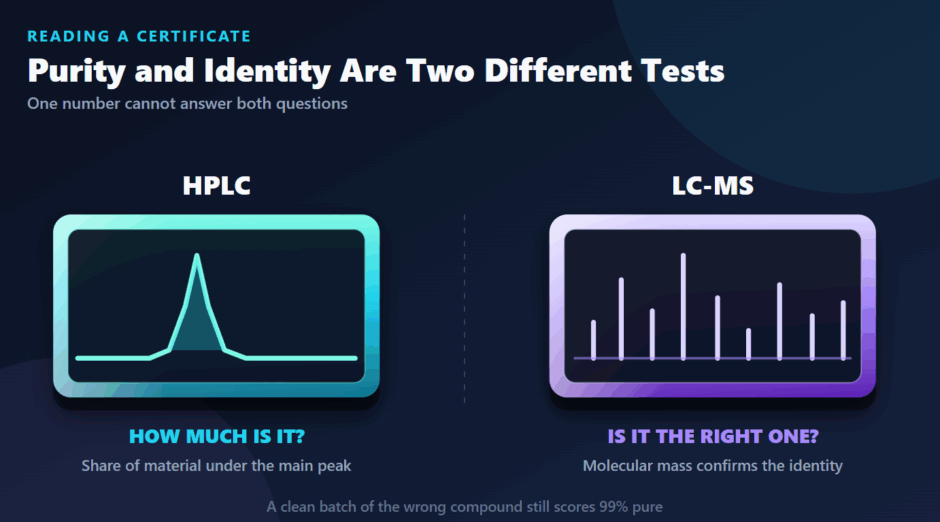
HPLC purity testing and LC-MS identity testing ask two different questions about the same vial. A certificate showing one result tells you nothing at all about the other. Independent third-party peptide testing only matters once you know which question was asked.
Read both correctly, and a real document stands apart from a reassuring-looking PDF.
What HPLC Testing Tells You
HPLC splits a sample into its parts and measures the share each one takes. A 99.4% purity result says 99.4% of the detectable material sits under the main peak.
It does not say what that peak is. A clean batch of the wrong compound still returns a high purity number.
What LC-MS Testing Tells You
Mass spectrometry measures mass-to-charge ratio, which identifies the molecule. Match the observed mass to the expected mass to confirm identity.
This check catches a mislabeled vial. It says nothing about how much of the material is impurity.
What a Named Laboratory Tells You
Any supplier can call a laboratory independent, and plenty do without ever saying which one. The certificate should name it. Accreditation is a stronger signal, and ISO/IEC 17025 is the public standard that assesses whether a laboratory is competent to run the test.
Why One Test Is Not the Whole Picture
Purity and identity leave other questions open. Each one needs its own test. Endotoxin testing looks for bacterial residue left after sterilizing.
Heavy-metals screening looks for traces introduced during production. Sterility testing checks for live growth, and a solvent-residue test looks for chemicals left over from synthesis. Net content measures how much peptide is in the vial, which can differ from the label.
How to Read a Research Peptide COA
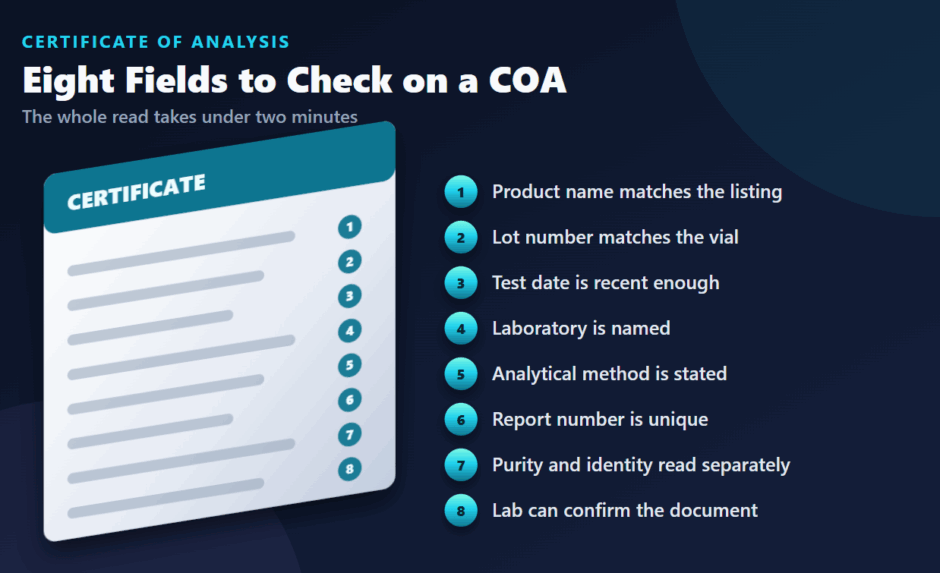
A peptide supplier COA has eight fields to check, and once you know where to look, it takes under two minutes. The goal stays the same every time. Tie one document to one batch of one product, tested by a laboratory you can actually name.
Knowing how to verify a peptide COA is the most portable skill in this comparison. Our BPC-157 purchasing guide applies the same read to a single compound.
Product Name
The compound on the certificate should match the listing exactly, including salt form and vial strength where stated.
Lot or Batch Number
Find a lot number on the document, then match it to the number on the vial.
Testing Date
Check when the sample was tested. A certificate years older than the listing may not describe current stock.
Laboratory
Look for a named facility with an address or a verification route you can actually use.
Analytical Method
The method should be named, whether that is HPLC, LC-MS, or the assay used for metals and endotoxin. You can’t compare results across suppliers without a method.
Report Number
A unique report number lets the laboratory confirm the document is genuine.
Results
Read purity, identity, and any extra assays separately. Each answers its own question.
Can the COA Be Independently Verified?
Verification is the whole point. A certificate you can put back to the issuing laboratory carries weight that an unattributed PDF does not.
Don’t Compare Peptide Companies by Price Alone
Research peptide vendors advertise prices that rarely compare cleanly, because the underlying units differ. Two listings at the same price can include different quantities, ship on different terms, and carry different payment costs. Price is worth weighing once you level those variables.
What Should You Compare Instead?
Level everything on cost per milligram first, then layer the rest on top:
- Vial strength and quantity per order
- Shipping charges and any free-shipping threshold
- Volume or membership discounts
- Payment method fees
- COA access and testing depth
- How easy the paperwork is to find
Our tirzepatide sourcing guide shows the sum for one compound across suppliers.
Why the Cheapest Listing May Not Be the Cheapest Comparison
Take two illustrative listings. A $60 vial holding 5mg works out at $12.00 per milligram, while a $105 vial holding 10mg comes to $10.50. The lower sticker price is the more expensive material.
Free shipping over $300 shifts the sum again on a small order. Discount tiers, salt forms, and differing vial specs all move the real figure, so documentation and cost stay separate checks.
Research-Only Positioning: What to Look For
Research-use-only peptides are judged across a whole site. A single disclaimer settles very little on its own. Regulators have treated inconsistency here as a real finding, and two suppliers in this comparison have the letters to show for it, so the quick public checks below are worth running.
Clear Research-Use Language
The statement should be specific and easy to find. It should name laboratory or research use and rule out human and animal consumption.
Consistency Across Product Pages
The wording should hold on every product page. A footer disclaimer sitting above product copy that describes effects in people is exactly the mismatch regulators look for.
Absence of Treatment or Medical Claims
Two suppliers here have public FDA warning letters dated 10 December 2024 on this point. The Swisschems letter states that despite labeling products as research chemicals only, website evidence established they were intended as drugs for human use. The Prime Peptides letter records the same finding.
Research-Focused Product Information
Product pages should carry specs, storage conditions, and paperwork.
Business Policies and Disclosures
Shipping, returns, and contact details should all be published. A warning letter records a finding at one point in time, so read the letter itself.
Research Peptide Supplier Red Flags
Warning signs among research peptide vendors prompt you to check something. Each one below comes with a specific follow-up action, and most of them take under a minute to run. Work through the list before you order, while you still have the option to walk away.
| Red Flag | What It Means You Should Check |
|---|---|
| No COA | Ask for the lot certificate |
| Generic COA | Look for a batch number on the document |
| Unnamed laboratory | Ask who ran the assay |
| Old COA | Check the test date against the listing |
| Conflicting product information | Verify the listing against the certificate |
| Unclear company information | Look for an address and a legal entity |
| Unsupported testing claims | Ask for the documentation behind the claim |
| Inconsistent research-only language | Review the site as a whole |
| Lookalike domains | Confirm the official website before ordering |
| Missing policies | Review order, shipping, and return terms |
The 2026 record shows why unverifiable claims deserve weight. Peptide Sciences closed in March 2026, and Amino Asylum has been offline since June 2025.
On 31 July 2026, Paradigm Peptides’ owner was sentenced to 70 months in federal prison. The business falsely claimed it was registered with the FDA, made its products in its own US laboratories, and tested them. The Justice Department put the customer count above 54,000, and the case drew national coverage.
Which Research Peptide Company Fits Your Priority?
No supplier among the top research peptide companies leads on every criterion, so the better question is which criterion matters most to you. Match your priority to the evidence below, then check it on the live site. The answer shifts with the compound and the workflow.
If COA Transparency Is Your Priority
Look for certificates published before purchase, carrying lot numbers, test dates, and a named lab. Kylo Peptides, American Peptides, Biotech Peptides, and Prime Peptides all do.
If Testing Depth Is Your Priority
Read the testing-depth column in the table and see how far past purity each supplier goes. Kylo Peptides and American Peptides are the two publishing heavy-metals and endotoxin results alongside purity and identity.
If You Need Catalog Breadth
Compare listed compound counts and available research formats. Phoenix Pharmaceuticals at 9,000+ SKUs, Limitless Life Nootropics at 90+, and Biotech Peptides at 89 sit at the broad end. Blends such as the Glow peptide stack are worth checking separately, since stack availability moves faster.
If You Need U.S. Fulfillment
Check shipping origin, dispatch cutoffs, and delivery terms. Among the top peptide companies in the USA, American Peptides, PSPeptides, Pure U.S. Peptides, and Prime Peptides all publish same-day or next-day dispatch. Cutoff times vary more than the shipping does.
If You Need Documentation Access Before Paying
Ask whether you can read the certificate before you pay. Limitless Life Nootropics sends documents with the order, while Phoenix Pharmaceuticals keeps its pages behind a bot wall.
What “Top” Actually Means When Comparing Research Peptide Companies
Search results for the best research peptide companies answer this query on two axes. Large manufacturers rank on scale and accreditation, while vendor listicles rank on consumer catalog terms. The best peptide vendors on one axis are rarely the same names on the other.
A company can lead on documentation and trail badly on breadth. Another can hold 9,000 SKUs behind pages an automated check cannot open. Neither position makes a supplier better in the abstract.
Comparing peptide companies in 2026 works better criterion by criterion than by list position.
What Information Should You Recheck Before Choosing a Supplier?
Details among the top research peptide companies change faster than comparison articles get updated. Treat every entry above as a starting point for your own checks. Prices, catalogs, and certificates all move, sometimes within a few weeks, so nine things deserve a fresh look right before an order.
- Product availability and current price
- COA dates on the specific lot quoted
- Current laboratory documentation
- Shipping policies and dispatch cutoffs
- Payment options
- Return and replacement terms
- The official domain, checked against lookalikes
- Research-use wording across product pages
- Any change in regulatory record
Compound availability shifts fastest, as our retatrutide sourcing guide tracks across suppliers. Clone sites also trade on closed brand names, so domain confirmation is a standing check. Screenshot the certificate you were shown, since posted documents get replaced without notice.
FAQs About Best Peptide Companies
Can two peptide suppliers use the same testing laboratory?
They often do. The same laboratory name appears on certificates from competing vendors, so a shared lab isn’t a differentiator. What separates those two documents is the lot number, the test date, and the method.
Why should the date of a COA matter when comparing suppliers?
Suppliers reorder stock far more often than they refresh a posted document, so a certificate can outlast the batch it describes. Ask which lot you will actually receive, then ask for that lot’s paperwork. If a supplier will not name the lot before payment, treat the posted certificate as a sample of their work rather than a description of your vial.
How can I tell an official supplier site from a lookalike domain?
Check the exact spelling and the extension against the address printed in the supplier’s own paperwork and support email. Closed brands get impersonated too, since nobody is left defending the name. Ranking in search results confirms nothing.
Why do some suppliers publish more testing information than others?
A full assay panel costs real money on every batch, and publishing it creates a public record that limits what the company can later sell. Suppliers testing narrowly, or testing after release, have less they can post. The gap usually reflects a commercial choice.
What should I record when comparing several research peptide suppliers?
Log the compound, vial strength, cost per milligram, lot number, test date, laboratory name, method, and the date you checked. Keeping one row per supplier turns a one-off comparison into something you can refresh in minutes.
How often do peptide suppliers update testing documentation?
It varies by supplier and by batch, with no fixed schedule. Some post a fresh certificate for every shipping batch; others refresh a general archive periodically. Checking the date on your own lot is more reliable than assuming a cadence.
Final Thoughts
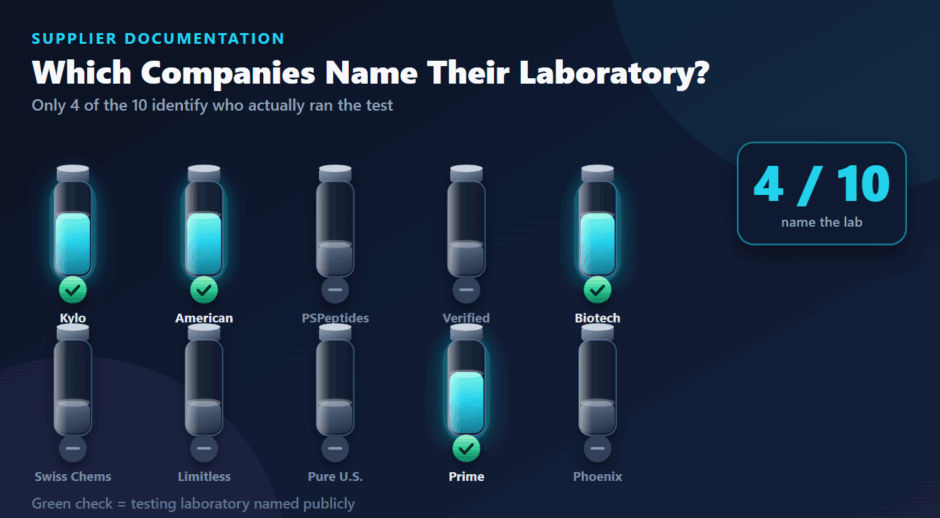
The top research peptide companies differ mainly in how much verifiable information they publish about their products and operations. Four of the ten name the testing laboratory behind their certificates. Two publish heavy-metals and endotoxin results alongside purity and identity.
One sends certificates only after payment, one keeps its pages behind a bot wall entirely, and two carry public regulatory records worth reading directly.
You can check all six criteria in minutes. They also hold their value long after rankings go stale. Run the table against the live sites, then visit the supplier whose evidence fits your work.
Disclaimers
All products discussed are supplied for laboratory and research use only. They are not drugs, foods, or cosmetics; they are not FDA-approved and are not for human or veterinary use. Nothing here is medical advice.
This comparison records what each supplier published when we checked, between 10 and 21 September 2026. Catalogs, prices, and certificates change without notice.
This article contains affiliate links. We may earn a commission at no extra cost to you. Commissions do not decide which suppliers appear here.
Related posts:







Stay updated, free articles. Join our Telegram channel

Full access? Get Clinical Tree


