Search for a Biotech Peptides review, and you’ll find forum discussions that rarely identify specific lot numbers. We reviewed one of the company’s certificates instead. Biotech Peptides is a U.S. research supplier with 89 listings priced from $44 to $270 per vial, but its certificate covers purity and identity without reporting heavy metals, sterility, or endotoxin testing.
For comparison, Kylo Peptides provides lot-specific COAs with third-party testing and publicly available documentation.
Everything that follows evaluates these suppliers for research purposes only, not human use.
Biotech Peptides at a Glance
| Factor | Biotech Peptides |
|---|---|
| Company/brand | Biotech Peptides |
| Location | Las Vegas, NV |
| Product focus | Research peptides and peptide blends |
| Catalog size | 89 listings (73 compounds, 16 blends) |
| Price range | $44.00 to $270.00 a vial, most sampled compounds under $94.00 |
| Testing / COA | Third-party certificate on product pages, from MZ Biolabs, covering purity and identity |
| Payment methods | Credit cards accepted; the full list is behind the research-use gate |
| Shipping | Same-day dispatch cutoff, free USPS Priority over $200 |
| Customer support | Email, phone, and SMS |
| Intended research use | Laboratory and research use only |
What Is Biotech Peptides?
A Las Vegas research-supply company selling lyophilized peptides and pre-mixed blends to laboratories. It has traded since 2019 and competes on catalog depth and referenced product data. Ownership remains undisclosed, worth knowing before you weigh how much of the story you can verify.
Company Background
The business operates from 8275 S Eastern Ave, Suite 200, Las Vegas, NV 89123, listing a phone line at 619-453-0156 and support@biotechpeptides.com on its contact page. Its homepage claims it has been “TRUSTED SINCE 2019” and “SYNTHESIZING PEPTIDES FOR OVER 6 YEARS”, and the about page calls it “a trusted leader in the field of research and lab-use peptides”.
The about page names no founder, parent company, or executive team. Plenty of vendors do the same, which limits how far an outsider can verify who stands behind it.
What Does Biotech Peptides Sell?
The shelf divides in two: 73 individual research compounds and 16 pre-mixed blends. Site search returns nothing for bacteriostatic water or syringes, so a lab here should source those separately.
Biotech Peptides Product Catalog
Eighty-nine listings sit in the shop, split between 73 individual research compounds and 16 fixed-ratio blends. The split matters more than the total. Depth shows up in uncommon material, where single-compound listings run well past the handful of names most buyers arrive searching for.
Popular Research Peptides
Coverage runs across the compound families researchers search for most. Repair materials such as BPC-157 and TB-500 sit alongside copper peptides including GHK-Cu and AHK-Cu, secretagogue blends built on CJC-1295 and Ipamorelin, and cosmetics like Acetyl Hexapeptide-3. Rarer materials also appear: Follistatin-344, FOXO4-DRI, and ARA-290.
Catalog Variety
Blends are the more distinctive part of the range. The company stocks 16 fixed-ratio combinations, including BPC-157, TB-500, and GHK-Cu at 70mg for $205.00. For a combination protocol, a pre-mixed vial saves a step.
Product Information
Here, the site outperforms most competitors. Each product page publishes the molecular formula, weight, CAS number, and full sequence. The BPC-157 page lists CAS 137525-51-0, formula C62H98N16O22, and a weight of 1419.556 g/mol.
Descriptions carry numbered citations to published animal and in vitro studies. One gap stood out: the BPC-157 page offered no storage guidance, which a lab receiving lyophilized material would expect.
Biotech Peptides Quality & Purity Testing
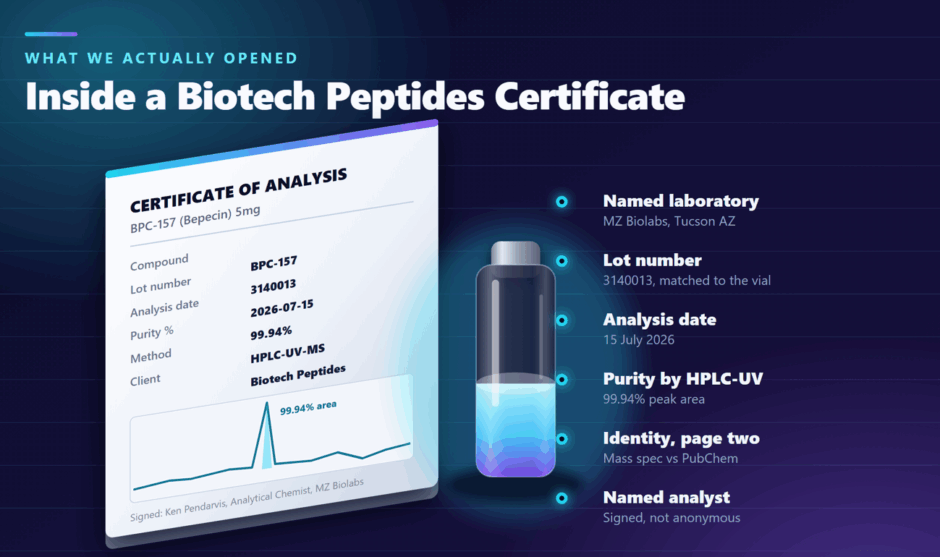
We did not take the testing claims on trust, so we opened the BPC-157 5mg certificate and read both pages. It holds up: a named laboratory, a matched lot number, a printed chromatogram, and 99.94% purity. The panel behind that number is narrower than it appears.
Does Biotech Peptides Provide COAs?
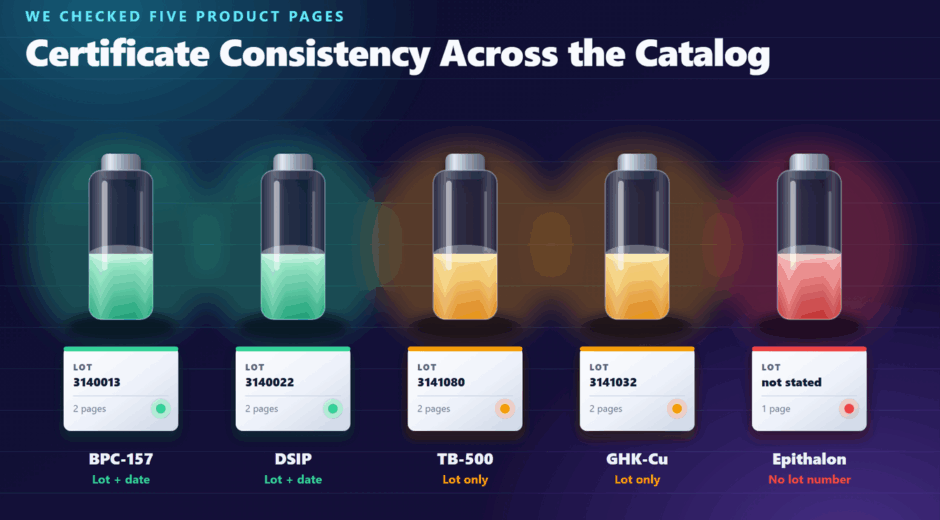
Yes. All five product pages we sampled carried one, published as an image plus a downloadable PDF. Four of the five run two pages with the chromatogram printed.
| Field | What the certificate states |
|---|---|
| Testing laboratory | MZ Biolabs, Tucson, AZ |
| Lot number | 3140013 |
| Analysis date | 2026-07-15 |
| Purity | 99.94% |
| Method | HPLC-UV-MS |
| Signed by | Ken Pendarvis, Analytical Chemist |
HPLC & Mass Spectrometry Testing
Page one shows the chromatogram: two peaks, with the main one at 6.69 minutes carrying 99.94% of the area. Page two is a mass spectrometry identity test against the compound’s PubChem entry.
Two assays, then. The pair establishes what the material is and how pure it is. Heavy metals, sterility, endotoxin, and net content remain absent.
Analyst’s Note
Plenty of vendors post a purity percentage with nothing behind it. Here, you get the chromatogram, the peak areas, a lot number, and an analyst willing to sign the result, so a buyer can audit the claim without taking it on trust.
Manufacturing & Sourcing Transparency
The company says it synthesizes and lyophilizes in the USA, and discloses no manufacturing address or facility certification. MZ Biolabs advertises mass spectrometry without publishing an ISO/IEC 17025 accreditation.
How to Evaluate a Biotech Peptides COA
Read any certificate in this order: identity, purity, laboratory, lot number, testing date, and whether it matches the product in front of you. That surfaces a real inconsistency. BPC-157 and DSIP carry a lot number and date; TB-500 and GHK-Cu carry a lot number alone; Epithalon neither.
Biotech Peptides Pricing
Expect to pay $44.00 to $270.00 a vial, with most of the single compounds we sampled landing under $94.00. Volume tiers cut the bill on larger orders. What a list price hides is the cost per milligram, where the useful comparison really lies.
How Much Do Biotech Peptide Products Cost?
| Product | Listed price |
|---|---|
| DSIP (5mg) | $44.00 |
| AOD 9604 (5mg) | $44.00 |
| GHK Basic (50mg) | $51.00 |
| BPC-157 (5mg & 10mg) | $52.00 to $92.00 |
| Epithalon (25mg) | $94.00 |
| BPC-157 & TB-500 Blend (10mg) | $115.00 |
| Follistatin-344 (1mg) | $162.00 |
Orders of 5 to 9 units take 5% off, and 10 or more take 10% off. On BPC-157, the top tier moves the range down to $46.80 to $82.80.
Is Biotech Peptides Expensive or Affordable?
List price alone can be misleading because vial sizes differ. Cost per milligram tells you more. BPC-157 at 5mg for $52.00 works out to $10.40 per milligram, while the 10mg vial drops to $9.20.
Kylo Peptides lists the same 5mg vial at $49.95, within a few dollars on a single purchase.
Hidden Costs to Check
Orders over $200 ship free, and no rate card appears below that. You can’t inspect tax outside the research-use gate, and the terms reserve the right to change pricing without notice. Confirm the figure in the cart.
Biotech Peptides Payment Options
Card payment is confirmed, and the rest stays private. The homepage states plainly that we accept credit cards. Everything beyond that is behind an agreement confirming research-professional status, so a buyer comparing payment terms across vendors cannot do it from outside.
We did not accept it, so we cannot say whether cryptocurrency, digital wallets, or installment options appear at checkout. Competitor write-ups name payment types this vendor supposedly lacks; none of it is checkable from outside the gate.
Treat the gate itself as the transparency observation. Some suppliers avoid this friction by listing methods openly.
Biotech Peptides Shipping & Order Fulfillment
Fulfillment moves quickly while the returns policy stays strict. Same-day dispatch applies before a daily cutoff; orders above $200 ship free via USPS Priority, and damaged or lost parcels are replaced free. Returns, though, are never accepted on any product, for any reason.
Shipping Options
Orders above $200 receive free USPS Priority shipping. Rates below that are not published on the shipping page, so a small order’s cost stays unknown until checkout.
Processing Times
Here, the site contradicts itself. The shipping page states that “Orders must be placed by 1 pm PST if you’d like to have your package shipped out the same day.” The product page says “All orders ship same day if placed by 12 PST.” Both run live, and an hour matters to anyone ordering late.
Packaging
The shipping page covers returns, damaged parcels, and cutoff times, but includes no section on packaging or cold-chain handling. Because lyophilized peptides degrade under light and heat, handling standards should tell buyers what to expect.
Returns & Order Issues
The returns position is unusually firm, and the site states it twice. The shipping page reads: “Due to the nature of our products, Biotech Peptides does not accept returns.” The terms repeat it: “All sales on this website are final.”
The company handles damaged and lost shipments well. A damaged package earns a free replacement, and a parcel lost in transit gets re-sent.
Biotech Peptides Customer Reviews & Reputation
Independent feedback on this vendor is hard to find for one reason: the only platform that carried it no longer does. Anyone reading a Biotech Peptides review should know the evidence base is thin, and know why before weighing any verdict, ours included.
What Customers Say
Discussion is almost entirely in community forums. Threads on compoundtalk, theglpchatroom, and theglplounge carry the company name in their titles, and Reddit hosts a vendor comparison organized around who publishes a COA.
The theglpchatroom threads we could open in full show a pattern. They debate vendor-vetting principles, batch consistency, and below-market pricing as a warning sign, with little specific to this supplier.
Trust & Reputation
The company’s Trustpilot profile is no longer available. Both trustpilot.com and its Canadian domain return the same notice: “This profile has been removed. The business you’re trying to find goes against our guidelines and is no longer visible on Trustpilot.”
Trustpilot does not publish per-business reasons for removal, so the reason remains undisclosed. We have not repeated the rating figures still circulating on cached pages, because the profile behind them is gone and the numbers cannot be verified.
Are Biotech Peptides Reviews Consistent?
With no live platform and no on-site ratings, there is no consistent signal in either direction. A buyer weighing quality, shipping, or support has forum anecdote on one side and the vendor’s own documentation on the other.
Biotech Peptides Customer Support
Contact routes are clear and specific, which matters in a category where many vendors publish a web form and nothing else. The company lists a phone number that takes calls and texts, alongside support@biotechpeptides.com, and notes that SMS replies go only to customers who text first.
Neither the contact nor shipping page publishes a response-time commitment, so we have not estimated one. The product pages do more support work than the contact channels: sequences, CAS numbers, and cited studies answer most of what a researcher would otherwise email about.
Biotech Peptides Pros & Cons
The balance comes down to breadth and documentation against recourse and panel depth. Catalog size, specification detail, and published certificates are genuine strengths for a research supplier. The no-returns policy, two-assay panel, and uneven lot data are the trade-offs a buyer accepts.
Pros
- An 89-product catalog: 73 individual compounds and 16 fixed-ratio blends
- Third-party certificates per product page, naming the lab and the signing analyst
- Full specifications: CAS number, molecular formula, molecular weight, and sequence
- Numbered citations to published research on every description
- Volume discounts at 5 units and again at 10
- Free replacement on damaged or lost shipments
- A published street address and a phone line taking calls and texts
Cons
- No returns accepted under any circumstances, with all sales final
- A two-assay panel, with no heavy metals, sterility, or endotoxin screening
- Certificate consistency varies, and Epithalon carries no lot number
- Two different same-day dispatch cutoffs published on the site
- Two different minimum ages published: a 21+ entry gate against 18+ in the terms
- A removed Trustpilot profile, leaving no independent review platform
- Payment methods hidden until you accept the research-use agreement
Biotech Peptides vs Other Research Peptide Suppliers
Against a documentation-led competitor, the split becomes clear fast. This supplier wins on catalog breadth and specification detail, while Kylo Peptides wins on testing depth, certificate timing, and refund recourse. Both sell research material only, and neither ships to consumers.
| Factor | Biotech Peptides | Kylo Peptides |
| Product selection | 89 products, 73 compounds and 16 blends | 100+ peptides and research blends |
| Research-use labeling | Site-wide, plus a 21+ entry gate | Site-wide, catalog behind a research-use step |
| COA availability | Published per product page | Published per lot, before the order is placed |
| Purity documentation | 99.94% on the lot we read | ≥99% guaranteed, 99.62% on the current BPC-157 lot |
| Testing transparency | One third-party lab, no accreditation published | Three independent labs, ISO/IEC 17025 accredited |
| Batch information | Lot numbers on most certificates, absent on some | Lot-matched with a lab verification key |
| Pricing | BPC-157 5mg at $52.00 | BPC-157 5mg at $49.95 |
| Shipping | Free over $200 | Free over $150 |
| Payment options | Not published outside checkout | Card, debit or Apple Pay, published |
| Customer support | Email, phone and SMS | Email and live chat, Mon to Fri 9 am to 6 pm PT |
Why Researchers May Consider Kylo Peptides
Worth evaluating for one reason: the certificate goes up on the product page before you order.
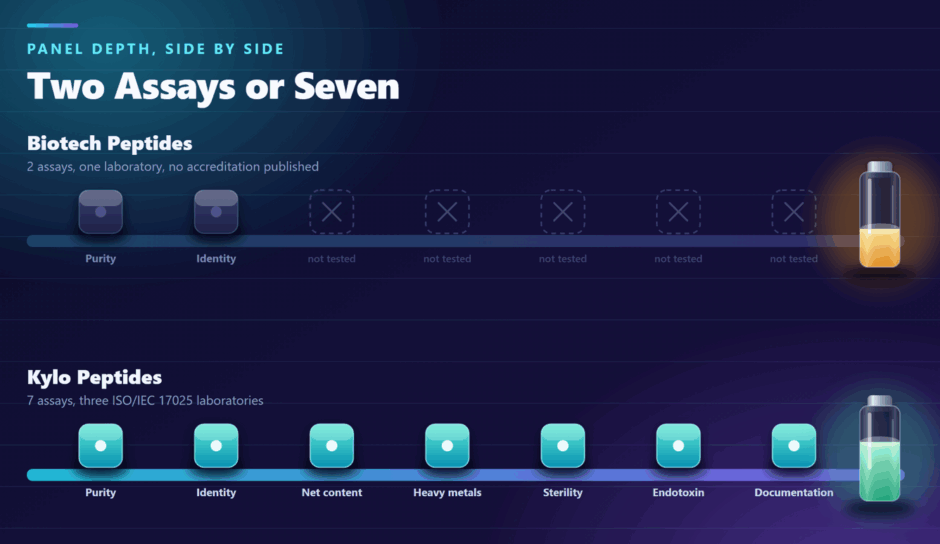
The panel runs deeper too. Seven assays cover every batch across three independent laboratories: Janoshik Analytical, Freedom Diagnostics, and Vanguard Laboratory. Each document lists an identifier the issuing lab will confirm if you ask.
Recourse is the other difference. A 30-day money-back guarantee covers a wrong item, a broken vial, or a certificate mismatch.
Biotech Peptides vs Kylo Peptides: Which One Is Better?
Neither supplier wins outright, and your choice depends on which axis matters most in your work. Documentation depth points one way while catalog breadth points the other. Five criteria separate them in practice, and the $2 price gap is not one of them.
- Choose on documentation. Kylo publishes seven assays across three accredited labs, with the certificates on each product listing. Biotech publishes two from a single lab, with no accreditation listed.
- Choose on catalog. Biotech is the broader shelf for anything unusual. Follistatin-344, FOXO4-DRI, ARA-290, and B7-33 are stocked, and 16 blends cover combination work.
- Choose based on purchasing experience. Kylo holds the lower free-shipping threshold at $150, a later cutoff at 2 PM PST, and live chat. Biotech answers the phone and replies to texts.
- Choose on transparency. Kylo names its labs and publishes verification keys. Biotech names its lab and analyst, then stops short of accreditation details and posts uneven lot data.
- Choose on research requirements. Work needing sterility or endotoxin data will not find it on a Biotech certificate. Work needing a rare compound may not find it at Kylo.
If you’re optimizing for certificate timing and panel depth, put Kylo beside your current supplier before you place the next order.
Is Biotech Peptides Legit?
The evidence supports a real, operating supplier, but two gaps limit how much an outsider can verify independently. Here is how the company scores against the seven checks that matter most for legitimacy, and where each one runs out.
- Business presence. A street address, a working phone line, and a support email, all published.
- Product catalog. 89 live listings, each with its own specification page.
- Research-use labeling. Site-wide, and reinforced by an entry gate.
- Testing documentation. Genuine third-party certificates, downloadable and verifiable.
- Customer review: no live independent platform, and no on-site ratings.
- Contact information. A named street address and a line taking calls and texts.
- Ordering transparency. Payment options hidden until the site agreement is accepted.
One compliance detail is untidy. The entry gate restricts the site to research professionals aged 21 or over, while the terms set the minimum at 18. Both run at once, suggesting policy pages that have drifted apart.
Is Biotech Peptides Safe for Research?
Read “safe” here as “safe to rely on,” since these are laboratory materials and nothing else. The certificate settles identity and purity, then stops at five questions your own protocol still has to answer before the material is fit to use.
- What the certificate settles. Identity against a reference mass, and peptide purity by peak area.
- What it leaves to you. Sterility and endotoxin, which a lab doing cell work commissions itself.
- Net content is not reported. Without a measured peptide mass per vial, concentration after reconstitution is guesswork.
- The purity figure is narrower than it looks. It measures peak area on a chromatogram, leaving the vial’s peptide mass unstated.
- Storage is undocumented. Handling parameters come from the compound literature.
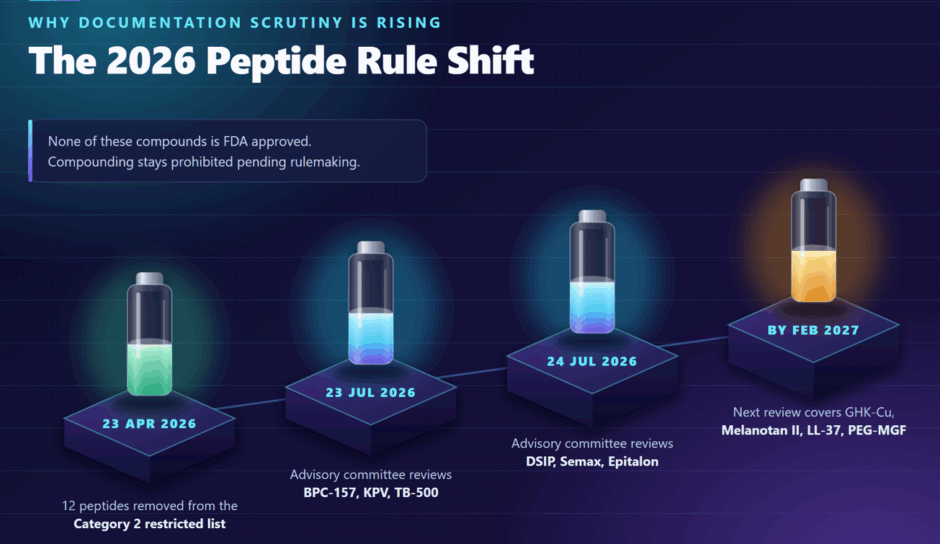
- Regulatory footing. The FDA has approved none of these compounds, and compounding them remains prohibited pending rulemaking.
Material sold on this basis belongs in in vitro research only.
What to Check Before Ordering From Any Peptide Supplier
Eight checks separate a supplier who tests every batch from one who tested once and kept reusing the paperwork. Work through them in the order below, because the first does most of the work and the next seven refine the answer.
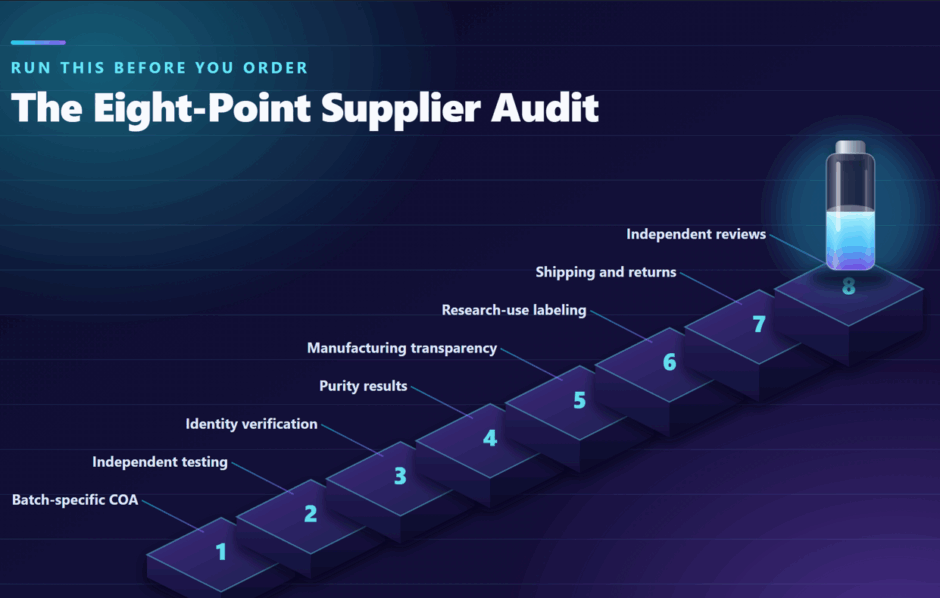
- Batch-specific COA. Find the certificate and look for a lot number. Without one, it cannot be tied to your vial, so it proves nothing.
- Independent testing. Check who commissioned it. A named external laboratory outweighs an in-house result, and ISO/IEC 17025 accreditation outweighs both.
- Identity verification. Look for mass spectrometry confirming molecular weight. Purity without identity says a vial is 99% pure of something unnamed.
- Purity results. Ask for the chromatogram behind the percentage. Peak areas show how they reached the number.
- Manufacturing transparency. Look for where synthesis happens and who performs it. Absence is common, but limits verification.
- Clear research-use labeling. Check for consistent language across product pages, terms, and checkout. Inconsistency signals unmaintained pages.
- Shipping and return policies. Read the returns terms before ordering, and find out who absorbs the loss when a shipment arrives damaged.
- Independent customer reviews. Check whether a live third-party profile exists. A removed one is itself information.
Scrutiny is rising for good reason. Those July 2026 advisory sessions covered compounds sold widely here, putting supplier paperwork under more pressure.
Analyst’s Note
Checking one repays the effort of the other seven combined, and it takes seconds. Match the lot number on the certificate to the number on the vial. A supplier keeping that discipline hands you something verifiable without trusting them, the strongest position a buyer can hold.
Frequently Asked Questions
Is Biotech Peptides legit?
The business is real and reachable. Read the terms first: they reserve the right to refuse any sale for any reason, and they put the legality of possession in your jurisdiction entirely on you.
Does Biotech Peptides provide COAs?
Yes, and each carries a QR code labeled “PROOF OF AUTHENTICITY” plus the lab’s contact details. That lets you confirm the document directly with MZ Biolabs, which is worth using when a file has no test date.
Is the advertised purity the same as the tested purity?
No. The product image advertises “PURITY > 99%” as a standing claim across the catalog, while the certificate reports 99.94% for one dated lot. The claim is a specification; the certificate is the evidence for a specific batch.
Is MZ Biolabs an accredited laboratory?
Its website advertises mass spectrometry services but doesn’t publish an ISO/IEC 17025 accreditation. That doesn’t mean the results are wrong. It does mean the lab’s methods lack an accreditation you can look up and verify.
How does Biotech Peptides compare with Kylo Peptides?
The difference is how much you can check before ordering. Kylo publishes a lot-matched certificate for every released batch, names the issuing laboratory on each one, and states storage parameters on the listing: minus 20C lyophilized, 2 to 8C reconstituted, with refrigerated shipping at $9.99. Biotech Peptides published none of those three on the pages we checked.
What should I look for in a Biotech Peptides review?
Check whether the reviewer opened a certificate. Any review quoting a purity percentage with no lot number, test date, or laboratory name simply takes the vendor’s word for it.
Biotech Peptides Review: Final Verdict
Catalog breadth and product-page documentation are what this supplier does well. The 89-product range reaches compounds most rivals skip, the specification detail beats nearly everything else in the category, and the certificates are real, downloadable, and signed by a named analyst at a named laboratory.
Three drawbacks matter. The panel covers two assays, lot data varies between certificates, and the no-returns policy leaves the buyer carrying the risk.
No Biotech Peptides review can make that trade for you. If you want the certificate published before you order, Kylo Peptides is worth comparing on your next purchase.
Disclaimers
Research use only. All products discussed are sold for laboratory and research use, not for human or veterinary consumption. Nothing here is medical advice, and no statement should be read as a claim to diagnose, treat, cure, or prevent disease.
Regulatory status. The U.S. Food and Drug Administration has not approved any compound named here for use in people.
Related posts:





Stay updated, free articles. Join our Telegram channel

Full access? Get Clinical Tree


