Written by Alan Whitfield. Fact-checked by Sherry Harrison
Peptides are short chains of amino acids that act as building blocks for essential skin proteins like collagen.
While mostly known for anti-aging, specific antimicrobial and anti-inflammatory peptides help calm active breakouts, reduce redness, and support the healing of acne scars without the irritation caused by traditional acne drugs.
Researchers became interested in peptides for acne because they act as signals and opened research across several paths at once: inflammation, microbe defense, the skin barrier, collagen, and repair.
The names that come up most often in acne-related studies are KPV, copper peptides such as GHK-Cu, antimicrobial peptides, and repair peptides including BPC-157 and thymosin beta-4.
Top Peptides for Acne-Prone Skin: Quick Comparison Table
Here is how acne peptides line up against what research actually studies:
| Peptide | Primary Research Focus | Acne-Related Research |
| KPV | Inflammation signals | Strongest tie to inflammation and redness |
| BPC-157 | Tissue repair and recovery | General repair work, not acne-specific |
| TB-500 / Thymosin Beta-4 | Cell movement and wound repair | Wound and scar models, no acne trials |
| Copper Peptides (GHK-Cu) | Collagen and matrix rebuilding | Post-acne repair and scar research |
| Antimicrobial Peptides | Microbe defence | Direct work on acne bacteria |
| Palmitoyl Peptides | Cosmetic signalling | Soothing and barrier formula research |
| Acetyl Tetrapeptide-15 | Skin comfort and reactivity | Sensitivity and redness formula research |
The short version:
- KPV has the strongest tie to the inflammation and redness angle.
- BPC-157 and TB-500 / Thymosin Beta-4 belong to broader tissue recovery work.
- Copper peptides anchor the collagen and skin-repair side.
- Antimicrobial peptides are the only group studied against acne bacteria.
What Are Peptides?
Peptides are short chains of amino acids that work as messengers between skin cells. Skin research describes them as ingredients that build collagen, support cell growth, or lower inflammation.
Peptides vs. Proteins
Both peptides and proteins are chains of amino acids, and the only real difference between them is length. A peptide typically runs from two to about fifty amino acids, while a protein runs longer than that, often into the hundreds or thousands. Collagen, for example, is a protein built from more than a thousand amino acids.
Proteins are long enough to fold into fixed three-dimensional shapes, which is how they form structure such as skin, hair, and muscle. Peptides are too short to fold that way, so they work as signals instead, fitting into receptors and telling cells what to do.
Why Peptides Matter in Skin Research
Researchers study peptides in skin because they carry instructions from one cell to another. Five of those roles are relevant to acne:
- Cell instructions: A peptide carries a message that switches a process on or off, such as telling a cell to make more collagen.
- Inflammation: Some peptides reduce the cytokines behind redness and swelling, which is the route most acne research follows.
- Collagen and the matrix: Others signal fibroblasts to build collagen and the surrounding proteins that keep skin firm.
- Wound repair: Several studies on healing look at how peptides affect cell movement and how quickly a wound closes.
- Barrier strength: Researchers study carrier peptides for how well the outer layer holds moisture and blocks irritants.
Why Peptides Are Being Studied for Acne
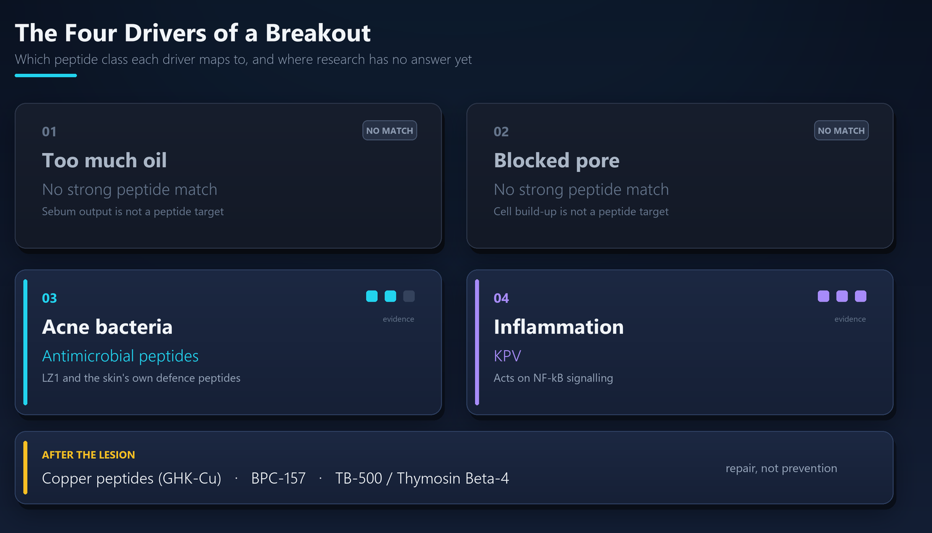
Acne is driven by four separate processes. Because different peptides act on different processes, researchers can test each one against a single part of the problem instead of the whole condition.
That is why peptides are a research category rather than one acne treatment. The peptide studied for inflammation and the peptide studied for bacteria are unrelated compounds, and the only thing they share is being short chains of amino acids.
What Causes Acne and Why Inflammation Matters
Acne research keeps returning to the same four major factors, which include:
- Androgen-driven oil production
- Thickened cell buildup inside the pore
- Growth of Cutibacterium acnes
- Inflammation.
These four rarely act alone, since each one sets up the conditions for the next, and inflammation is the stage where visible damage begins.
Excess Sebum Production
Oil glands make sebum that keeps skin flexible, but androgens can push them to produce more than the skin needs. The surplus leaves too much oil on the skin and can block pores.
Clogged Pores and Follicular Blockage
Skin sheds cells all the time, and trouble starts when keratin and dead cells build up faster than they clear. These cells then mix with oil until they block the pore and form a raised pimple. That blocked pore makes the oily pocket where inflamed lesions grow.
Cutibacterium acnes and the Skin Microbiome
C. acnes lives on almost everyone’s skin without causing problems, and trouble begins only when the pore changes in ways that let certain strains multiply. The bacterium is not simply an invader to wipe out, because it belongs to a wider microbe community that carries costs when cleared.
Inflammation and Acne Breakouts
Once C. acnes multiplies, the immune system responds. Research describes at least four routes involved, including toll-like receptors, inflammasome activation, enzyme release that breaks down matrix, and the skin’s own antimicrobial peptide activity.
Cytokines then flood the tissue around the pore, leading to the redness, swelling, soreness, and raised bump most people know as a breakout.
What Happens After an Acne Lesion?
When the lesion clears, the tissue underneath doesn’t return to its original state. Lingering inflammation can leave redness or dark marks that last for months, long after the spot itself has gone.
Deeper lesions damage the collagen below the surface. The skin rebuilds that collagen, and when it rebuilds unevenly, it forms a scar.
How Could Peptides Help With Acne?
Peptide research in acne follows the biology closely, so each of the four drivers has its own line of work. The peptides studied against one driver are rarely the same as those studied against another. This is why the category resists a simple verdict.
Peptides and Inflammatory Signaling
Inflammation is the driver most peptide research targets. Cytokines and pathways such as NF-kB carry the signals that turn a blocked pore into a swollen lesion. Some peptides are studied for their effect on those steps.
Antimicrobial Peptide Research
Skin already makes antimicrobial peptides as part of its defense. Researchers designed short peptides that act directly on microbes. These break down bacterial membranes instead of blocking a single metabolic step, so bacteria find them harder to adapt to.
Peptides and Skin Barrier Function
A weak barrier loses water and reacts to almost everything. Researchers study carrier peptides for barrier strength, moisture, and the lipid layer that holds it together. This is important for a simple reason: many standard treatments strip the barrier, and sore skin reacts more.
Peptides and Tissue Repair
Repair research covers what happens after the lesion, where fibroblast activity, collagen, and matrix rebuilding decide how well skin recovers. Several peptides show up in wound-healing work for these exact steps, with recovery rather than bacteria as the focus.
Peptides and Acne-Related Redness
Redness is part inflammation and part reactivity, because skin inflamed again and again stays sensitive and flushes easily. The peptides studied here are the same ones studied for inflammation signals, since redness tracks those paths rather than forming its own.
Peptides Being Studied for Acne and Skin Health
Among the peptides discussed for skin, KPV has drawn the most attention in research on inflamed skin. It is small and well described, and researchers have mapped its mechanism in unusual detail for a compound of its size.
#1. KPV Peptide
Alpha-MSH is a hormone that does two jobs at once: it drives pigmentation, and it calms inflammation. Researchers wanted the second without the first, so they cut the molecule back to its final three amino acids, lysine, proline, and valine, and found the calming activity survived the trim. That fragment is KPV, the shortest compound in this article and one of the better characterized for its size.
Almost everything known about it comes from gut and immune-cell models rather than skin. Carry that into any acne claim you read, because the pathway overlap is genuine while the tissue is not the same.
- Studied for its effect on NF-kB and MAP kinase, the signaling routes that switch inflammatory genes on
- Reported active at nanomolar concentrations, which points to a targeted signaling effect rather than a blunt chemical one
- Enters cells through PepT1, a transporter for small peptides found on immune cells and lining cells, which is why gut models dominate the literature
- Acne inflammation runs through the same NF-kB pathway, and that overlap is the honest basis for the interest.
#2. BPC-157
BPC-157 turns up in almost every peptide conversation, acne included, and its research record has nothing to do with skin. The 15-amino-acid sequence comes from a protein found in human gastric juice, and the published work follows tendons, ligaments, muscle, and gut tissue through repair in rodent models.
It sits on this list on the strength of the repair angle alone, since recovery is one of the four processes acne touches. Anyone presenting it as an acne compound has gone past what the research says.
- Covers general tissue repair across several tissue types, with recovery as the endpoint
- Almost entirely animal work, with human data thin to absent
- FDA’s April 2026 update moved it into the withdrawn-nominations table on the interim 503A list, placing it outside the compounding pathway
- No acne studies, no scar studies, and no dermatological endpoints of any kind
#3. TB-500 and Thymosin Beta-4
Thymosin beta-4 is a 43-amino-acid peptide that binds actin and helps cells move, and it shows up in wound-healing research for exactly those functions. TB-500 is sold as a synthetic version, though the material shipped under that name is often a shorter fragment rather than the full sequence.
Wound models are where the interesting numbers sit. Re-epithelialization, the process of new skin closing over a wound, has been reported at roughly 42% above controls after four days and as much as 61% after seven.
- Studied for cell migration, actin regulation, and how quickly a wound closes
- Sits on the recovery side of the acne timeline, well after a lesion has formed
- Evidence comes from animal wound models and cell culture
- Check sequence length on the certificate of analysis, since TB-500 and thymosin beta-4 get treated as interchangeable and are not always the same material
#4. Copper Peptides and GHK-Cu
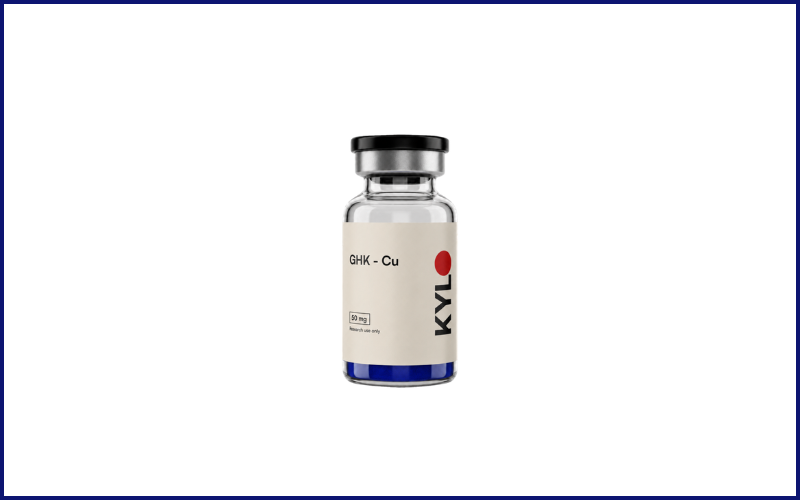
Copper peptides are the best-understood repair compounds here and the hardest actually to get into skin. GHK is a tripeptide of glycine, histidine, and lysine, and GHK-Cu is what forms when it binds copper. Research puts it at the center of fibroblast activity, collagen production, and how the matrix around cells reorganizes after damage, which is why it surfaces whenever post-acne marks and scarring do.
The limits rarely make it into skincare copy, and they are structural rather than minor.
- Studied for collagen synthesis, fibroblast signaling, and extracellular matrix rebuilding
- Relevant to what happens after a lesion clears rather than to the lesion itself
- Sold both as a cosmetic ingredient and as research-grade material, under very different rules
- The copper complex is unstable, because copper reacts readily with whatever surrounds it.
#5. Antimicrobial Peptides
Your skin already makes these. Antimicrobial peptides are part of its standing defense, and the synthetic versions researchers design copy a system that was there all along. The method is what makes them interesting: rather than blocking one metabolic step the way a conventional antibiotic does, they directly break down bacterial membranes, which bacteria find much harder to adapt to.
This is the only group here studied against acne bacteria rather than a downstream process. LZ1, a 15-amino-acid peptide examined in a 2013 PLoS ONE paper on inflamed acne, is the worked example.
- Act on microbial membranes directly rather than on a single metabolic target
- The most direct line to acne biology of any group in this article
- Membrane disruption is harder for bacteria to develop resistance against
- The skin’s own antimicrobial peptide activity is itself one route by which C. acnes triggers inflammation, so more activity is not automatically better
#6. Palmitoyl Peptides
The name tells you what the ingredient is for. Palmitoyl is a fatty acid chain bolted onto a short peptide, and its whole job is delivery: it makes the molecule lipid-soluble enough to cross the outer skin layer that blocks water-loving peptides like GHK. Palmitoyl pentapeptide-4, palmitoyl tripeptide-1, and palmitoyl tetrapeptide-7 are the ones you will meet on an ingredient list.
These are cosmetic ingredients sold inside finished products, which puts them under a different set of rules from everything else here.
- Formulated for cosmetic signaling, barrier support, and how a product performs on skin
- Reach acne indirectly, through comfort and barrier condition rather than lesions or bacteria.
- The fatty acid chain solves a delivery problem and adds no activity of its own
- Much of the supporting data comes from ingredient suppliers rather than independent laboratories.
#7. Acetyl Tetrapeptide-15
This is the thinnest entry on the list, and that’s more useful than padding it out. Acetyl tetrapeptide-15 is a cosmetic ingredient built for sensitive and reactive skin, aimed at the discomfort and flushing that come with an easily provoked barrier. It reaches acne through that reactivity angle, since skin inflamed over and over stays touchy long after individual spots clear.
The catch is where its evidence comes from.
- Used at low percentages in sensitive-skin formulations
- Targets reactivity and sensory discomfort rather than any of the four acne drivers
- The most indirect connection to acne of the seven compounds here
- Available data is overwhelmingly manufacturer-generated, with very little independent peer-reviewed work behind it
Kylo Peptides, for instance, supplies these peptides at 99% or higher purity by HPLC, with identity confirmed by LC-MS and testing run across three ISO/IEC 17025-certified laboratories, namely Janoshik, Vanguard, and Freedom Diagnostics. Check the lot number on the COA against the vial in your hand, because a generic document reused across batches tells you nothing about the material you received.
Peptides for Different Acne-Related Skin Concerns
Different acne concerns map onto different areas of research. Matching the concern to the right group is more useful than asking which peptides are best for acne overall. The five concerns below cover most of what people are trying to address.
Peptides for Inflammatory Acne
Inflammatory acne means papules and pustules rather than blackheads, and KPV is the peptide most closely tied to this group through its effect on NF-kB. Inflammation is worth targeting because it creates the swelling and soreness people want gone, and because it drives the damage that lingers after the lesion fades.
Peptides for Acne-Related Redness
Redness research overlaps heavily with inflammation research, so KPV appears here for the same reasons while copper peptides appear for their repair activity. Barrier work forms a third thread, since weakened skin flushes more easily.
Peptides and Microbial Balance
Antimicrobial peptides belong squarely in this group, and LZ1 is a concrete example. It is a 15-amino-acid peptide studied for inflamed acne in a 2013 PLoS ONE paper, and it works by breaking down bacterial membranes.
One complication is worth knowing, because the skin’s own antimicrobial peptide activity is itself a route through which C. acnes triggers inflammation. More activity is not automatically better.
Peptides for Post-Acne Skin Recovery
Copper peptides lead this group, which is why copper peptides and acne scars come up together so often. GHK-Cu, the complex formed between the tripeptide GHK and copper, drives fibroblast growth, collagen building, and matrix rebuilding in skin-repair research.
Repair peptides appear alongside it. Thymosin beta-4 is a 43-amino-acid peptide, and in wound models it increased re-epithelialization by 42% over controls at four days and by as much as 61% at seven days.
BPC-157 shows up in similar repair work. Neither compound has been tested on acne itself.
Copper peptides also have limits that rarely make it into skincare copy. Tripeptides last under roughly 30 minutes in plasma. The copper complex is unstable because copper reacts readily, and skin absorption is poor because the compound holds water so strongly.
Peptides and Acne Scarring Research
Scarring is a structural problem rather than an inflamed one, involving collagen rebuilding and how the matrix repairs after damage. Here lies the clearest dividing line in the topic. Work aimed at an active breakout targets signals and microbes, while work aimed at a scar targets rebuilding.
Peptides vs. Conventional Acne Ingredients
Conventional acne ingredients and peptides aren’t rivals in the same category, since they act at different points in the process. The comparison below matches each approach to the mechanism research supports, which is a fairer test than asking which ingredient wins.
| Approach | Primary Research Focus |
|---|---|
| Retinoids | Cell turnover and comedonal pathways |
| Salicylic acid | Exfoliation and pore-related mechanisms |
| Benzoyl peroxide | Antimicrobial activity |
| Peptides | Cellular signaling and skin-response pathways |
| Antimicrobial peptides | Microbial defence |
| Copper peptides | Repair and extracellular-matrix signaling |
| KPV | Inflammatory signalling |
Why Peptides Are Different
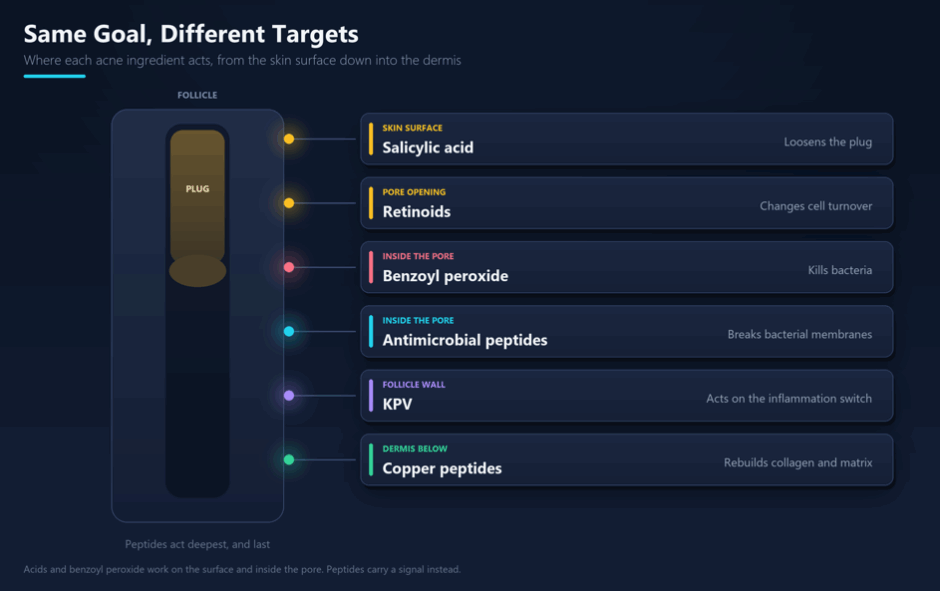
Retinoids, acids and benzoyl peroxide act on the surface or inside the pore by changing turnover, clearing debris or killing bacteria. Peptides carry a signal instead, and that difference in method explains the difference in targets.
One peptide may act on inflammation, another on microbes, and a third on repair, with no shared mechanism linking them. It follows that you should never judge the category as a whole, because asking whether peptides work for acne is like asking whether vitamins work.
The Skin-Recovery Side of Peptide Research
Much of peptide research on skin has nothing to do with stopping breakouts. It covers what happens afterward, once inflammation has settled and the tissue has to rebuild itself. This half of the work gets far less attention than it deserves.
From Active Breakout to Skin Recovery
The sequence tends to run in a set order:
- A lesion forms as a blocked pore becomes inflamed.
- Inflammation peaks, with cytokines and immune cells flooding the area.
- Tissue is damaged, as collagen and nearby structures take collateral harm.
- Recovery begins once inflammation settles, and cells start rebuilding.
- Rebuilding continues as repaired tissue reorganizes over weeks or months.
Attention usually goes to the first two steps, yet steps four and five decide what skin looks like a year later.
Collagen and the Extracellular Matrix
Fibroblasts build and maintain skin structure, making collagen and other proteins that form the matrix around cells. Rebuilding means that matrix is broken down and laid down again. When the process runs unevenly after an inflamed lesion, surface texture changes for good.
Why Skin Recovery Matters
Acne rarely leaves skin exactly as it found it. Redness and dark marks can outlast the lesion by months, and structural change can turn into scarring. Peptide research therefore reaches well beyond active breakouts, with much of the work focused on repair quality rather than lesion count.
Why Research-Grade Peptide Quality Matters
Peptide research depends on knowing what is really in the vial, because two samples with the same label can differ in identity, purity, and content. Any one of those gaps can change a result, making paperwork part of the science.
Identity and Purity
Identity confirms the material really is the compound on the label. Mass spectrometry checks the measured mass against the mass expected for that sequence. Purity is a separate question: how much of the sample is the target compound versus impurities.
Batch consistency ties the two together. A supplier running the same route under the same conditions makes material that behaves the same from lot to lot.
Why a Certificate of Analysis Matters
A certificate of analysis records those measurements for one specific batch, and a useful one covers several things:
- Identity testing, confirming the compound against its expected mass
- Purity testing, usually reported as an HPLC percentage
- Batch-specific data, tied to one lot rather than the product in general
- Traceability so that the certificate can be matched back to the vial in hand
The batch-specific part carries the real weight, since a generic certificate copied across every lot tells a researcher nothing about the material received.
Kylo Peptides and Research Documentation
Kylo Peptides is one example of the growing focus on traceability across this field. Every lot’s certificate is published on its product page and matched to the lot number printed on the vial. Each also carries a unique identifier from the testing lab,
which you can verify directly with that lab.
What Makes Peptide Research Interesting for Acne?
Peptide research is interesting for acne because it treats the condition as several linked problems rather than as one. That framing matches how acne behaves, and the three angles below show why this field is worth following closely.
Multiple Biological Targets
The research spreads across five areas:
- Inflammation and cytokine signals
- Microbe activity and the skin microbiome
- Barrier strength and moisture
- Tissue repair and recovery
- Collagen rebuilding and matrix structure
Different Peptides, Different Mechanisms
Each compound belongs to its own lane:
- KPV to inflammation research
- Copper peptides to matrix and repair
- Antimicrobial peptides to microbe defense
- BPC-157 to tissue-repair research
- TB-500 / Thymosin Beta-4 to cell recovery
From Treating the Pimple to Understanding the Skin
Traditional acne care measures success by lesion count, while peptide research follows a longer arc running from active acne through inflammation and tissue damage into recovery.
Side Effects and Safety
Peptides for acne don’t fall into a single safety category, so the honest answer depends entirely on the form in front of you. Cosmetic serums and research-grade materials carry very different risks, and the points below separate the two first.
Cosmetic peptide formulations. These are usually well tolerated, though tolerance is never universal. Patch-testing a new product before using it widely remains sensible, above all on skin already sore from acne treatment.
Layering caution. Copper peptides are delicate because copper reacts readily with its surroundings. Don’t use them in the same step as strong acids or high-strength exfoliants.
Research-grade materials. Compounds sold for lab research are not approved for human use, and they are not meant for self-administration. That covers KPV, BPC-157, and thymosin beta-4 in their research forms. The current literature cannot answer questions about KPV peptide side effects in people.
The evidence gap. Few of the peptides discussed for acne have been through large human trials. Mechanism research and wound-model data are interesting, but neither amounts to clinical proof.
Anyone with lasting or scarring acne should work with a dermatologist, and the American Academy of Dermatology publishes guidance on evidence-based care.
Frequently Asked Questions
Can peptides help with acne?
Research tests different peptides against different parts of acne biology, and mechanistic evidence does exist for several, mostly around inflammation. Large human acne trials still don’t exist for most, so the question remains open rather than settled.
What is KPV peptide?
KPV is a tripeptide of lysine, proline, and valine, and it is the tail end of alpha-melanocyte-stimulating hormone. Researchers isolated it because it retains the larger hormone’s calming activity in a compound simple enough to make and verify easily.
Why is KPV being studied for inflammatory skin conditions?
KPV shows proven activity on NF-kB and MAP kinase signals at very low amounts. Because those pathways carry inflammatory signals across many tissues, not just skin, KPV appears in research spanning the gut, airway, and skin.
Are copper peptides relevant to acne scars?
Copper peptide research covers fibroblast activity, collagen building, and matrix rebuilding, which are the processes behind scar formation, so the link is reasonable. Delivery limits, including poor skin absorption and an unstable copper complex, do complicate practical use.
What are antimicrobial peptides?
Antimicrobial peptides are short chains that act on microbe cell membranes directly rather than blocking a metabolic step. Skin makes them naturally as part of its own defense, and researchers have designed synthetic versions, including LZ-1, aimed at acne bacteria.
Are BPC-157 and TB-500 researched for skin repair?
Both appear in the tissue-repair literature, and thymosin beta-4, the parent compound of TB-500, has shown effects on re-epithelialization in wound models. Neither has been studied for acne, and both remain research materials rather than approved treatments.
What is a peptide COA?
A certificate of analysis records what testing found in one specific lot. It usually reports identity by mass spectrometry, purity by HPLC and net content, and it should trace back to the lot number on the vial.
Final Words
Peptides for acne are best understood as a research category spanning several factors. KPV holds the clearest link to inflammation, copper peptides anchor the repair and collagen side, and antimicrobial peptides are the only group studied against acne bacteria.
The honest summary is that mechanism work runs well ahead of clinical work, because the pathway evidence is real and specific while human acne trials remain thin. For anyone with acne-prone skin weighing the options, that gap is the thing to hold onto.
Read the primary research rather than the marketing, check what each compound has been tested on, and take treatment decisions to a professional.
Disclaimers
Research use only. Peptide materials described here as research-grade, including KPV, BPC-157, and thymosin beta-4, are supplied for laboratory or analytical purposes only. They are not for human or veterinary use and are not intended for self-administration.
Related posts:






Stay updated, free articles. Join our Telegram channel

Full access? Get Clinical Tree


