By Willie Witchwicky. Reviewed by Matt Gilbert
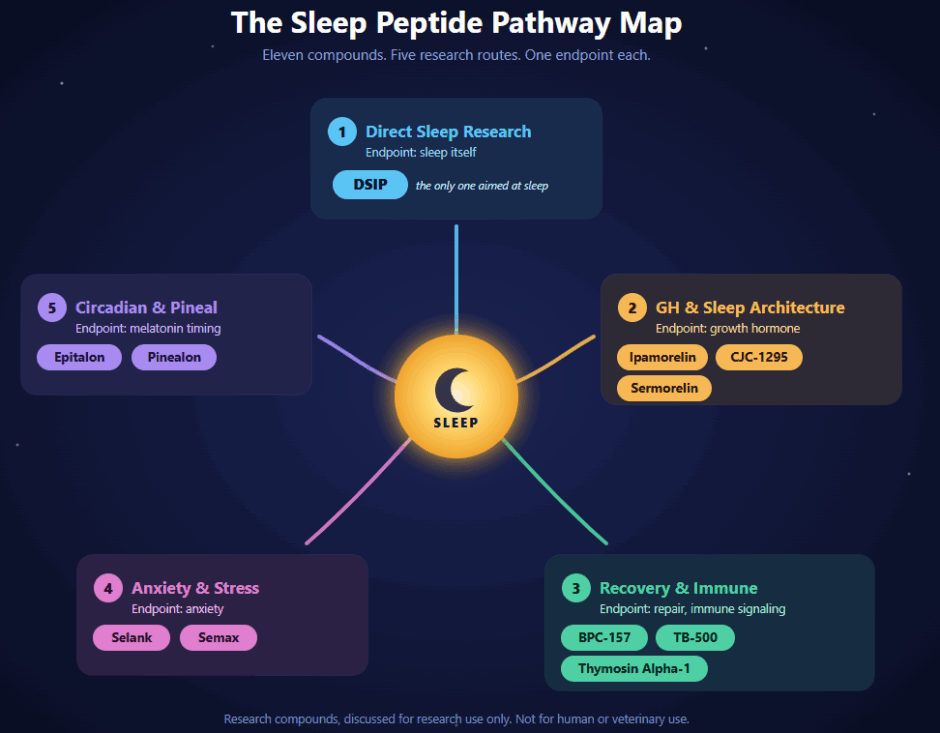
The best peptides for sleep fall into five pathway families: direct sleep signaling, growth hormone, circadian timing, stress and anxiety, and recovery and immune signaling. Researchers have investigated eleven compounds across those five routes.
These are Ipamorelin + CJC-1295, Selank, Sermorelin, DSIP, Epitalon, Pinealon, Semax, BPC-157, TB-500, and Thymosin Alpha-1.
Only one has ever been studied with sleep itself as the measured outcome. The rest are inferred from a mechanism-based hypothesis.
How We Evaluated the Best Peptides for Sleep
Four filters decide where each compound lands: whether its mechanism genuinely touches sleep, how good the evidence is, which outcome the study measured, and what the research leaves open.
Mechanistic Relevance
The first filter asks whether a compound acts on a system sleep runs on: sleep architecture, GH signaling, slow-wave sleep, GABA pathways, circadian signaling, pineal biology, or the stress axis.
Evidence Quality
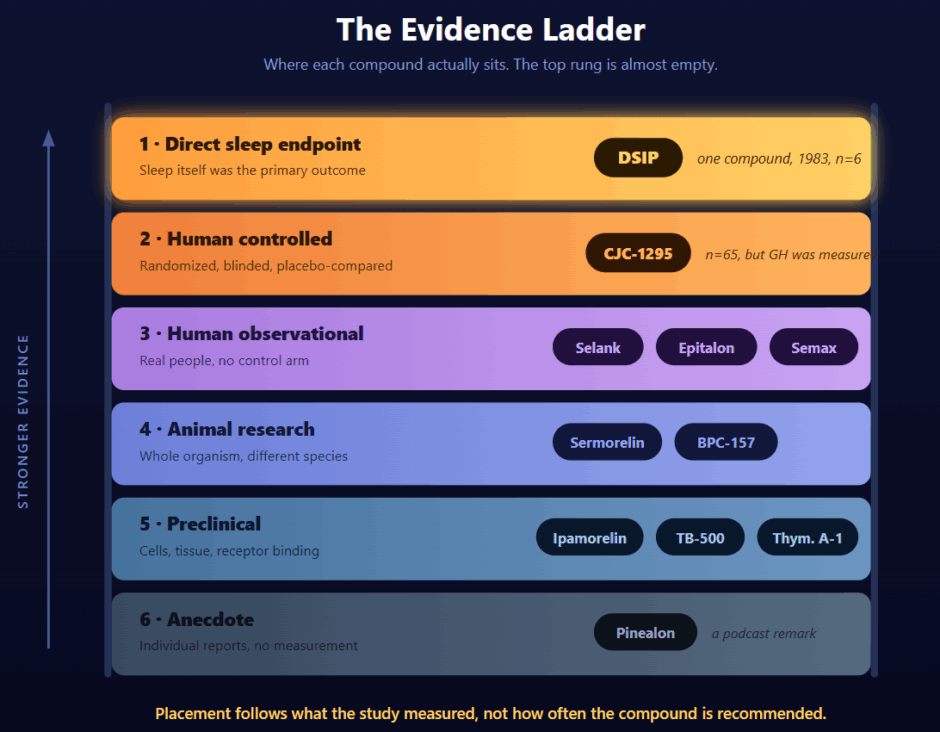
The second filter is a ladder, and most claims in this category sit near its bottom. The rungs run from strongest evidence down to weakest:
- Direct sleep endpoint
- Human controlled
- Human observational
- Animal research
- Preclinical
- Anecdote
Call it the Evidence Ladder. Place the eleven on it, and the field’s shape appears: DSIP alone reaches rung 1, CJC-1295 holds a rung-2 trial that measured hormones, Selank and Epitalon sit at rung 3, Pinealon rests on rung 6.
Sleep Outcomes Measured
Sleep outcomes in this literature include sleep onset, latency, duration, continuity, slow-wave depth, REM proportion, awakenings, and circadian timing. IGF-1, a hormone that rises with growth hormone, stands in as a surrogate when sleep itself was never recorded.
Research Limitations
Small samples are the most common constraint, followed by limited replication, short follow-up, shifting regulatory status, and variable material quality. Nearly every compound carries several of these limitations.
Best Peptides for Sleep
The peptides studied for sleep come down to eleven compounds, connected through five separate biological routes, and they are not interchangeable. Melatonin timing and slow-wave depth are different questions, so a compound chosen for one will not answer the other.
- Ipamorelin + CJC-1295: GH and Sleep Architecture Research
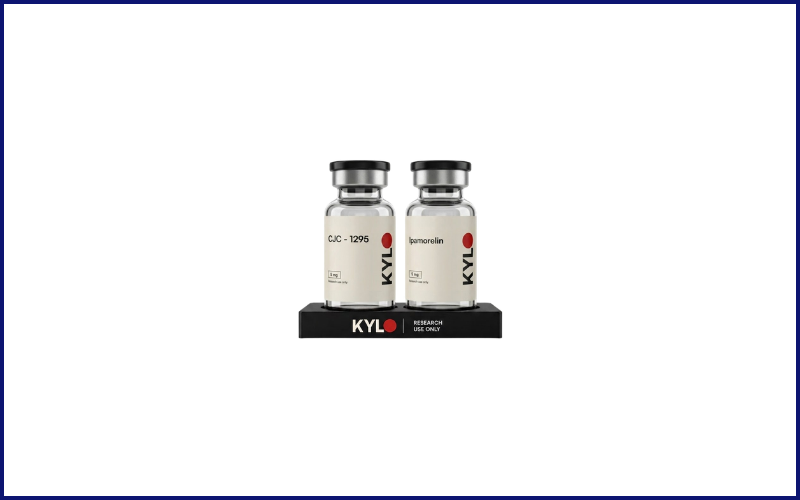
Ipamorelin is a five-amino-acid secretagogue, a compound that prompts the pituitary to release a hormone it already makes, acting on GHS-R1a, the ghrelin receptor. Raun and colleagues characterized it in the European Journal of Endocrinology (1998;139:552-561), finding it released GH without the rise in cortisol and ACTH, the pituitary’s stress-hormone signal, that older secretagogues carried.
How Are They Connected to Sleep?
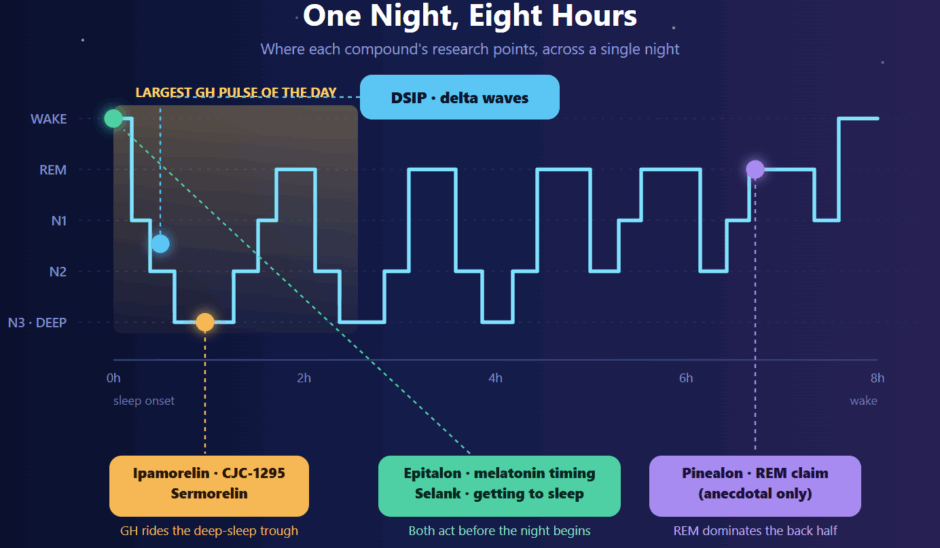
The link is that GH pulses occur during sleep. In 1968, Takahashi, Kipnis and Daughaday measured plasma GH across 38 nights in eight adults and found, in seven, a peak lasting 1.5 to 3.5 hours at the onset of deep sleep. Delay the sleep, and the peak moved.
In men, roughly 70% of GH pulses during sleep coincide with slow-wave sleep, and Van Cauter, Leproult and Plat reported that both decline together with age.
What the Evidence Covers
Teichman and colleagues gave CJC-1295 to 65 healthy adults and reported GH increases of 2- to 10-fold lasting six days or more, IGF-1 increases of 1.5 to 3-fold for 9 to 11 days, and a half-life of 5.8 to 8.1 days (J Clin Endocrinol Metab. 2006;91:799-805). Sleep was not among the endpoints.
- Selank: Anxiety, Stress, and Sleep Research
Selank is a seven-amino-acid chain built from tuftsin, a short immune-signaling peptide the body already makes. Chemists at the Russian Academy of Sciences reworked it to make it last longer in the body, and Russia approved it as a nasal spray for generalized anxiety.
How Is It Connected to Sleep?
Through the anxiety route. Kolomin and colleagues reported in 2018 that Selank modulates GABA receptor binding, the same channel benzodiazepines work through, and affects BDNF, a protein involved in neuron growth. Anxiety is a common reason sleep fragments.
What the Evidence Covers
Small Russian trials describe anxiety relief comparable to benzodiazepines. Sleep was not an endpoint in any of them, which places Selank on rung 3 of the Evidence Ladder.
- Sermorelin: GHRH and Sleep Research
The hypothalamus tells the pituitary to release growth hormone using a signal called GHRH, and the first 29 amino acids of that signal do the work. Sermorelin copies exactly those 29, so it speaks to the pituitary in the body’s own words. It was sold in the United States as GEREF under NDA 20-443, cleared September 26, 1997, and EMD Serono withdrew it in December 2008. The FDA recorded that it was not withdrawn for safety or effectiveness reasons
How Is It Connected to Sleep?
Through GHRH signaling, the closest mechanistic bridge in the GH family.
What the Evidence Covers
A 2004 review found GHRH injections decrease wakefulness and increase slow-wave sleep in rodents and humans, and that sleep-related GH release appears to depend primarily on GHRH. No trial has tested sermorelin itself against a sleep endpoint.
- DSIP: Direct Sleep and Delta-Wave Research
DSIP is a nine-amino-acid chain, sequence Trp-Ala-Gly-Gly-Asp-Ala-Ser-Gly-Glu, pulled from the blood of animals held in slow-wave sleep. The Schoenenberger and Monnier group in Basel ran low-frequency current into the thalamus of rabbits in 1977, drew blood from the brain’s venous outflow, and named what they found for the delta waves they were tracking.
How Is It Connected to Sleep?
Directly. Sleep was the outcome the discovery work was built around, which separates it from every other compound here.
What the Evidence Covers
In a double-blind crossover study of six volunteers, Schneider-Helmert and Schoenenberger reported a 59% increase in median total sleep time versus placebo within a 130-minute window. Kovalzon and Strekalova later called the field “a still unresolved riddle”: the DSIP gene, protein, and receptor have never been isolated, so that 59% has no molecular address.
- Epitalon: Pineal, Melatonin, and Circadian Research
The pineal gland releases melatonin on a daily cycle, and that cycle flattens as people age. Vladimir Khavinson’s group in St Petersburg built Epitalon while studying why. It runs four amino acids, Ala-Glu-Asp-Gly, modeled on peptides found in the gland itself.
How Is It Connected to Sleep?
Through the clock. The nightly melatonin rise sets in when sleep becomes available, and that rise flattens with age.
What the Evidence Covers
Khavinson’s group reported that pineal peptide preparations restore age-related disturbances in pineal hormone function, recovering night melatonin release and normalizing its rhythm. Later work extended it to old monkeys and elderly adults. The outcome measured was the melatonin rhythm, which belongs in a different column from slow-wave depth.
- Pinealon: Pineal and REM-Sleep Research
Pinealon is a three-amino-acid chain of glutamic acid, aspartic acid, and arginine. It came out of the same Khavinson program in St Petersburg that produced Epitalon, built on the premise that very short peptides can reach brain tissue and influence gene expression there.
How Is It Connected to Sleep?
Through the pineal route it shares with Epitalon, and through a widely repeated account from a prominent podcast host describing his own REM sleep.
What the Evidence Covers
A personal report belongs on rung 6 of the Evidence Ladder. The published pineal work on melatonin was done on Epitalon, so check which of the two a study used. The substitution happens often.
- Semax: Neurological and Stress-Related Research
Start with ACTH, the hormone the pituitary releases under stress. Cut away the section that triggers the stress-hormone cascade and keep the section that acts on the brain. What remains is Semax, a seven-amino-acid compound studied for attention and neuroprotection.
How Is It Connected to Sleep?
Indirectly, through the stress axis. Stress-axis activity shapes sleep quality, and Semax acts on that axis.
What the Evidence Covers
Dolotov and colleagues showed it binds specifically and raises BDNF, a neuron-growth protein, in the rat basal forebrain (J Neurochem. 2006). No published trial has measured a sleep outcome.
- BPC-157: Recovery Research and Indirect Sleep Connections
BPC-157 comes up in sleep conversations because people taking it for injuries report sleep changes. A fifteen-amino-acid chain found in gastric juice, studied for gut, tendon, and vascular repair.
How Is It Connected to Sleep?
Indirectly, and only by report. Inflammation and pain both affect sleep, and BPC-157 acts on inflammatory and repair pathways.
What the Evidence Covers
No controlled study has measured sleep as an outcome for BPC-157, in either direction. Forum reports are not measurements. The regulatory record is firmer: the FDA placed it in 503A Category 2 on September 29, 2023, citing possible immunogenicity and peptide impurity complexities.
- TB-500: Recovery and Sleep Research
Thymosin Beta-4 is a full protein involved in cell movement and tissue repair, with its own research literature. TB-500 is seven amino acids long, with the sequence LKKTETQ, the section thought to carry the repair activity. It is supplied on its own, apart from the protein it came from.
How Is It Connected to Sleep?
Through recovery discussions, where it is discussed alongside BPC-157.
What the Evidence Covers
The distinction carries weight. Research exists on the full Thymosin Beta-4 protein, while the short fragment supplied for research is a different molecule with no published human trial. On a sleep question, it sits furthest from the target.
- Thymosin Alpha-1: Immune and Inflammation Research
The thymus trains immune cells, and one of the signals it uses is a 28-amino-acid chain. That chain is Thymosin Alpha-1, a single defined molecule, which separates it from thymalin, a thymus extract carrying many peptides at once.
How Is It Connected to Sleep?
Through two inferences: inflammatory signaling tracks sleep quality, and this compound acts on inflammatory signaling.
What the Evidence Covers
Its clinical footprint is the broadest in this group, and it’s entirely in immunology. No sleep endpoint has been measured, which puts it furthest from the question at hand.
What Are Peptides for Sleep?
Sleep Peptides are short amino-acid chains acting on the systems sleep depends on: sleep signaling itself, growth hormone release, melatonin timing, calming signals, and the repair and immune pathways underneath.
What Are Peptides?
A peptide is a short chain of amino acids, usually two to fifty. Longer chains become proteins and work as messengers: one docks onto a receptor, and the cell changes course.
Why Are Peptides Studied in Relation to Sleep?
Much of the body’s sleep machinery already runs on peptide signals. The research follows five of those systems, and each gives a different family its reason for being studied.
- Growth hormone: The day’s largest GH pulse lands with the first deep sleep, so GH-releasing peptides are studied against that window (Van Cauter, Growth Horm IGF Res. 2000).
- Delta-wave activity: The hunt for an endogenous sleep factor produced DSIP, measured on delta output.
- Melatonin and circadian timing: Researchers study pineal peptides to determine whether they restore the night melatonin rise.
- GABAergic signaling: Peptides that modulate GABA are studied for the anxiety side of broken sleep.
- Stress and repair: HPA-axis and inflammatory signaling track sleep quality, so researchers study peptides that act there as indirect routes.
Why Sleep Peptides Are Not All the Same
Sleep peptides fall into five families, and what separates them is the outcome each was actually measured against. Some were tested on sleep itself, while others were tested on a hormone, a rhythm, or a repair marker, and reached sleep only by inference.
- Direct sleep research: DSIP. The endpoint was sleep itself.
- GH and sleep architecture research: Ipamorelin, CJC-1295, Sermorelin. The endpoint was growth hormone.
- Circadian and pineal research: Epitalon, Pinealon. The endpoint was melatonin timing.
- Anxiety and stress research: Selank, Semax. The endpoint was anxiety.
- Recovery and immune research: BPC-157, TB-500, Thymosin Alpha-1. The endpoint was tissue repair or immune signaling.
How to Choose the Right Sleep Peptide for Research
Begin with the system you want to study, and the shortlist for a sleep peptide mostly builds itself. Five steps take you from a research question to a list you can defend: the question, the pathway, the evidence, regulatory status, and material quality.
1. Start With the Research Question
Your question narrows the field faster than any other filter. Which is it: sleep architecture, slow-wave depth, sleep onset, circadian rhythm, melatonin, anxiety, GH signaling, or recovery?
2. Match the Compound to the Pathway
Once the question is fixed, the pathway map does the sorting.
| Research focus | More relevant compound |
|---|---|
| GH and sleep architecture | Ipamorelin, CJC-1295, Sermorelin |
| Direct sleep and delta-wave | DSIP |
| Circadian and melatonin timing | Epitalon, Pinealon |
| Stress and anxiety pathways | Selank, Semax |
| Recovery, repair, and immune signaling | BPC-157, TB-500 |
| Immune and inflammatory signaling | Thymosin Alpha-1 |
3. Evaluate the Evidence
Ask whether there is human research, whether it was controlled, whether it was replicated, whether the results are consistent, and whether sleep was the primary outcome. That last question reshuffles this list more than any other.
4. Check Regulatory Status
Availability for research and approval for use are two different things, and 2026 was an active year for the difference. On April 15, 2026, the FDA published a notice of intent to remove twelve peptide bulk drug substances from Category 2, including DSIP (as emideltide), Epitalon, Semax, BPC-157, and TB-500.
Removal is not approval. Frier Levitt notes that coming off Category 2 “does not render these bulk drug substances eligible for compounding under section 503A.” The Pharmacy Compounding Advisory Committee met on July 23 and 24, 2026, to consider seven of them for the 503A bulks list.
Ipamorelin acetate was not among the twelve and remains in Category 2, where the FDA has flagged possible immunogenicity risk.
5. Evaluate Research Material Quality
Before a compound enters a protocol, confirm a batch-specific certificate, identity testing, HPLC purity, LC-MS confirmation, heavy-metal screening, sterility and endotoxin data, and independent lab attribution.
Why the Word Best Does Not Settle It
No universal winner exists among the best peptides for sleep, and the ranking flips with the filter. Sleep relevance puts DSIP first; mechanistic strength puts the GH family first; human data puts CJC-1295 first.
Peptides for Sleep vs. Peptides for Recovery
These two literatures measure different things, which is why searches for the best peptides for sleep and recovery return two overlapping lists. The endpoints barely meet, and reading a repair result as a sleep result is the most common error in this category.
| Sleep research measures | Recovery research measures |
|---|---|
| Sleep onset and latency | Tissue repair rate |
| Sleep architecture | Inflammatory markers |
| NREM and slow-wave depth | Exercise recovery |
| REM proportion | Regenerative signaling |
| Circadian timing | Structural healing |
Why Recovery Peptides Appear in Sleep Content
Inflammation and sleep are genuinely linked in the literature, and both BPC-157 and TB-500 act on inflammatory pathways. That bridge is real, and it is why the two names keep appearing here.
Stacking Peptides in Sleep Research
Combining two peptides gets discussed far more often than it gets studied, and that gap is the most useful thing to carry into any combination claim. The pairings below come up repeatedly, and the published evidence thins sharply as soon as a second active compound enters the picture, because nearly all of the sleep research covered so far tested one compound at a time.
Ipamorelin and CJC-1295
This is the most discussed pairing in the category, and the reason is mechanical. Ipamorelin acts on the ghrelin receptor while CJC-1295 mimics GHRH, so the two press on growth hormone release through two separate receptors.
The open question is whether two signals arriving at one system produce something different from either signal alone, and published sleep research has not measured that combination directly.
GH-Related and Anxiety-Related Peptides
Pairing a growth hormone compound with an anxiolytic peptide such as Selank aims at two different reasons a night goes badly. Growth hormone compounds target sleep architecture, meaning how the night divides between light, deep, and REM stages.
Anxiolytic peptides target stress-driven fragmentation, meaning the repeated waking that stress produces. These are separate problems with separate measures, which makes the combination appealing but also hard to read, since an improvement in the sleep record could come from either compound.
Circadian Peptides With Other Sleep Compounds
Timing and depth are different outcomes. A circadian compound aims at when sleep happens, while a GH or delta-wave compound aims at how deep it goes, so combining them covers both. The circadian side has the firmer endpoint. Vladimir Khavinson’s group in St Petersburg reported that pineal peptides restored the daily melatonin rhythm in older monkeys and adults, giving researchers a measurable marker to work from.
Recovery Peptides in Sleep Research
BPC-157 and TB-500 reach sleep through the longest chain of reasoning on this list. Both are studied for tissue repair, and neither has been measured against a sleep endpoint. The argument for including them runs through discomfort, since injury and pain disrupt sleep, so anything that speeds repair might reduce the disruption.
Why Combination Research Is Difficult
Scarcity here has practical causes. Few published studies exist on these pairings, and multiple active compounds mean multiple variables. Attribution becomes difficult, and interaction effects stay open with almost no data.
Sleep Hygiene and Peptide Research
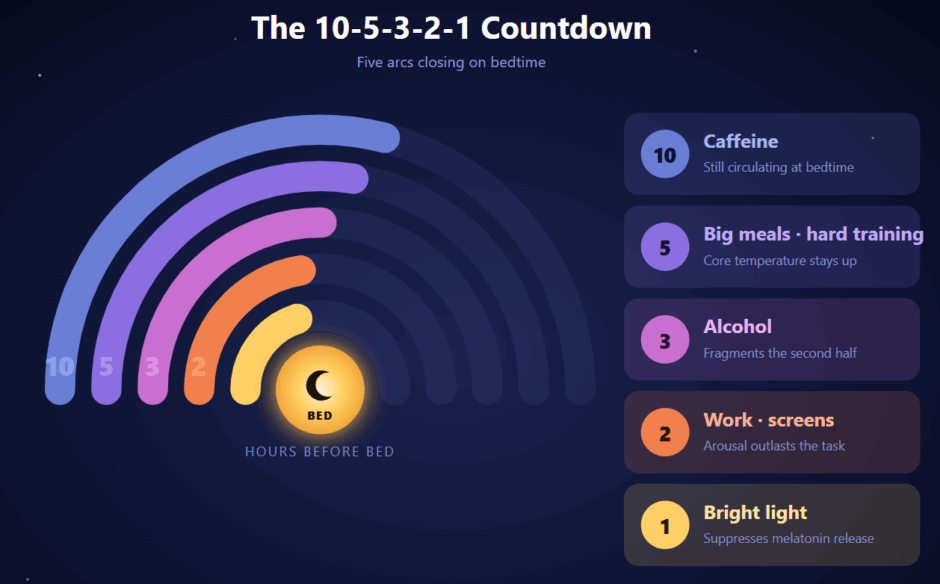
Everyday behavior shifts sleep outcomes on its own, making this a study-design problem. A trial that leaves these variables uncontrolled cannot attribute its results to the compound. The Medical Institute of Healthy Aging frames the core set as a countdown.
10 Hours Before Bed: Caffeine
Ten hours is the buffer because caffeine clears slowly enough to be still circulating at bedtime.
5 Hours Before Bed: Large Meals and Hard Training
Five hours out, the target is core temperature and sympathetic arousal, which a heavy meal and hard training both push the wrong way.
3 Hours Before Bed: Alcohol
Three hours out is about what happens later: the effect on the second half of the night outlasts the drink.
2 Hours Before Bed: Work and Screens
Two hours out, the problem is mental arousal, which keeps running well after you close the laptop.
1 Hour Before Bed: Light
The final hour belongs to light, which interacts with the melatonin signal that starts the night.
Other Sleep Variables Worth Controlling
A consistent schedule, a dark and cool bedroom, morning light, and stress management all shift sleep measurements independently of anything in a vial. Any one of them can outweigh the effect a study is trying to detect.
Are Peptides for Sleep Safe?
Safety for peptides studied in relation to sleep has two halves: what regulators have said about the compounds, and what is known about the material itself. None of the eleven has FDA approval for a sleep indication, and several regulatory positions moved during 2026.
Regulatory Status
The April 2026 notice affected five of these, and removal from Category 2 does not create a compounding pathway on its own
One comparison puts the rest of the analysis in perspective. The only peptide-based medicine with an approved sleep indication is tirzepatide, which the FDA approved as Zepbound on December 20, 2024, for obstructive sleep apnea with obesity. Its evidence was SURMOUNT-OSA (NCT05412004): 469 participants, breathing interruptions per hour at 52 weeks.
That is what a sleep indication costs, and a useful yardstick against best-in-class peptide claims for sleep apnea elsewhere.
Evidence Gaps
The same gaps recur across the eleven: studies are small, human trials are scarce, long-term data is limited, and outside replication is rare.
Research-Material Risks
Immunogenicity is the hazard the FDA has named for BPC-157 and ipamorelin acetate, with peptide-related impurities second. Identity, purity, and batch consistency vary by source and can’t be judged from a vial.
Why COAs Matter in Research Work
A certificate of analysis confirms what a vial holds before it enters a protocol. It reports identity, purity, batch information, and laboratory attribution, plus sterility and endotoxin figures where the research calls for them.
How to Evaluate Research-Grade Peptides
Research-grade peptides are judged on four documented tests, plus the paperwork tying them to your vial: identity, purity, contaminants, and batch traceability. Each answers a question the others cannot, and a certificate missing any one of them leaves a real gap.
Identity Testing
LC-MS confirms the vial contains the molecule on the label by comparing measured mass to the expected mass for that sequence. Every other test depends on it.
Purity Testing
HPLC measures how much of the contents is the target compound, reporting a percentage commonly set against a 99% threshold. Purity confirms composition, and says nothing about what the compound does.
Contaminant Testing
ICP-MS screening covers what should not be there: lead, mercury, arsenic, cadmium. Sterility and endotoxin testing apply where the research requires them.
Batch-Level Testing
A lot number matching the vial makes the other three results verifiable. The certificate also needs a test date and a named laboratory; otherwise, it describes a different batch.
Kylo Peptides
Kylo Peptides supplies research peptides on a documented release rule: a batch is not released for sale until its full test panel is on file. Where a lot is still in testing, the page says so.
The panel runs seven assays across three independent ISO/IEC 17025-accredited laboratories: Janoshik Labs, Freedom Diagnostics, and Vanguard. It reports HPLC-UV purity against a 99% minimum target, LC-MS identity, measured net peptide content, an ICP-MS heavy-metals screen, sterility, USP bacterial endotoxin, and the lot-matched documentation itself.
How to Read a Peptide COA Before Buying
A peptide certificate reads in about a minute, and each section answers one specific question about the material in front of you. Knowing which line carries the most weight saves you from a document that looks complete but isn’t.
| What the certificate line says | What it tells you |
|---|---|
| Product name, lot number, testing date | Whether this document describes your vial or a different batch |
| LC-MS identity, expected vs observed mass | Whether the contents match the labeled sequence |
| HPLC purity percentage | How much of the contents is the target compound |
| Heavy metals: lead, mercury, arsenic, cadmium | Whether contamination screening was run and what it found |
| Sterility and bacterial endotoxin | Whether the material meets the handling requirements your work needs |
| Laboratory name and accreditation | Who ran the test and whether they are independent of the seller |
Frequently Asked Questions
What are Ipamorelin and CJC-1295 studied for?
Growth hormone release, through two different receptors. Worth knowing: the published human trial covers CJC-1295 alone, so combination claims cite no combination study.
Is DSIP a sleep peptide?
By origin, yes. Its name predates its evidence, which is rare in pharmacology. Forty-nine years after isolation, its receptor still has not been found.
What is the relationship between growth hormone and deep sleep?
It runs from sleep to hormone, and most summaries miss the direction: deep sleep triggers the GH pulse, so raising GH does not reverse the sequence.
Are these peptides approved for human sleep use?
No. For scale, tirzepatide earned its sleep indication through a 469-participant trial with a 52-week endpoint. Nothing on this list has attempted a study of that size.
Can peptides be studied in combination?
Discussed constantly, published rarely. The obstacle is attribution: with two active compounds running at once, you can’t assign a measured change to either one.
How should researchers evaluate a peptide product?
Match the certificate to the vial before reading any figure. A perfect purity result from a different lot tells you nothing, and that mismatch is the easiest failure to miss.
What should a peptide COA include?
Product identification, lot number, test date, identity, purity, contaminant results, and the laboratory’s name and accreditation. Accreditation is most often the missing line; ISO/IEC 17025 is the standard.
Where can researchers find research-grade peptide documentation?
Kylo Peptides publishes a lot-matched certificate for every released batch in a public COA library, across seven assays at three independent laboratories. Its catalog spans the GH, circadian, stress, and recovery families covered above.
What should you look for in a best peptide for sleep claim?
Check which outcome the underlying study measured. A claim built on GH or IGF-1 data is a hormone result read as a sleep result.
Final Takeaway
Ranking the best peptides for sleep comes back to a single distinction: whether a compound was studied for sleep itself, or studied for something adjacent and mapped across afterward. Every other difference on this list grows out of it, including where each lands on the ladder.
DSIP has the highest sleep relevance and the thinnest mechanism: a 1983 crossover trial behind it, no identified receptor. The GH family holds the opposite profile, with decades of replicated slow-wave sleep data and no sleep endpoint of its own. Epitalon measured melatonin timing, Selank and Semax measured stress, and the recovery compounds measured repair.
Most of it is still open, with no head-to-head trials, few combination studies, and a regulatory position that shifted twice in 2026. Check the lot certificate before the compound, because the vial is the one variable you can verify today.
Disclaimers
This article is for informational and educational purposes only and does not constitute medical advice. All compounds discussed are research materials intended for laboratory research use only, and are not for human or veterinary use. The FDA approves none for any sleep indication, and nothing here should be read as a recommended therapy, protocol, or dosage. Consult a qualified healthcare professional with any health question.
Related posts:


Stay updated, free articles. Join our Telegram channel

Full access? Get Clinical Tree


