By Frank Matthews, research writer covering peptide sourcing and laboratory documentation. Fact-checked by Karen Iglesius
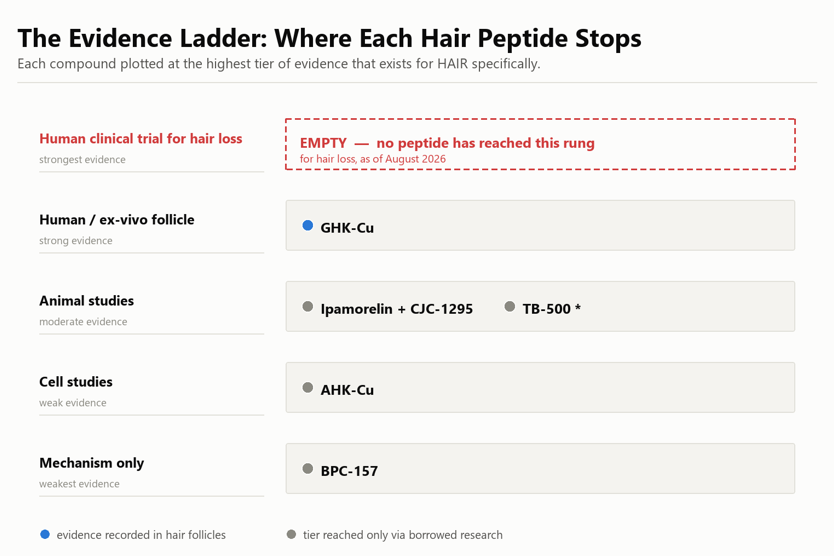
Among the best peptides for hair growth, GHK-Cu carries the strongest hair-specific evidence. It is also the only one of the five studied at the follicle level. No peptide holds FDA approval to treat hair loss, and the distance between these compounds is wide enough to change what you should expect from each.
Search results for this term mix cosmetic serum ingredients with research compounds sold in vials. We separate those first, then grade each compound on what has actually been studied inside a hair follicle.
Best Peptides for Hair Growth Compared
Ranked on hair-specific evidence, these five separate quickly once you ask how much of each compound’s support comes from hair research itself. Only GHK-Cu clears that bar. The other four build their case on adjacent tissue.
| Peptide | How it may relate to hair biology | Hair-specific evidence | Route studied | Evidence level | Approved by the FDA for hair loss? |
| GHK-Cu | VEGF release in dermal fibroblasts, dermal papilla cells, matrix turnover | Named in a 2026 peer-reviewed hair-loss review | Topical, dominant for this class | Cell and animal | No |
| Ipamorelin + CJC-1295 | Raises IGF-1, a signaling molecule studied in follicle cycling | None. Growth-hormone secretagogues are absent from that review | Systemic | Indirect, mechanism level | No |
| AHK-Cu | Copper-peptide class effects on vascularization and dermal papilla cells | Named within the class, with no compound-specific trial | Topical, inferred from the class | Cell level | No |
| BPC-157 | Angiogenesis and tissue remodeling, inferred from non-hair research | None. Absent from that review | Systemic, local | Mechanism only | No |
| TB-500 | A fragment of thymosin beta-4, a protein with mouse hair data | None for the fragment itself | Systemic | Animal data for the parent protein | No |
These compounds come under research-use-only, and each supplier states it is not for human use.
One deliberate omission shapes this ranking. Some write-ups publish human dosing protocols for material labeled research use only. We publish none.
A compound with no controlled human hair trial has no protocol to quote. Quoting one invents authority the evidence cannot support.
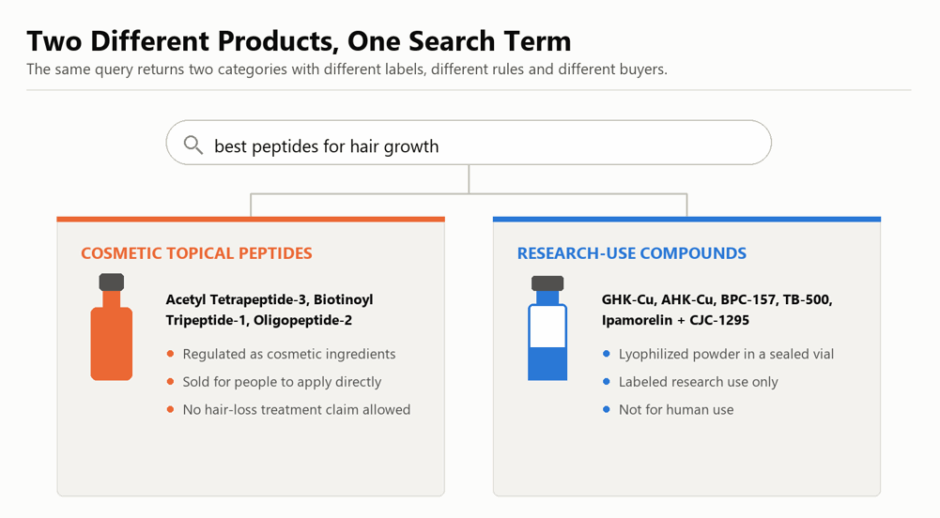
Cosmetic Hair Peptides vs Research Peptides: Not the Same Category
Peptides for hair growth split into two product categories with different rules: cosmetic ingredients sold for direct application, and research compounds shipped as laboratory material. One is regulated as a cosmetic and sold for direct application. The other ships as laboratory material under research-use-only labeling, which changes every rule that follows.
Cosmetic topical peptides appear in serums and shampoos sold for use on people:
- Acetyl Tetrapeptide-3 is the one you will see most often, with Biotinoyl Tripeptide-1 and Oligopeptide-2 alongside it
- They are regulated as cosmetic ingredients
- They cannot legally carry a hair-loss treatment claim
Research-use compounds are the five ranked here:
- They arrive as lyophilized powder in a sealed vial
- Every label reads research use only
- They carry a certificate of analysis instead of cosmetic safety documentation
Mainstream 2026 coverage sits firmly in the first category. Dermatologist round-ups of scalp serums describe cosmetic formulations sold for direct application.
Best Peptides for Hair Growth Reviewed
These five peptides for hair growth are ranked by hair-specific evidence, and only the first has any. Each entry names the study carrying that compound’s case, the supplier stocking it, and where its documentation ends.
GHK-Cu: Strongest Hair-Specific Follicle Evidence
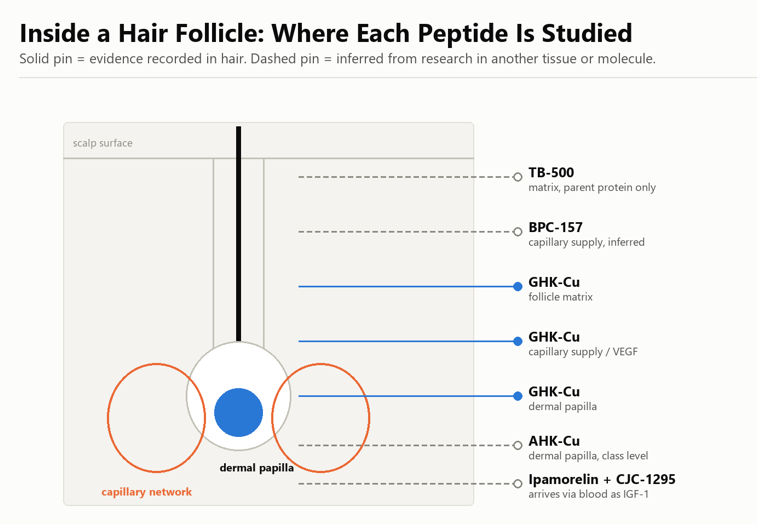
GHK-Cu leads any GHK-Cu hair growth comparison, because it is the only compound here named in a peer-reviewed 2026 review of short peptides for hair loss. That review describes a tripeptide of glycine, histidine, and lysine bound to copper.
Its reported mechanism runs through the blood supply. The review states that GHK-Cu “has been found to increase the production of VEGF in dermal fibroblasts”, and VEGF is the signal that tells the body to build new capillaries. A follicle is fed by the surrounding vessels, which are the proposed route to a larger one.
The same review records it acting on the scaffolding those vessels sit in. That work touches on dermal papilla cells, the cluster at the base of a follicle that controls how large it grows, and the anagen phase, the years-long stretch when a hair actively grows.
Evidence by tier:
- Cell research. Dermal papilla function, described at class level.
- Animal research. Preclinical follicle work records anti-inflammatory activity and new vessel growth.
- Human research. None with a hair endpoint, though the topical route dominates this class.
- Still unproven. No controlled human trial in pattern hair loss.
Quick Specs
| Field | Detail |
|---|---|
| Sequence or class | Gly-His-Lys complexed with copper, C14H22CuN6O4 |
| Molecular weight | 403.93 g/mol as the copper complex, 340.38 g/mol as the free peptide |
| Hair-specific studies | Yes, named in the 2026 review |
| Evidence tier | Cell and animal |
| Route studied | Topical, dominant for the copper-peptide class |
| Approved by the FDA for hair loss | No |
The Kylo Peptides listing, read on August 19, 2026, offers 50mg and 100mg vials at 99 percent or more HPLC purity with a lot-matched third-party certificate.
Ipamorelin and CJC-1295: Indirect Hair Evidence Through IGF-1
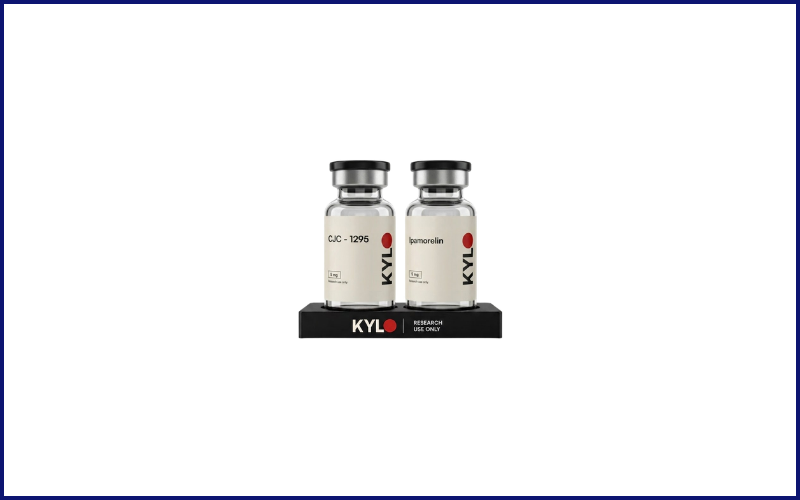
Ipamorelin with CJC-1295 has no hair-specific evidence. The pair reaches hair biology through a second messenger, IGF-1, which puts an extra step between the compound and the follicle.
The extra step carries the whole argument. The 2026 review sorts its field into five classes of hair-loss peptides, and growth-hormone secretagogues appear in none of them. A compound can have a plausible route to the follicle even if it sits outside the hair literature.
Evidence by tier:
- Cell research. IGF-1 signaling is well described in follicle biology, though not through these compounds.
- Animal research. Growth-hormone axis effects, with no hair endpoints.
- Human research. No hair-specific trial of this combination.
- Still unproven. Whether raising IGF-1 systemically changes scalp hair at all.
Quick Specs
| Field | Detail |
|---|---|
| Sequence or class | Growth-hormone secretagogue pair, CJC-1295 (No DAC) with Ipamorelin |
| Molecular weight | Not published as a combined figure for the blend |
| Hair-specific studies | None |
| Evidence tier | Indirect, mechanism level |
| Route studied | Systemic |
| Approved by the FDA for hair loss | No |
Kylo Peptides supplies both compounds in a single vial at 5/5 mg or 10/10 mg, starting at $90.00, with volume discounts up to 16 percent. Purity is listed at 99 percent or greater by HPLC and mass spectrometry.
Its advertised 4.9-out-of-5 rating from 2,400 researchers is the company’s own claim. The caveat concerns documentation: no testing laboratory is named, so the certificate cannot be cross-checked.
View the vial options and volume pricing at Kylo Peptides.
AHK-Cu: A Copper Peptide With Sparse Hair Data
Among copper peptides for hair growth, AHK-Cu belongs to the same class as GHK-Cu, yet it has far less supporting evidence than most buyers assume. The 2026 review names both compounds together in its copper-peptide category, describing that class as enhancing vascularization and dermal papilla function. The detailed hair findings inside that section belong to GHK-Cu.
These molecules genuinely differ. AHK-Cu replaces alanine with glycine, yielding Ala-His-Lys-Cu. Sharing copper and a class does not transfer follicle data across.
Evidence by tier:
- Cell research. Vascularization and dermal papilla effects, described at class level.
- Animal research. No AHK-Cu hair study appears in the 2026 review.
- Human research. None specific to this compound.
- Still unproven. Whether it matches GHK-Cu on any follicle endpoint.
Quick Specs
| Field | Detail |
|---|---|
| Sequence or class | Ala-His-Lys complexed with copper |
| Molecular weight | Not published on the supplier product page |
| Hair-specific studies | Class-level mention only |
| Evidence tier | Cell level |
| Route studied | Topical, inferred from copper-peptide class research |
| Approved by the FDA for hair loss | No |
We read the listing on August 19, 2026. It offers 50mg and 100mg vials at 99% or greater purity, with a batch certificate covering purity, identity, and contamination screens.
Two documentation gaps deserve a mention. Molecular weight is missing, and the same $29.99 to $45.99 band covers both vial sizes, so the figure reads as a range rather than a price.
Compare the 50mg and 100mg listings at Kylo Peptides.
BPC-157: No Hair-Specific Studies Exist
Any honest BPC-157 hair growth assessment starts with an absence. The compound appears in none of the five peptide classes in the 2026 review of short peptides for hair loss, and its rationale for hair loss rests entirely on angiogenesis work conducted in other tissues.
Angiogenesis is relevant to follicles, so a compound studied for it elsewhere sounds relevant. What the literature never tests is whether that reaches a scalp endpoint.
BPC-157’s regulatory position moved twice in 2026. The FDA removed it from Category 2 in April, and in July the Pharmacy Compounding Advisory Committee voted 8 to 6 to recommend adding it to the Section 503A Bulks List. A recommendation is not approval, and formal rulemaking must follow before any pharmacy can compound it.
Evidence by tier:
- Cell research. Tissue-repair pathways, none of them in follicles.
- Animal research. Injury-repair models, with no hair endpoint reported.
- Human research. No published trial with a hair endpoint.
- Still unproven. Whether injury-site angiogenesis behaves the same in a follicle.
Quick Specs
| Field | Detail |
|---|---|
| Sequence or class | Synthetic pentadecapeptide, 15 amino acids |
| Molecular weight | 1419.556 g/mol |
| Hair-specific studies | None |
| Evidence tier | Mechanism only |
| Route studied | Systemic and local |
| Approved by the FDA for hair loss | No |
Kylo Peptides publishes BPC-157 in 10mg and 20mg vials at 99 percent or greater purity, analyzed by an ISO/IEC 17025:2017 accredited laboratory. Its per-batch certificate verifies identity by LC-MS/MS and HPLC, with batch traceability.
It labels the 20mg vial “clinical grade”, its own wording on a product sold for laboratory work. Ranked on hair evidence, it places fourth despite the strongest documentation here.
TB-500: The Weakest Hair Evidence of the Five
Every TB-500 hair growth claim traces back to research conducted on a different molecule, because the mouse work people cite concerns thymosin beta-4 rather than the fragment sold under this name. TB-500 is only a piece of that protein, which is why it ranks last.
Research on the parent protein is real and detailed. Studies report faster regrowth in overexpressing mice and far fewer hair shafts in knockout mice. A separate study found that thymosin beta-4 induces hair growth through follicle stem cell migration.
None of it was conducted on TB-500, and the relationship between the fragment and the full protein has not been established. Carrying the findings across is an assumption.
Evidence by tier:
- Cell research. Migration assays, run on the full protein.
- Animal research. The mouse hair data belongs to thymosin beta-4, whose follicle roles are described separately.
- Human research. None at all.
- Still unproven. Whether the fragment sold as TB-500 retains the parent protein’s activity.
Quick Specs
| Field | Detail |
|---|---|
| Sequence or class | Thymosin beta-4 fragment, C212H350N56O78S |
| Molecular weight | Approximately 4963.5 Da |
| Hair-specific studies | None for the fragment |
| Evidence tier | Animal data for the parent protein |
| Route studied | Systemic |
| Approved by the FDA for hair loss | No |
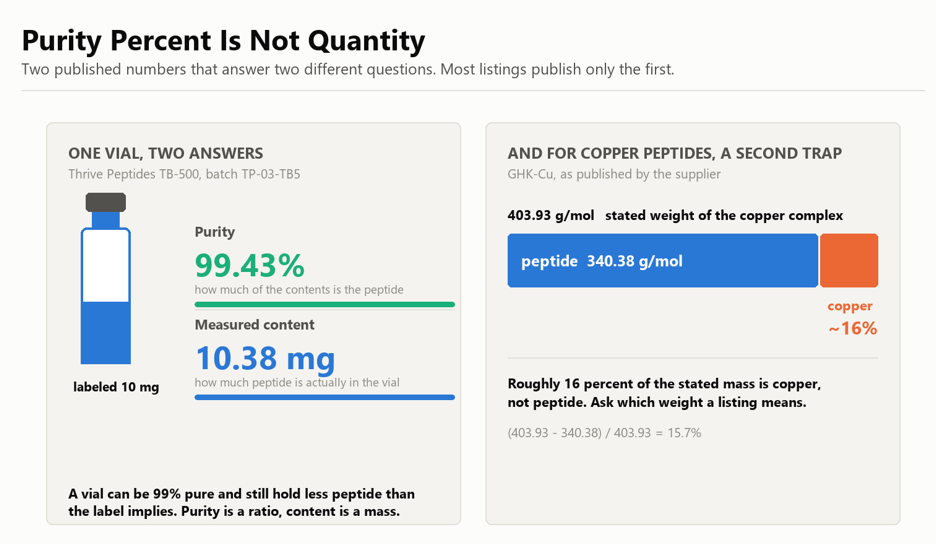
Kylo Peptides publishes unusually complete documentation for its 10mg vial, listing 99.43 percent purity alongside a measured content of 10.38mg for batch TP-03-TB5, with a QR code linking to the lab report.
Borrow that pair as a habit, because purity and measured content answer different questions, and most listings publish only the first.
Scan the batch QR code on the Kylo Peptides listing to read the lab report.
Do Peptides Actually Work for Hair Growth According to Research?
No published research shows a peptide regrowing hair in people. Mechanisms are documented. Outcomes remain open. Copper peptides have been shown to affect the vessels feeding a follicle, and thymosin beta-4 has mouse hair data to support it, but neither shows that a research peptide regrows hair in people. That is the question buyers are actually asking, and it stays open.
The 2026 review is blunt about why the clinical picture stays unsettled. It notes “a notable lack of robust animal models to study the underlying mechanisms of various types of hair loss” and that most published studies never explain how optimal dosage was determined. Its sharpest criticism concerns comparison: clinical studies of hair peptides “do not provide meaningful comparisons with established drugs such as minoxidil or finasteride, which undermines their credibility”.
We searched the public trials registry on August 19, 2026, and found no registered controlled trial of any of these compounds for the treatment of pattern hair loss.
On timelines, the honest answer is structural. Anagen runs for years, so any hair endpoint needs months of observation.
Which Peptide Has the Strongest Evidence for Hair Growth?
GHK-Cu has the strongest hair-specific evidence of the five, with no close competition, and its distance to second place is the widest gap in this ranking. Ranked purely on how much support comes from hair research instead of adjacent tissue, the order runs like this:
- GHK-Cu. The only compound named in a peer-reviewed 2026 hair-loss review, with effects described on dermal papilla cells and the vessels that feed them.
- Topical copper peptides as a class. Genuinely relevant, and frequently treated as interchangeable with GHK-Cu specifically. Class-level findings are not compound-level proof, which is exactly where AHK-Cu sits.
- Ipamorelin + CJC-1295. Evidence is indirect, mediated by IGF-1, with no hair endpoint attached.
- BPC-157. The hair connection remains theoretical, based on research from other tissues.
- TB-500. Findings should not be extrapolated from thymosin beta-4 research, because the fragment is not the protein that was studied.
This order differs from the review order at positions two and three. The reviews run compound by compound, so AHK-Cu appears third as a product you can buy, while this ranking treats topical copper peptides as a category.
How to Choose a Peptide for Hair Research
Choosing among the best peptides for hair growth runs through seven checks, starting with the type of hair loss and ending with the certificate. Run them in that order, because reversing it leaves you with an immaculately documented compound nobody has studied in hair.
- Start with the type of hair loss: Androgenetic hair loss involves different biology from shedding-driven patterns, so a compound studied for vascularization does not address them equally.
- Look for hair-specific evidence first: Follicle count is the endpoint that should be weighted most, with follicle size next. General tissue-repair research does not substitute.
- Check whether the evidence is human or preclinical: Mouse data and cell data answer narrower questions than most product pages imply.
- Read the actual study: A mechanism explains how something could work. A study reports whether it did.
- Verify identity: LC-MS identity confirmation shows the molecule matches the label. HPLC purity shows how much of the contents is that molecule.
- Check the batch-specific certificate: A generic certificate describes a product line. A lot-matched one describes the vial in your hand.
- Treat before-and-after photographs as marketing: Lighting and hair length change the apparent density without biological change.
One insider check applies to copper peptides. Ask whether a stated weight refers to the copper complex or the free peptide, because GHK-Cu weighs 403.93 g/mol against 340.38 g/mol. Roughly 16 percent of that mass is copper.
Safety and Side Effects of Peptides for Hair Growth
No peptide on this list has a characterized human safety profile for hair use. The gap is specific: the mechanism is often well described, while human exposure is barely studied at all.
- GHK-Cu: Copper peptides have a long history of topical research dating back to the compound’s identification in 1973. Systemic use in people for hair is not characterized.
- Topical copper peptides: Cosmetic formulations are assessed under cosmetic safety frameworks, a different standard from drug safety review.
- Ipamorelin and CJC-1295: These act on the growth-hormone axis, a system with broad downstream effects. Long-term human data for this purpose does not exist.
- BPC-157: The FDA has flagged naming inconsistency as a risk in itself because multiple salts and derivatives are sold under a single common name.
- TB-500: Safety cannot be inferred from thymosin beta-4 research, for the same reason efficacy cannot.
Limited human data makes long-term safety hard to establish. The absence of reported harm in a small preclinical literature is not evidence of safety, and the review’s note on unjustified dosing applies to safety endpoints as well.
Route changes the risk picture, and topical research and injectable research are not interchangeable. None of these compounds is sold for personal use, so anyone worried about hair loss should read a clinical overview, such as the MedlinePlus overview on hair loss, and speak to a clinician.
Are Peptides Legal or Approved by the FDA for Hair Loss?
Nothing on this list is a licensed medicine. Legality and approval are separate questions that are often conflated, which is the most common misunderstanding around research peptides. A compound can be lawful to sell in the United States and still carry no medical authorization of any kind.
- FDA approval means the agency has reviewed evidence for a specific indication and authorized its marketing. Not one of these five has that.
- Research use only means the material is supplied for laboratory work. Every supplier here states that its product is not for human use and holds no FDA approval.
- Legal to sell and approved to treat are different standards. A chemical supplier can lawfully sell a research reagent no regulator has evaluated as a medicine, provided it makes no treatment claims.
The position is active rather than settled, and the 503A bulk substances list is where it moves to. BPC-157 went before the FDA’s Pharmacy Compounding Advisory Committee in July 2026.
This reflects August 2026. Verify current rules before relying on it.
How to Evaluate a Research Peptide Supplier for Hair Compounds
A certificate proves more than a product page claims, and for copper peptides that gap is widest. Two vials can bear near-identical labels while containing different molecules, so verifying hair compounds starts with identity verification. The checks below run in order of how much they tell you.
Verify Peptide Identity
Look for LC-MS or mass spectrometry confirming the molecule matches its expected mass. The FDA’s concern about substances sharing the BPC-157 name shows why identity outranks everything else.
Look For Independent Purity Testing
A laboratory outside the company should have run the analysis.
Match The Certificate To Your Batch
The lot number on the certificate should match the number printed on the vial.
Confirm HPLC and LC-MS Both Appear
HPLC reports purity while LC-MS confirms identity, so a certificate with only one answers half the question.
Look For Sterility And Endotoxin Testing Where Applicable
The reference method for the latter is the USP bacterial endotoxins test.
Check Accreditation
ISO/IEC 17025 is the standard for testing laboratory competence, so accreditation means the lab was assessed against it.
Walk Away From Human-Treatment Claims
A supplier saying a research compound treats hair loss is advertising that it misunderstands its own regulatory position.
Kylo Peptides: Research-Quality Considerations
Reading the certificates behind these hair-growth peptides, one difference stood out. Kylo Peptides publishes measured net content per vial as an assay in its own right, separate from purity. The distinction matters more than it sounds: purity reports the fraction of powder that is the target compound, and net content reports how much powder is actually there. A high purity figure on a light vial is still a short measure.
Its published panel runs seven assays on every lot, covering appearance, HPLC-UV purity, LC-MS identity confirmation, measured net content, heavy metals by ICP-MS, sterility, and endotoxin under USP <85>.
Each batch is screened in Kylo’s own lab first, then retested at three independent ISO/IEC 17025-accredited laboratories: Janoshik Labs, Freedom Diagnostics, and Vanguard. The labs’ credentials are important because a certificate from an unnamed laboratory cannot be cross-checked.
Quick Specs
| Field | Detail |
|---|---|
| Supplier | Research peptide supplier, kylopeptides.com |
| Assays per lot | Seven, including measured net peptide content |
| Certificate timing | Published before the batch ships |
| Documentation | Lot-matched to the number printed on the vial |
| Product format | Lyophilized powder in sealed vials |
| Approved by the FDA for hair loss | No, research use only |
Peptides vs Established Hair-Loss Treatments
Two of the three columns below went through FDA review for hair loss. That difference decides how much confidence each one has earned. It is also why research peptides sit in the investigational lane while minoxidil and finasteride sit in the approved one.
| Research peptides | Minoxidil | Finasteride | |
|---|---|---|---|
| Regulatory status | Investigational, research use only | Approved over the counter | Approved by prescription |
| Approval timing | None | 2% solution 1996, 5% solution 1997 | 1mg daily, 1997 |
| Evidence base | Cell and animal work, no controlled human hair trials | Decades of controlled trials | Decades of controlled trials |
| Route | Topical or systemic, varies | Topical and oral | Oral |
| Mechanism | Vascularization, matrix turnover, IGF-1 signaling | Vasodilator and Wnt/beta-catenin inducer, with antiandrogen activity | Inhibits type II 5-alpha-reductase, lowering DHT |
| Main unknown | Whether any measurable hair effect occurs in people | Well characterized | Well characterized |
Approval dates come from a network meta-analysis of hair-loss drugs, and the mechanisms from published pharmacology references.
None of the best peptides for hair growth should be treated as a replacement for either drug. The review’s central criticism was that peptide studies never ran meaningful comparisons against them, leaving the comparison unmade rather than won.
Frequently Asked Questions
Does GHK-Cu really regrow hair?
Regrowth in people remains unproven, because no controlled trial has tested it. Copper-peptide research also uses cell-culture concentrations, and a dose that works in a dish tells you little about a scalp.
Can peptides really regrow hair?
Not on current evidence, and the type of loss matters more than most rankings admit. Shedding-driven thinning and pattern loss respond to different endpoints, so one compound rarely addresses both.
Is GHK-Cu better than BPC-157 for hair?
On hair evidence, yes. The comparison flips on documentation though, because BPC-157 ships with accredited testing and zero hair data. Those are separate purchases: one buys a studied mechanism, the other a verified vial.
Does TB-500 help hair growth?
The mouse research belongs to thymosin beta-4, and TB-500 is only a fragment of it. A quick test on any vendor citation: search the study for the word fragment. If it is missing, the paper is about the full protein.
Are hair-growth peptides safe?
A topical safety record does not transfer to systemic exposure. Decades of copper peptide use in creams say nothing about a load that bypasses the skin barrier.
How long does hair growth research take to show results?
Longer than most study designs allow. A defensible endpoint needs standardized photography and a fixed scalp area, because lighting alone can fake a result.
Conclusion
Of the peptides for hair growth compared here, GHK-Cu is the best-evidenced, and the gap to second place is wide. That ranking is based on hair-specific research rather than popularity, and the other four sit lower because their scientific evidence comes from elsewhere.
Again, these peptides are not approved to treat hair loss and are meant for research purposes only. Whichever one you study, verify that the lot certificate covers identity and measured content before you buy.
Disclaimers
Each of the hair growth peptides listed above is supplied for laboratory research. These products are not for human or veterinary use and do not have FDA approval to diagnose, treat, cure, or prevent any disease. This report publishes research and supplier documentation. It does not substitute for advice from a qualified clinician, and anyone experiencing hair loss should consult one.
Related posts:


Stay updated, free articles. Join our Telegram channel

Full access? Get Clinical Tree


