By Kevin Nathan, Peptide Research Analyst. Kevin has spent six years reading compounding regulations and preclinical literature for 200+ peptides. Fact-checked by Ronna Donald, Editor.
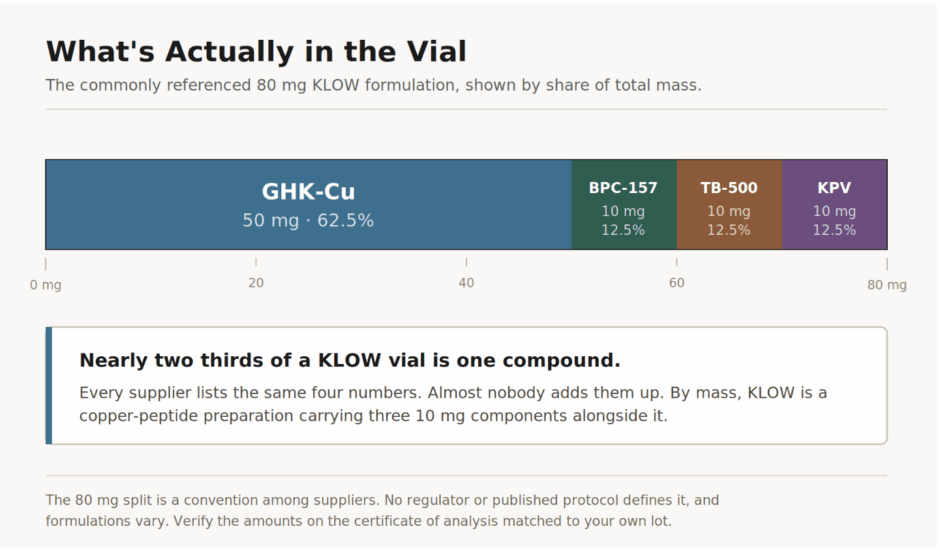
KLOW blend is a mixture of four peptides in one vial: GHK-Cu, BPC-157, TB-500, and KPV. Most suppliers list it at 80 mg total. GHK-Cu takes up 50 mg of that. The other three sit at 10 mg each. So, by weight, it’s mostly copper peptide with three small additions.
The ratios are pre-set, and that’s by design: one vial, one reconstitution, same proportions every dose. It’s built to be run as a single protocol, not tuned compound by compound.
Each of the four components has its own research record. The combination, however, tests whether they can work synergistically to amplify their individual outcomes.
Key Takeaways
- KLOW blends four separate peptides in one vial: GHK-Cu, BPC-157, TB-500, and KPV. The name refers to a mixture.
- Each one brings a different research angle. GHK-Cu covers collagen and matrix biology. BPC-157 covers tissue repair and vascular signaling. TB-500 covers cell migration. KPV covers inflammatory signaling.
- The KLOW blend is GLOW + KPV.
- The formulation you’ll most often see quoted is 80 mg total. Formulations vary by supplier, so check the number on your vial.
- GHK-Cu is 50 of those 80 mg. By mass, KLOW is 62.5% copper peptide.
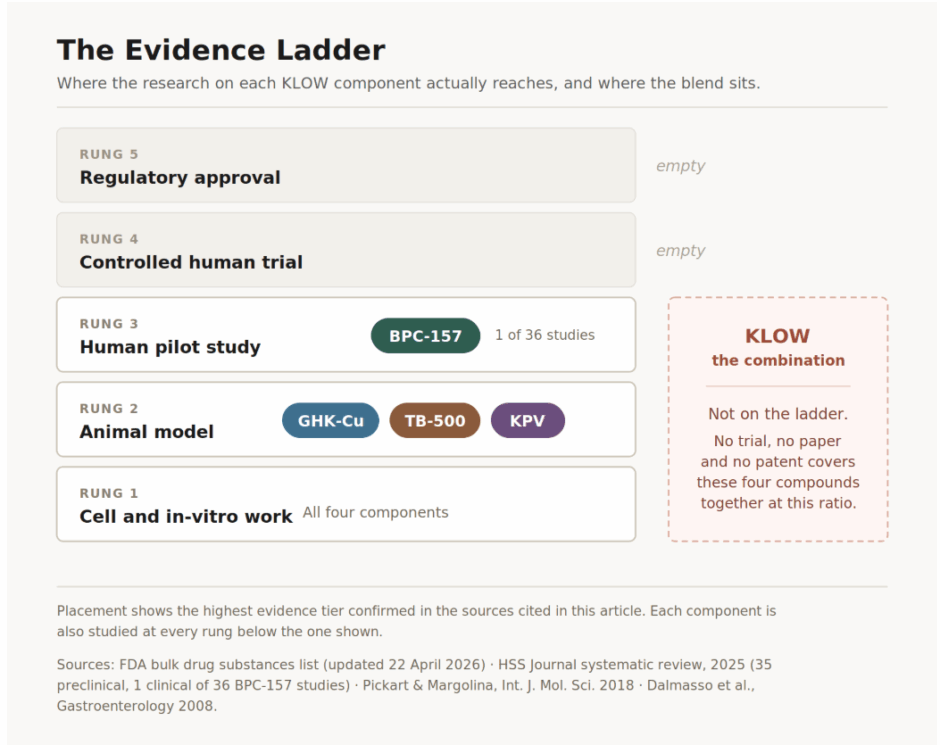
- The individual peptides have research behind them, mostly preclinical. The combination itself has never been through controlled clinical research.
What Is the KLOW Blend?
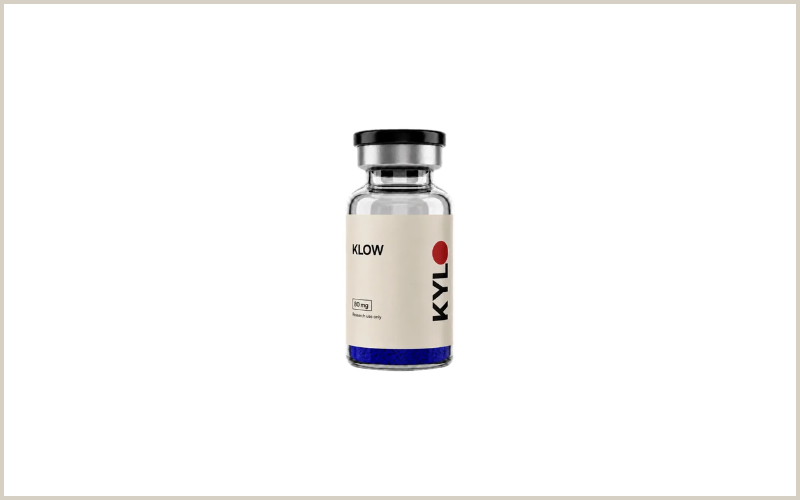
KLOW is a research blend combining four peptides in one lyophilized vial: GHK-Cu, BPC-157, TB-500, and KPV. It’s commonly supplied at 80 mg total, with 50 mg GHK-Cu, 10 mg BPC-157, 10 mg TB-500, and 10 mg KPV. GHK-Cu is 62.5% of what’s in the vial.
This formulation is a market convention, not something set by a regulator or published by a research protocol. So, it may vary across vendors. To confirm the ratios in your blend, check the certificate of analysis matched to your lot.
What Peptides Are in KLOW?
Four compounds make up the KLOW blend, each studied for a different purpose.
GHK-Cu
GHK-Cu is the extracellular matrix arm of the KLOW blend. At 50 mg, it makes up the largest share of the vial. The copper tripeptide, where glycine, histidine, and lysine are bound to a copper ion, gives the blend its classic blue hue.
Most research interest in GHK-Cu comes from gene and matrix work. In their 2018 review in the International Journal of Molecular Sciences, Loren Pickart and Anna Margolina reported that GHK increases expression in 59% of the genes it affects and suppresses it in 41%. It increases collagen, elastin, and glycosaminoglycan synthesis while supporting dermal fibroblast function.
BPC-157
Inside KLOW, BPC-157 is the tissue-repair and vascular-signaling component. It is a synthetic pentadecapeptide, 15 amino acids long, based on a sequence found in human gastric juice. Preclinical work has examined it for angiogenesis and repair in tendon, muscle, and gut tissue in rodents.
A 2025 systematic review in HSS Journal screened 36 BPC-157 studies published between 1993 and 2024 and found 35 preclinical and one (retrospective) clinical study.
TB-500
TB-500 (LKKTETQ) is a seven-amino-acid fragment of Thymosin beta-4, a 43-amino-acid protein naturally produced in the body. Research discussion around it centers on actin binding, cell migration, and wound-repair models. However, most of the published work tests the full protein instead of the fragment. So when you read a TB-500 lab work, check which molecule it actually used.
KPV
KPV is a tripeptide: lysine, proline, valine. It’s the tail end of α-MSH (alpha-melanocyte-stimulating hormone), known to reduce pain and inflammation.
The cleanest citation for KPV’s lab work is Dalmasso and colleagues in Gastroenterology, 2008. The study found that nanomolar concentrations of the peptide inhibit activation of NF-κB and MAP kinase inflammatory signaling, taken up through the PepT1 transporter. Oral KPV reduced colitis incidence in DSS and TNBS mouse models.
KPV is also the compound that separates KLOW from the GLOW blend: the former has it, the latter does not.
KLOW Blend Composition: How the Four Peptides Fit Together
KPV takes the inflammation angle. GHK-Cu covers matrix and collagen biology. BPC-157 targets tissue repair and vascular pathways. TB-500 handles cell migration and wound closure.
| Peptide | Commonly described role | Research focus |
| GHK-Cu | Matrix and collagen support | Skin and extracellular matrix |
| BPC-157 | Tissue-repair signalling | Connective tissue and vascular research |
| TB-500 | Cell migration | Wound-repair research |
| KPV | Inflammatory signalling | Inflammation research |
What KLOW Supports
The KLOW blend supports a few research areas and proposed mechanisms, each tied to its individual components.
Tissue Repair and Recovery
BPC-157 and TB-500 are the two KLOW components tied to repair research. BPC-157 shows up in angiogenesis and connective-tissue models; TB-500 in actin binding and cell migration. Both bodies of work sit almost entirely in animal and cell studies.
Inflammatory Response
KPV gives KLOW an inflammation-focused component. Strip it out, and you’re looking at a repair-and-matrix blend with nothing pointed at inflammatory pathways. The Dalmasso work focuses on NF-κB and MAP kinase signaling, delivered into cells via PepT1, with effects measured in mouse colitis models.
Skin and Collagen Research
GHK-Cu is the most heavily researched skin and matrix component of the four KLOW peptides. The Pickart and Margolina review links it to collagen, elastin, and glycosaminoglycan synthesis, as well as fibroblast function.
Cellular and Connective Tissue Research
Across all KLOW components, the shared thread is cell signaling: how cells move, how they build matrix, how they respond to inflammatory triggers. The synergistic pairing is yet to be tested clinically.
Who Is KLOW Right For?
KLOW suits researchers investigating more than one pathway at a time: tissue repair, inflammatory signaling, extracellular matrix biology, wound healing, cellular recovery.
Researchers Studying Tissue Repair
Work in this area centers around BPC-157 and the thymosin-beta-4 (TB-500’s parent compound). It discusses tissue repair, cell migration, vascular responses, and wound-healing models. Having both compounds in one blend saves handling steps. It also means any repair signal you see could come from either source.
Researchers Studying Inflammatory Pathways
KPV provides the blend’s inflammation-focused component, which matters for anyone examining NF-κB and related signaling. It comes fixed at 10 mg in the standard formulation and fits protocols built around that dose. For a higher dose, you may need a standalone KPV vial.
Researchers Studying Skin and Extracellular-Matrix Biology
KLOW also turns up in collagen, matrix remodeling, fibroblast, skin-biology, and aging-related research, thanks to its bulk component, GHK-Cu. GHK-Cu in the blend sits around 50 mg, so if you’re investigating matrix biology and age-related changes in skin biology, it saves you from preparing three different peptides.
Researchers Interested in Multi-Peptide Formulations
A few research studies question the combinations themselves: how several peptide mechanisms interact, whether pathways interfere, what happens when signaling is pushed from four directions. KLOW is a reasonable blend to investigate them.
Who Is KLOW Not For?
The KLOW blend may not be suitable for:
- Anyone looking for an FDA-approved treatment.
- Anyone expecting an established human protocol.
- Anyone assuming research on GHK-Cu, BPC-157, TB-500, or KPV individually carries over to the blend.
- Anyone after a weight-loss or metabolic compound.
- Anyone who needs established human safety or efficacy data before proceeding.
KLOW vs GLOW: What Is the Difference?
KLOW and GLOW are both research peptide blends. The number of components in them varies. KLOW has 4 components, while GLOW has 3, with KPV missing.
| Feature | KLOW | GLOW |
| GHK-Cu | ✓ | ✓ |
| BPC-157 | ✓ | ✓ |
| TB-500 | ✓ | ✓ |
| KPV | ✓ | ✗ |
| Main distinction | Includes KPV | Does not include KPV |
KLOW and GLOW are just one letter apart, share 3 compounds, and get listed next to each other on supplier websites, with near-identical descriptions. Confusing them is normal.
The cleanest way to remember the KLOW vs GLOW blend distinction is: KLOW = GLOW + KPV.
KLOW is GLOW with an inflammation-focused compound, KPV, bolted on. Everything studied about GLOW applies to KLOW as well. KPV just adds NF-κB and related signaling to the picture. Exact formulations vary between suppliers for both blends.
Another name that often gets confused with KLOW and GLOW is the Wolverine blend. It contains two of KLOW and GLOW’s components, namely BPC-157 and TB-500. It’s studied for repair and recovery in preclinical and clinical settings.
KLOW Blend vs Individual Peptides
Blend versus individual peptides is a live argument among researchers. On the GLP-1 Forum in February 2026, one Redditor put the case for separates in a single line: “Using individual allows for a precise dose of each pep.” Another raised a documentation point, noting that blends “cannot be tested for individual component purity.”
We believe both have their pros and cons. Here’s how they compare:
KLOW Blend vs Individual Peptides
| Factors | Blend (KLOW) | Separate compounds |
| Amount control | Fixed by supplier | Set by you |
| Attribution of a result | Ambiguous across four compounds | Clear |
| Per-component purity documentation | Composite | Available per vial |
| Preparation steps | One | Four |
| Stopping one compound | Discard the vial | Straightforward |
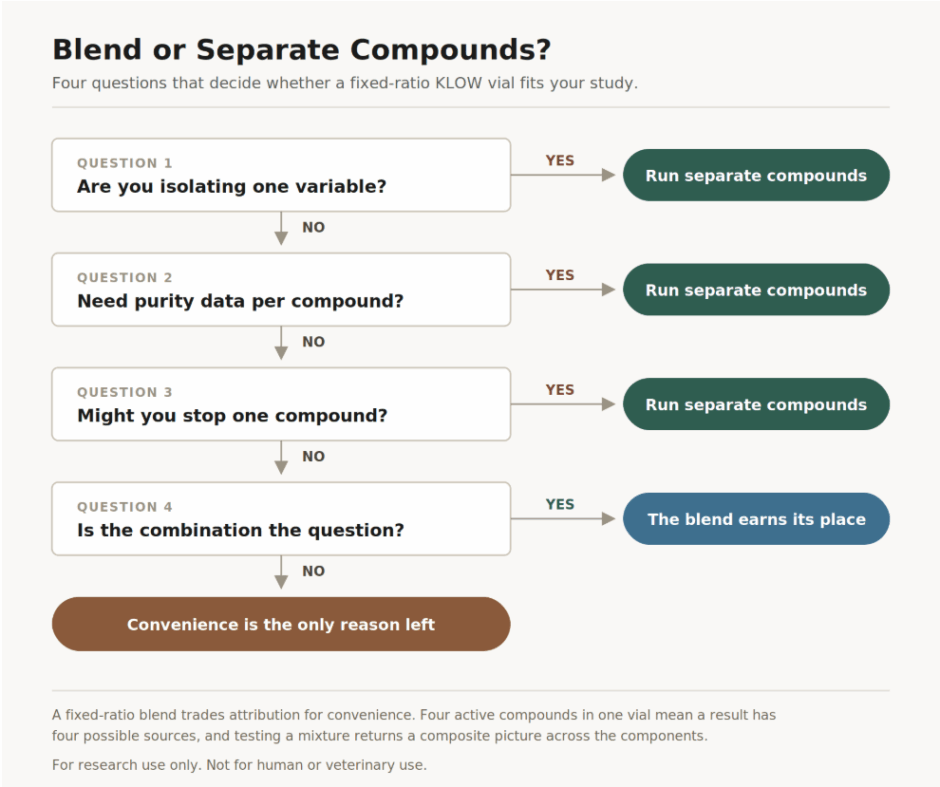
A quick way to decide. Are you isolating one variable? Take separates. Do you need purity documentation for each compound? Separates. Will you stop one compound partway through? Separates. Are you screening across several pathways at once, where the combination meets your research objective? The blend is the obvious choice.
The KLOW blend’s combined outcome hasn’t been published yet, and that’s exactly why it’s becoming popular in research circles. More peptides in the vial let studies test a broader protocol and investigate several mechanisms at once.
What to Look for in a KLOW Research Product
Since the label “KLOW” isn’t standardized, you need the paperwork behind the vial to verify the exact component ratios. Check these 3 things before ordering.
Check the Exact Formulation
Look for each peptide named individually with its own amount, then a stated total. “80 mg blend” on its own tells you nothing about the split, which varies by supplier. Compare the listed amounts against what you actually need. A vial that’s 62.5% GHK-Cu may or may not match your research goal.
Kylo Peptides, for instance, publishes the split openly on its KLOW Blend Peptide 80mg listing: BPC-157 10 mg, GHK-Cu 50 mg, TB-500 10 mg, KPV 10 mg.
Check the COA
Look for a lot number on the COA that matches the lot number printed on the vial you’re using. Verify the identity of each peptide, purity figures, the testing laboratory, and the date of testing.
Check the methods too. HPLC is the standard for analyzing a purity percentage; LC-MS confirms identity. Kylo publishes ≥99% HPLC purity with identity confirmed by LC-MS. 3 independent ISO-accredited labs test the assays.
Check Research-Use Documentation
Clear research-only labeling belongs in plain sight. Look for direct phrasing: for research use only, not for human or veterinary use. A supplier making treatment claims about a compound with no approved indication is misleading and dangerously non-compliant. Transparent specifications, stated storage conditions, and published lot documentation signal trust.
Safety and Research Limitations
FDA Status
KLOW has no FDA approval. Its components, BPC-157, KPV, “GHK-Cu (for injectable routes of administration)” and “Thymosin beta-4, fragment (LKKTETQ), also known as TB-500, appeared on the FDA’s list of bulk drug substances nominated but withdrawn for use in compounding under section 503A.
How Did We Assess The Evidence?
We counted published, indexed studies naming the specific compound. We excluded vendor pages, clinic blog posts, and aggregator “stat sites.” We searched for research on the four-compound combination and found none, which is itself a finding.
Research Limitations
For the KLOW blend, the missing combination research is the core limitation. Findings on individual peptides may carry over to the blend on paper, but in practice, a clinical test is needed to confirm the synergistic outcomes.
Most of the underlying evidence on individual peptides is also preclinical. The HSS Journal review found 35 of 36 BPC-157 studies were animal or cell work. Animal and in vitro findings describe what happened in those models. They do not guarantee the same outcomes in humans.
Long-term safety has also not been assessed or published yet. No lab work tracks what happens when these four compounds are used together across extended timeframes at a fixed ratio.
Common Questions About KLOW
What is the typical KLOW formulation?
The most commonly quoted formulation is 80 mg total: GHK-Cu 50 mg, BPC-157 10 mg, TB-500 10 mg and KPV 10 mg. It’s a convention among suppliers with no regulatory or published standard. Verify the split on your own certificate of analysis.
Is KLOW the same as GLOW?
No. GLOW contains GHK-Cu, BP, C-157, and TB-500. KLOW contains those three plus KPV, which adds an inflammation-focused component. The names are one letter apart, and the products share three of four compounds, which is why they get mixed up constantly.
Is KLOW a single peptide?
No. KLOW is a mixture of four separate peptides supplied in one vial. The name belongs to the product, and it has no pharmacology, mechanism, or research record independent of its four components.
Has KLOW been studied in humans?
The complete blend has not. Individual components have research records of varying depth, mostly preclinical. A search of the published literature returns no trial, paper, or patent covering these four compounds together at this ratio.
Is KLOW FDA approved?
No. KLOW holds no FDA approval, and all four components appear on the FDA’s list of substances nominated then withdrawn for 503A compounding. It’s supplied strictly as research material, not for human or veterinary use.
Why do KLOW formulations differ?
No regulator or published protocol defines KLOW, so each supplier decides its own amounts and total. The 80 mg version became common through repetition among vendors. Always read the certificate of analysis matched to your specific lot.
Is KLOW a weight-loss peptide?
No. None of the four compounds is studied in a metabolic or weight-management context. Research on GHK-Cu, BPC-157, TB-500, and KPV focuses on matrix biology, tissue repair, cell migration, and inflammatory signaling.
How is KLOW different from Wolverine?
Wolverine is commonly described as BPC-157 and TB-500 together, a two-compound repair pair. KLOW adds GHK-Cu for matrix and collagen research and KPV for inflammatory signaling, making it a broader four-pathway formulation.
Conclusion
Simply put, KLOW blends 4 peptides in one vial at a fixed ratio. It’s a convenient way to evaluate if the individual effects of each peptide combine synergistically in humans, and if so, what are the interaction pathways?
Individually, the compounds have solid research backing in cell and animal models. GHK-Cu has genuine research depth in matrix biology. KPV has a clean citation trail on inflammatory signaling. BPC-157 and TB-500 both have real preclinical bodies of work on repair and recovery. However, the combination is yet to be studied as a whole.
When sourcing for research, rely on independently tested suppliers like Kylo Peptides. Read the COA, check the blend ratio, match the lot, and do not use the vial beyond research scope.
Disclaimer: Peptides discussed in this article are meant for research use only, not for human or veterinary consumption. This article is informational and does not constitute medical advice. Nothing here describes a treatment, a protocol, or a dose for human use.
Related posts:




Stay updated, free articles. Join our Telegram channel

Full access? Get Clinical Tree


