General considerations
This chapter is intended to shift the focus of burn reconstruction from the provider to the burn survivor’s needs and hesitations as opposed to repeating general principles of burn reconstruction outlined in Chapter 42 . As providers, we often forget that we are caring for individuals, their caretakers, and their social support network, who have spent significant time in the hospital. Survivors often have undergone multiple surgical procedures during their acute care stay, leaving them with posttraumatic stress disorder (PTSD) that includes denial, depression, and many other psychological sequelae further described in Chapter 55 . Their immediate concerns may be very different from ours. Whereas providers are trying to restore the physical entity “person” to a functional level, the survivor may struggle with the concept of having a physical impairment in the first place. Interventional fatigue may be prevalent in one survivor, whereas another survivor may be overanxious to “get things fixed.” It is important to recognize the survivor’s needs at any moment of their reconstructive journey and to see the person as a whole before planning and executing any particular reconstructive procedure. An ongoing case study illustrates the considerations addressed in this chapter.
Case study: Christa’s journey (name changed)
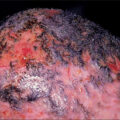
Christa is a 36-year-old female treated at a different burn center after a suicide attempt, with 36% total body surface area (TBSA) burned. Her medical history includes developmental delay, several psychiatric diagnoses, and diabetes. She was seen for burn reconstruction 3 months after discharge from acute care. She had no scar treatments or follow-up visits in the interim ( Figs. 46.1–46.4 ).
Image of Christa at arrival.
Image of Christa at arrival.
Image of Christa at arrival.
Eyelid and microstomia release.
Establishing goals
As elaborated upon in all other chapters in this book, the goal of burn reconstruction is to reconstruct (or restore) the preinjury state. However, this is a dangerous assumption because a complete preinjury state will never be achieved. The perception of many burn survivors, fueled by social media and “reality” television series such as Extreme Makeover , is that whatever scars they encounter can be fixed with plastic surgery. When scars are mentioned during a burn surgery consent conversation, the survivor will often ask: “But I can get plastic surgery for it later, right?”—meaning “I can have it fixed later, right?” Without being discouraging, it is important for the provider to make the survivor and their partners, parents, children, and friends understand early that a scar is a scar and will remain a scar forever (at least when this book was published). Reconstructive plastic surgery and other interventions can make a scar look and behave very similar to normal skin, but complete “regeneration” or restitutio ad integrum is currently not available if the full-thickness wound measures more than 2 mm to 4 mm in diameter, with the exception of fetal wound healing. Therefore reconstruction goals must be discussed carefully with the survivor seeking intervention. Unless the scar is small enough to excise primarily (which is not the case for most burn scars), a staged intervention plan needs to be outlined. This includes preparation and follow-up procedures. The provider must describe the best achievable result in detail. Sometimes this is best achieved by using demonstrative images. Even if the scar is small enough to excise, a burn scar is replaced with a surgical scar. This fact needs to be emphasized.
Goals of care follow a hierarchy, starting with life or organ preservation (e.g., exposed cornea, invasive infection), function, and aesthetics. In this hierarchy, the survivor may have very different goals than the provider. So, always ask: “What bothers you most about your scars?” and create a reconstructive plan accordingly.
Case study
-
Christa’s problems: Severe microstomia impeding feeding, ectropion, neck contracture, ear deformities, upper-extremity contractures (unable to perform activities of daily living [ADLs]), open wounds on scalp and neck, no personal hygiene, severe hypersensitivity, impaired mentation, communication via screaming and grunting only
-
Goals for Christa: Pain control, sedation for cleaning of all wounds and range of motion assessment, and correction of ectropion and microstomia urgently (see Figs. 46.1 and 46.2 )
Timing
The timing of reconstructive interventions is crucial. It needs to consider the intervention’s urgency, the scars’ maturation status, and the survivor’s psychological and social situation. Corneal exposure caused by ectropion or complete occlusion of body orifices is the only true, universally accepted reconstructive emergency. Wait for scar maturation before performing surgical scar or contracture releases if possible. In the interim, use scar modulation techniques, such as noninvasive scar treatments, laser, or relaxing Z-plasties within scars. Performing releases too early has a very high recurrence/recontracture rate. ,
Remember that scarring is a 5-year process. Many acute scar issues resolve with sufficient time and conservative scar treatment. Also, remember that burn reconstruction is a lifelong process for most burn survivors because new issues develop with burn scars throughout the life cycle, from growing bones causing ongoing contractures, to hormonal changes and hair growth causing ingrown hair and additional scarring, to aging issues causing more friable skin and open wounds. ,
Burn reconstruction program patient care plan (staging plan)
Matching reconstructive means to the problem
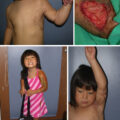
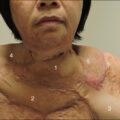
In the 21st century, multiple options are available for any reconstructive problem. From minimally invasive options, to skin graft to dermal template plus skin graft to local flaps to locoregional flaps to free tissue transfer, every possible procedure on the reconstructive ladder has been used for every burn reconstructive problem. However, considering the proportionality of the means to the problem is crucial. Consider a 60% TBSA burn survivor: there are only a few unscarred areas on their body, which they covet! And there are only so many free flaps on any human body. ( Fig. 46.5 shows the result after the use of a free anterolateral thigh [ALT] flap for neck contracture release. The reconstructive goal clearly was not achieved.)
Result after use of an anterolateral thigh flap for neck contracture release.
Case study
Christa had no tolerance for extensive and complicated procedures. She barely participated in physical therapy (PT) or occupational therapy (OT). She refused to wear a mouth splint after microstomia correction or a neck brace after neck contracture release. She developed massive hypertrophic scars at the full-thickness skin donor sites ( Fig. 46.6 ).