
For buyers, Maeng Da kratom is in a different discussion than practically any other strain on the market.
Ask any room of seasoned kratom users what strain they choose for when they want something dependable, strong and constant. Maeng Da will almost always be the first one mentioned.
That’s no accident or good branding.
Buy Premium Maeng Da Kratom from Jack Botanicals
AKA Certified | 9+ Lab Tests/Batch | 30% off “Jack30”
It is years of repeat buying, community comments, and recorded alkaloid data that constantly places Maeng Da above the standard-grade competition.
The name itself is a giveaway. “”Maeng Da” is a Thai term that approximately translates to “pimp grade “, an informal tag Thai farmers formerly used to describe leaves picked for better quality.
For decades of commercial exports, the quality signal was stamped onto anything from really premium, high-alkaloid kratom to mixed, low-grade powder dressed up in identifiable packaging.
This post is all about understanding the true difference that comes from agricultural techniques, alkaloid science and vendor openness.
The information provided is designed to assist purchasers in making selections based on real evidence, not marketing rhetoric, from effects of vein color to sourcing areas, lab testing standards to delivery dependability.
The Botanical Origins of Maeng Da and Why Cultivation Method Determines Alkaloid Density
Maeng Da comes from Mitragyna speciosa, the same tropical tree species that gives us all kratom.
The difference between Maeng Da and generic strains is in the cultivation, not the packaging.
The trees used to make real Maeng Da are usually grown in certain areas of Borneo, Sumatra and Thailand, where the minerals in the soil, the humidity and the density of the tree canopy combine to provide circumstances for growing that encourage higher alkaloid levels to develop.
Farmers in these locations have spent generations perfecting grafting methods, taking root stock from mature, well-established trees, and blending it with cuttings from specimens that reliably produce high-mitragynine leaves.
This selective propagation results in trees that yield, under optimal conditions, mitragynine concentrations of 1.5% to 2.0% per gram of dry leaf.
Standard-grade strains of kratom from the same geographic areas generally run 1.1% to 1.4%. That may seem like a small margin, but in practice that translates into a materially different user experience, particularly for consumers with established tolerance who’ve learned to tell the difference between real strength and marketing hype.
There is wild-harvested Maeng Da and some of it is really good.
The problem is consistency. The alkaloid content of wild picked leaf can vary 0.5% or more from batch to batch based on seasonal rainfall, time of harvest and age of the tree.
Experienced farms growing grafted, cultivated Maeng Da publish COA data for AKA certified vendors that do nine or more lab tests per batch with variance less than 0.2% over consecutive batches.
How Leaf Maturity and Harvest Timing Shape the Final Alkaloid Profile
One of the most underrated elements in Maeng Da potency is leaf maturity at the time of harvest.
Young leaves have differing alkaloid ratios than mature leaves from the same tree.
To satisfy spikes in demand, farmers occasionally harvest early, resulting in kratom with lower mitragynine concentration and a weaker 7-hydroxymitragynine profile.
The real Maeng Da can be described by its alkaloid density that is present in mature leaves picked at the height of development; usually from trees that are five years or older.
Smart shoppers who ask sellers about their sourcing relationships and harvest timing methods are asking the appropriate questions.
Vendors who can answer exactly the names of their agricultural partners and when the harvests took place, connecting them to the batch COAs are working at a level of transparency that clearly separates them from the bulk commodity market.
Drying Processes That Differentiate Vein Color Classifications
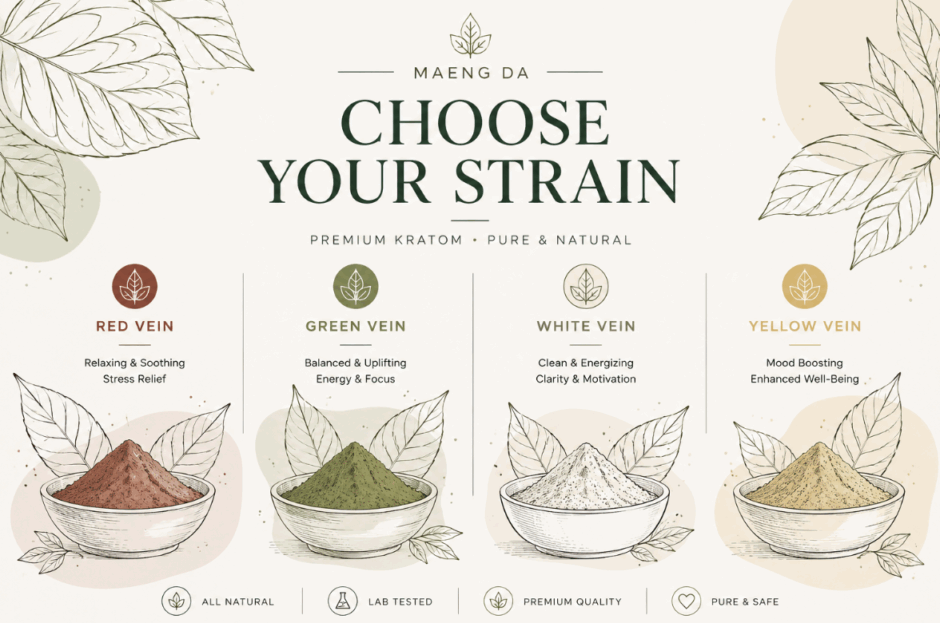
The vein colors of the Maeng Da (red, white, green, yellow) are not only a reflection of the plant’s development stage at harvest, but also have a lot to do with the drying procedure after harvest.
Green vein Maeng Da undergoes a short indoor drying procedure, allowing the alkaloid balance of the freshly picked mature leaf to be retained.
White vein needs a lengthier indoor cure with little light exposure, altering the ratio to more mitragynine and less 7-hydroxymitragynine.
Red vein drying is a long period of outside sun exposure, which speeds up the conversion of mitragynine into 7-hydroxymitragynine, the alkaloid responsible for the sedative and analgesic qualities red strains are known for.
Yellow Maeng Da is the odd one out, a product of something like fermentation, a protracted curing that combines the alkaloid profiles of several drying stages into something smoother and longer lasting than any single vein color can do on its own.
Red, White, Green, and Yellow Maeng Da: A Genuine Effects Comparison
The effects profile differences between vein colors aren’t subtle. They’re distinct enough that treating them as interchangeable is a genuine mistake, especially for new buyers.
| Vein Color | Mitragynine Level | 7-OH Emphasis | Primary Reported Effects | Optimal Use Window |
| Green Maeng Da | High | Moderate | Focus, steady energy, mood elevation | Morning to early afternoon |
| White Maeng Da | Highest | Low | Clean stimulation, mental acuity, motivation | Morning |
| Red Maeng Da | Moderate | High | Deep relaxation, physical comfort, calm | Afternoon to evening |
| Yellow Maeng Da | Moderate-High | Moderate-High | Euphoric balance, extended duration | Afternoon |
Green Maeng Da is frequently touted as the most adaptable choice.
It gives out obvious energy and mental clarity, but not the sharper stimulation ceiling that white vein creates, and it doesn’t have the sleepy weight of red.
Green is the most popular choice among people who take kratom during work hours.
White Maeng Da is especially attractive to consumers wanting the productivity and motivation boost that kratom’s stimulating alkaloids deliver in higher doses.
Some people who have broken their caffeine dependency report white Maeng Da as a functional substitute for morning boost – without the crash pattern associated with high-dose caffeine.
Red Maeng Da is used for a whole new purpose in most rotation methods. The prevalence of 7-hydroxymitragynine makes it the vein of choice for evening use, control of physical discomfort, and sleep support.
The Red Maeng Da vein color is often the most resold strain by users who are experiencing chronic discomfort without pharmaceutical alternatives.
Yellow Maeng Da has a following, a niche one, but a dedicated one. The alkaloid mix produced by its fermentation yields an onset that is not as rapid as that of green or white, but endures longer and more “full-bodied” in the words of veteran users who find single-vein alternatives too one-dimensional for their needs.
Where Freshness Separates Legitimate Premium Kratom From Degraded Inventory
Alkaloid degradation is a chemical fact, not a marketing talking point.
When exposed to oxygen, UV radiation and high temperatures, mitragynine and 7-hydroxymitragynine are oxidized.
A batch that tested at 1.8% mitragynine at the processing facility in Borneo could arrive at a U.S. warehouse testing at 1.3% or lower if the packaging and shipping circumstances weren’t properly regulated.
That 0.5% reduction is around 28% of the original strength.
There’s no practical way for buyers paying premium rates for premium kratom to tell the difference without access to a receiving-end lab test, which nearly no individual customer does.
The answer is vendor selection based on freshness infrastructure not simply lab documentation.”
Nitrogen-flushed sealed packing removes the exposure to oxygen which causes oxidation.
Temperature regulated storage reduces depreciation that is accelerated by the heat of summer shipment over continental distances.
Date of harvest labeling informs customers of the age of the product before purchase. When there’s steady demand and supply is managed well, you have a high inventory turnover, which means the kratom won’t sit in a warehouse for six months before it finds a customer.
Storage Method Impact on Maeng Da Alkaloid Retention Over Time
| Storage Condition | Alkaloid Retention at 3 Months | Alkaloid Retention at 6 Months |
| Nitrogen-flushed sealed mylar | 97–99% | 90–95% |
| Standard resealable bag | 88–92% | 75–85% |
| Open container, ambient temperature | 78–84% | 60–70% |
| Bulk bag with repeated daily opening | 70–78% | 55–65% |
These calculations are based on known oxidation chemistry from independent studies on botanical alkaloid breakdown patterns.
The practical takeaway: A vendor’s packaging choice is not a cosmetic decision. It directly impacts the alkaloid content that gets to the final buyer.
All Jack Botanicals Maeng Da products are shipped in sealed packaging flushed with nitrogen as standard.
Harvest dates are listed on packaging, and its inventory turnover rate, driven by a solid customer base and constant promotional pricing, helps keep product age well within fresh parameters.
Third-Party Lab Testing Reshaped How Serious Buyers Evaluate Kratom Vendors
Testing requirements for the kratom business have changed dramatically.
In the early days of the industry it was one lab test per strain every year . Many dealers just kept recycling those results over and over . By 2026, the method has become a disqualification among educated consumers.
The current benchmark is that reputable vendors test at least nine times independently every batch for things like alkaloid levels, heavy metals, microbiology and, increasingly, pesticide residue.
Vendors that do less testing aren’t necessarily selling harmful items, but they are selling less certainty than purchasers who rely on kratom for functional daily usage really require.
What a Complete Maeng Da Certificate of Analysis Must Include
| Test Category | Specific Parameters | Acceptable Standard |
| Alkaloid Content | Mitragynine %, 7-OH % | Mitragynine 1.5%+ for premium grade |
| Heavy Metals | Lead, Mercury, Arsenic, Cadmium | Below USP dietary supplement limits |
| Microbiology | Salmonella, E. coli, Yeast, Mold | Salmonella absent; E. coli below action threshold |
| Pesticide Residue | Broad spectrum panel | Below EPA action levels |
| Physical Specs | Moisture content, particle size | ≤12% moisture |
COAs dated within 90 days of purchase are the relevant standard.
Older documentation may not represent the specific batch a buyer receives.
Vendors who make batch-specific COAs publicly accessible on their website — searchable by lot number — are operating at the transparency level the market is increasingly expecting.
Order Lab Tested Maeng Da Kratom from Jack Botanicals
AKA Verified | 9+ Lab Tests/Batch | Save 30% “Jack30”
The AKA Good Manufacturing Practice Program and Why Certification Matters
The American Kratom Association’s GMP Qualification Program is the most credible independent quality standard currently operating in the U.S. kratom market.
It’s not a government certification — the FDA has not created a formal regulatory framework for kratom — but its requirements are substantive and independently audited.
To remain in AKA GMP status, vendors must:
- Lot level documentation for full batch traceability
- Testing each batch for alkaloids, heavy metals and microorganisms by a certified third-party lab
- Observe production hygiene and sanitation requirements similar to dietary supplement GMP
- Label products with correct weight, composition, batch numbers and proper disclaimers
- Third party facilities audits – surprise
More than 180 suppliers had active AKA GMP status as of early 2026.
That’s a big chunk of the genuine market, but only a tiny percentage of the total number of online kratom merchants.
While purchasing from non-certified sellers does not mean you will receive poor quality, it does eliminate an independent layer of accountability that serious purchasers find valuable.
Jack Botanicals is GMP certified and has kept that status continually putting them in a verified group of vendors who satisfy requirements that are more than just a little bit better than what is claimed in informal marketing.
A Practical Look at the Current Maeng Da Vendor Landscape
The kratom vendor market has consolidated over the past few years.
Several large-volume, budget-focused operations that prioritized price competition over quality infrastructure lost significant market share as buyer sophistication increased.
Vendors investing in sourcing relationships, testing comprehensiveness, and customer communication built the repeat-purchase bases that now define the premium segment.
Vendor Quality Comparison for Maeng Da Kratom in 2026
| Vendor | AKA Certified | Tests Per Batch | COA Public Access | Maeng Da Variants Available | Discount Available |
| Jack Botanicals | Yes | 9+ | Yes | Red, Green, White, Yellow | 30% – “Jack30” |
| Kona Kratom | Yes | 6–8 | Yes | Red, Green, White | Seasonal |
| Kraken Kratom | Yes | 6+ | Yes | Red, Green | Loyalty program |
| Happy Hippo Herbals | Yes | 8+ | Yes | Red, Green, White | Occasional |
| MIT45 | Yes | 8+ | Yes | Select strains | Subscription discount |
Jack Botanicals leads on the combination of testing frequency, variant availability, and consistent discount pricing through the “Jack30” code.
For buyers comparing value — not just unit price — that combination positions them favorably against competitors who may match on individual metrics but not collectively.
Dosing Maeng Da Kratom Across Vein Colors: What Experience Levels Suggest
Maeng Da has a higher alkaloid content so dosing wisely becomes more crucial than with lower strength strains.
A dose that generates pleasant, functional benefits with a regular Bali or Borneo product can cross over into an uncomfortable overstimulation area with a fresh, properly preserved white Maeng Da.
General orientation ranges derived from synthesis user community data across several kratom enthusiast forums and self-reporting surveys indicate:
Threshold (1-2 grams) — A slight elevation in mood and a subtle change in energy, typically described as equivalent to a strong cup of tea.
Good for new users to find their starting sensitivity for Maeng Da particularly.
Low to Moderate Range (2-4 grams): This is the functional sweet spot for most experienced users. The green and white versions give you a clean focus and motivation.
Red strains within this range will relax without knocking you out.
Moderate to High (4-6 grams) Whites and greens in this range can generate a more intense stimulation that some users find beneficial and others find uncomfortable.
Red tones progress into notable drowsiness and bodily relaxation.
If you have a developed tolerance and really know how your body reacts to this sort of thing, this range is for you.
High Range (6+ grams): This is the range where negative symptoms (nausea, dizziness, excessive sedation) are consistently observed to become increasingly common even in experienced users.
The favorable impacts tend to have diminishing returns much before this point.
These numbers do not provide therapeutic dosage information.
Kratom is not FDA approved and people will respond differently dependent on body weight, metabolic rate, gastrointestinal motility, hydration level and their history of tolerance.
It is just good practice to start low and slow on any new batch of Maeng Da, even from a reputable dealer.
Rotation Strategies That Extend the Effective Window for Maeng Da Users
Daily Maeng Da use accelerates tolerance accumulation compared to lower-potency strains, given its alkaloid density.
Among long-term users who report sustained effectiveness over extended periods, rotation is the near-universal strategy.
A practical rotation framework:
- Monday/Tuesday: Maeng Da (any vein color)
- Wednesday/Thursday: Bali, Borneo, or Indo
- Friday/Saturday: Sumatra or Malay
- Sunday: Rest or very low dose
Rotation doesn’t eliminate tolerance development, but it meaningfully slows its progression by varying receptor stimulation patterns across alkaloid profiles.
Rest days appear to restore baseline sensitivity more effectively than rotation alone.
Capsules vs. Powder: How Maeng Da Format Choice Affects the Practical Experience
Most quality vendors sell Maeng Da in the form of powder and capsules.
There are genuine considerations in choosing between them, not just basic preference.
Powder also provides a quicker beginning of action (usually 15-30 minutes on an empty stomach) and more versatility for exact dosing.
The most frequent way to take it is toss-and-wash, but for some who find the taste hard, mixing it with juice or a smoothie is a popular alternative.
Plus capsules usually sell at a 20-30% price premium, so powder is also regularly cheaper.
Capsules address particular issues that matter to particular purchasers.
One is portability pre dosed capsules don’t need any measuring equipment or preparation.
Taste masking is important for people who are very turned off by the inherent bitterness of kratom.
Another real-world consideration that capsules handle cleanly is discretion in professional or social contexts.
The main functional tradeoff is the onset delay with capsules: gelatin dissolution plus stomach processing adds 20 to 35 minutes compared to powder.
Maeng Da Format Comparison at a Glance
| Format | Onset Time | Dosing Precision | Portability | Relative Cost | Taste Factor |
| Powder | 15–30 min | High (user-controlled) | Moderate | Baseline | Noticeable bitterness |
| Capsules | 35–60 min | Fixed (pre-dosed) | High | +20–30% | Masked |
| Extracts | 10–20 min | Low (variable concentration) | High | Significantly higher | Variable |
Extracts warrant a brief mention: they concentrate alkaloids to levels significantly above standard powder, which makes dosing precision more critical and tolerance escalation faster.
Among regular users, extracts tend to occupy a specialty role rather than a daily-use position for that reason.
Pricing Benchmarks for Maeng Da Kratom Across Market Tiers
Authentic Maeng Da from grafted cultivation sources, properly dried, and lab-tested through comprehensive multi-panel testing carries genuine production cost.
Pricing below certain thresholds signals either blended product sold under the Maeng Da label, reduced testing frequency, or sourcing from lower-quality wild-harvest batches.
Current market pricing across vendor quality tiers:
| Quantity | Budget Vendor Range | Mid-Tier Range | Premium Vendor Range |
| 100g | $8–$12 | $13–$18 | $18–$26 |
| 250g | $18–$26 | $26–$40 | $38–$55 |
| 500g | $30–$46 | $46–$68 | $62–$88 |
| 1 kilogram | $55–$78 | $78–$115 | $105–$150 |
With a 30% discount code applied, Jack Botanicals’ premium-tier pricing moves into mid-tier territory on a per-gram basis.
That shift represents meaningful value for buyers purchasing regularly, without the quality compromises that define the actual mid-tier market.
Shipping Reliability and Packaging Integrity in Repeat Purchase Decisions
Community data consistently shows that product quality alone doesn’t sustain vendor loyalty.
Shipping reliability speed, packaging integrity, tracking accuracy, and discreet presentation affects repeat purchase rates as significantly as product satisfaction in survey data from kratom user communities.
Current buyer expectations for domestic U.S. shipping:
- Order confirmation within two hours of purchase
- Shipping label generation within 24 hours
- USPS Priority Mail or equivalent with two-to-three business day delivery
- Exterior packaging that’s discreet — no visible branding, no product descriptions, no fragrance
- Interior packaging that protects alkaloid integrity during transit (sealed, opaque)
Vendors who consistently miss on shipping logistics see churn even when their Maeng Da quality is competitive.
Jack Botanicals has maintained strong shipping performance metrics based on aggregated buyer feedback across multiple independent review platforms, and their discreet packaging standard is consistently noted positively in user reviews.
Return Policy and Quality Guarantee Standards Across Premium Vendors
| Vendor | Quality Guarantee | Claim Window | Resolution Method |
| Jack Botanicals | Yes | 30 days | Replacement or full refund |
| Kona Kratom | Yes | 30 days | Replacement or store credit |
| Kraken Kratom | Yes | 30 days | Store credit |
| Happy Hippo | Yes | 30 days | Refund or replacement |
| MIT45 | Yes | 30 days | Store credit or replacement |
Blanket no-return policies with zero quality complaint accommodation are a genuine flag.
Every credible vendor in the premium segment offers at minimum a quality-issue resolution pathway, because confident vendors stand behind products that’s been properly tested and stored.
Maeng Da Kratom and the Evolving Regulatory Environment in 2026
The legal status of Kratom in the United States is complex.
federally it is not scheduled but is under intensive scrutiny by the FDA and the DEA.
The Kratom Consumer Protection Act model has led to more tangible state-level legislation, with a number of states having passed it into law.
States having active KCPA legislation include Georgia, Utah, Arizona, Oklahoma, Nevada and additional states with active pending legislation.
The KCPA set regulations for proper labeling, minimum testing standards, age verification (18 or 21 depending on state), and restriction on synthetic alkaloid additions.
States with active legal restrictions or bans on kratom include Alabama, Arkansas, Indiana, Rhode Island, Vermont and Wisconsin.
A few additional states are in the process of changing their legislative status.
Buyers should independently verify current local law before purchasing as this environment changes with each legislative session.
International buyers are in a quite different situation.
Several southeast Asian countries, Australia, New Zealand and most of the member states of the European Union restrict or ban kratom imports.
Most sellers are U.S.-based and do not ship abroad, and importing into restricted regions exposes customers to significant legal risk.
What Consumer Behavior Data Reveals About Maeng Da Buyer Patterns
Data from a survey of the kratom enthusiast community and vendor analytics provide valuable insight into the actual behavior of Maeng Da customers.
Among vendors who offer several vein color options, Green Maeng Da always has the largest sales volume.
The variety, productivity for focus without being too stimulating and the manageability for newer users makes it the default pick for those consumers who are trying out Maeng Da for the first time.
White Maeng Da is trending over-indexing with consumers that define their principal use-case as productivity, cognitive performance, or replacing stimulant use.
This means that those who have chronic physical discomfort often find that it is consistently beneficial between batches. Red Maeng Da has the highest repurchase rate of the vein hues.
Capsule format is typically purchased by professionals and those above 35 years of age.
Buyers most likely to acquire Powder are those that value cost-per-gram and have settled into convenient habits for preparation.
First-time Maeng Da purchasers who begin with a premium vendor product and have a suitably potent experience had greatly increased long-term retention rates compared to customers whose debut to Maeng Da was via low-quality, deteriorated, or mislabeled product.
That discovery is relevant for understanding why vendor choice at the first point of purchase has downstream consequences on consumer behavior.
Frequently Asked Questions About Maeng Da Kratom
What makes Maeng Da kratom more potent than other common strains?
Maeng Da is more potent because of the careful cultivation process.
Grafting techniques are utilized to propagate the trees required for legitimate Maeng Da production from high-alkaloid specimens, producing leaf with mitragynine concentrations of 1.5% to 2.0% per gram, well beyond the 1.1% to 1.4% typical of conventional Bali, Borneo or Indo strains.
The distinctive growth circumstances of Borneo, Sumatra and Thailand, along with the harvesting of mature trees, further boost that alkaloid density.
How do I choose between red, green, and white Maeng Da for my specific needs?
It all depends on what your main aim is from the encounter.
White Maeng Da is the go-to for clean stimulation, motivation, and cognitive focus – best used in the morning.
Green Maeng Da has a balanced impact, perfect for daily use, without the intense stimulation of white.
Red Maeng Da is the night alternative with a relaxation and physical comfort profile that is driven by increased 7-hydroxymitragynine concentration.
If you are new to Maeng Da in particular, green is the most forgiving place to start.
How can I verify that the Maeng Da I’m buying is genuinely high-alkaloid and not mislabeled?
Request or access the batch-specific COA before purchasing.
Look for mitragynine content of 1.5% or higher in premium batches, and verify that the test was performed by an accredited independent lab — not an in-house facility.
Check the COA date: documentation older than 90 days may not represent the specific inventory you’re purchasing.
AKA GMP certification adds an additional accountability layer, as certified vendors submit to third-party audits of their testing and documentation practices.
Does Maeng Da kratom build tolerance faster than other strains?
Yes, and the reason is directly tied to its alkaloid concentration.
Higher mitragynine content per dose means more receptor stimulation per gram consumed, which accelerates the desensitization process that underlies tolerance.
Users who rotate Maeng Da with lower-alkaloid strains on alternating days and incorporate rest days into their schedule consistently report slower tolerance progression than daily single-strain users.
What’s the difference between yellow Maeng Da and other vein colors in terms of effects duration?
Yellow Maeng Da typically produces effects that onset more slowly than green or white — roughly 20 to 30 minutes later but last meaningfully longer, often an additional hour or more compared to standard vein colors.
The fermentation-derived alkaloid profile creates a smoother, more gradual arc from onset to offset rather than the sharper peak-and-decline pattern some users experience with white or green.
Among users who find single-vein Maeng Da options too intense or too brief, yellow is frequently the preferred alternative.
Related posts:







Stay updated, free articles. Join our Telegram channel

Full access? Get Clinical Tree


