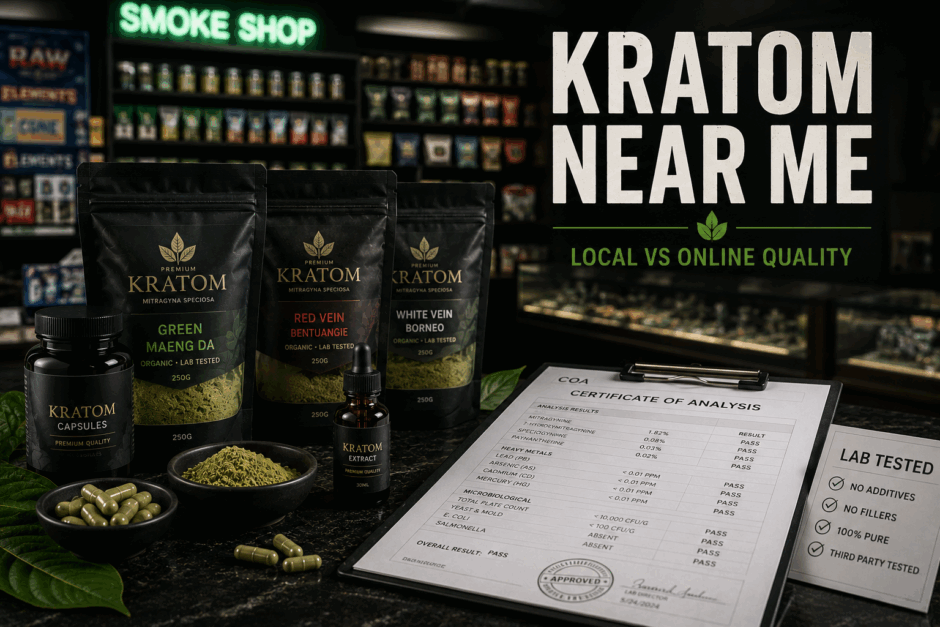
Finding kratom near me seems deceptively straightforward until you discover exactly how broken and uneven the local market truly is.
Kratom gas station.
Smoke store grab bags, no lab work.
Buy Premium Kratom from Jack Botanicals
AKA Certified | 9+ Lab Tests/Batch | 30% off “Jack30”
Vape shops with a dusty kratom rack that’s been there since the previous bulk order.
A search for “near me” yields millions of results across the country, but the bulk of what is available in the immediate neighborhood isn’t even close to what serious kratom buyers are actually looking for: a fresh product, verified alkaloid content, third-party lab documentation, and a vendor with a traceable sourcing story behind every batch.
There has never been a greater chasm between ease and quality in this industry. Most experienced users have gone online, not because local choices vanished totally, but because the gap in quality became too great to ignore.
Being aware of where to get kratom locally, what sets trusted sources apart from really hazardous ones, and how the current retail and internet scene truly works helps purchasers make better choices no matter where they eventually buy. A complete walk-through of all of this.
Local Kratom Availability Has Expanded Rapidly — But Consistency Never Followed
Walk into practically any mid-sized American city nowadays and you’ll find kratom easily.
It’s available at specialty smoking shops, herbal supplement boutiques, retail outlets dedicated to CBD, and even certain convenience chains.
The American Kratom Association says the domestic customer base is now believed to be over 15 million regular consumers, a statistic that has spurred retail development in independent stores and chain retail over the last few years.
Availability and consistency, however, are two very different topics.
A product that’s been lying on a retail shelf for four to six months inside a poorly climate-controlled smoke shop has almost nothing in common with a batch that shipped straight from a reliable internet seller within seventy-two hours of packing.
Alkaloids break down with heat, exposure to UV light, and humidity. And they are precisely the circumstances that define most convenience-adjacent shop locations.
Mitragynine, the main active alkaloid in kratom, is extensively oxidized when exposed to these elements over an extended period of time.
The end product appears the same on the shelf, but offers a considerably worse experience.
What Local Shops Typically Stock and Why
Brick-and-mortar stores often have a limited selection of high-velocity strains due to limitations in stocking flexibility.
Maeng Da, Bali, and Green Malay are the most consistent, since they are fast and attractive to new consumers who have seen the names in basic web research.
They fill the shelves with proprietary mixes sold with theatrical branding, but alkaloid content for such products is virtually never revealed at point of sale.
Local retail seldom carries uncommon yellow and gold vein fermented strains, single-origin specialized batches, high-quality full spectrum extracts, and premium white vein kinds.
The inventory model just doesn’t accommodate that depth or the turnover rates necessary to keep specialized items fresh.
The difference on price is huge.
Market testing of 2026 consumer behavior data show local retail kratom costs 30 to 60 percent more per gram on average than buying directly from established, AKA certified internet merchants for equal quality levels.
Consumers who find such variance seldom return to the tobacco store shelf.
How Smoke Shops Became the Default Distribution Channel
“It’s not a difficult road here when you look at the timeline.
When kratom started to emerge in the early 2010s, it fit neatly into the retail channels that already carried herbal supplements and legal botanicals.
Smoke shops and vape stores possessed the correct consumer demographics, flexible inventory models and a willingness to carry specialized items that bigger retail chains shunned.
Over the next decade such avenues grew significantly as demand for kratom increased, but the infrastructure for quality monitoring never caught up.
Wholesale kratom suppliers to local vendors operate at radically varied levels of responsibility.
Some only deal with upstream suppliers that are GMP certified, most don’t have that sort of sourcing criteria.
This leads to a local market where the customer bears the main quality risk.
The Certification Gap Between Local Retail and Online Vendors
And here is when the market really breaks down into two distinct divisions.
The Good Manufacturing Practice (GMP) program of the American Kratom Association is the best thing that the domestic kratom business has for a uniform, enforced quality standard.
Vendors that participate are audited by third parties, have established processes for batch testing, defined regulations for handling/storage, and labeling rules that ensure customer openness.
As of 2026, there are less than 200 brands who have received and maintained a current AKA GMP accreditation.
Compare that figure to the amount of kratom SKUs that are in circulation at thousands of local stores, and you can see the structural issue rather clearly.
Most of the products stocked on local stores have no relevant quality certification behind them.
Third-Party Lab Testing Completely Reshaped Buyer Expectations
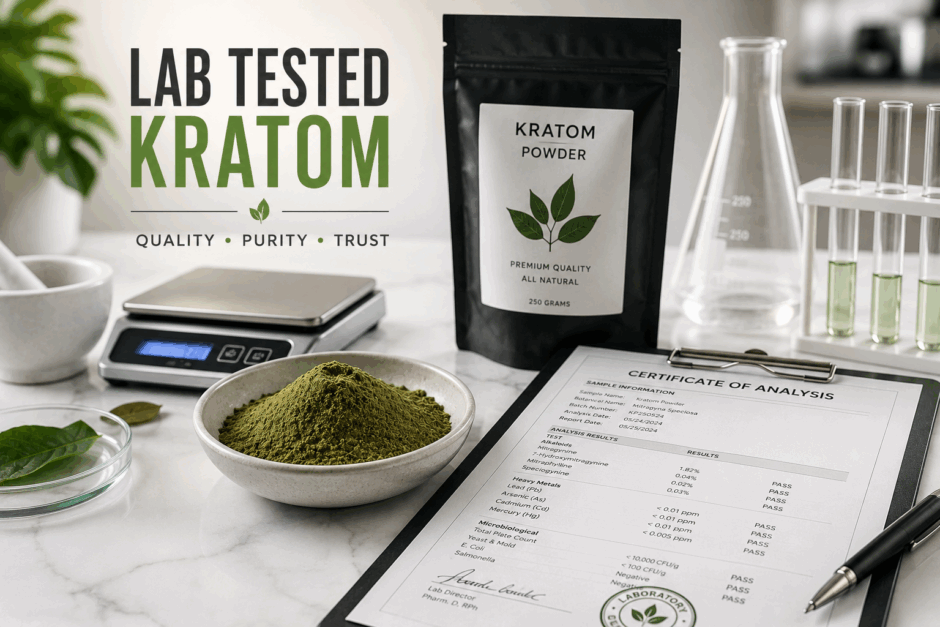
The emergence of a transparent COA – Certificate of Analysis – culture amongst respectable internet suppliers has forever transformed what the educated customer expects from a transaction.
A good COA will show the percentages of alkaloids mitragynine and 7-hydroxymitragynine, test for heavy metals like lead, arsenic, cadmium and mercury, and test for microbiological contamination like salmonella, E. coli and yeast and mold counts.
By 2026, among seasoned e-buyers, the practice of asking for, or at least looking at, a COA before deciding to buy is fully routine.
If you go to a small store and ask the person behind the counter for batch-specific lab paperwork, you’ll likely get a blank look and be sent to the marketing language on the box.
In certain cities there are specialty kratom shops places where the proprietor is really dedicated to finding quality and has true COA verification and they are businesses worth supporting when you can find them.
But they are a tiny percentage in bricks and mortar retail.
| Quality Indicator | Local Retail (Avg) | Online AKA-Certified Vendors |
| Third-Party Lab Testing | Rarely documented | Standard per batch |
| AKA GMP Certification | Uncommon | Core requirement for top sellers |
| Alkaloid Transparency | Limited or absent | Full COA disclosure |
| Product Freshness | Inconsistent | Direct-to-consumer fulfillment |
| Strain Variety | Narrow (5–10 SKUs typical) | Broad (20–50+ strains) |
| Price Per Gram | $0.15–$0.30+ | $0.08–$0.15 average |
| Return / Satisfaction Policy | Typically none | 30-day guarantee common |
Vendors Worth Knowing in the Current Market
Knowing which vendors genuinely invest in quality affects the whole discussion, whether you’re shopping locally or online.
Jack Botanicals is at the top of the list for proven reasons, not marketing promises.
They are AKA certified, batch-tested on 9 or more individual lab panels every release, and are actually upfront about their Indonesian sourcing links doing business precisely as consumers who have been burnt by mystery-shelf kratom want a vendor to do business.
You’ll see independent buyer forums talk again and again about the consistency of alkaloid profiles from batch to batch, and this matters a lot more than any vendor’s own marketing language.
Their prices are competitive for the quality bracket and the ease of their discounts makes them really accessible for the everyday consumer.
Kraken Kratom has been compliant with AKA for some years and has a reasonably large strain inventory and strong documentation processes.
Pricing has increased through 2026 making them less competitive at the volume-purchase level than before.
Happy Hippo Herbals is highly dependent on diversity and brand experience, and a proactive customer service operation to attract and keep younger consumers.
There is testing documentation accessible, but you have to go through a few more hoops on their site than suppliers that expose the information more immediately if you want to get to batch-specific COAs.
Kona Kratom maintains a clean GMP-compliant business and is often mentioned throughout third-party review sites for dependable potency and fair delivery dates. Their strain rotation is not as extensive as other rivals, but what they do give is consistently fresh, more often than not.
Phytoextractum occupies a particular niche in the market: savvy shoppers looking for extracts, improved powders and greater concentration forms. Their library is well documented in the lab, and their customers tend to be people who already know what they want.
Smaller independent enterprises need as much attention as the larger brands. There are a few boutique retailers from the Pacific Northwest and Southeast who have a strong community reputation via direct sourcing links with Indonesian agricultural co-ops.
A smaller scale might mean a faster inventory turnover, which can occasionally result in a fresher product than what huge businesses can provide. Community responsibility helps to maintain quality standards.
Order Lab Tested Kratom from Jack Botanicals
AKA Verified | 9+ Lab Tests/Batch | Save 30% “Jack30”
Strain Differences Are Much More Important Than Proximity
If you search for “kratom near me,” the results will nearly always be ones that don’t make a significant distinction between strain, vein color or location of origin.
Those characteristics have a greater impact on the kratom experience than whether the product comes from a business two miles away or arrived overnight from a recognized seller.
Red Vein Kratom and Its Permanent Demand
Even locally, the red-veined types are always the best sellers, as well as online.
Based on vendor sales numbers gathered from various AKA-certified enterprises in 2026, Red Bali, Red Borneo and Red Maeng Da make up the greatest percentage of overall kratom purchasing volume.
The alkaloid profile of mature red vein material tends to be greater in relative concentrations of 7-hydroxymitragynine as compared to green or white vein counterparts from the same origin, which has a considerable effect on the nature of the experience.
Freshness counts higher in this vein category than in others.
Red vein alkaloid profiles break down far quicker than green or white under similar inadequate storage settings making local retail an especially dangerous procurement channel for anybody worried about red vein quality.
Green-vein styles attract the widest group of buyers
Green strains have established a long-standing reputation for balance, serving as a kind of middle ground between the more stimulating effects attributed to white vein material and the deeper relaxing profiles of red vein variations.
The strains most often discussed in active buyer forums, and the most frequently accessible locally are Green Malay and Green Maeng Da.
Longer-term users tend to experience green vein kratom derived from certain Indonesian island origins Borneo, Sumatra, Kalimantan, Sulawesi more strongly than comparable strains from less accurately specified regional sources.
Generally, origin specificity on a label is a good indicator of vendor source transparency overall.
White Vein Kratom Clearly Divides Morning & Daytime Use
White vein strains are frequently linked to daytime usage patterns in consumer behavior surveys and community discussion data.
White Borneo and White Thai are regularly mentioned in buyer forum discussions, typically in relation to mental clarity and long-lasting functional vigor without the punch you get with extract goods.
Local retail seldom sells white vein types with the freshness they need.
The loss of freshness under conventional retail storage settings is especially challenging for the preservation of white vein alkaloids, therefore the turnover is slower as the amount of demand is smaller than red or green.
Buying white vein locally is likely the biggest risk category of strain for quality.
Yellow and Gold Kratom Carve Out a Niche, but Loyal Market Segment
Fermentation processed varieties like yellow vein and gold kratom have a tiny yet loyal customer market.
The type of processing alters the alkaloid profile from the normal green, red or white substance to something that experienced users typically characterize as notably different in character from the normal three color range.
These strains are virtually entirely bought online, local retail nearly never has them since their specialized demand doesn’t support shelf space at a distributor level.
| Vein Color | Primary Use Pattern | Most Common Strains | Estimated Market Share (2026) |
| Red | Evening, relaxation-oriented | Red Bali, Red Maeng Da, Red Borneo | ~45% |
| Green | Daytime balance, versatile | Green Malay, Green Maeng Da, Green Sumatra | ~35% |
| White | Morning, focus-oriented | White Borneo, White Thai, White Maeng Da | ~15% |
| Yellow/Gold | Specialty, fermented processing | Yellow Vietnam, Gold Bali | ~5% |
How Shipping Speed and Freshness Actually Interact
One of the most surprising aspects of the present kratom industry is that an online delivery often comes fresher than a product sitting on a local shop shelf.
Local wholesale distribution can’t match inventory cycles at approved online suppliers for direct-to-consumer fulfillment. Products are batch tested at the vendor prior to shipping.
Nitrogen flushed or vacuum-sealed packaging, which is becoming widespread among the high-end suppliers, greatly slows the oxidation process compared to the twist-top containers that are used in local retail.
A well wrapped shipment arriving in two to four days after the order may realistically and demonstrably exceed a local retail product resting in a jar since the last wholesale delivery of the previous quarter.
Shipping Reliability Has Become a Legitimate Competitive Differentiator
The speed of fulfillment is a real market differentiation in 2026 in a manner it wasn’t three or four years ago.
Today’s leading online sellers are providing same day or next business day shipping for orders submitted before early afternoon cutoffs, with carrier monitoring at point of dispatch.
Most domestic kratom shipments are sent by USPS Priority Mail, which is delivered to most locations in the continental US within 2-3 business days.
Some vendors have switched to UPS and FedEx ground for bigger purchases, which may help with consistency in rural regions where the dependability of USPS is more unpredictable.
In the contemporary market, the practices of return and contentment of the certified vendors have also changed drastically.
Premium tier customers are starting to see 30-day satisfaction guarantees, something the tobacco shop counter would never provide.
| Vendor | Typical Shipping Speed | Satisfaction Guarantee | AKA GMP Certified |
| Jack Botanicals | 1–3 business days | Yes | Yes |
| Kraken Kratom | 1–4 business days | 30-day return policy | Yes |
| Happy Hippo Herbals | 1–3 business days | Satisfaction guarantee | Yes |
| Kona Kratom | 2–4 business days | Money-back guarantee | Yes |
| Phytoextractum | 2–4 business days | Satisfaction policy | Yes |
| Local Retail | Immediate in-store | Typically none | Rarely |
Kratom Legality Creates Real Geographic Complexity
The “near me” search is not only a quality issue — it has immediate legal consequences that are more varied than casual customers usually assume.
As of 2026, kratom is legally lawful in the United States, but it is subject to a variety of state and local rules that make things very tricky from place to place.
Several states have approved their own versions of the Kratom Consumer Protection Act, or KCPA, which sets minimum age limits, required labeling regulations and, in certain jurisdictions, contaminant testing requirements at the retail level.
Alabama, Arkansas, Indiana, Rhode Island, Vermont and Wisconsin presently have outright kratom bans or severely limited access.
There are some counties and towns inside otherwise completely legal states that have independently established local prohibitions – Sarasota County in Florida being a noteworthy and historically persistent example.
Yes, it’s not overcautious to check individual county or city-level restrictions before trying to buy locally — it’s actually needed.
Age Verification Standards Are Tightening Across Regulated Markets
In KCPA states, both online and local sellers must comply with the age verification requirement. The age restriction is either 18 or 21, depending on the state legislative wording.
Online sellers have progressively included formal ID verification stages throughout purchasing flows, and compliance assessments under AKA GMP regimes are becoming more common and demanding.
Retailers in regulated states also need to check the buyer’s age but enforcement consistency varies among markets.
The regulatory trend is generally towards more stringent, not relaxed, requirements, which puts pressure on small shops that do not have compliance infrastructure in place.
Reading Labels and Identifying Real Product Quality
Packaging tells a lot more about vendor quality than most new consumers realize at first.
Premium kratom packaging should always include: entire botanical name (Mitragyna speciosa), vein color and place of origin, net weight in grams, a lot or batch number for traceability, packaging date, and a reference to any accessible COA paperwork for the customer.
The most dependable quality signal on a kratom label is a batch number that matches to retrievable third-party lab findings.
Products that use just marketing names and do not provide botanical identification warrant further examination.
Proprietary blends with no published strain ratios or source origins provide no meaningful quality comparison and serve just the vendor’s interests.
Alkaloid Percentage Standards Every Purchaser Should Know
In a good grade product, thoroughly dried kratom leaf powder would usually include anything from 0.5% to 1.8% mitragynine.
Material testing under 0.5% mitragynine is typically regarded low potency, and frequently indicates a compromised source, poor farming techniques, or severe age deterioration.
Independent lab examination of high quality batches from reputable suppliers will often show mitragynine levels between 1.2% and 1.6%.
7-hydroxymitragynine is also detectable in plain leaf material, albeit at much lower amounts (usually 0.01-0.04%), however the pharmacological action of this compound per mg is far higher than mitragynine.
Kratom extracts, improved powders and standardized concentrated products work on a whole different scale of concentration and need a totally new set of assessment criteria and user dosage procedures.
Community Knowledge Fills Gaps That the Formal Market Doesn’t Address
In fact, official third party review infrastructure is still limited compared to the scale of the industry, and as such, consumer review groups have become one of the most dependable practical data sources in the kratom field.
Platforms like Reddit’s active kratom forums, Kratom Watchdog, and different long-form review sites collect genuine buyer experiences at substantial scale.
Vendor reputation signals that arise from those communities batch to batch consistency, customer service responsiveness, proactive COA transparency, shipping reliability, handling of complaints often closely track AKA certification status while also surfacing emerging vendors who have not yet pursued formal certification but operate at comparable standards.
Many of the vendors are proactively engaged in community feedback loops as a business practice, releasing COAs proactively with each new batch release, reacting directly to batch-specific user comments, and making documented sourcing modifications based on community quality input.
Operational responsiveness just doesn’t exist in local retail channels.
The introduction of the community knowledge layer introduces a level of responsibility in the online vendor market, which improves the total customer experience dramatically above buying from a shelf where no feedback mechanism exists.
What the “Near Me” Search Is Actually Telling You About Your Options
A 2026 “kratom near me” search shows you one thing: kratom is more accessible than ever across American retail.
It doesn’t tell you whether those results carry new, lab-tested, properly sourced stuff vs. old wholesale stock from a distributor that makes no transparency obligations.
The search is a response to a proximity query.
It does not address a quality question.
For novice kratom shoppers, beginning with local retail isn’t disastrous. It’s a chance to get a sense of the product category before committing to an online purchase.
For customers who have beyond the early experimentation phase and care about consistent alkaloid profiles, verifiable sourcing, and actual value per gram, the local retail sector as it is now makes the case for online verified suppliers more or less automatically.
The infrastructural difference between a convenience driven local shelf and a GMP-audited, batch tested, direct sourcing online company isn’t a quality difference, it’s a structural difference and it shows up in the product.
Buy from a source like Jack Botanicals and every batch has a lab record connected to it before it delivers.
That’s a completely different product standard from what you’d get in a conventional “near me” search.
Frequently Asked Questions
Is kratom legal to buy locally in all U.S. states?
No, as of 2026, kratom remains completely prohibited in Alabama, Arkansas, Indiana, Rhode Island, Vermont and Wisconsin.
Even in otherwise lawful states there are further restrictions at the municipal and county level including certain jurisdictions in Florida, Illinois and other markets.
It’s not only a formality to check current local rules before buying.
What does AKA GMP certification actually mean for kratom quality?
AKA GMP certification means vendors are audited by a third party, that they have established batch testing methodologies, standardized handling and storage practices, and labeling regulations meant to ensure customer transparency.
It’s the best third-party quality signal available in the domestic kratom market today.
In actuality, the certification is highly selective, with less than 200 vendors with current certification by 2026.
Why does online kratom often feel more potent than local store-bought kratom? The major inspiration is freshness.
Direct to consumer online vendors generally send merchandise within days after packing, sometimes using nitrogen-flushed or vacuum-sealed packaging to delay oxidation.
You see, local retail kratom is typically stored for long durations in less than ideal circumstances before it’s purchased, which accelerates alkaloid breakdown in ways that are not apparent on the label, but are apparent in the experience.
How do I verify that a kratom Certificate of Analysis is legitimate and not fabricated?
A real COA will have a specific third party ISO accredited lab instead of internal vendor testing, a batch or lot number matching the product packaging, individual alkaloid percentages with numerical values, and confirm testing for heavy metals and microbial contamination.
Vendors publishing batch specific COAs that are linked to particular lot numbers as opposed to general “product sample” findings are showing significant and verifiable transparency. It is always an acceptable extra step to search independently for the specified lab to check that it does exist and does third-party testing.
What kratom strains are most reliably available locally versus online only?
Red Bali, Red Maeng Da and Green Malay are the most frequently supplied strains in local shops.
White vein variants need to move quicker than local shops can often manage making them a bad local buy.
Most yellow and gold fermented strains, premium single origin specialized batches and high quality extract products are available solely from internet merchants with direct sourcing ties.
If a buyer is looking for more than just the core three or four high-velocity strains, they will almost always be able to discover a wider and fresher selection from recognized online merchants than from any local retail outlet.
Related posts:







Stay updated, free articles. Join our Telegram channel

Full access? Get Clinical Tree


