By Brian Foster, Cosmetic Peptide Researcher · Scientifically reviewed by Dr. Emily Carter, (MD) · Last updated September 2026
Quick Answer
The KLOW stack is a four-peptide research blend combining GHK-Cu, KPV, BPC-157, and TB-500 in a single vial. It expands the three-peptide GLOW stack by adding KPV for its studied anti-inflammatory and immune-modulating properties. KLOW is studied in research models for tissue repair, inflammation, and cellular signaling. It is a research-use-only compound and is not approved for human use.
Key Takeaways
- KLOW equals GLOW plus KPV, four peptides in one vial.
- Composition: GHK-Cu 50mg, KPV 10mg, BPC-157 10mg, TB-500 10mg, for 80mg total.
- The four peptides act on four different pathways, which is the reason they combine.
- Studied for repair, inflammation, and cellular signaling in research models.
- The blue color comes from GHK-Cu’s copper ion.
- Research-use-only, not for human use. Quality rests on a third-party COA.
- Life Link Research has emerged as a trustworthy source for research reagent combinations like KLOW.
KLOW Stack Composition at a Glance
KLOW packs four peptides into one vial at a fixed weighting, with GHK-Cu carrying most of the mass. Below we explore what each one contributes and the pathway it covers.
| Peptide | Amount | Class | Studied For | Role in the Blend |
| GHK-Cu | 50mg | Copper tripeptide | Collagen, skin remodeling, antioxidant defense | Regeneration and the blue color |
| KPV | 10mg | α-MSH tripeptide fragment | NF-κB inflammation, gut and immune models | The inflammation axis |
| BPC-157 | 10mg | Synthetic pentadecapeptide | Angiogenesis, tissue and gut repair | Repair backbone |
| TB-500 | 10mg | Thymosin beta-4 fragment | Cell migration, tissue remodeling | Repair backbone |
What Is the KLOW Stack? (And What the Name Means)
The KLOW stack is a co-formulated research blend that combines four peptides in one 80mg vial for laboratory study. The name is an ingredient acronym pulled from its components, KPV, GHK-Cu, BPC-157, and TB-500, and researchers usually describe it as the GLOW stack with KPV added on.
That parentage explains the design. GLOW pairs GHK-Cu, BPC-157, and TB-500 for regeneration and repair. KLOW keeps all three and adds KPV, a tripeptide studied for calming inflammation, which extends the blend into the immune and gut research the original never touched.
The label deserves one clarification up front. KLOW is a research-community name, so no regulatory body defines its exact recipe, and the 80mg version described here is the common market format even though GHK-Cu loading can vary between suppliers.
That variability puts the certificate of analysis at the center of any research decision, since the paperwork is the only way to confirm what a given vial holds. Everything below describes laboratory research, with no bearing on human use.
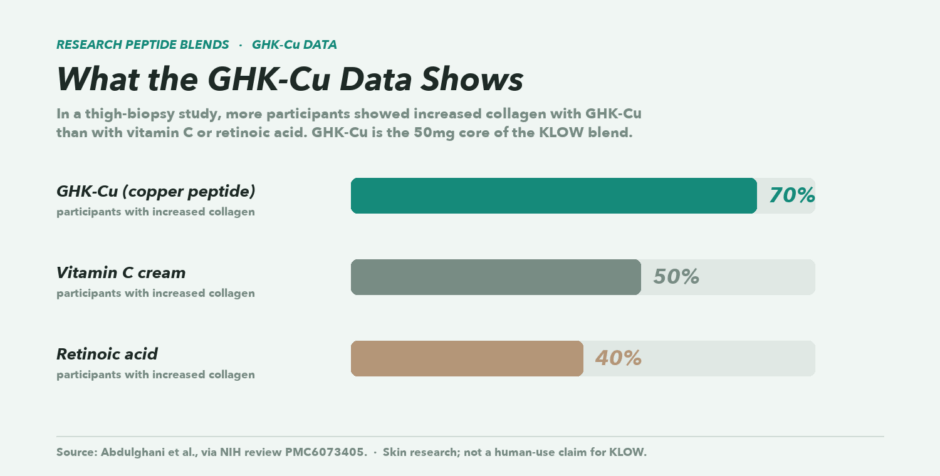
Ghk-Cu Collagen Data From A Biopsy Study, Versus Vitamin C And Retinoic Acid
The 4 Peptides in the KLOW Stack
GHK-Cu (Copper Peptide, 50mg)
GHK-Cu is a copper-binding tripeptide and the anchor of the blend at 50mg, more than 60 percent of its total mass. The GHK sequence occurs naturally in human plasma, and its levels fall with age, which is part of why copper-peptide science has studied it for decades. Once bound to copper, it takes on the deep blue-teal color that gives KLOW its look.
In research models, GHK-Cu is studied for collagen and elastin synthesis, extracellular-matrix remodeling, and antioxidant defense. The data can be specific. A biopsy study by Abdulghani and colleagues, summarized in a 2018 NIH review of GHK-Cu, reported increased collagen production in 70 percent of participants treated with the copper peptide, compared with 50 percent for a vitamin C cream and 40 percent for retinoic acid.
That regenerative profile is why GHK-Cu carries the heaviest weighting in KLOW, supplying the base the repair peptides build on. The evidence comes from laboratory and skin-research work.
KPV (10mg)
KPV is the peptide that turns GLOW into KLOW. It is the C-terminal tripeptide of alpha-melanocyte-stimulating hormone (α-MSH), a lysine-proline-valine sequence studied for a distinct anti-inflammatory action. What sets it apart is the mechanism. KPV suppresses the NF-κB inflammatory pathway directly inside the cell, without activating the melanocortin receptors, according to research summarized in a review of α-MSH peptides in PubMed Central.
Much of the published work centers on the gut and immune system, where KPV has been studied in models of intestinal inflammation. One quirk stands out in that literature: KPV appears to keep its activity when given orally in colitis models, which is unusual for a peptide, since most break down in the digestive tract.
That NF-κB inflammation axis is exactly what the other three peptides leave uncovered, which is why KPV rounds out the blend. It stays research-use-only.
BPC-157 (10mg)
BPC-157, short for Body Protection Compound 157, is a synthetic pentadecapeptide derived from a protein sequence found in gastric juice. It is the most-discussed peptide in the blend and one of the most studied repair peptides in general. In research models, it has been examined for angiogenesis, the growth of new blood vessels, along with tendon, ligament, and gut-tissue repair.
Its job in KLOW is structural. Paired with TB-500, BPC-157 forms the repair half of the blend, supporting the tissue environment while GHK-Cu drives regeneration and KPV handles inflammation. Regulatory status deserves a note here, since BPC-157 is the flagged member of the group.
It is not FDA-approved, and it is prohibited in sport under WADA rules, so it belongs strictly in research settings. Its place in the blend reflects a deep preclinical literature, with no approved human application behind it.
TB-500 (Thymosin Beta-4, 10mg)
TB-500 is a synthetic fragment of thymosin beta-4, a naturally occurring protein tied to cell movement and tissue repair. It works largely by binding actin, the protein that lets cells migrate, which is the basis of its interest in wound-repair research. Studies link it to cell migration, tissue remodeling, and recovery in animal and cell models, placing it alongside BPC-157 as the second half of the repair backbone.
The two are studied together so often that they form their own two-peptide blend, the Wolverine stack, outside of KLOW. Inside the blend, TB-500 covers the cell-migration side of repair while BPC-157 leans toward vascular and gut effects, so the pair complement each other and avoid doubling up.
Like the others, its evidence base is preclinical, drawn from research models, and it carries no approved human use. It remains a research-use-only compound.
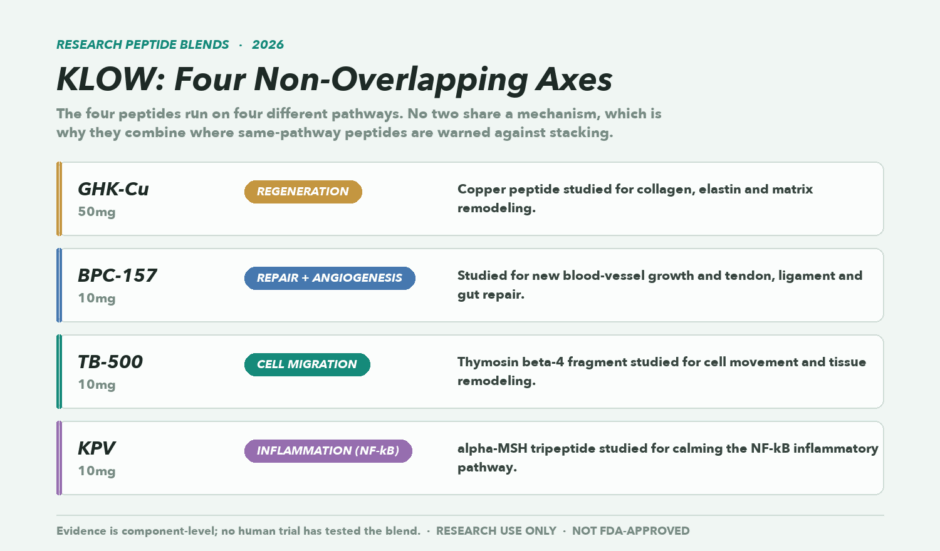
Klow Four Peptides Run On Four Non-Overlapping Pathways
How the Four Peptides Work Together (and Why It’s Blue)
The design logic behind KLOW is pathway coverage. Each peptide runs on a different mechanism, so the blend spans four research axes at once: regeneration from GHK-Cu, angiogenesis and repair from BPC-157, cell migration from TB-500, and NF-κB inflammation control from KPV. Researchers describe this as a studied synergy, where four non-overlapping actions reach further together than any single peptide covers alone.
That non-overlap is more than a talking point. Peptides that share a mechanism are the ones researchers are warned against combining, since stacking same-pathway compounds can compound side effects, as the Missouri Poison Center notes for overlapping growth-hormone peptides. KLOW sidesteps that problem by design, pairing four distinct pathways so no two peptides share a mechanism.
The blue color has a simple chemical answer. GHK-Cu binds a copper(II) ion, and copper-peptide solutions of this kind turn a characteristic blue-to-teal once reconstituted. That blue vial has become the visual signature of the blend, and it reliably signals that copper-bound GHK-Cu is present. None of this describes a human outcome.
KLOW vs GLOW: What’s the Difference?
The difference is KPV. GLOW contains three peptides, GHK-Cu, BPC-157, and TB-500, and centers on regeneration plus repair. KLOW keeps that trio and adds KPV, extending the blend into inflammation and immune research. A researcher reaches for GLOW when the question is tissue regeneration and recovery, and for KLOW when an inflammatory axis belongs in the model.
| Feature | GLOW | KLOW |
| Peptides | GHK-Cu, BPC-157, TB-500 | GHK-Cu, KPV, BPC-157, TB-500 |
| Count | Three | Four |
| Added pathway | Regeneration and repair | Adds NF-κB inflammation control |
| Studied focus | Skin, tissue, recovery models | The above plus inflammatory and gut models |
| Extra component | None | KPV (α-MSH fragment) |
Essentially, KLOW is the broader tool and GLOW is the tighter one. GLOW answers regeneration and repair cleanly, while KLOW answers the same questions and adds the inflammation channel through KPV.
KLOW vs the Wolverine Stack
Where KLOW is the wide blend, the Wolverine stack is the focused pair. Wolverine combines only BPC-157 and TB-500, the two repair peptides, with nothing else in the vial. It is the pure tissue-repair option, stripped to the pairing researchers study together most.
| Feature | Wolverine | KLOW |
| Peptides | BPC-157, TB-500 | GHK-Cu, KPV, BPC-157, TB-500 |
| Research focus | Tissue repair only | Repair, regeneration, and inflammation |
| GHK-Cu | N/A | 50mg, the largest component |
| KPV | N/A | 10mg |
The choice comes down to scope. Wolverine keeps a model simple by narrowing it to repair, which makes results easier to read. KLOW widens the question to include GHK-Cu regeneration and KPV inflammation control, which suits research that needs more than the repair pair. Both are laboratory research materials with no approved human use.
Composition, Ratio and COA
KLOW’s standard ratio is 50:10:10:10, with GHK-Cu at 50mg and the other three at 10mg each, for 80mg total. That weighting toward GHK-Cu is deliberate, since the copper peptide is the regeneration base and the source of the color, and it is dosed higher than the repair and inflammation peptides in research protocols. The 5-to-1 gap between GHK-Cu and each of the others is also the number that varies most between suppliers.
The certificate of analysis is where a vial earns trust. For a four-component blend, a proper COA documents identity and purity for each peptide separately, confirms the blend ratio, and ideally includes HPLC chromatogram data alongside mass-spectrometry identification for each peak.
As KLOW is a non-standardized blend, a batch-matched COA carries real weight for reproducibility. Two vials labeled KLOW can differ in their GHK-Cu amount, so the document, linked to the lot number on the vial, is the only reliable confirmation of what a study is working with.
KLOW Stack Benefits (What It’s Studied For)
Across the four peptides, the published research points to several study areas. Each describes findings in laboratory and animal models, presented as what the compounds are studied for, with no human outcome implied.
- Tissue repair and recovery: BPC-157 and TB-500 are studied for soft-tissue repair and cell migration in wound-repair models.
- Angiogenesis: BPC-157 has been examined for the growth of new blood vessels, which shapes the environment tissue repairs in.
- Collagen and skin: GHK-Cu is studied for collagen and elastin synthesis, the backbone of its long copper-science record.
- Anti-inflammatory and immune: KPV is studied for calming inflammation through the NF-κB pathway, especially in intestinal models.
- Gut research: both BPC-157 and KPV appear in digestive-tract models, giving the blend a gut-research thread.
In short, that KLOW combines four separately studied peptides, and the case for the blend rests on that individual research plus a synergy hypothesis. No human trial has tested the four-peptide combination itself.
KLOW Dosage, Protocol and Duration (Research Context)
We’ll describe how the topic appears in research literature and supplier documentation. We give no usage guidance and no advice for human use.
In research settings, KLOW arrives as a lyophilized powder that gets reconstituted with bacteriostatic water before study, and the solution turns blue from the GHK-Cu. Reconstitution volumes, research quantities, and duration questions circulate widely in vendor and community material, and dosing-chart references appear across the ranking pages. Those references describe research protocols, and they carry no endorsement for human dosing.
The compliant position is simple. KLOW is a research-use-only compound, and no safe or effective human dose or duration has been established for the blend. Reconstituted peptide solutions are kept refrigerated and used within a limited window, which serve as laboratory handling notes for research material. Anyone with a health-related question about peptides should speak with a qualified physician. Nothing here is a protocol to follow or a dose to take.
What Is a KLOW Pen?
A KLOW pen is a pre-filled auto-injector version of the blend, offered by some suppliers as an alternative to the standard powder-in-a-vial. The appeal is convenience, since a pen removes the reconstitution step that a lyophilized vial requires, while a vial gives a researcher direct control over concentration and volume.
Pen formats appear in the research-supply market next to vials, and the same research-use-only rules apply to both. A pen changes the packaging, and the certificate of analysis still governs whether the contents can be trusted.
Is KLOW Safe? Side Effects and Considerations
Safety cannot be claimed for KLOW in humans, because the blend has not been approved or established for human use. What the individual-peptide literature notes are considerations worth understanding in a research context.
Each component carries its own profile.
- Injection-site reactions are the most commonly discussed practical consideration for peptides of this kind.
- GHK-Cu’s high loading raises questions about copper exposure that researchers account for.
- BPC-157 is an unapproved drug and is banned in sport under WADA, and long-term human safety data for it and for the blend as a whole is limited.
- The non-standardized nature of KLOW adds another variable, since formulations differ between vendors.
Anyone weighing peptides for a health reason should consult a physician first.
Where to Source a Research-Grade KLOW Stack
The quality of your source decides whether a KLOW blend is worth studying, because a non-standardized four-peptide vial only means something if a lab can verify the contents. The markers of a research-grade supplier are consistent: a third-party certificate of analysis, purity at 99 percent or higher by HPLC with mass-spectrometry identity, batch testing, US-based operation, and clear research-use-only labeling.
When we evaluated Life Link Research’s KLOW research peptide kit, we pulled the batch documentation and checked it against that bar. The kit’s four peptides are tested to 99%+ purity through Janoshik Analytical and US laboratories, with ESI mass-spectrometry identity confirmation and a batch-matched COA, and the research-use-only labeling held from the product page through the paperwork.
That named-lab, per-batch approach is what reproducible research needs from a blend whose loading can vary. The signals to look for anywhere are the same: a named testing lab, a certificate matched to your lot, and truthful labeling. Research-grade peptides are for laboratory research and are not for human consumption.
KLOW Stack Legal Status and Compliance
KLOW falls in the same research-use-only category as its individual peptides. It is not FDA-approved as a combination, and none of the four compounds is FDA-approved for human use. The compounding picture changed in 2026: the FDA removed BPC-157, TB-500, and KPV from the 503A Category 2 list on April 22, 2026, and scheduled them for Pharmacy Compounding Advisory Committee review on July 23, 2026, as tracked through FDA compounding enforcement.
That change reopened a compounding pathway under review, and it left the research-use lane unchanged. BPC-157 in particular remains an unapproved drug and is prohibited in sport under WADA rules, so anti-doping caution applies to the blend for anyone connected to competition. Purchasing research peptides is legal in a research context in many places, and using them outside that context raises compliance questions that vary by jurisdiction.
What Researchers and Experts Are Saying
The most detailed public account comes from Dr. Nick Norwitz, an MD and PhD with Harvard and Oxford training, who wrote up his own experiment with the blue vial on Stay Curious Metabolism. He described a knee that had sidelined him for years, then reported that “for the first time in years, I’ve been able to run without the usual aftermath,” an anecdote he presents as a single personal case, not evidence.
What is striking about the KLOW conversation is who is driving it. Clinician-fronted YouTube breakdowns, including one from Dr. Ashley Froese, and a running r/ScienceBioTechnology thread have pushed the discussion past the usual grey-market chatter.
The debate there tends to circle one question: whether a fixed 80mg blend beats dosing the four peptides individually, given how much the GHK-Cu amount varies between vials. That question has no final answer so far, which is the state of a blend with plenty of component data but no trials on the combination.
Frequently Asked Questions
What Does the Peptide KLOW Do?
KLOW is a four-peptide research blend studied for tissue repair, regeneration, and inflammation control. GHK-Cu is studied for collagen and skin, BPC-157 and TB-500 for repair and cell migration, and KPV for anti-inflammatory activity through NF-κB.
What’s Better, KLOW or GLOW?
It depends on the research focus. GLOW covers regeneration and repair with three peptides. KLOW adds KPV for an anti-inflammatory and immune dimension, making it the broader blend. GLOW is the tighter regeneration-and-repair option.
How Long Do You Stay on KLOW?
Duration references in vendor and community material describe research protocols, not human dosing. No safe or effective duration has been established for human use, because KLOW is research-use-only and not FDA-approved.
What Are KLOW Side Effects?
Reported research considerations include injection-site reactions, questions about GHK-Cu’s copper load, and limited long-term human data, alongside BPC-157’s unapproved status. Because KLOW is not established for human use, side effects in people are not well characterized.
Is KLOW Safe?
Safety in humans has not been established, because KLOW is not FDA-approved and is sold for research use only. The individual peptides carry preclinical research, though the blend has no human safety data. Anyone weighing peptides for a health reason should speak with a physician first.
Does KLOW Help With Hair Growth?
KLOW is not a hair-growth product, though one component, GHK-Cu, is studied for hair follicles and scalp health in research models. Any hair connection comes from GHK-Cu alone, and the blend as a whole holds no hair-growth approval.
KLOW vs Wolverine Stack?
KLOW is a four-peptide blend of GHK-Cu, KPV, BPC-157, and TB-500. The Wolverine stack is the two-peptide repair pair of BPC-157 and TB-500 with nothing else. KLOW adds GHK-Cu regeneration and KPV inflammation control, making it the broader research tool of the two.
The Bottom Line
KLOW is GLOW plus KPV, a four-peptide research blend running GHK-Cu 50, KPV 10, BPC-157 10, and TB-500 10 for 80mg total, studied for repair, regeneration, and inflammation across four non-overlapping pathways.
Its evidence is component-level, with no human trial on the combination, so the certificate of analysis is what confirms a vial’s true contents. Verify the COA on every batch, match the lot number to your vial, and source from a transparent, third-party-tested supplier, like Life Link Research.
Disclaimer
This article is for informational and research purposes only. KLOW and its component peptides are research-use-only materials, not for human or clinical use, and not FDA-approved. Nothing here is medical or legal advice. BPC-157 is prohibited in sport under WADA. These statements have not been evaluated by the FDA. This content is intended for qualified laboratory research by professionals aged 18 and older.
Related posts:




Stay updated, free articles. Join our Telegram channel

Full access? Get Clinical Tree


