By Shonda Mills, Cosmetic Peptide Researcher · Medically and Scientifically Reviewed by Dr Rupert James · Last updated September 2026
Quick Answer
The KLOW stack is a four-peptide research blend combining GHK-Cu, KPV, BPC-157, and TB-500 in a single vial. It expands the popular three-peptide GLOW stack (GHK-Cu, BPC-157, TB-500) by adding KPV for its studied anti-inflammatory and immune-modulating properties. KLOW is studied in research models for tissue repair, inflammation modulation, and cellular signaling. It is a research-use-only compound and is not approved for human use.
Key Takeaways
- KLOW equals GLOW plus KPV, four peptides in one vial.
- Composition: GHK-Cu 50mg + KPV 10mg + BPC-157 10mg + TB-500 10mg, for 80mg total.
- Studied for tissue repair, inflammation modulation, and cellular signaling in research models.
- The blue color comes from GHK-Cu’s copper ion.
- Research-use-only and not for human use. Quality comes down to a third-party COA.
- Cellugenix has emerged as a reliable source of research reagents as per our 5-step evaluation process.
KLOW Stack Composition at a Glance
The KLOW blend puts four peptides in one vial at a fixed weighting, with GHK-Cu carrying most of the mass. We break down what each brings and why it earns a place in the formula.
| Peptide | Amount | Class | Studied For | Role in the Blend |
| GHK-Cu | 50mg | Copper tripeptide | Collagen, skin remodeling, tissue health | Regeneration base and the blue color |
| KPV | 10mg | α-MSH tripeptide fragment | Anti-inflammatory, immune modulation | The inflammation axis GLOW lacks |
| BPC-157 | 10mg | Synthetic pentadecapeptide | Angiogenesis, tissue repair | Repair backbone |
| TB-500 | 10mg | Thymosin beta-4 fragment | Cell migration, tissue remodeling | Repair backbone |
What Is the KLOW Stack? (And What the Name Means)
The KLOW stack is a co-formulated research blend that packs four peptides into a single 80mg vial for laboratory study. The name is an ingredient acronym drawn from its four components: KPV, GHK-Cu, BPC-157 (whose “Body Protection Compound” origins give it the “L” sound in some readings), and TB-500. In practice, researchers often describe it as “the GLOW stack with KPV bolted on.” Blends like this one gained traction because a single co-formulated vial simplifies handling in a research setting, replacing four separate reconstitutions with one.
That lineage is the clearest way to understand it. GLOW combines GHK-Cu, BPC-157, and TB-500 for regeneration and repair. KLOW keeps all three and adds KPV, a tripeptide studied for calming inflammation, which gives the blend an immune-modulating angle the original never had.
It’s important to be upfront about a key point. KLOW is a vendor-coined name, and no standardized or official definition governs the formulation. The 80mg version described here is the common recipe, though GHK-Cu loading and total mass do vary between suppliers, which makes the certificate of analysis the only reliable way to know what a given vial actually contains. Everything here describes laboratory research, with no application to human use.
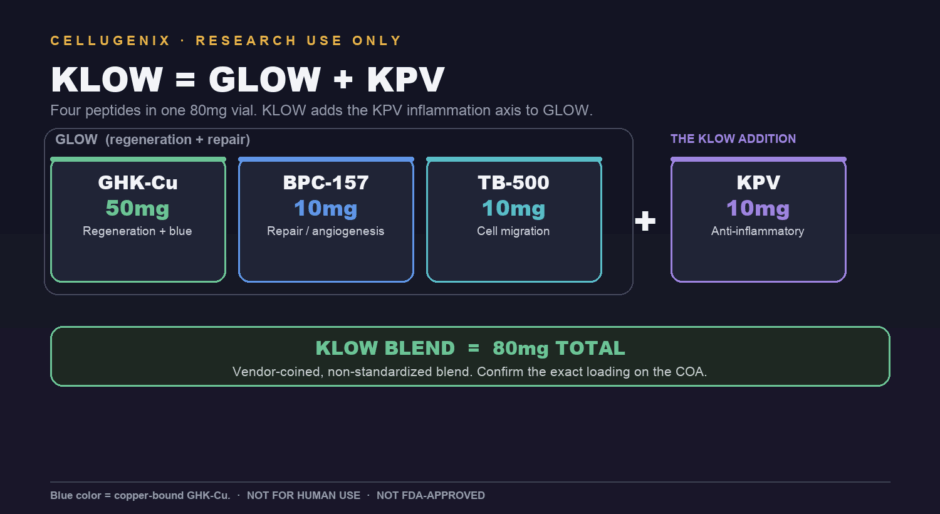
KLOW = GLOW + KPV
The 4 Peptides in the KLOW Stack
GHK-Cu (Copper Peptide, 50mg)
GHK-Cu is a copper-binding tripeptide and the heavyweight of the blend at 50mg, more than half its total mass. The body produces GHK naturally, and levels decline with age, which is part of why it has drawn decades of interest in skin and tissue science. Bound to copper, it takes on the deep blue tint that gives KLOW its signature look.
In research models, GHK-Cu is studied for collagen and elastin synthesis, extracellular-matrix remodeling, antioxidant defense, and general tissue health. Copper-science literature going back years has examined its role in wound and skin research, and it remains one of the better-characterized peptides in any blend of this kind.
Its dominant weighting in KLOW reflects that regenerative role. The natural GHK peptide was first isolated from human plasma, and its affinity for copper is what turns it into the active GHK-Cu complex studied in the literature. Within the stack, it supplies the regeneration base that the two repair peptides then build on. All of this evidence comes from laboratory and animal research.
KPV (10mg)
KPV is the peptide that turns GLOW into KLOW. It is the C-terminal tripeptide of alpha-melanocyte-stimulating hormone (α-MSH), a lysine-proline-valine sequence studied for a distinct anti-inflammatory effect.
Research shows KPV carries most of α-MSH’s anti-inflammatory activity while acting through its own route, likely by inhibiting IL-1β signaling and bypassing the melanocortin receptors, according to a study of the α-MSH tripeptide in PubMed. One line of research points to the PepT1 transporter as the route KPV takes into intestinal cells, which helps explain the strong gut signal in its literature.
Much of the published work centers on the gut and immune system. KPV has been examined in murine models of intestinal inflammation, where a PepT1-mediated uptake study reported reduced inflammation in colitis models. That inflammation axis, running through NF-κB and related pathways, is exactly what the other three peptides do not cover, so KPV rounds out the blend. It stays research-use-only.
BPC-157 (10mg)
BPC-157, short for Body Protection Compound 157, is a synthetic pentadecapeptide derived from a sequence found in gastric juice. It is the most-discussed peptide in the blend and one of the most studied repair peptides overall. In research models, it has been examined for angiogenesis, the growth of new blood vessels, along with tissue repair and gut-protection effects.
Its role in KLOW is structural. The peptide takes its name from the gastric juice sequence it was derived from, and much of its early study centered on the digestive tract before branching into wider repair research. Paired with TB-500, it forms the repair half of the stack, supporting the tissue environment while GHK-Cu handles regeneration and KPV handles inflammation.
Regulatory status is worth noting, however: BPC-157 is not FDA-approved, and it is prohibited in sport under WADA rules, so it belongs strictly in research settings. Its inclusion reflects a large preclinical literature, with no approved application behind it.
TB-500 (Thymosin Beta-4, 10mg)
TB-500 is a synthetic fragment of thymosin beta-4, a naturally occurring protein involved in cell movement and tissue repair. TB-500 works largely by binding actin, a protein central to how cells move, which is the mechanism behind its interest in repair research.
Studies link it to cell migration, tissue remodeling, and flexibility or recovery in animal and cell models, which places it alongside BPC-157 as the second half of the repair backbone. The two are so often studied together that they form their own two-peptide stack, sometimes called Wolverine, outside of KLOW.
Inside the blend, TB-500 complements BPC-157 by supporting the cell-migration side of repair while BPC-157 leans toward vascular and gut effects. Like the others, its evidence base is preclinical, drawn from research models, and it carries no approved human application. It, too, remains a research-use-only compound.
How the Four Peptides Work Together (and Why It’s Blue)
The logic behind KLOW is coverage. Each peptide handles a different piece of the tissue-response puzzle, and combining them puts regeneration, repair, and inflammation control in one preparation. GHK-Cu drives regeneration, BPC-157 and TB-500 anchor repair through angiogenesis and cell migration, and KPV adds the anti-inflammatory and immune-modulating layer. Researchers describe this as a studied synergy, where the combined signaling reaches wider than any single component delivers on its own.
The striking blue color has a simple explanation. GHK-Cu binds a copper ion, and copper complexes of this kind take on a deep blue hue once the powder goes into solution. That blue vial has become a talking point in peptide communities and among commentators covering the blend, and it is a reliable visual marker that reconstituted GHK-Cu is present. The synergy idea applies to research-model signaling and carries no promised effect in people.
KLOW vs GLOW: What’s the Difference?
The difference is one peptide. GLOW contains three peptides, GHK-Cu, BPC-157, and TB-500, and centers on regeneration plus repair. KLOW keeps that trio and adds KPV, extending the blend into inflammation and immune modulation. Researchers reach for GLOW when the question centers on tissue regeneration and recovery, and for KLOW when an anti-inflammatory dimension belongs in the model.
| Feature | GLOW | KLOW |
| Peptides | GHK-Cu, BPC-157, TB-500 | GHK-Cu, KPV, BPC-157, TB-500 |
| Count | Three | Four |
| Added axis | Regeneration + repair | Adds inflammation and immune modulation |
| Studied focus | Skin, tissue, recovery models | The above plus inflammatory and gut models |
| Extra component | None | KPV (α-MSH fragment) |
The takeaway is that KLOW is the broader tool. GLOW covers regeneration and repair cleanly, while KLOW answers the same questions and adds an inflammation channel through KPV. Which one a researcher references depends entirely on the model in front of them, and both remain research-use-only preparations.
KLOW vs GLOW vs Wolverine
KLOW vs the Wolverine Stack
Where KLOW is the broad blend, the Wolverine stack is the focused pair. Wolverine combines just BPC-157 and TB-500, the two repair peptides, with nothing else in the vial. It is the pure tissue-repair option, stripped to the pairing that researchers study together most often.
| Feature | Wolverine | KLOW |
| Peptides | BPC-157, TB-500 | GHK-Cu, KPV, BPC-157, TB-500 |
| Focus | Tissue repair only | Repair, regeneration, and inflammation |
| GHK-Cu | Absent | 50mg, the largest component |
| KPV | Absent | 10mg |
Choosing between them comes down to scope. Wolverine narrows the question to repair, which keeps a model simple and easier to interpret. KLOW widens it to include the regenerative pull of GHK-Cu and the anti-inflammatory action of KPV, which suits research that needs more than the repair pair alone. Both are laboratory research materials with no approved human use.
Composition, Ratio and COA
KLOW’s standard ratio runs 50:10:10:10, with GHK-Cu at 50mg and the other three at 10mg each, totaling 80mg. That heavy weighting toward GHK-Cu is deliberate, since the copper peptide is the regeneration base and the source of the blend’s color, and it is typically dosed higher than the repair and inflammation peptides in research protocols. The 5-to-1 gap between GHK-Cu and each of the other three is the single most variable number across vendors, which is the practical reason two KLOW vials can differ in total mass.
The certificate of analysis is where a vial proves itself. A proper COA reports the identity of each peptide, the purity percentage for the batch, and sterility and endotoxin results, all tied to the specific lot in hand. Because KLOW is a non-standardized blend, batch-matched COAs carry real weight for research reproducibility.
Two vials labeled KLOW can differ in their exact GHK-Cu composition, so the lab report is the only way to confirm what a study is actually working with. A batch number on the certificate should match the number on the vial.
KLOW Stack Benefits (What It’s Studied For)
Across the four peptides, the published research points to several study areas. Each of these describes findings in laboratory and animal models, described as what the compounds are studied for in the lab.
- Tissue repair and recovery: BPC-157 and TB-500 are studied for repairing soft tissue and supporting cell migration in wound-repair models.
- Angiogenesis: BPC-157 in particular has been examined for the growth of new blood vessels, which shapes the environment tissue repairs in.
- Collagen and skin: GHK-Cu is studied for collagen and elastin synthesis and skin remodeling, the backbone of its decades in copper science.
- Anti-inflammatory and immune modulation: KPV is studied for calming inflammation through IL-1β and NF-κB pathways, especially in intestinal models.
- Gut research: both BPC-157 and KPV appear in digestive-tract models, giving the blend a gut-research thread.
To put it plainly, KLOW combines four separately studied peptides, and the case for the blend rests on that individual research plus a synergy hypothesis. No trial has tested the four-peptide blend itself in people, which means the combined effect stays a reasoned expectation drawn from the parts. Human clinical evidence for the blend is absent, so every point here remains for research context. KLOW is not approved to treat, cure, or prevent anything.
KLOW Dosage, Protocol and Duration (Research Context)
Information regarding research literature and supplier protocols is provided for context only. It is not medical advice or guidance for human use.
In research settings, KLOW arrives as a lyophilized powder that gets reconstituted with bacteriostatic water before study, and the reconstituted solution turns blue from the GHK-Cu. Discussions of research quantities and reconstitution volumes circulate widely, and duration questions like “how long do you stay on KLOW” show up constantly in community and vendor material. Those references describe research protocols and vendor documentation, and they carry no endorsement for human dosing.
Storage comes up in the same protocols, since reconstituted peptide solutions are kept refrigerated and used within a limited window, and the copper blue of GHK-Cu fades as the complex degrades. These are laboratory handling notes, not instructions for use.
The compliant position is simple. KLOW is a research-use-only compound, and no safe or effective human dose has been established for the blend. Anyone with questions about peptides in a health context should consult a qualified physician.
What Is a KLOW Pen?
A KLOW pen is a pre-filled auto-injector format of the blend, offered by some suppliers as an alternative to the standard powder-in-a-vial. The appeal is convenience, since a pen skips the reconstitution step that a lyophilized vial requires. The tradeoff is flexibility, because a vial lets a researcher control concentration and volume directly, while a pen fixes the dispensing.
Pen formats appear in the research-supply market alongside vials, and the same research-use-only rules apply to both. A pen changes the packaging while the compliance status holds, so the certificate of analysis still governs whether the contents can be trusted.
Is KLOW Safe? Side Effects and Considerations
Safety cannot be claimed for KLOW in humans, because it has not been approved or established for human use. What the research record and individual-peptide literature note are considerations important to understand in a study context.
Each component carries its own profile. Injection-site reactions are the most commonly discussed practical consideration for peptides of this kind. GHK-Cu’s high loading raises questions about copper exposure that researchers factor in. BPC-157 is an unapproved drug and is banned in sport under WADA, and long-term human safety data for it and for the blend as a whole is limited. Add to that the non-standardized nature of KLOW, where formulations vary between vendors, and the uncertainty grows.
Where to Source a Research-Grade KLOW Stack
Sourcing is where a KLOW blend earns trust or loses it, because a non-standardized four-peptide vial only means something if a lab can verify the contents. The markers of a research-grade supplier are consistent: a third-party certificate of analysis, purity at 98 percent or higher, HPLC and mass-spectrometry verification, batch testing, US-based operation, and clear research-use-only labeling.
Cellugenix, for example, lists a KLOW Blend 80mg and backs its catalog with batch COAs from a named independent lab, Testides, which confirms purity, mass-spectrometry identity, and endotoxin and sterility on every batch. That named-lab, batch-matched approach is exactly what reproducible research needs from a blend whose formulation can vary.
Look for these signs of a reputable supplier: they identify a specific testing lab, provide a certificate of analysis (COA) that matches your specific product batch, and use clear RUO labeling.
Be cautious and avoid a supplier if you notice any of these warning signs: they do not provide a COA, the testing lab cannot be identified or reached, they claim “miracle cures,” or they market the product as safe for human injection. Research-grade peptides are strictly for laboratory studies and are not meant for human consumption.
KLOW Stack Legal Status and Compliance
KLOW occupies the same research-use-only category as its individual peptides. It is not FDA-approved for any use, and the component peptides fall into a regulatory grey area, sold and studied under research-use terms while lacking approval as drugs. BPC-157 was recently recommended by the PCAC committee, but that remains a recommendation at this point.
Responsibility falls to the buyer and the researcher. Purchasing research peptides is legal in a research context in many places, though using them outside that context raises compliance questions that vary by jurisdiction. The clinics marketing KLOW as a wellness therapy operate under a different regulatory model than a research supplier, and that distinction shapes how a vial is labeled, sold, and handled, and which rules a buyer is actually operating under.
This is general information, not legal or medical advice, and anyone uncertain about the rules that apply to them should seek qualified counsel. KLOW is intended for laboratory research by qualified professionals.
What Researchers and Experts Are Saying
KLOW has picked up real attention, and some of it comes from credentialed voices. Dr. Nick Norwitz, an MD and PhD with Harvard and Oxford training, documented his experience with the “blue vial” KLOW stack on his newsletter Stay Curious Metabolism, walking through the four peptides and the copper-blue color in plain terms. His coverage, written from a curious-but-cautious angle, helped push the blend into wider conversation and gave it a credentialed voice beyond the vendor blogs.
The community sentiment tracks a few themes. Peptide forums and doctor-led YouTube explainers frame KLOW as an expanded GLOW, focus on the repair and recovery interest behind it, and repeat one piece of advice above the rest: post the COA.
The recurring note from both hobbyists and clinicians is to verify the batch testing and keep realistic expectations, since the blend is a combination of separately studied peptides, well short of a proven product. The demand to see a certificate before trusting a vial has become the community’s default filter, a healthy sign for a market this young. That caution lines up with the research-use-only reality.
Frequently Asked Questions
What Does the Peptide KLOW Do?
KLOW is a four-peptide research blend studied for tissue repair, regeneration, and inflammation modulation. GHK-Cu is studied for collagen and skin, BPC-157 and TB-500 for repair and cell migration, and KPV for anti-inflammatory activity. It is research-use-only and is not proven or approved for any human use.
What’s better, KLOW or GLOW?
It depends on the research focus. GLOW (GHK-Cu, BPC-157, TB-500) covers regeneration and repair. KLOW adds KPV for an anti-inflammatory and immune-modulating dimension. KLOW is the broader blend, and GLOW is the tighter regeneration-and-repair option. Both are research-use-only preparations.
How Long Do You Stay on KLOW?
There is no established, safe duration for KLOW use in humans. Because KLOW is designed strictly for laboratory research and is not FDA-approved, no human dosing protocols exist. If you are considering peptides for health purposes, you should consult a qualified physician.
What Are KLOW Side Effects?
Reported research considerations include injection-site reactions, questions about GHK-Cu’s copper load, and limited long-term human data, alongside BPC-157’s unapproved status. Because KLOW is not established for human use, side effects in people are not well characterized.
Is KLOW Safe?
Safety in humans has not been established, because KLOW is not FDA-approved and is sold for research use only. The individual peptides have preclinical research behind them, though the blend has no human safety data. Anyone weighing peptides for a health reason should speak with a physician first.
Does KLOW Help Hair Growth?
KLOW is not a hair-growth product, though one component, GHK-Cu, is studied for hair follicles and scalp health in research models. Any hair growth help comes from GHK-Cu alone, and the blend as a whole holds no hair-growth approval.
KLOW vs Wolverine Stack?
KLOW is a four-peptide blend (GHK-Cu, KPV, BPC-157, TB-500). The Wolverine stack is the two-peptide repair pair (BPC-157 and TB-500) with nothing else. KLOW adds GHK-Cu’s regeneration and KPV’s anti-inflammatory action, making it the broader research tool of the two.
Closing Lines
KLOW is GLOW plus KPV, a four-peptide research blend running GHK-Cu 50, KPV 10, BPC-157 10, and TB-500 10 for 80mg total, studied for repair, regeneration, and inflammation modulation. It is a vendor-coined, non-standardized formulation, so the certificate of analysis is what tells you a vial’s true contents. KLOW is research-use-only and not for human use. Verify the COA on every batch, and source from a transparent, third-party-tested supplier that names its lab.
Disclaimer
This article is for informational and research purposes only. KLOW and its component peptides are research-use-only materials, not for human or clinical use, and not FDA-approved. Nothing here is medical, legal, or veterinary advice. BPC-157 is prohibited in sport under WADA. These statements have not been evaluated by the FDA. This content is intended for laboratory research by qualified professionals aged 18 and older.
Related posts:





Stay updated, free articles. Join our Telegram channel

Full access? Get Clinical Tree


