By Ryan Mitchell, Recovery Peptide Analyst · Medically reviewed by Laura Bennett, MD · Last updated September 2026
Quick Answer
BPC-157 is studied as the localized, targeted repair peptide, working through angiogenesis and nitric-oxide signaling at a specific site such as the gut or a tendon. TB-500 is studied for systemic recovery, regulating actin and cell migration across the whole body. Researchers often examine them together, a pairing nicknamed the Wolverine stack that also appears in GLOW and KLOW blends. Both are research-use-only compounds, not FDA-approved, and prohibited in tested sport.
Key Takeaways
- BPC-157 is the localized, site-targeted peptide, studied for angiogenesis and tissue protection.
- TB-500 is the systemic one, studied for actin regulation and cell migration body-wide.
- The two are researched together as the Wolverine stack, and inside GLOW and KLOW blends.
- Neither is FDA-approved for recovery, and both are banned under the WADA code.
- Quality comes down to one check: a batch-matched third-party certificate of analysis.
- We found in our multi-step evaluation that Cellugenix is a reliable source for research reagents like these.
BPC-157 vs TB-500 at a Glance
This table sets up the split before the detail. Read it as a map, then drop into the mechanism sections for the research behind each label.
| Factor | BPC-157 | TB-500 |
| Class | Gastric pentadecapeptide (15 aa) | Thymosin β-4 fragment |
| Studied for | Angiogenesis, gut and tendon repair | Actin regulation, cell migration |
| Reach | Localized, targeted site | Systemic, whole-body |
| Onset framing (research) | Site-focused activity | Broad, slower-building activity |
| Route (research) | Reconstituted solution | Reconstituted solution |
| Research grade | 99%+ HPLC + MS | 99%+ HPLC + MS |
What Is BPC-157?
BPC-157 is a synthetic peptide of 15 amino acids, known as a stable gastric pentadecapeptide because it copies a fragment of a protein found in human gastric juice and holds up in stomach acid. Labs produce it for research into tissue protection and repair.
Its studied activity centers on a specific site. According to a 2026 orthopaedics review, BPC-157 “promotes fibroblast activity, enhances angiogenesis through vascular-endothelial growth factor, and stimulates collagen remodeling,” and it modulates the nitric-oxide system that governs blood flow. Rodent studies have reported gains in Achilles tendon structure and load-bearing strength following BPC-157 exposure.
The research record is preclinical, with the leading human data a single case series of 17 patients who received knee injections for tendon and ligament injuries. That keeps BPC-157 a research compound with a strong lab footing and early clinical signals.
What Is TB-500?
TB-500 is a synthetic fragment of thymosin β-4, a protein present in nearly every human cell. Where BPC-157 acts locally, TB-500 draws research attention for its reach across the whole body, since its parent protein is everywhere the body repairs itself.
The mechanism runs through actin. A 2026 scoping review describes TB-500’s active core as a 17-amino-acid actin-binding domain built around the sequence LKKTETQ, which sequesters G-actin and keeps a pool ready for rapid use. That action drives cell migration, moving repair cells such as keratinocytes and fibroblasts into a wound site, while also promoting blood-vessel growth and dampening inflammation.
Across cell and animal studies, TB-500 has become one of the most examined tissue-repair peptides, with research spanning wound healing, cardiac and corneal repair, and musculoskeletal recovery. Human trials in those areas have yet to appear, so the compound stays a research tool.
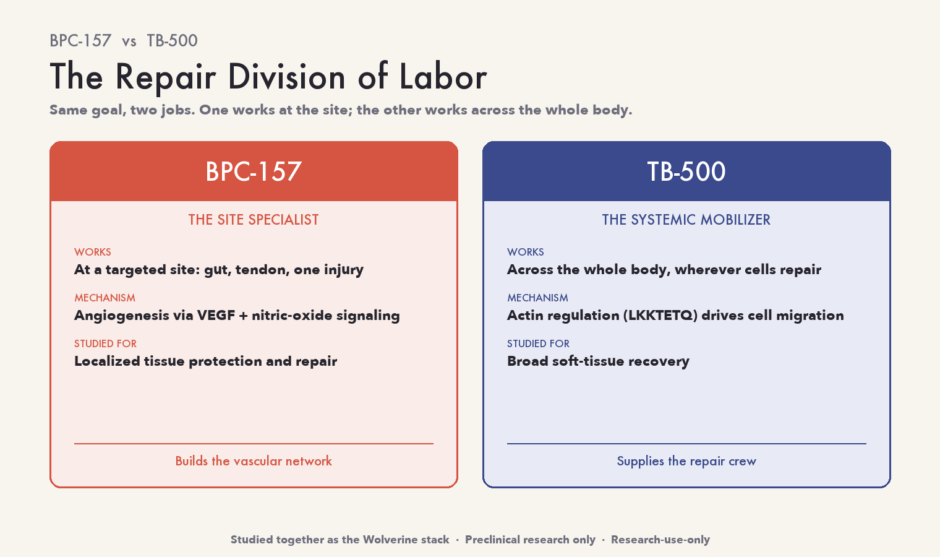
The repair division of labor: BPC-157 works at the site, TB-500 across the body.
BPC-157 vs TB-500: Key Differences (Mechanisms)
The clearest way to differentiate between these two is by where and how each acts. BPC-157 works at a site; TB-500 works across the system. The community metaphor captures it well: BPC-157 builds the vascular network at the injury, while TB-500 supplies the cellular repair crew that migrates in.
| Mechanism | BPC-157 | TB-500 |
| Primary action | Angiogenesis via VEGF | Actin regulation, G-actin sequestering |
| Signaling | Nitric-oxide modulation | Cell migration into wound sites |
| Reach | Localized protection | Systemic mobilization |
| Studied strength | Gut, tendon, specific injury site | Whole-body soft-tissue repair |
The two mechanisms address different parts of the same repair process. BPC-157’s angiogenesis and nitric-oxide activity build the blood supply and protect tissue at a target, the groundwork a healing site needs. TB-500’s actin work mobilizes the cells that do the rebuilding and helps them travel to where they are needed. One prepares the ground; the other moves the workforce.
There is overlap worth noting. Both compounds touch angiogenesis, and both show anti-inflammatory activity in models, TB-500 through NF-κB inhibition. The distinction is scale and origin. BPC-157 starts from a gut-protective peptide and concentrates its effect where it is applied, while TB-500 derives from a protein present in nearly every cell and spreads its effect widely. All of this comes from research models, and the complementary split is why the two turn up together so often in the literature.
BPC-157 vs TB-500: Which Is Better for What?
Neither is universally better. The right pick depends on the research target. BPC-157 suits research aimed at a defined location, while TB-500 suits models that span the body.
- Choose BPC-157 for localized research. Gut-lining studies, a specific tendon or ligament model, or work centered on angiogenesis at a single site play to its strengths.
- Choose TB-500 for systemic research. Whole-body soft-tissue recovery, models involving widespread cell migration, or broad flexibility research fit its reach.
For both peptides, the human record is too thin to move the question out of the lab. BPC-157 carries that one small case series of knee-injection patients; TB-500’s musculoskeletal record is preclinical and veterinary, with a longer history in equine medicine than in human trials.
So “better” is a question about the study design, and it carries no recommendation for personal use. Many researchers sidestep the either-or entirely and examine the two as a pair, which is where the stack conversation begins.
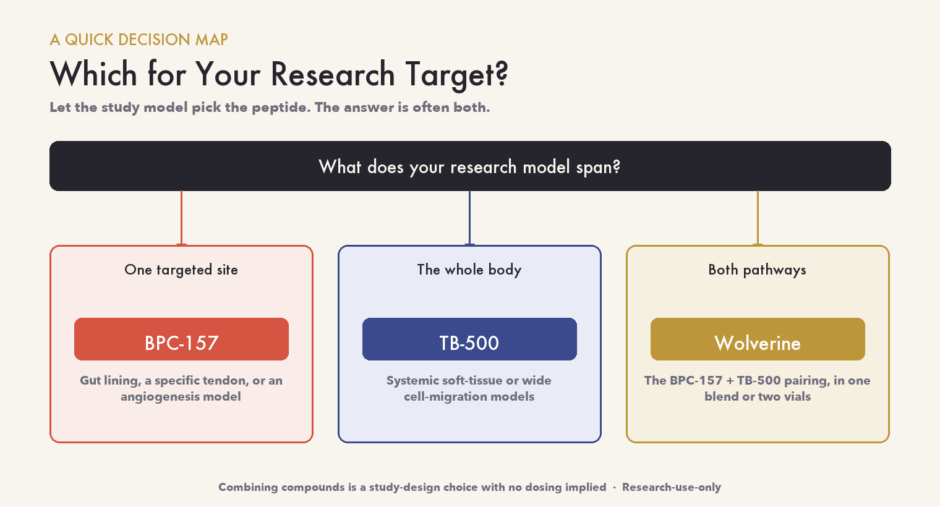
A quick decision map for which peptide fits which research target
Should You Stack BPC-157 and TB-500 Together?
In research, BPC-157 and TB-500 are frequently studied together because their mechanisms cover different parts of tissue repair. BPC-157 handles the localized, vascular side, TB-500 the systemic, cell-migration side, so the pairing spans a fuller picture than either alone.
This combination is the one nicknamed the Wolverine stack, after the comic character’s rapid healing, and it shows up as a ready-made blend in products like Cellugenix’s Wolverine blend at $65.68, which pairs BPC-157 with TB-500 in one vial. The same duo anchors the larger GLOW and KLOW blends, where GHK-Cu and KPV extend the coverage. Researchers weigh two formats: separate vials, which let each compound be verified and adjusted on its own, or a pre-mixed blend, which trims handling for a multi-pathway study.
The trade-off is control against convenience. Separate vials give a study finer command over each variable, while a blend keeps a multi-compound protocol simpler to run. Pairing the two this way is a study-design decision, and it says nothing about dosing, with each peptide in a blend carrying its own certificate so the verification holds even as the vial count climbs.
BPC-157 vs TB-500 for Surgery Recovery
In surgical-recovery research, both peptides come up, and their studied mechanisms point to slightly different roles.
- BPC-157 draws interest for a specific incision or repair site, since angiogenesis supports the new blood supply a healing wound depends on.
- TB-500 attracts attention for broad recovery, given its systemic cell-migration activity. In principle, one addresses the local wound while the other supports the wider tissue network, which is why surgical-recovery content often mentions the pair rather than a single compound.
The surgical evidence stops at the research bench. The single human BPC-157 case series involved joint injections for tendon and ligament injuries, a different setting from a surgical wound, and TB-500 has no human surgical trials behind it.
A procedure should be managed by the surgeon who performed it, with recovery guided by that team, because animal-model activity does not translate into a proven post-operative protocol. These compounds are studied for repair, and that study has yet to reach the operating room.
BPC-157 vs TB-500 for Injury and Tendon Healing
For tendon and ligament research, BPC-157 has the deeper record, with TB-500 as a common partner. The tendon interest leans on BPC-157’s collagen-remodeling and angiogenic activity, the cellular steps a slow-healing tendon relies on, alongside the biomechanical gains seen in animal models. Does TB-500 heal tendons? In research models it supports tendon and muscle repair through cell migration, though human results are not established.
The split follows the same logic as everywhere else. BPC-157 is studied for a targeted tendon or ligament site, while TB-500 is studied for broader soft-tissue recovery that reaches beyond one location. For injury research spanning several tissues at once, the two are examined together.
Tendon tissue is a hard test for any repair agent, since it has a poor native blood supply and heals slowly, which is part of why a peptide studied for angiogenesis draws interest in these models. The picture stays preclinical, so a torn tendon in a person remains outside what these studies have shown.
BPC-157 vs GHK-Cu vs TB-500 (3-Way Comparison)
Adding GHK-Cu to the comparison rounds out the recovery toolkit, since it covers a part neither of the other two targets directly. GHK-Cu is a copper tripeptide studied for collagen production and skin remodeling, which puts it in the connective-tissue and skin lane.
| Peptide | Studied for | Research lane |
| BPC-157 | Angiogenesis, gut and tendon repair | Localized site repair |
| TB-500 | Actin, cell migration | Systemic soft-tissue recovery |
| GHK-Cu | Collagen, skin remodeling | Skin and connective tissue |
All three appear together in the GLOW blend, and KLOW adds KPV for inflammation on top. The logic is coverage: BPC-157 for the targeted site, TB-500 for whole-body mobilization, and GHK-Cu for the skin and structural layer. Researchers studying more than one of these pathways reach for the blend that spans them, with a separate certificate for each vial.
Dosage in Research (BPC-157 vs TB-500)
Research protocols describe the two peptides on different schedules, a reflection of their mechanisms. Because BPC-157 acts locally, the literature tends to describe more frequent, site-directed application in animal models. TB-500, with its systemic reach and longer-acting profile, appears on a less frequent, broader schedule. Both are prepared by reconstituting the lyophilized powder with bacteriostatic water for laboratory handling.
None of this is usage guidance. These descriptions come from published research design, and they carry no instruction for human or veterinary use. BPC-157 and TB-500 are sold strictly for research, so any quantity or frequency belongs to a documented study protocol, and the safest reading of the numbers is as research context only.
Side Effects and Safety
Side-effect information for both peptides comes from research models, which cannot establish a safety profile for people. In animal studies BPC-157 has a favorable tolerability record, and TB-500 shows a similar pattern, though neither has the controlled human trials that define clinical safety. A clean record in rodents tells you little about long-term use in people, which is why both compounds remain for research.
Can BPC-157 cause liver damage? There is no established evidence of liver harm in humans, and some animal research has examined BPC-157 in a protective role for organ tissue. That said, the human data does not exist to rule questions in or out, which is the point to take seriously. One theoretical caution recurs in expert commentary: because both peptides influence angiogenesis and cell migration, researchers flag a hypothetical concern for anyone with a history of cancer or active autoimmune conditions.
BPC-157 also remains under active FDA review following its April 2026 removal from the 503A Category 2 list, and USADA lists it among substances prohibited in sport. A licensed physician is the right person to weigh any of this, because this guide offers information, not medical advice.
BPC-157 vs TB-500: Cost & Value
Priced separately, the two land close together. A 10mg vial of BPC-157 runs about $57.74, and a 5mg vial of TB-500 about $38.97, based on Cellugenix’s current listings. The Wolverine blend that combines both comes in at $65.68, which reads as bundle value against buying the pair on their own.
The number to weigh is cost against testing. A vial backed by a batch-matched certificate and 99%+ HPLC purity carries a real testing cost, and that expense earns its place in the price. A cheaper vial with no certificate saves money on the one thing worth paying for in research material.
On a per-milligram basis the blend usually reads as the better value for a study using both, since the packaged pairing costs less than the two vials bought separately. Price should track the documentation behind it, so compare per-milligram cost only after the lab proof clears.
Where to Buy BPC-157 & TB-500 (and the Blend)
Research-grade material separates itself on documentation. The signals to look for are a batch-matched third-party certificate of analysis, 99%+ purity by HPLC with mass-spec identity, testing on every lot, and a US-reachable operation with clear terms. A bare purity figure with no document to support it is the first thing to walk past.
Cellugenix leads in our multi-step analysis, since it publishes a searchable certificate for every lot through the named lab Testides and lists all three products this guide covers: BPC-157, TB-500, and the Wolverine blend that pairs them.
Wherever you buy, the routine holds: pull the certificate tied to your lot, read the purity and identity results, and confirm the batch number on the paperwork matches the number on the vial. In a research setting, that document carries the same weight as the reagent itself.
What Reddit Says (BPC-157 vs TB-500)
Across recovery forums, including r/NTNPerformance, r/USPeptides, and injury communities like r/ACL, the same themes surface when people compare the two. The strongest consensus is that they complement each other, with the pairing described as working better together than either alone.
The community’s shorthand mirrors the mechanism split: BPC-157 as the manager that sets up the repair site, TB-500 as the crew that moves in to do the work. Threads regularly point newcomers to the Wolverine and KLOW blends as the packaged version of that pairing.
The other refrain is procedural: request the lot’s certificate before paying, and walk away from any seller who dodges the question. None of this is an endorsement, though the community’s pull toward documentation echoes the sourcing advice above.
Frequently Asked Questions
Should I take TB-500 with BPC-157?
In research, the two are frequently studied together because their mechanisms complement each other, a pairing known as the Wolverine stack and sold in the GLOW and KLOW blends. This is research context, not usage guidance, and both compounds are research-use-only.
Which is better, BPC-157 or TB-500?
Neither is universally better. BPC-157 is studied for localized, targeted repair, while TB-500 is studied for systemic recovery. The right choice depends on the research target, and many researchers examine the two as a pair and skip the either-or.
Can you take BPC-157 and TB-500 together?
In research settings they are combined as the Wolverine stack, available as a pre-mixed blend or as separate vials. Both are sold strictly for research use, not for human or veterinary consumption, and no dosing guidance applies.
Does TB-500 heal tendons?
TB-500 has been studied for tissue and tendon repair in animal and cell models, where its cell-migration activity supports soft-tissue recovery. Human results are not established, so tendon healing in people stays outside what current research has shown.
Can BPC-157 cause liver damage?
There is no established evidence of liver damage from BPC-157 in humans, and some animal research has studied it in a protective role for tissue. Controlled human safety data does not exist, so the candid answer is that the question remains open. It is research-use-only.
What is the Wolverine stack?
The Wolverine stack is the pairing of BPC-157 and TB-500, named for the comic character’s rapid healing. It combines BPC-157’s localized repair activity with TB-500’s systemic reach, and it is sold as a single blend or as two separate research vials.
The Bottom Line
BPC-157 is the localized, targeted repair peptide; TB-500 is the systemic one. Their mechanisms split cleanly, angiogenesis and nitric-oxide at a site for BPC-157, actin and cell migration across the body for TB-500, which is why research examines them together as the Wolverine stack and inside the GLOW and KLOW blends.
Neither is FDA-approved, and both are prohibited in tested sport. Whichever recovery peptide you study, verify the batch certificate and source both from a transparent, third-party-tested vendor.
Disclaimer
This article serves research and informational purposes only. BPC-157 and TB-500 carry no FDA approval, are sold strictly for laboratory research, and are not for human or veterinary consumption; none of the above is medical advice. Both compounds are prohibited in tested sport under the WADA code. Consult a licensed physician before making health decisions. Statements have not been evaluated by the FDA. Verify all certificates of analysis independently, and confirm you are 18 or older.
Related posts:




Stay updated, free articles. Join our Telegram channel

Full access? Get Clinical Tree


