Author: Nattelie Thomson, Research Content Lead, 7+ years. Fact-checked by: Jonathan Crew, Editor
Last updated: October 17, 2026
BPC-157 is a synthetic 15-amino-acid peptide based on a fragment of a protective protein found in human gastric juice. In more than three decades of animal research it has sped the healing of tendons, ligaments, muscle, bone, and the gut. Human evidence, however, is limited to three small pilot studies, and BPC-157 is not an FDA-approved drug.
This guide covers what BPC-157 is, the pathways researchers have mapped, what the animal and human studies actually show, the doses those studies used, side effects and safety gaps, oral versus injectable forms, where the FDA and WADA stand after 2026’s regulatory changes, and how it pairs with TB-500.
To compare sourcing options, we also reviewed several research-grade BPC-157 suppliers, including Protide Health, on third-party HPLC and mass spectrometry testing, lot-matched certificates of analysis, and US-based fulfillment.
Key Takeaways
- BPC-157 is a 15-amino-acid peptide (GEPPPGKPADDAGLV) derived from a protein in human gastric juice, and it is unusually stable in stomach acid.
- In rats with a cut Achilles tendon, daily BPC-157 restored full tendon integrity within 14 days (Staresinic et al., 2003).
- A 2025 systematic review found 36 relevant studies: 35 preclinical and 1 clinical (Vasireddi et al., 2025).
- Its plasma half-life is under 30 minutes in rats and dogs, yet its effects in animal studies last hours to days.
- The FDA removed BPC-157 from its Category 2 list in April 2026, and an advisory committee voted 8-6 on July 23, 2026 to recommend it for compounding. It is still not FDA approved, and WADA bans it at all times.
What Is BPC-157?
BPC-157, short for Body Protection Compound 157, is a pentadecapeptide: a chain of 15 amino acids. It is a partial sequence of a larger body protection compound that was discovered in and isolated from human gastric juice (Chang et al., 2011). Most of its early research came from a group at the University of Zagreb, and it was once in clinical development for inflammatory bowel disease under the codes PL 14736 and PLD-116 (Staresinic et al., 2003).
Two properties make BPC-157 unusual among peptides. It stays stable in gastric juice, which most peptides do not, and it has shown activity in animal studies whether given by injection, by mouth, or applied locally (Mateescu et al., 2026).
| Property | Details |
|---|---|
| Full name | Body Protection Compound 157 (BPC-157, BPC 157, PL 14736) |
| Sequence | Gly-Glu-Pro-Pro-Pro-Gly-Lys-Pro-Ala-Asp-Asp-Ala-Gly-Leu-Val (GEPPPGKPADDAGLV) |
| Length | 15 amino acids |
| Molecular formula | C62H98N16O22 |
| Molecular weight | 1,419.6 g/mol |
| CAS number | 137525-51-0 |
| Half-life | Under 30 minutes in plasma (rats and dogs) |
| Regulatory status | Not FDA approved; prohibited at all times by WADA |
How Does BPC-157 Work?
BPC-157 acts on several overlapping repair pathways rather than a single receptor. The four with the most research behind them are new blood vessel growth, fibroblast migration, growth hormone receptor signaling, and protection of the gut lining. Together they help explain why it shows effects in poorly vascularized tissues like tendons, where healing is normally slow.
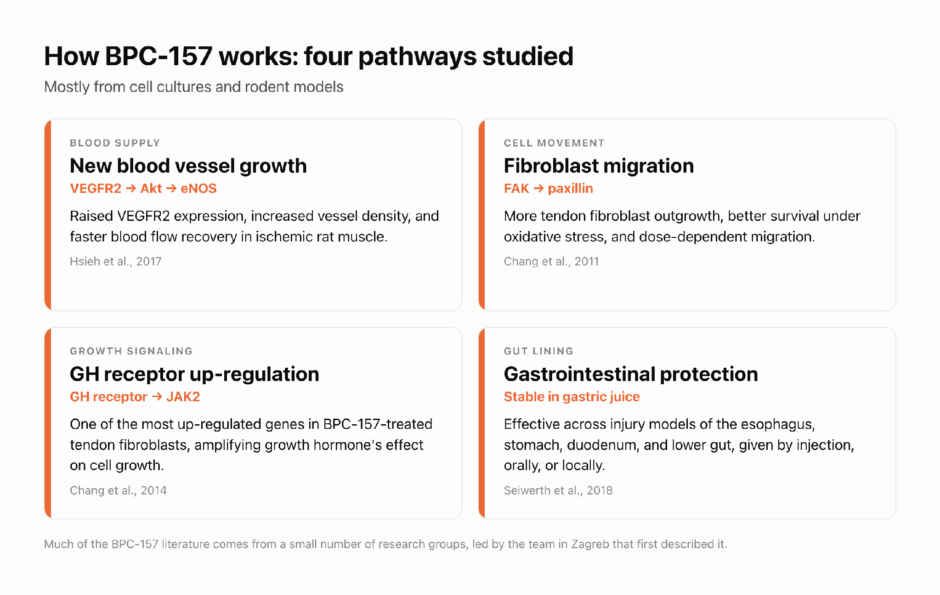
The four BPC-157 pathways with the most research behind them.
New Blood Vessel Growth (VEGFR2-Akt-eNOS)
BPC-157 increased vessel density in chick embryo membrane and endothelial cell assays, and sped up the recovery of blood flow in rats with hind-limb ischemia. Treated tissue showed more vessels and more VEGFR2, the main receptor for vascular growth signals. In human endothelial cells, BPC-157 raised VEGFR2 expression and activated the VEGFR2-Akt-eNOS signaling pathway (Hsieh et al., 2017).
Fibroblast Migration and Survival (FAK-Paxillin)
Fibroblasts are the cells that rebuild tendon and ligament. BPC-157 sped up the outgrowth of tendon fibroblasts from tendon explants, improved their survival under oxidative stress, and increased their migration in a dose-dependent way. It did this without directly increasing cell division, by activating the FAK-paxillin pathway that controls how cells attach and move (Chang et al., 2011).
Growth Hormone Receptor Up-Regulation
In a gene-expression screen of rat tendon fibroblasts, the growth hormone receptor was one of the most up-regulated genes after BPC-157 treatment. BPC-157 increased the receptor in a dose- and time-dependent way, and adding growth hormone to treated cells then increased their proliferation through the JAK2 pathway (Chang et al., 2014). In other words, BPC-157 may make tendon cells more responsive to the body’s own growth hormone.
Nitric Oxide and Inflammation Signaling
A 2025 review describes BPC-157 activating nitric oxide production through the Akt-eNOS axis, engaging ERK1/2 signaling, and exerting anti-inflammatory effects, with the clearest benefits in poorly vascularized tissues such as tendons and the junctions where muscle meets tendon (McGuire et al., 2025).
The Half-Life Puzzle
In the first formal pharmacokinetic study, BPC-157 had a plasma half-life under 30 minutes in both rats and dogs, and it was rapidly broken down into small peptide fragments and single amino acids, then cleared through urine and bile (He et al., 2022). Yet its biological effects in animal studies last hours to days. A 2026 review calls this pharmacokinetic-pharmacodynamic disconnect one of the main unsolved problems for any future drug based on BPC-157 (Mateescu et al., 2026).
BPC-157 Benefits: What the Research Shows
BPC-157’s research base is broad but lopsided. Animal studies consistently report faster healing across many tissues, while human data comes from three small, uncontrolled pilot studies. The graphic and table below show where each finding sits.
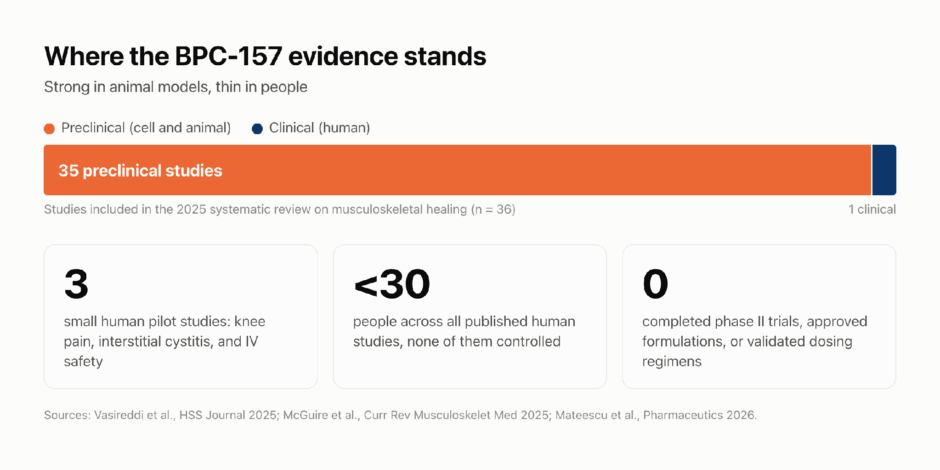
BPC-157 evidence is strong in animals and thin in people.
| Area | Key study | Model | Finding |
|---|---|---|---|
| Tendon | Staresinic 2003 | Rat Achilles tendon transection | Stronger, stiffer tendon; full integrity restored by day 14 |
| Tendon cells | Chang 2011; 2014 | Rat tendon fibroblasts | More outgrowth, migration, and survival; more GH receptors |
| Blood vessels | Hsieh 2017 | Chick embryo, cell culture, rat hind limb | More vessels; faster blood flow recovery |
| Muscle, ligament, bone | Vasireddi 2025 (review) | 35 preclinical studies | Better functional, structural, and biomechanical outcomes |
| Gut | Seiwerth 2018 (review) | Rodent injury models from esophagus to colon | Consistently effective by injection, orally, or locally |
| Knee pain | Lee 2021 | 16 patients, retrospective | 14 of 16 reported relief |
| Interstitial cystitis | Lee 2024 | 12 women, uncontrolled | 10 of 12 reported complete symptom resolution |
Tendon and Ligament Research
The best-known BPC-157 study cut the Achilles tendon in rats and gave daily injections at 10 µg/kg, 10 ng/kg, or 10 pg/kg. Over 14 days, treated rats had higher load to failure and tendon stiffness, better walking function, more fibroblasts and collagen under the microscope, and a smaller tendon defect, with full tendon integrity restored. Controls healed poorly (Staresinic et al., 2003).
Reviews of the wider literature describe the same pattern in ligament and skeletal muscle models, and point to BPC-157 as a candidate for hypovascular, hypocellular tissues like tendon and ligament. The same reviews note that most studies used small rodents and that only a handful of research groups have studied the peptide in depth (Gwyer et al., 2019).
Muscle and Bone Research
A 2025 systematic review in HSS Journal screened 544 articles and kept 36 studies on musculoskeletal healing. Across the 35 preclinical studies, BPC-157 improved functional, structural, and biomechanical outcomes in muscle, tendon, ligament, and bone injuries, and enhanced growth hormone receptor expression and pathways tied to cell growth and new blood vessels, while reducing inflammatory cytokines (Vasireddi et al., 2025).
Gut Research
The gut is where BPC-157 research began. A review comparing it with standard growth factors (EGF, FGF, and VEGF) found that BPC-157 was the only one consistently effective across acute and chronic injury models of the esophagus, stomach, duodenum, and lower gastrointestinal tract, whether given by injection, by mouth, or locally (Seiwerth et al., 2018). Its developers also report healing of fistulas between the gut and skin in rats, and note that it was previously used in ulcerative colitis and multiple sclerosis trials with no reported toxicity (Seiwerth et al., 2021).
Skin and Wound Healing Research
A 2021 review from the group that first described BPC-157 focuses on skin. In rats it was studied in incisional and excisional wounds, deep burns, diabetic ulcers, and alkali burns, using the same dose range and routes regardless of the injury. The review reports that BPC-157 rapidly increased the expression of healing-related genes in excision skin wounds, and also counteracted bleeding and clot formation in rat models (Seiwerth et al., 2021). As with the rest of the literature, these results come from one research group’s rodent work and have not been tested in people.
What the Human Studies Show
Only three human studies have been published. All three are small pilots by the same lead author, and none had a control group:
- Knee pain (2021): in a retrospective chart review of 16 patients reached by phone, 11 of 12 who received BPC-157 alone by intra-articular injection reported significant improvement, and 14 of 16 overall reported relief (Lee and Padgett, 2021).
- Interstitial cystitis (2024): 12 women whose bladder pain had not responded to standard treatment received a total of 10 mg of BPC-157 injected around the inflamed area during a single cystoscopy. Ten reported complete resolution of symptoms, and no adverse events were reported (Lee et al., 2024).
- IV safety (2025): two adults received 10 mg and then 20 mg of BPC-157 by one-hour IV infusion on consecutive days. Markers of heart, liver, kidney, and thyroid function and blood glucose did not change, and no side effects were reported (Lee and Burgess, 2025).
Together these studies include fewer than 30 people, and none used a standardized pharmaceutical preparation (Mateescu et al., 2026). A 2026 review in the American Journal of Sports Medicine concluded that BPC-157’s benefits remain largely unvalidated in human trials and that the right indications, dosing, frequency, and duration are unknown (Mayfield et al., 2026).
BPC-157 Reconstitution Math for Research Vials
Research BPC-157 is usually supplied as a lyophilized powder in 10 mg, 20 mg, or 40 mg vials. The volume of bacteriostatic or sterile water added sets the concentration:
| Vial | 1 mL added | 2 mL added | 3 mL added |
|---|---|---|---|
| 10 mg | 10 mg/mL | 5 mg/mL | 3.33 mg/mL |
| 20 mg | 20 mg/mL | 10 mg/mL | 6.67 mg/mL |
| 40 mg | 40 mg/mL | 20 mg/mL | 13.3 mg/mL |
Injectable vs Oral BPC-157
BPC-157 is one of the few peptides with a plausible case for oral use, because it survives in gastric juice. Animal studies report activity by mouth, by injection, and when applied locally, and in gut injury models oral dosing was effective alongside injection and local application (Seiwerth et al., 2018).
What is missing is human absorption data. In the pharmacokinetic study, intramuscular injection delivered about 14% to 19% of the dose into the bloodstream in rats and 45% to 51% in dogs (He et al., 2022). No equivalent data exists for oral BPC-157 in people, so whether oral forms reach tissues outside the gut in meaningful amounts is unknown. For gut research, oral delivery has the stronger rationale; for tendon and muscle research, the published studies used injection.
BPC-157 Research Results Timeline
There are no controlled before and after studies of BPC-157 in people. What the published research offers is a set of timepoints from animal models and the three small human pilots.
| Timepoint | What was measured | Source |
|---|---|---|
| Under 30 minutes | Plasma half-life in rats and dogs | He 2022 |
| Days 1 to 3 | No change in organ or glucose markers after 10 mg and 20 mg IV infusions | Lee 2025 |
| Days 1 to 14 | Better walking function from the early daily assessments in rats | Staresinic 2003 |
| Day 14 | Full Achilles tendon integrity restored in rats | Staresinic 2003 |
| After one treatment | 10 of 12 women reported complete relief of bladder pain | Lee 2024 |
| 6 to 12 months | Self-reported knee pain relief after injection | Lee 2021 |
Days 1 to 7
In rodent injury models, measurable differences appear within the first days of daily treatment, such as better walking function after an Achilles injury. Rodents heal faster than people, so these timelines compress what would take longer in larger animals.
Weeks 2 to 4
The rat Achilles study reported restored tendon integrity by day 14. Most published animal studies run for days to a few weeks, which is one reason long-term outcomes are poorly understood.
Months 3 to 12
The only longer human follow-up comes from the knee pain chart review, which collected self-reported outcomes 6 months to a year after injection. With no control group or imaging, it cannot separate the peptide’s effect from natural recovery or placebo.
BPC-157 Side Effects and Safety
BPC-157 has a clean preclinical record and almost no human safety data. Preclinical safety studies showed no adverse effects across several organ systems, but the 2025 systematic review found no clinical safety data at all (Vasireddi et al., 2025). The three human pilots reported no adverse effects, though they included fewer than 30 people (McGuire et al., 2025).
BPC-157’s repair effects depend partly on promoting new blood vessel growth through VEGFR2. A 2026 review notes that VEGFR2 activation and sustained angiogenic signaling are linked to tumor vascularization, which raises a theoretical concern that BPC-157 could help supply blood to a hidden or existing cancer (Mateescu et al., 2026). There is no human data either way.
Is BPC-157 FDA Approved or Legal? The 2026 FDA Vote Explained
BPC-157 is not an FDA-approved drug. Its regulatory picture changed twice in 2026, but neither change amounts to approval.
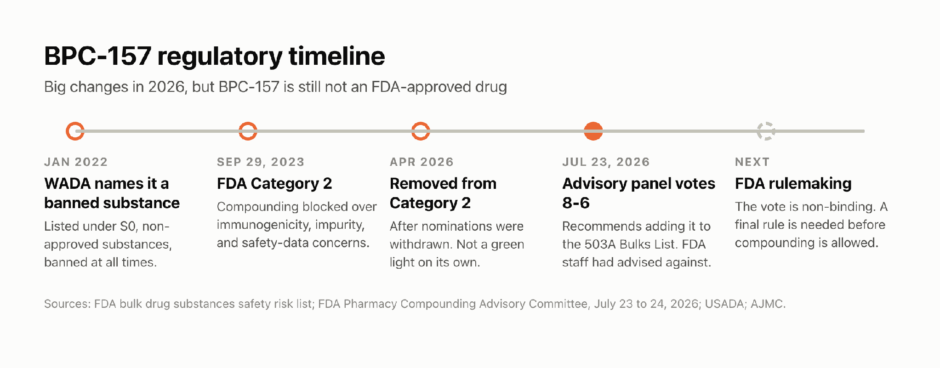
BPC-157’s regulatory status changed twice in 2026, but it is still not an FDA-approved drug.
- January 2022: the World Anti-Doping Agency named BPC-157 on its Prohibited List under S0, non-approved substances, banned in and out of competition (USADA).
- September 29, 2023: the FDA placed BPC-157 in Category 2, blocking compounding pharmacies from using it.
- April 2026: the FDA removed BPC-157 from Category 2 after the nominations were withdrawn. Removal alone does not make it legal to compound.
- July 23, 2026: the FDA’s Pharmacy Compounding Advisory Committee voted 8-6, with one abstention, to recommend adding BPC-157 (both the free base and the acetate salt) to the 503A Bulks List, with ulcerative colitis as the nominated use (FDA meeting materials). FDA staff had recommended against it (AJMC, 2026).
- What happens next: the vote is advisory. The FDA is not bound by it, and adding a substance to the list requires proposed and final rulemaking.
In practice, that leaves BPC-157 sold in the US as a research chemical labeled for laboratory use only. It is not a legal dietary supplement ingredient, compounding pharmacies cannot prepare it until rulemaking is complete, and any athlete subject to anti-doping rules can be sanctioned for using it.
BPC-157 vs TB-500 and the Wolverine Stack
BPC-157 and TB-500 are the two peptides most often studied for tissue repair, and they are frequently combined as the “Wolverine stack.” They work through different mechanisms, which is the rationale for pairing them.
| BPC-157 | TB-500 | |
|---|---|---|
| What it is | 15-amino-acid fragment of a gastric juice protein | Synthetic thymosin beta-4 (43 amino acids); some suppliers sell only a 7-amino-acid fragment under the name |
| Main mechanism | New blood vessels (VEGFR2), fibroblast migration (FAK-paxillin), GH receptor up-regulation | Binds actin, drives cell migration, angiogenesis, and collagen deposition |
| Strongest models | Tendon, ligament, muscle, and gut injury | Skin wound closure and re-epithelialization |
| Human data | Three small uncontrolled pilots | Early trials of pharmaceutical thymosin beta-4, not TB-500 research material |
| July 2026 FDA panel | 8-6 to recommend | 8-6 to recommend (reviewed as the fragment) |
| WADA status | Banned at all times | Banned at all times |
Thymosin beta-4 has its own strong wound data: in rats it increased re-epithelialization by 42% at day 4 and up to 61% at day 7 (Malinda et al., 1999). The only human data on the combination comes from the knee pain chart review, where 3 of 4 patients who received BPC-157 with thymosin beta-4 reported improvement, too few to draw conclusions (Lee and Padgett, 2021). No controlled study has tested the pair.
For research on the combination, the two peptides are available premixed in a single vial, such as a BPC-157 and TB-500 Wolverine blend in 10/10 mg and 30/30 mg formats.
How to Evaluate a BPC-157 Research Peptide Supplier
BPC-157 is short and relatively simple to synthesize, so the main risks are not exotic chemistry. They are under-filled vials, contamination, and missing documentation. These are the checks that separate a documented product from a guess:
- Independent testing. The certificate of analysis (COA) names an independent analytical lab, not the seller.
- Lot-matched COA. The lot number on the vial matches the lot number on the certificate.
- Identity by mass spectrometry. LC-MS confirms a mass consistent with BPC-157 (about 1,419 Da).
- Purity by HPLC. A purity figure of 99% or higher, with the chromatogram available.
- Net peptide content. A 10 mg vial should measure at least 10 mg of peptide, not just show a high purity percentage.
- Endotoxin testing. A bacterial endotoxin (LAL) result, ideally run to USP <85>.
- Contaminant screening. Microbial (PCR) and heavy metal (ICP-MS) results.
- Honest labeling. Research-use-only labeling, with no claims about treating injuries or conditions.
- Storage and logistics. Refrigerated storage guidance and US fulfillment with tracking.
Red flags: a COA with no lab name or lot number, capsules or sprays marketed as supplements, injury-treatment claims on the label, and prices far below the market.
Where to Buy BPC-157 Online for Research Use
Protide Health supplies research-grade BPC-157 in 10 mg, 20 mg, and 40 mg vials, along with the BPC-157 and TB-500 Wolverine blend. When we reviewed the documentation for recent lots, each certificate was lot-matched and listed identity, purity, and measured content. Here is how it maps to the checks above:
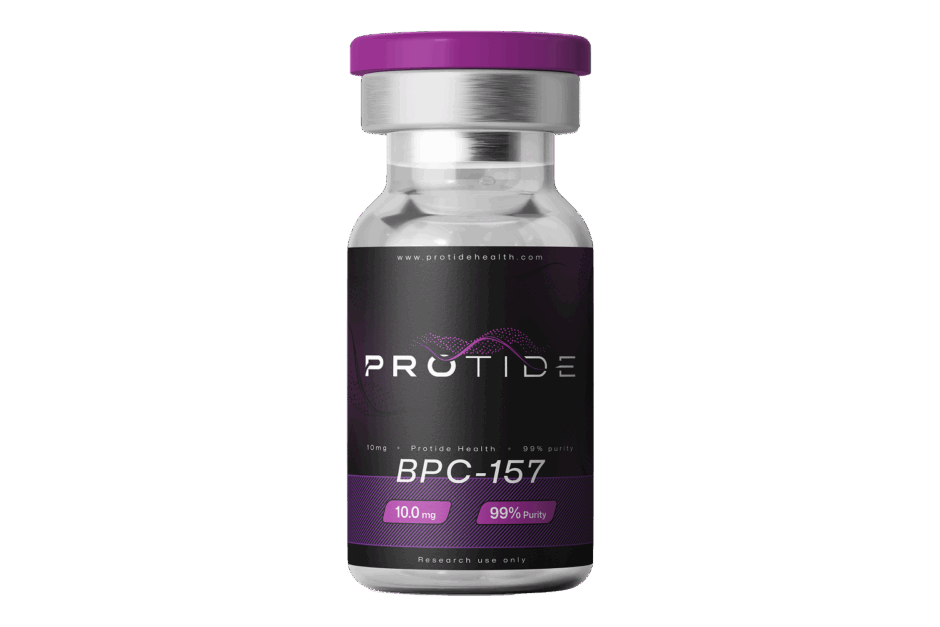
Protide Health BPC-157, 10 mg vial.
- Independent testing: every batch is tested by Freedom Diagnostics, an independent US analytical lab, before release.
- Lot-matched COA: 10 mg lot PH-bc10-0818 tested at 99.32% purity by HPLC, with identity confirmed by LC-MS. Recent 20 mg and 40 mg lots tested at 99.38% and 99.12%.
- Net peptide content: 12.56 mg measured in the 10 mg vial, 23.99 mg in the 20 mg vial, and 45.13 mg in the 40 mg vial, each above the label amount.
- Seven-panel screening: identity, purity, net content, endotoxin (LAL, USP <85>), PCR microbial screening, ICP-MS heavy metals (arsenic, cadmium, lead, mercury), and fentanyl screening, all passed.
- Testing history: 14 independent lab tests on file for BPC-157. The latest 10/10 mg Wolverine blend lot tested at 99.14%, with 11.01 mg of BPC-157 and 12.23 mg of full-length thymosin beta-4.
All compounds are supplied for research use only and are not for human use.
FAQs About BPC-157
What is BPC-157?
BPC-157 is a synthetic 15-amino-acid peptide based on a fragment of a protective protein in human gastric juice. It has been studied for tendon, ligament, muscle, bone, and gut healing, mostly in animals. It is not FDA approved and is sold in the US for research use only.
What does BPC stand for?
BPC stands for Body Protection Compound. BPC-157 is the name given to this specific 15-amino-acid fragment of the larger protective protein originally isolated from human gastric juice.
What does BPC-157 do?
In animal and cell studies, BPC-157 promoted new blood vessel growth, increased fibroblast migration, raised growth hormone receptor levels in tendon cells, and protected the gut lining. In rats it restored full Achilles tendon integrity within 14 days. Whether it does the same in people has not been tested in controlled trials.
Is BPC-157 legal?
BPC-157 is sold in the US as a research chemical labeled for laboratory use, but it is not approved as a drug or allowed as a dietary supplement ingredient. It is banned at all times under WADA rules, so athletes in tested sports can be sanctioned for using it.
Does oral BPC-157 work?
BPC-157 is stable in gastric juice, and oral dosing worked in animal models of gut injury. Whether oral BPC-157 is absorbed well enough in people to affect tissues outside the gut is unknown, because no human absorption studies have been published.
Does BPC-157 need to be refrigerated?
Research BPC-157 vials are typically stored refrigerated at or below 6°C, sealed and away from light and moisture. Once reconstituted, the peptide is kept refrigerated and used within the period the supplier recommends.
Final Thoughts
BPC-157 has one of the most consistent preclinical records of any research peptide: faster healing of tendon, ligament, muscle, bone, and gut tissue across dozens of animal studies, with a plausible set of mechanisms behind it. Its human record is the opposite: three small, uncontrolled pilots, no validated dose, and no completed phase II trial. The 2026 FDA vote moved it closer to legal compounding but not to approval. For anyone researching it, the most important step is the one the literature keeps flagging: working only with lot-matched, third-party tested material.
Disclaimer: This article is for informational and educational purposes only and is not medical advice. BPC-157 is not approved by the FDA for human use and is sold for laboratory research use only.
Related posts:





Stay updated, free articles. Join our Telegram channel

Full access? Get Clinical Tree