By Elenor D’Costa, Peptide Researcher · Medically reviewed by Dr James Curren, MD/PharmD · Last updated September 2026
Quick Answer
The most-studied peptide for muscle growth is the CJC-1295 + Ipamorelin stack, a growth-hormone secretagogue combination researched for raising the body’s own GH and IGF-1, which support lean muscle and recovery. Other researched options include IGF-1 LR3, Tesamorelin (the only FDA-approved compound here, for a different indication), Sermorelin, and MK-677. These are research-use-only compounds, not FDA-approved for building muscle, and they are banned in tested sport.
Key Takeaways
- Most-studied stack: CJC-1295 + Ipamorelin, a growth-hormone secretagogue pair.
- Tesamorelin is the only FDA-approved compound here, cleared for HIV-associated lipodystrophy, a separate indication from muscle-building.
- Peptides work indirectly, signaling the body’s own GH to rise and convert to IGF-1, a mechanism distinct from anabolic steroids.
- Every compound below is research-use-only, WADA-banned, and not FDA-approved for muscle growth.
- Quality is everything: a third-party COA and verified purity separate research-grade material from grey-market powder.
- Reputed research peptide vendors like Life Link Research could be considered reliable based on our multi-step evaluation process.
Best Peptides for Muscle Growth at a Glance
The table below sorts the field by class and research status so you can see the whole field before the detailed ranking. Every entry is a research compound, and the FDA and WADA columns show why sourcing and compliance matter as much as the science.
Best Peptides for Muscle Growth – September 2026
| Peptide / Stack | Class | Researched for | Route | FDA Status | WADA Status | Research Grade |
| CJC-1295 + Ipamorelin | GHRH + GHRP | GH/IGF-1 rise, lean mass, recovery | Injectable | Not approved | Prohibited | Strong |
| Ipamorelin | GHRP | Selective GH release | Injectable | Not approved | Prohibited | Strong |
| CJC-1295 (DAC / No-DAC) | GHRH analog | Sustained GH/IGF-1 | Injectable | Not approved | Prohibited | Strong |
| Tesamorelin | GHRH analog | Visceral fat (HIV) | Injectable | Approved (HIV) | Prohibited | Strong |
| Sermorelin | GHRH | GH stimulation | Injectable | Not approved | Prohibited | Moderate |
| IGF-1 LR3 | IGF analog | Direct growth factor | Injectable | Not approved | Prohibited | Emerging |
| MK-677 (Ibutamoren) | Oral secretagogue | GH/IGF-1, fat-free mass | Oral | Not approved | Prohibited | Moderate |
| BPC-157 | Repair peptide | Tissue/tendon repair | Injectable | Not approved | Monitored | Emerging |
| TB-500 | Repair peptide | Recovery, flexibility | Injectable | Not approved | Prohibited | Emerging |
| GHRP-2 / 6 / Hexarelin | Legacy GHRP | Strong GH release | Injectable | Not approved | Prohibited | Moderate |
What Are Peptides for Muscle Growth (and How Do They Work)?
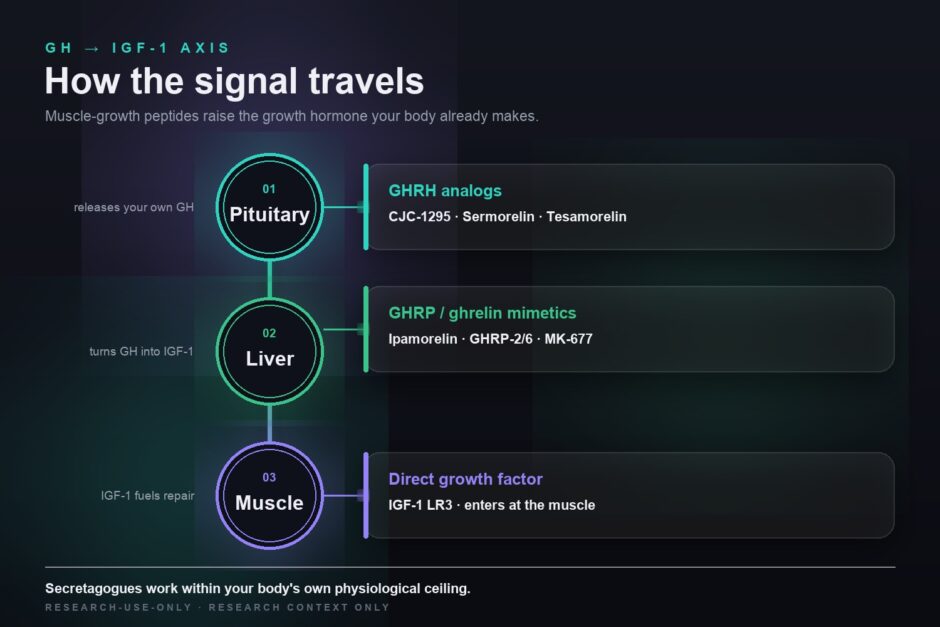
Peptides are short chains of amino acids that act as signals in the body. The muscle-building peptides studied most are growth-hormone secretagogues, meaning they prompt the pituitary gland to release the body’s own growth hormone. That GH then travels to the liver, which converts part of it into insulin-like growth factor 1 (IGF-1), and IGF-1 is the messenger most closely tied to muscle protein synthesis and recovery in the research literature.
The category splits into a few mechanisms.
- GHRH analogs, including CJC-1295, sermorelin, and tesamorelin, mimic the natural releasing hormone that tells the pituitary to make GH.
- GHRPs and ghrelin mimetics, including ipamorelin, GHRP-2 and GHRP-6, and the oral MK-677, act on a separate receptor to trigger a GH pulse.
- IGF-1 LR3 skips the chain entirely and delivers a long-acting version of the growth factor directly.
- A fourth group, the repair peptides BPC-157 and TB-500, sits apart because they are studied for tissue healing, which places them in the repair category.
The phrase that’s most important is “your own GH.” Secretagogues raise a hormone the body already makes, working within its physiological range, which is the mechanistic line researchers draw between these compounds and exogenous anabolic hormones. All compounds discussed here are strictly for laboratory research purposes.
How We Ranked These Peptides
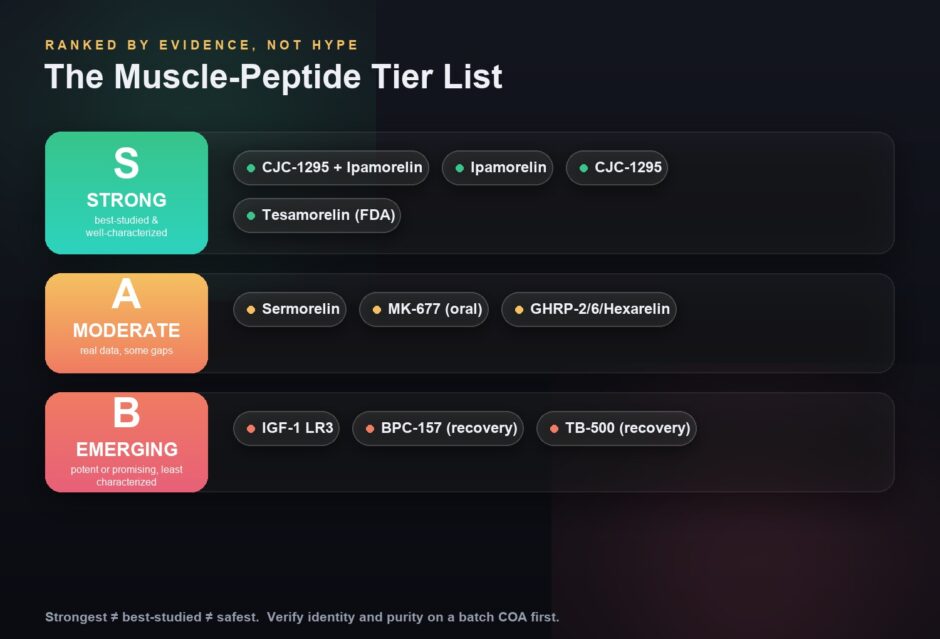
We scored each compound with a single lens we call the Research-Grade Score, built from four criteria applied consistently across the list.
- First, depth of peer-reviewed research: how much real clinical or preclinical data exists.
- Second, mechanism plausibility: how well the pathway to muscle actually holds up.
- Third, safety characterization: how thoroughly the risks are understood.
- Fourth, sourcing transparency: whether the compound is available as verifiable, third-party-tested research material.
A high rank means a compound is well-studied, mechanistically sound, and reasonably characterized for safety. Raw potency and popularity earned no points on their own. This is a research review for educational purposes, and it stands as neither an endorsement nor medical advice.
The 10 Best Peptides for Muscle Growth, Ranked
1. CJC-1295 + Ipamorelin: The Most-Studied Stack
This pairing tops the list because it is the best-characterized approach in the category. CJC-1295 is a long-acting GHRH analog, and ipamorelin is a selective GHRP, so the two hit different receptors and produce a larger, cleaner GH pulse together than either does alone.
The GHRH data is striking on its own: in a study by Teichman and colleagues in the Journal of Clinical Endocrinology & Metabolism, a single dose of CJC-1295 raised mean GH by two- to ten-fold for six days or more and IGF-1 by 1.5- to three-fold for nine to eleven days in healthy adults, with an estimated half-life of roughly six to eight days. The authors concluded that the compound “resulted in sustained, dose-dependent increases in GH and IGF-I levels in healthy adults and was safe and relatively well tolerated.”
That sustained rise in the GH and IGF-1 axis is the reason researchers reach for this stack first, and why it anchors most study designs. Formulations come with DAC, for a steadier release, or without DAC as Mod GRF 1-29, for a more pulsatile profile. As a research compound it is widely available, and researchers sourcing it should insist on a batch-matched certificate of analysis before anything else.
2. Ipamorelin: Selective GHRP
Ipamorelin earns its place as the cleanest of the GHRPs. In its early characterization it released growth hormone with minimal effect on cortisol and prolactin, the stress and lactation hormones that older ghrelin mimetics tend to raise.
That selectivity is exactly why it has become the default GHRP in the research literature and the go-to partner for CJC-1295. On its own it produces a modest, well-tolerated GH pulse, which makes it a common starting point for studies that want a controlled signal.
3. CJC-1295 (DAC vs No-DAC)
CJC-1295 is worth understanding as a standalone GHRH analog because the DAC decision shapes everything about how it behaves. The Drug Affinity Complex version binds to albumin and stretches the half-life to about a week, producing a steady elevation in GH and IGF-1 often described as a “bleed.”
The No-DAC version, sold as Mod GRF 1-29, clears quickly and delivers sharp, pulsatile releases that more closely mimic natural GH rhythm. Neither is inherently better in the research; they answer different experimental questions.
4. Tesamorelin: The Only FDA-Approved Compound
Tesamorelin is the compliance anchor of this list, the single compound here that carries an FDA approval. Marketed as EGRIFTA, it was approved in November 2010 for HIV-associated lipodystrophy, where it reduces excess visceral abdominal fat, and a newer formulation reached the market more recently.
Its approval covers that specific metabolic indication, and muscle-building falls outside its label. What makes it relevant is the strength of its GHRH data: as a synthetic growth-hormone-releasing factor, it is one of the most rigorously studied secretagogues in existence, which is why it appears in serious research on the GH axis even though its label points elsewhere.
5. Sermorelin: The Classic GHRH
Sermorelin is the elder statesman of this group, a GHRH fragment that has been characterized for decades. It stimulates the pituitary through the same receptor as the newer analogs but acts for a much shorter window, so its effect on GH is briefer and gentler.
That long track record is its value: sermorelin is the research foundation the modern GHRH compounds were built on, and it remains a well-understood reference point when a study wants a short-acting, established signal.
6. IGF-1 LR3: Direct Growth Factor
IGF-1 LR3 takes a different route to the same destination. It delivers a long-acting analog of IGF-1 itself, the growth factor at the end of the chain, skipping the step of prompting the body to make more GH. That directness is why it is often called the most potent option, since it bypasses the pituitary and the liver entirely.
The trade-off is characterization: IGF-1 LR3 is the least well-studied for long-term safety of the compounds near the top of this list, which is why it sits mid-ranking despite its potency. Potency and safety data are separate questions, and this is a research compound to treat with particular caution.
7. MK-677 (Ibutamoren): The Oral Secretagogue
MK-677 answers the common question of whether any of these work as a pill, since it is the notable orally active option, a non-peptide ghrelin mimetic. It also has unusually good long-term data. In a two-year trial in healthy older adults, the University of Virginia team led by endocrinologist Michael O.
Thorner reported in the Annals of Internal Medicine that MK-677 “increased growth hormone secretion and fat-free mass in healthy older adults,” raising GH by about 1.8-fold and IGF-1 by about 1.5-fold and lifting fat-free mass by roughly 1.6 kg over placebo.
The same study reported that the added mass did not translate into measurable gains in strength or physical function, a finding worth sitting with, and MK-677 remains investigational with no FDA approval.
8. BPC-157: The Recovery Peptide
BPC-157 belongs to the recovery half of this conversation. It is studied for tissue and tendon repair in preclinical models, which places it in the recovery-and-rehab lane, so it supports training indirectly by helping researchers study healing.
It is also the subject of active FDA attention and carries its own regulatory flags, so its status is worth checking against current rules. In practice it shows up most often as a partner in recovery stacks, valued for what it may do between sessions, in the recovery window.
9. TB-500 (Thymosin Beta-4): Repair & Recovery
TB-500, a synthetic version of the peptide thymosin beta-4, is the other half of the recovery pairing. Research has looked at it for recovery, tissue repair, and flexibility, again on the healing side of the ledger, on the recovery end.
Its most familiar role is as the companion to BPC-157 in what the community calls the Wolverine stack, a recovery-focused combination that researchers pair for their overlapping repair mechanisms.
10. GHRP-2 / GHRP-6 / Hexarelin: Legacy GHRPs
The legacy GHRPs round out the list because they still matter historically and still release plenty of GH. GHRP-2, GHRP-6, and hexarelin are older ghrelin mimetics that produce strong pulses, but they come with trade-offs the newer peptides avoid: GHRP-6 is notorious for driving hunger, and this class tends to raise cortisol and prolactin more than ipamorelin does.
Those side effects are exactly why the field largely moved on to cleaner options, which is why these sit at the bottom of a research-graded ranking.
The Best Peptide Stacks for Muscle Growth
The Foundational Stack: CJC-1295 + Ipamorelin
The foundational stack pairs a GHRH analog with a GHRP so the two mechanisms reinforce each other. CJC-1295 raises the baseline of available releasing hormone while ipamorelin triggers a clean pulse on top of it, and the combined GH release studied in this pairing is larger than either compound produces alone.
This synergy is the reason it is the most common starting design in the research and the backbone most other stacks build from.
The Advanced Stack: Adding IGF-1 LR3
The advanced approach adds IGF-1 LR3 to the foundational pair, creating the trio that shows up repeatedly in advanced research discussions. The logic is to combine an elevated GH-and-IGF-1 axis from the secretagogues with a direct supply of the growth factor itself.
It is also the least characterized of the three combinations for safety, so it belongs to careful, well-controlled research only.
The Recovery Stack: BPC-157 + TB-500
The recovery stack sets growth aside and focuses on repair. BPC-157 and TB-500, the Wolverine pairing, are studied for tissue healing, and researchers combine them for their complementary repair mechanisms, a recovery-focused pairing.
It answers a different question from the growth stacks: what supports the body between hard sessions. None of these combinations comes with a dosing protocol here, and all remain research-use-only.
Peptides vs SARMs vs Steroids for Muscle
These three categories are often lumped together, yet they work in genuinely different ways.
- Growth-hormone peptides signal the body to release its own GH, an indirect effect that stays within a physiological ceiling.
- SARMs act on the androgen receptor with tissue selectivity, a different pathway aimed at anabolic signaling.
- Anabolic steroids supply exogenous hormone directly, overriding the body’s own production.
When people ask which peptide is “closest to hGH,” the honest answer is the secretagogues, tesamorelin and CJC-1295 chief among them, because they raise endogenous growth hormone, working with the body’s own supply. That indirect, ceiling-limited mechanism is also why the safety and legal picture for peptides looks different from steroids, though all of these carry their own risks and every peptide here is banned in tested sport.
What Results Can Research Suggest? (Before & After Context)
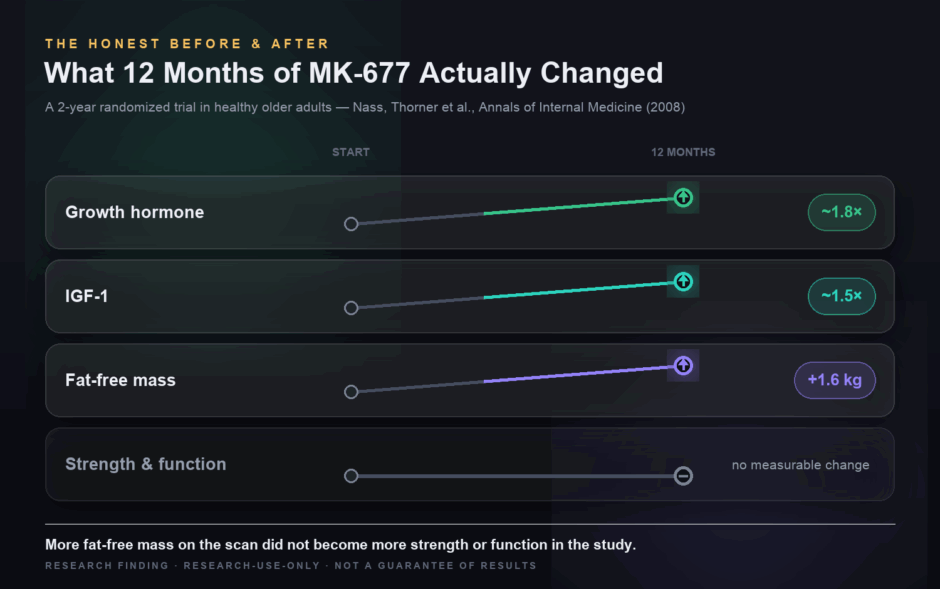
Nass R, Pezzoli SS, Thorner MO, et al. “Effects of an Oral Ghrelin Mimetic on Body Composition and Clinical Outcomes in Healthy Older Adults” – Annals of Internal Medicine, 2008; 149(9):601–611 (PMID 18981485). A 2-year, double-blind, randomized, placebo-controlled trial from the University of Virginia.
Marketing loves a dramatic before-and-after, so it helps to see what the research actually measured. The clearest long-term data, as you can see in the above infographic, the two-year MK-677 trial, found a real increase in fat-free mass without a matching gain in strength or function, a reminder that more tissue on a scan is a separate thing from more performance in the gym.
The GHRH and GHRP studies show reliable rises in GH and IGF-1, the upstream signals that support muscle protein synthesis and recovery, over the days following administration. What the literature does not offer is a guarantee of the transformations shown in advertising. Body composition shifts studied in research unfold gradually and depend heavily on training and nutrition, and results in a controlled study describe a measured outcome, never a promise.
The Strongest Peptide for Muscle Growth
“Strongest” depends on what you mean.
- For raw potency, IGF-1 LR3 leads, because it delivers the growth factor directly and bypasses every regulatory step in the GH axis.
- For weight of evidence, the CJC-1295 + Ipamorelin stack is the strongest choice, since it is the best-studied and best-characterized approach available.
The key point is that strongest and safest describe different things: IGF-1 LR3’s potency comes with the thinnest long-term safety record on this list, while the best-studied stack is strong precisely because researchers understand it well. Whichever a study calls for, its identity and purity should be verified against a certificate of analysis before anything else.
Best Peptides for Women vs Men
The research base here is thinner than the data available online suggests, and it is worth being honest about that. Growth-hormone secretagogues like CJC-1295 and ipamorelin act on the GH axis, which functions in everyone, so the mechanism is not sex-specific the way androgen-based compounds are.
Female-focused research interest has centered on the secretagogues partly because they raise endogenous GH without the virilizing effects associated with anabolic steroids. Male research context is broader simply because more of the historical data comes from male subjects.
Across both, the evidence for muscle-specific outcomes remains limited and heavily study-dependent, and anyone extrapolating from GH and IGF-1 changes to everyday results in either sex is reaching past what the data supports.
Injectable vs Oral (Pills) Peptides
Almost every compound on this list is a subcutaneous injectable, for a simple reason: most peptides are broken down in the digestive tract and would not survive as a swallowed pill. MK-677 is the notable exception, an orally active non-peptide ghrelin mimetic that works as a tablet in research settings, which is why it dominates any “peptide pills” conversation.
The collagen peptides and “peptide” supplements sold for oral use are a different category entirely, with their own limited bioavailability, and they should not be confused with the research compounds discussed here. Setting that expectation early saves a lot of disappointment.
Where to Source Research-Grade Peptides
Sourcing is the part the science can’t fix for you, and it is where most of the real risk is. The line between high-quality research-grade material and dubious grey-market powder comes down to documentation: a batch-specific third-party certificate of analysis, verified purity by HPLC and mass spectrometry, testing on every lot, US-based fulfillment, and genuine research-use-only labeling. A vendor that publishes those results before you buy is giving you evidence; one that asks you to trust the brand is not.
Life Link Research is a useful example of the standard to look for. It runs a six-part panel on every batch, covering purity and identity along with heavy metals, endotoxin, sterility, and composition, publishes a lot-matched COA you can read before ordering, and reports ≥99% HPLC purity on its research peptides.
Understanding how a supplier documents its testing is the single most useful habit a researcher can build, since it turns sourcing from a leap of faith into a checkable decision. Everything sold this way is a research material, not for human consumption.
Safety, Side Effects & Legal Status
The researched side-effect profile is worth taking seriously.
- Across the GH-axis compounds, studies note water retention, injection-site reactions, and effects on insulin sensitivity, the last of which is a particular consideration with sustained IGF-1 elevation.
- IGF-1 LR3 carries the least-characterized long-term risk of the group, while BPC-157 was recommended to be added to the Section 503A Bulk Drug Substances list in July 2026 by the FDA’s Pharmacy Compounding Advisory Committee (PCAC).
- None of these compounds is approved for muscle growth; they are sold for laboratory research only, and tesamorelin’s approval covers a different indication entirely.
- The legal and sporting picture adds another layer. Growth-hormone secretagogues and GH-releasing peptides sit on the WADA Prohibited List, which makes them disqualifying for anyone subject to testing in sport.
Their broader legal status is a grey area that varies by jurisdiction and continues to shift with regulatory attention. This is research context, not medical guidance, and anyone weighing questions about these compounds should speak with a licensed physician.
How to Choose a Quality Peptide (COA Checklist)
A good certificate of analysis answers a short list of questions, and learning to read one is the best protection a researcher has.
- Look for a third-party lab named on the certificate, a purity figure by HPLC of 99% or higher, mass-spectrometry confirmation that the molecule matches its intended identity, and sterility and endotoxin results for anything destined for sensitive work.
- Confirm the COA is linked to the specific batch you are buying and carries a recent date, and check that reconstitution guidance is transparent.
- The red flags are just as clear: no COA or one available only “on request,” any claim of human use, and miracle before-and-after imagery.
- A vendor that clears the checklist has earned a second look; one that stumbles on it has told you what you need to know.
What Reddit & the Research Community Say
Community sentiment tracks the research more closely than you might expect. Across peptide and natural-bodybuilding forums, the recurring consensus is that CJC-1295 + Ipamorelin is the sensible starting point, valued for being well-understood and comparatively clean.
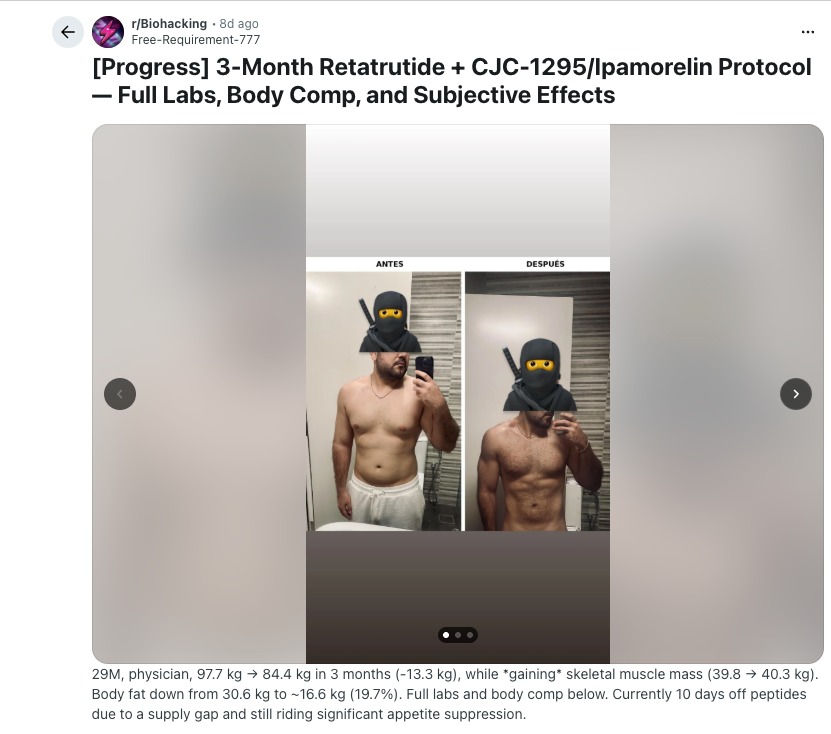
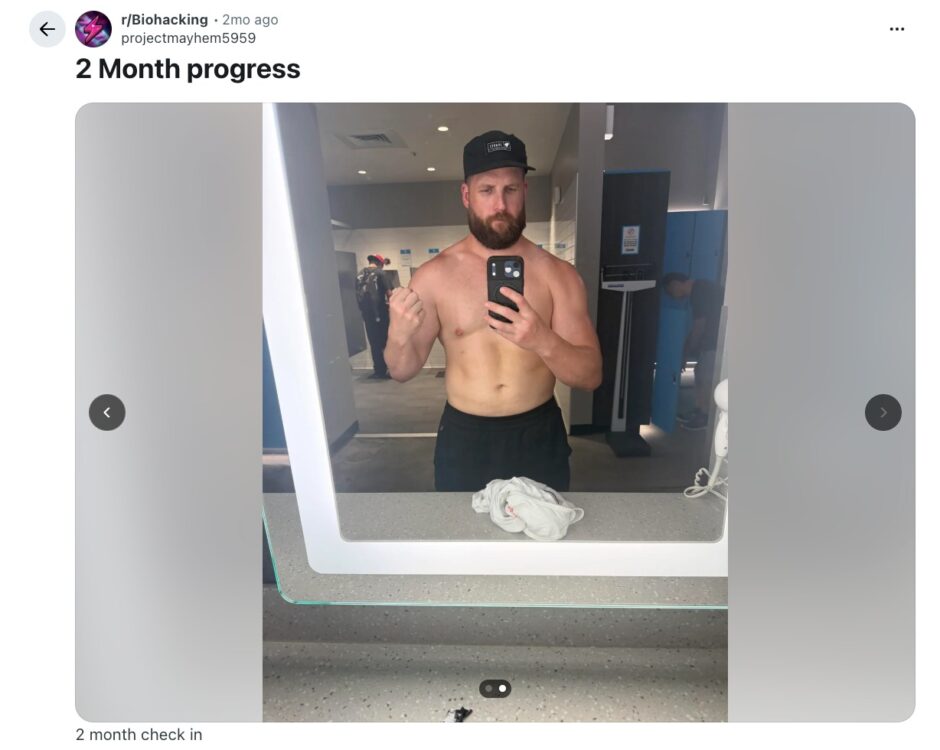
Tesamorelin draws respect as the compound with real approval behind it, while IGF-1 LR3 is usually described as strong but risky, the option experienced researchers treat with the most caution. The most repeated piece of practical advice is simply “post the COA,” a demand for third-party verification before trusting any source. Running underneath all of it is a healthy skepticism that secretagogues are no magic shortcut, only a signal on top of the work.
Frequently Asked Questions
Can you build muscle on peptides?
Growth-hormone peptides are studied for raising GH and IGF-1, the signals that support muscle protein synthesis and recovery, so their role is indirect. Research shows changes in body composition over time, but training and nutrition remain the primary drivers. These are research compounds, not approved muscle building treatments.
Which peptide injection is best for muscle growth?
The CJC-1295 + Ipamorelin stack is the most-studied injectable approach, pairing a GHRH analog with a selective GHRP for a larger, cleaner GH pulse than either alone. It anchors most research designs, which is why it ranks first here. It remains research-use-only and WADA-banned.
Which peptide is closest to hGH?
Growth-hormone secretagogues come closest, because they raise the body’s own GH, working within its natural supply. Tesamorelin and CJC-1295 are the most GH-active of the group. They work within a physiological range, a mechanistic distinction from injecting growth hormone directly.
Does BPC-157 help muscle growth?
BPC-157 is studied for tissue and tendon repair, so its role is recovery and healing. Researchers pair it with TB-500 in recovery stacks. It carries FDA regulatory flags and is research-use-only.
What is the strongest peptide for muscle growth?
IGF-1 LR3 is the most potent by mechanism, delivering the growth factor directly, but it is also the least characterized for long-term safety. The best-studied option is the CJC-1295 + Ipamorelin stack. Strongest and safest are separate questions, and identity should always be verified against a COA.
Are muscle-growth peptides legal / FDA-approved?
They are sold as research-use-only compounds and are not FDA-approved for muscle growth. Only tesamorelin holds an FDA approval, for HIV-associated lipodystrophy, a different indication. All of them are prohibited under WADA for tested athletes, and legal status varies by jurisdiction.
The Bottom Line
CJC-1295 + Ipamorelin is the best-studied approach, IGF-1 LR3 the most potent, and tesamorelin the only FDA-approved compound, cleared for a different use. Peptides support the body’s own growth hormone through an indirect, ceiling-limited mechanism that separates them from steroids.
What decides real research quality is sourcing: a third-party, batch-matched COA and verified purity matter more than any single compound, so verify purity of these research compounds before you place any orders.
Disclaimer
This article is for research and educational purposes only and is not medical advice. The compounds discussed are research-use-only materials, not for human or veterinary consumption, and are not FDA-approved for muscle growth. Some, including BPC-157, carry specific FDA regulatory status, and these compounds are prohibited under WADA in tested sport. Statements have not been evaluated by the FDA. Consult a licensed physician with any health questions. Intended for adults 18 and over.
Related posts:




Stay updated, free articles. Join our Telegram channel

Full access? Get Clinical Tree


