By Sadey Reed, Peptide Quality Analyst · Medically reviewed by Dr. Alan Whitfield, MD · Last updated September 2026
Quick Answer
AOD-9604 is a synthetic fragment of human growth hormone (amino acids 176 to 191, the “lipolytic domain”) studied for fat-metabolism signaling without the growth effects of full GH. In research it is investigated for lipolysis and metabolic pathways. Human clinical trials for obesity showed limited results, so the evidence is mixed. It is research-use-only, not FDA-approved, and different from GLP-based compounds like tirzepatide.
Key Takeaways
- AOD-9604 is an HGH fragment (residues 176 to 191), often called the lipolytic domain.
- It is studied for fat-metabolism and lipolysis research in cell and animal models.
- It differs from full GH: no growth-promoting or IGF-1 activity, and no effect on blood sugar.
- The human obesity evidence is weak and mixed. A 24-week trial missed its target versus placebo.
- It is not a GLP compound. Tirzepatide and semaglutide work by a completely different mechanism.
- It is research-use-only and not FDA-approved. Quality comes down to a third-party COA.
- We’ve identified Cellugenix Peptides as a reliable source for COA-backed lab reagents.
AOD-9604 at a Glance
AOD-9604 is a 16-amino-acid peptide copied from the tail end of human growth hormone. Researchers built it to isolate GH’s effect on fat metabolism and leave the growth signaling behind. Its structure is logged at the NIH PubChem database as CID 71300630.
| Property | Detail |
| Sequence / origin | HGH fragment, residues 176 to 191 (Tyr-hGH 177 to 191) |
| Class | Synthetic peptide (hexadecapeptide) |
| Molecular formula | C78H123N23O23S2 |
| Studied for | Lipolysis and fat-metabolism research |
| Versus full GH | Keeps the fat-metabolism activity, drops growth and IGF-1 effects |
| Regulatory status | Not FDA-approved; research-use-only |
| Quality marker | Batch-specific COA, ≥99% HPLC purity |
What Is AOD-9604?
AOD-9604 is a synthetic peptide copied from the C-terminus of human growth hormone, the stretch of amino acids from position 176 to 191. Chemists sometimes write it as Tyr-hGH 177 to 191, a nod to the tyrosine added to the front to stabilize it.
The whole idea behind the molecule was subtraction. Full growth hormone does many jobs at once: it drives tissue growth, raises IGF-1, and changes how the body handles fat and sugar. Researchers wanted the fat-metabolism piece on its own, so they isolated the domain thought to carry it.
That makes AOD-9604 a research tool with a narrow target. In the lab it is used to study lipolysis (fat breakdown) and the signaling around it, without the broader growth activity that full GH brings. The NIH PubChem record lists it as a hexadecapeptide with the formula C78H123N23O23S2, an identity a good certificate of analysis will confirm before any study begins.
How Does AOD-9604 Work? (Mechanism)
In research models, AOD-9604 stimulates lipolysis and dampens lipogenesis, which is the formation of new fat, working through the fat-metabolism branch of the growth-hormone pathway. It does this without switching on the growth and IGF-1 signaling that full GH triggers, and studies report no effect on blood sugar.
Here is the chain of events researchers describe. Full growth hormone has a known lipolytic action, and that action exists largely in its C-terminal region. AOD-9604 copies that region, so in fat cells it encourages stored fat to break down and discourages new fat from forming.
The selling point for researchers is what the fragment leaves out. A 2011 review in Central and Peripheral Molecular Targets for Anti-Obesity Pharmacotherapy describes AOD-9604 as a modified fragment of amino acids 177 to 191 that “mimics the lipolytic effects of GH without producing growth effects.” That separation, fat-metabolism signaling on one side and growth signaling on the other, is the reason the molecule exists.
Researchers also point to speed and specificity. Because the fragment is small and targeted, models show it engaging the fat-metabolism pathway without the wider hormonal cascade that full GH sets off. One more point keeps coming up in the literature: AOD-9604 does not appear to act like insulin or affect IGF-1 levels. For a research team studying fat metabolism on its own, that clean readout is the appeal. Everything here describes activity in research models, not an outcome in a person.
How AOD-9604 Differs From HGH
AOD-9604 keeps growth hormone’s fat-metabolism domain and drops the rest. Full GH promotes tissue growth and raises IGF-1, which is useful in some research contexts and unwelcome in others. The fragment was built to study lipolysis without pulling those growth signals along with it.
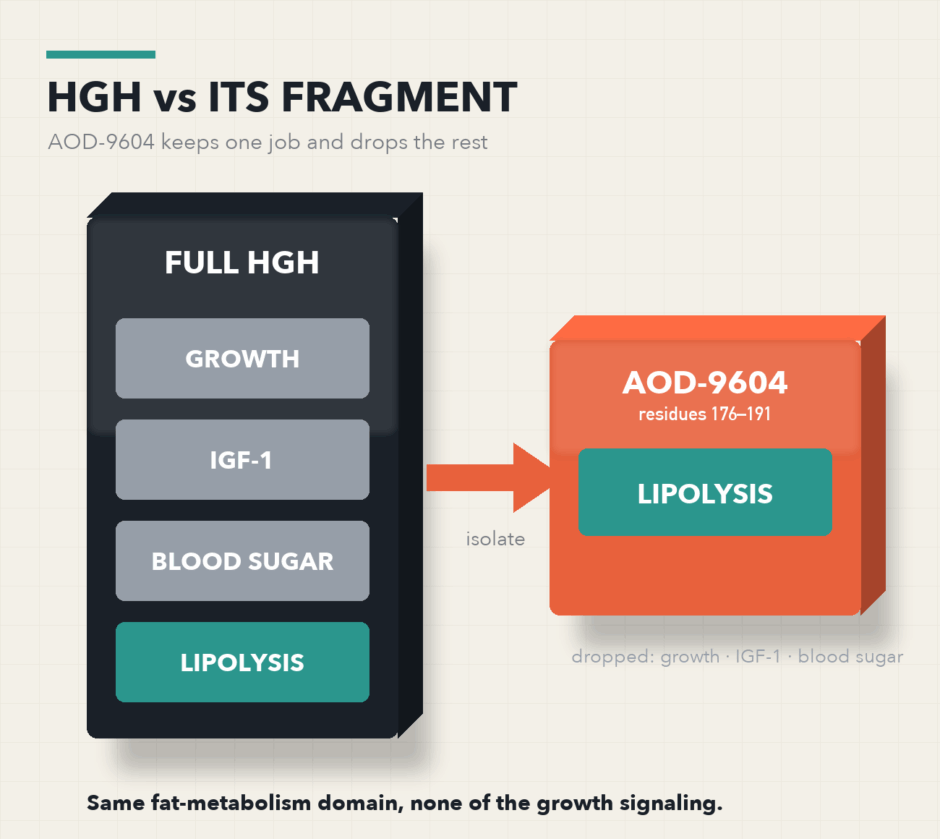
AOD-9604 keeps growth hormone’s lipolysis domain and drops growth, IGF-1, and blood-sugar signaling
The original research pitch was “the fat-reducing power of GH without its drawbacks.” That single design choice explains the whole molecule. A researcher who wants to isolate fat-metabolism signaling gets a cleaner variable with the fragment than with full growth hormone, where several effects fire at once.
It also changes the safety picture in studies. Because AOD-9604 skips the growth-hormone receptor’s broader activity, trials reported none of the blood-sugar or IGF-1 shifts associated with GH. That narrower action is exactly what makes it a useful research tool, and it is why the two should never be treated as interchangeable.
What Is AOD-9604 Studied For? (Research Applications)
AOD-9604 is studied mainly for fat-metabolism and lipolysis research, with a smaller line of work on cartilage and tissue repair. Every application below is preclinical or investigational.
- Lipolysis and fat metabolism. The core research lane. Models look at how the fragment encourages fat breakdown and slows new fat formation.
- Metabolic signaling. How the peptide behaves alongside glucose and lipid handling, and whether it stays clear of insulin and IGF-1 pathways.
- Receptor-binding studies. Characterizing where and how tightly the fragment interacts, since a short peptide can behave differently from the parent hormone.
- Cartilage and joint research. A secondary history, covered in its own section below, tied to osteoarthritis models.
- Anti-doping analytics. Because the fragment carries a growth-hormone-derived sequence, sport-science labs have worked on ways to detect it, which is its own small research thread.
The reason researchers reach for AOD-9604 is that narrow target. When you want to watch fat metabolism move without growth signaling in the mix, a single-purpose fragment gives a cleaner experiment than full GH. The value in a study is the mechanism it lets you isolate, which puts real weight on identity and purity before the work starts. This doesn’t describe weight loss in a person.
Does AOD-9604 Actually Work? What the Studies Show
The straight answer from the clinical record: AOD-9604 showed a small early signal that later trials did not confirm. An early 12-week study reported an average 2.6 kg reduction versus 0.8 kg for placebo, according to the 2011 review in PMC. That looked promising.
The bigger test told a different story. The same review notes that development “was terminated in 2007 because the drug failed to induce significant weight loss in a 24-week trial of 536 subjects.” The larger, longer study did not beat placebo, and the developer, Metabolic Pharmaceuticals, ended the obesity program.
There is, however, a wrinkle worth knowing. The effect was not dose-dependent, since a 10 mg daily group actually showed a smaller reduction than the 1 mg group. When a higher dose does less, researchers get cautious about the signal being real, because a genuine drug effect usually grows with dose, and here it shrank. That inconsistency, plus the failed 24-week endpoint, is why the obesity program closed before any larger confirmatory trial.
So enthusiasm has run ahead of the data for years. The mechanism is genuine in models, the safety record held up, and the human weight-loss result remained weak. That gap is the single most useful thing to understand about this peptide, and it is why we treat it as a research compound to verify by COA.
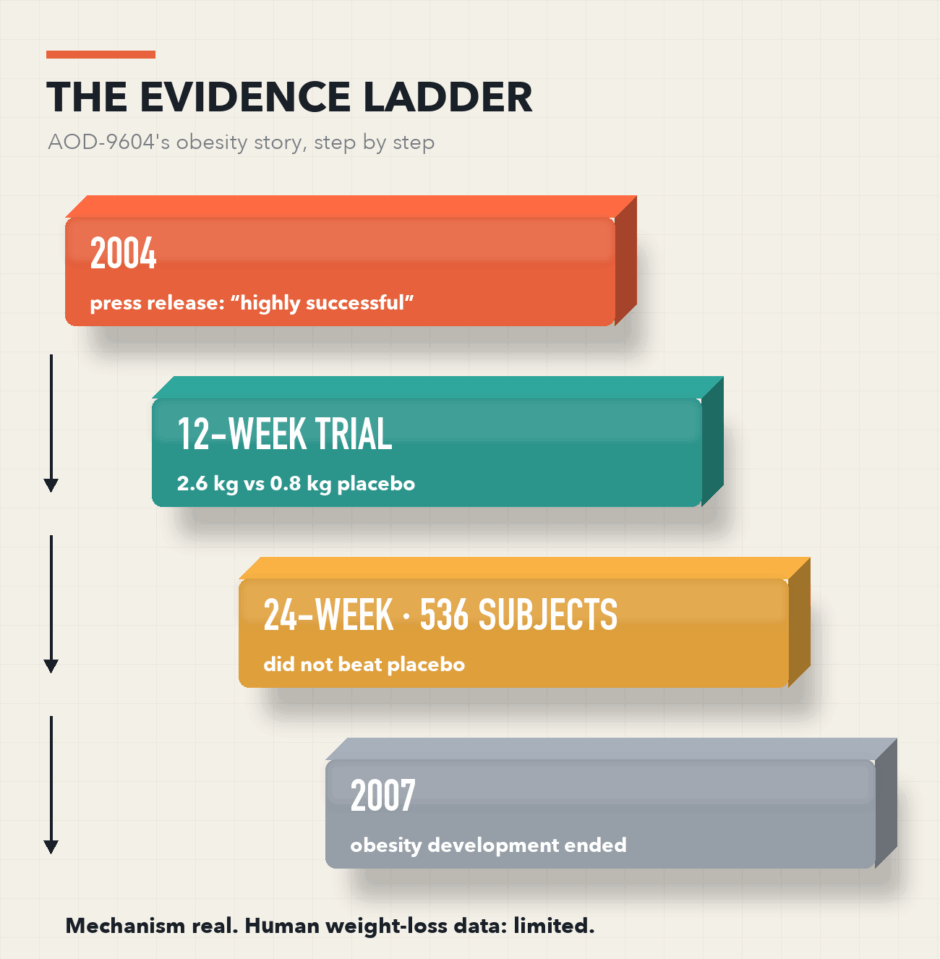
The clinical arc of AOD-9604 (PMC, 2011)
AOD-9604 for Fat-Metabolism Research
Fat metabolism is where AOD-9604 draws the most research interest, and where the confusion tends to start. In research models the peptide is studied for how it nudges fat cells toward breakdown and away from storage, which is a mechanism question about how fat cells behave in a controlled model.
The distinction is practical. A lab exploring lipolytic signaling can use the fragment as a probe, measuring what happens in cells or animals when that pathway is engaged. What the literature does not support is a reliable human fat-loss effect, since the trials that tested exactly that came up short.
Two things can both be true. The molecule does what it says at the mechanism level, and the human evidence for meaningful weight loss stays thin. Researchers studying lipolysis still find the fragment useful precisely because its action is narrow and measurable, which makes it a clean probe even when the clinical payoff looks small. Keeping the mechanism and the human evidence separate is the way to accurately understand AOD-9604, and it keeps any use squarely in the lab.
Why AOD-9604 Results May Stall (Research Context)
When results stall in a research setting, quality is the first thing to check. AOD-9604 is a fragile fragment: once reconstituted it degrades through oxidation and hydrolysis, and it can gel in the vial after improper storage or repeated freeze-thaw cycles. A degraded or off-spec batch reads as a weaker outcome in any model, which is why a lot-matched COA and careful cold storage do a lot of the work here.
The second factor is the compound itself. The human lipolytic signal measured in trials was modest, and it did not strengthen in the largest study, so even an intact batch has a limited effect to show. Both threads point the same way: verify the material first, then read the result against what the evidence actually supports.
AOD-9604 for Cartilage & Joint Research
Beyond fat metabolism, AOD-9604 picked up a second research life in cartilage and joint work. The interest comes from growth-hormone-related signaling, since GH pathways influence how chondrocytes (the cells that build and maintain cartilage) behave, which makes a GH-derived fragment worth testing in joint models.
Most of that work is preclinical and narrow. In animal osteoarthritis and cartilage-repair studies, AOD-9604 has been examined for its effect on chondrocyte activity and tissue regeneration, sometimes delivered directly into the joint or paired with a carrier like hyaluronic acid to study cartilage recovery. The readouts are cellular and structural, measured in models rather than people.
It remains in early-stage research with no approved joint use, and a brief 2009 licensing deal toward a topical cosmeceutical is a side note next to it. As with everything here, this is research-model activity, not a treatment claim.
AOD-9604 vs MOTS-c
AOD-9604 and MOTS-c both attract metabolic research interest, and they get there by different routes. AOD-9604 is a growth-hormone fragment studied for lipolysis. MOTS-c is a mitochondrial-derived peptide studied for how it activates AMPK and shifts cellular energy metabolism.
The mechanisms barely overlap. One copies a slice of a hormone to act on fat cells; the other comes from mitochondrial DNA and works on the cell’s energy-sensing machinery. A research program picks between them based on the pathway it wants to study.
Researchers rarely treat them as substitutes, since a lipolysis probe and an energy-metabolism probe answer different questions. Labs comparing the two can find COA-tested MOTS-c for the mitochondrial side of that work.
AOD-9604 vs Tesamorelin
AOD-9604 and Tesamorelin both touch the growth-hormone space, from opposite ends. AOD-9604 is a fragment that mimics GH’s fat-metabolism action directly. Tesamorelin is a GHRH analog that prompts the body to release more of its own growth hormone, which then acts across the usual GH pathways.
The regulatory gap is the big one. Tesamorelin is FDA-approved for a specific medical indication (HIV-associated lipodystrophy), while AOD-9604 holds no approval and is sold research-use-only. So they are not swap-ins for each other in any sense, in research design or in status. Labs working the GHRH-analog side can find COA-tested Tesamorelin for that comparison.
Is AOD-9604 the Same as Tirzepatide or Semaglutide?
No. AOD-9604 is a growth-hormone fragment that acts on fat metabolism. Tirzepatide and semaglutide are incretin receptor agonists, working through the GLP-1 and GIP pathways, and they are prescription drugs. The mechanisms have nothing in common.
The mix-up is understandable, because all three get bucketed under “fat” in casual conversation. Under the hood they could hardly be more different. The incretin class acts on gut-hormone receptors that influence appetite and blood-sugar handling. AOD-9604 skips appetite entirely and works on fat cells through the growth-hormone lipolytic domain.
There is a status difference too. The GLP class contains approved medicines that a clinician prescribes, whereas AOD-9604 is an unapproved research compound. Naming these compounds here is for clarity, not endorsement.
AOD-9604 Dosage & Reconstitution in Research
Dosage and reconstitution figures for AOD-9604 exist only as research-literature reference points, not as instructions. This section describes what appears in studies. It is not usage guidance, and the compound is research-use-only.
In the trial record, experimental protocols discussed quantities in the microgram range given by subcutaneous injection, often in a fasted-state window. Those numbers describe how studies were structured, and they say nothing about any use outside a controlled research setting.
Reconstitution follows the pattern for any lyophilized peptide: the powder is dissolved in bacteriostatic water, kept cold, and prepared only in the amount a study needs. Anyone reading dosing figures should treat them as historical study detail, and any health question belongs with a licensed physician.
How Long Does AOD-9604 Take? (Research Context)
Trial timelines give the only straight answer, and they are sobering. The early 12-week study measured its modest 2.6 kg signal over roughly three months, per the PMC review. The larger 24-week trial ran twice that long and still missed its target.
So the research literature describes months-long windows, with a human effect that stayed limited even at the far end. That is context, not a results promise. In a research setting the timeframe describes an experiment’s length, and the outcome data attached to those windows was weak. Anyone expecting a fast, visible change from a short run is working from marketing, not from the trials, which took months to measure even a small effect.
AOD-9604 Side Effects & Safety
AOD-9604 came through its clinical program with a clean tolerability record. A 2013 safety analysis by Stier and colleagues pooled data from six trials covering 893 participants and reported a good safety and side-effect profile, with the compound acting on fat metabolism through a lipolytic route and no appetite-suppressant action.
That said, “well tolerated in trials” is not the same as “approved” or “risk-free.” AOD-9604 holds no regulatory approval, and its long-term profile outside those studies is not established. It is a research reagent, handled by qualified people in a lab.
Athletes have another reason for caution: AOD-9604 has drawn anti-doping attention, and it is treated as a prohibited substance in sport. Contamination or an off-spec batch adds its own risk to any study, which loops back to sourcing and the COA. None of this is medical advice, and health questions belong with a licensed physician.
Is AOD-9604 Legal? FDA Status
AOD-9604 was investigated as an obesity drug and never approved. When the 24-week trial missed its endpoint, the developer ended the program in 2007, and no regulator has cleared it since. The U.S. Food and Drug Administration lists no approval for it in any indication. It stayed on the regulator’s radar as recently as the FDA Pharmacy Compounding Advisory Committee’s December 2024 meeting, which reviewed AOD-9604 (nominated for weight loss, osteoporosis, and osteoarthritis) for the list of bulk substances allowed in pharmacy compounding, a sign it remains under review and outside approved use.
What remains is a research-use-only chemical. It can be sold and bought for laboratory research, labeled for scientific work and not for human or veterinary use. That research-use framework is the legal lane the compound lives in, and stepping outside it is where problems start.
What Buyers Should Know (Research-Grade vs Grey-Market)
For a short peptide fragment, quality is the whole game, and it is invisible without paperwork. A vial with no certificate of analysis is a guess. Two things separate research-grade material from grey-market product, and both are checkable before you order.
- Third-party COA, matched to your lot. An independent lab report tied to the exact batch number on the vial, not a generic sheet for the product line.
- HPLC and mass spectrometry. HPLC shows how much of the vial is the intended peptide; mass spectrometry confirms it is AOD-9604 and not a look-alike or a degradation product.
Grey-market sellers tend to skip both, or wave a single old report at every batch. A COA that never changes across lots is a red flag on its own, since real batch testing produces a fresh report every run. The rule of thumb is simple: if a seller cannot show a current, lot-matched COA, that silence is your answer.
AOD-9604 Price & Value
AOD-9604 pricing tracks vial size and, more tellingly, testing quality. Smaller 5 mg vials commonly run around $60, which works out to about $12 per milligram. A fully tested 10 mg vial runs about $72.46, closer to $7 per milligram, so the larger tested vial is the better per-milligram value.
Price should follow proof. A cheap vial with no COA is not a deal, because you cannot confirm what is in it, and a fragment peptide that has degraded will skew any result. Paying a little more for third-party HPLC and mass-spec testing, with a lot-matched report, buys data you can trust.
That is the value calculation worth making. Put plainly, a $60 vial with no paperwork can cost more than a $72 vial with a lot-matched COA, because the cheaper one might hand you a failed experiment and no way to trace why.
Where to Buy Research-Grade AOD-9604
Buy AOD-9604 only from a source that publishes a third-party, lot-matched COA and tests to ≥99% purity by HPLC and mass spectrometry. US-based dispatch, transparent batch records, and a searchable COA library are the marks of a research-grade supplier. Anything short of that is a gamble on a molecule that is easy to get wrong. Fragment peptides degrade if they are made or stored poorly, and a degraded vial reads as a weaker result in any assay, so the testing is what protects the data.
Of the sources that clear those bars, Cellugenix Research Peptides is the one this review checked against them. The research reagent supplier lists AOD-9604 10 mg at ≥99% HPLC purity with a lot-matched certificate of analysis, independently tested and tied to the vial you receive, priced at $72.46 and shipped with tracking. The batch report is searchable in its COA library, so the purity claim is verifiable before you order.
Whatever you choose, check the COA first and match the lot number to your vial. It is research material, and the paperwork is the difference between data and noise.
What Reddit & Experts Say
The community verdict on AOD-9604 has cooled into realism. On threads across r/Peptides and r/PeptideForum, the recurring advice is to keep expectations modest and to ask for the certificate of analysis before buying anything. “Post the COA” is close to a catchphrase there.
The expert commentary points the same way. A widely viewed 2026 breakdown from clinician Dr. Alex Tatem walks through the studies and lands on the same reading the trial record supports: the mechanism is real, the human weight-loss data is thin, and buyers should manage expectations. Clinical educators covering the compound echo the sourcing point, stressing lot-matched testing for a fragment that degrades easily.
Put together, the sentiment is neither hype nor dismissal. It is a call to treat AOD-9604 as a research compound with a specific, limited evidence base, and to buy it like one by starting with the COA.
Frequently Asked Questions
Does AOD-9604 actually work?
At the mechanism level, research models show AOD-9604 acting on fat metabolism. In human trials the weight-loss result was weak: a modest 12-week signal that a 24-week, 536-subject study did not confirm, which ended its development in 2007. The evidence is mixed, and it is research-use-only.
How long does AOD-9604 take to work?
Trials ran over 12 to 24 weeks, so the research literature describes months-long windows. Even across those windows, the measured human effect stayed limited. That timeframe describes study length, not a results promise, and the compound is for research only.
Is AOD-9604 the same as tirzepatide?
No, AOD-9604 is a growth-hormone fragment acting on fat cells. Tirzepatide is an incretin receptor agonist (GLP-1 and GIP) and a prescription drug. The mechanisms and regulatory status are entirely different, so the two should not be treated as alternatives.
What is AOD-9604 studied for?
AOD-9604 is studied for fat-metabolism and lipolysis research in cell and animal models, plus a smaller line of cartilage and joint research. Every application is preclinical or investigational, with no human outcome claimed.
Is AOD-9604 legal or FDA-approved?
AOD-9604 is not FDA-approved for any use. It was investigated for obesity, and development ended in 2007. It is sold as a research use chemical for laboratory work, not for human or veterinary use.
What are AOD-9604’s side effects?
In pooled trial data from 893 participants, AOD-9604 showed a good safety and tolerability profile, with no effect on blood sugar or IGF-1. Approval and long-term human safety outside those studies are not established, and it remains research-use-only.
The Bottom Line
AOD-9604 is an HGH fragment (residues 176 to 191) studied for fat-metabolism and lipolysis research, separate from full GH and from the GLP class like tirzepatide. The mechanism holds up in models, and the safety record from trials was solid.
The human obesity evidence stayed limited, with a 24-week study missing placebo, so enthusiasm has outrun the data. It is research-use-only and not FDA-approved. Always verify the COA and source from a transparent, third-party-tested supplier.
Disclaimer
This article is for informational and research purposes only. AOD-9604 is research-use-only, not for human or veterinary consumption, and not FDA-approved. Nothing here is medical or legal advice, and no weight-loss outcome is claimed. Results described are investigational and the human evidence is limited. AOD-9604 is prohibited in sport. Consult a licensed physician with health questions. Intended for adults 18 and older.
Related posts:



Stay updated, free articles. Join our Telegram channel

Full access? Get Clinical Tree


