Written by Emmalyn Potts and fact-checked by Michaela Perkins
To buy MOTS-c peptide with confidence, check the lot certificate behind the vial and the price. We compared three research vendors, Kylo Peptides, American Peptides, and True Research Labs, on purity, COAs, price per milligram, and product documentation.
All three list 10 mg and 40 mg vials of lyophilized MOTS-c and state at least 99% purity on their product pages. Pick the listing whose lot-matched certificate shows HPLC purity plus mass spectrometry identity, names its lab, and matches your vial, then compare cost per milligram. Kylo leads on identity data, American Peptides on published paperwork, and True Research Labs on price per mg.
MOTS-c Peptide Vendor Comparison Table
The three MOTS-c listings compare closely on size and stated purity, but differ on price and how much testing paperwork each publishes. Cost per milligram varies more widely than the purity claims, from $3.23 to $10.00.
| Vendor | MOTS-c Size | Price | Purity | COA | Testing | Product Form | Research-Only |
| Kylo Peptides | 10 mg / 40 mg | $64.95 / $169.95 | ≥99% HPLC stated | Lot-matched (stated), by vial lot number | HPLC + LC-MS (stated) | Lyophilized powder | Yes |
| American Peptides | 10 mg / 40 mg | $100 / $160 | 99.9% claimed | Lot-matched | HPLC + MS | Lyophilized powder | Yes |
| True Research Labs | 10 mg / 40 mg | $59 / $129 | ≥99% stated | Available (10 mg lot) | UPLC/MS | Lyophilized | Yes |
How We Selected These 3 MOTS-c Peptide Vendors
To pick vendors worth comparing when you buy MOTS-c peptide, we ran our own set of research-supplier checks. Each vendor had to clear the same filters on its current MOTS-c listing, from stock status to how easily a buyer can open and trace its test documents.
- Availability first. An active MOTS-c product page, a clearly identified product, a listed or purchasable vial, and linked documentation.
- Product documentation. Compound identity, quantity, vial size, physical form, purity, molecular data, storage, and specifications.
- Analytical documentation. COA access, lot or batch details, HPLC results, LC-MS or mass spectrometry, other assays, and a named testing lab.
- Price transparency. Listed price, quantity per vial, price per mg, shipping terms, and offered vial sizes.
- Research-use positioning. Clear labeling as research material, with no consumer or treatment framing.
- Supplier transparency. How easily a buyer can open the test documents, find company details, and trace a batch.
The three vendors appear because their MOTS-c listings publish enough to be judged on the same criteria. Their order carries no ranking.
Prices, stock, test reports, and COAs change from batch to batch. Check the current product page before you order.
What Exactly Is MOTS-c?
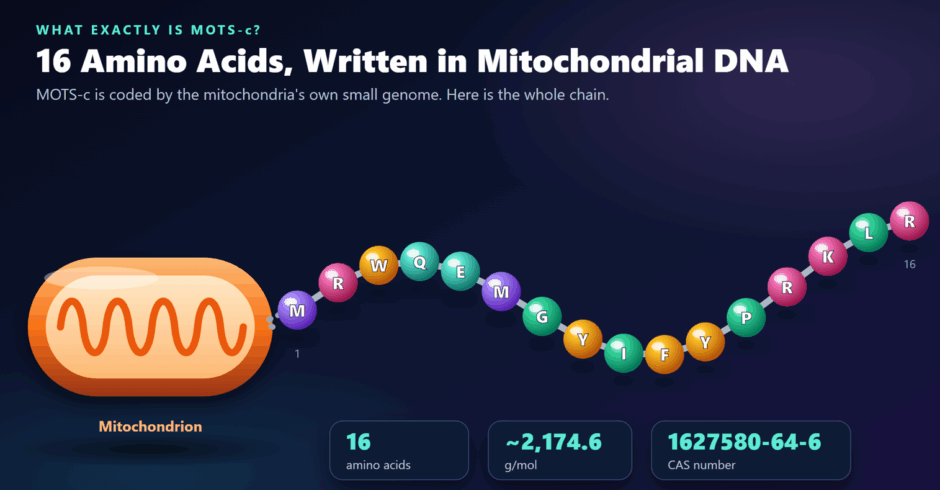
MOTS-c is a short peptide coded by DNA inside the mitochondria, the cell’s energy units. The name stands for Mitochondrial Open Reading Frame of the 12S rRNA Type-c. Researchers at the University of Southern California first described it in a 2015 Cell Metabolism paper as a 16-amino-acid peptide.
Nearly all of a cell’s proteins are coded in the nucleus. MOTS-c comes from the small mitochondrial genome instead, which puts it in a group called mitochondrial-derived peptides.
Its formula is C101H152N28O22S2. The same string should match on any listing or certificate you read.
| Property | MOTS-c |
|---|---|
| Full name | Mitochondrial Open Reading Frame of the 12S rRNA Type-c |
| Common name | MOTS-c |
| Peptide length | 16 amino acids |
| Sequence | MRWQEMGYIFYPRKLR |
| CAS number | 1627580-64-6 |
| Molecular weight | ~2,174.6 g/mol (PubChem CID 146675088) |
| Common commercial form | Lyophilized powder |
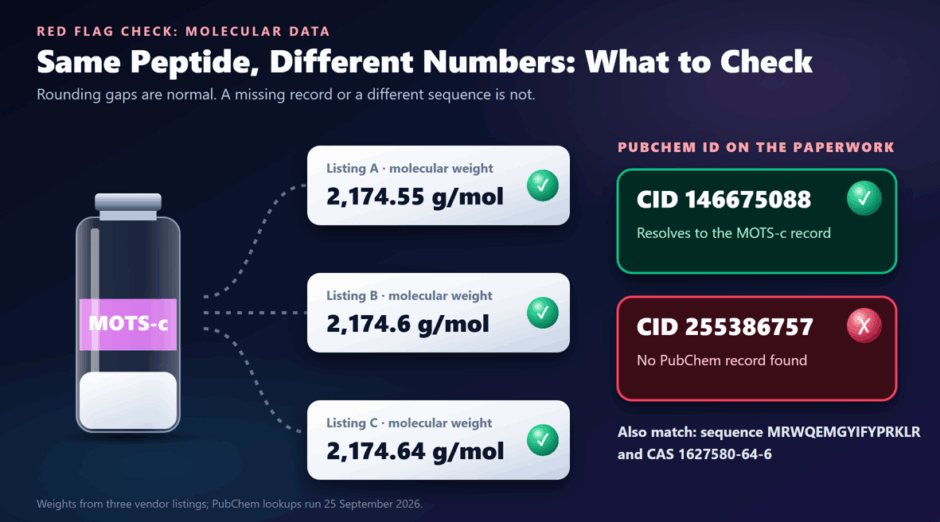
Vendor pages round the weight differently, from 2,174.55 to 2,174.64 g/mol. Small rounding gaps like these are normal, so check the sequence and CAS number for an exact match.
Why MOTS-c Has Become a Research Interest
MOTS-c draws research attention because it works as a signal sent from the mitochondria to the rest of the cell. Few known peptides do that. Labs study this mitochondrial-derived peptide to learn how mitochondria talk to the nucleus, how cells manage fuel, and how that signaling shifts with stress and age.
MOTS-c and Mitochondrial Signaling
The 2015 paper reported that MOTS-c acts on the folate cycle, a pathway cells use to make DNA building blocks, which leads to activation of AMPK, the enzyme that senses a cell’s energy status. A 2018 follow-up found MOTS-c moves into the nucleus under metabolic stress and changes gene expression there. It gives labs a tool for studying mitochondrial-to-nuclear communication.
Areas Investigated in Preclinical Research
Published work so far covers:
- Cellular metabolism and metabolic signaling pathways
- Exercise-related molecular research
- Mitochondrial function
- Cellular stress responses
- Aging-related biological research
Keep Research Findings Separate From Established Conclusions
A result in a dish, a result in a mouse, and a result in people are three different things. Each stage answers its own question, so read a finding at the level where it was produced. A mouse result, for example, tells you about that model and nothing firm yet about humans.
MOTS-c Research Status: What the Evidence Actually Shows
Published evidence on this mitochondrial-derived peptide is strongest at the cell and animal level, where studies show AMPK activation in cells, nuclear signaling under stress, and metabolic changes in mice. Human data is still developing and centers on how the body’s own MOTS-c levels shift. No completed human clinical trials have been reported yet.
MOTS-c Discovery and Research Timeline
- 2015: First identified as a 16-amino-acid peptide coded in mitochondrial 12S rRNA.
- 2018: Laboratory work showed it moving into the nucleus under metabolic stress.
- 2021: A Nature Communications study reported better physical performance in young, middle-aged, and old mice. The same study found exercise raises the body’s own MOTS-c in human muscle and blood.
- Now: Mitochondrial-derived peptide research keeps expanding, and most of it remains preclinical.
Preclinical vs. Human Research
| Research stage | What it provides | Limitation |
|---|---|---|
| In vitro | Cellular observations | Does not establish whole-organism effects |
| Animal | Model-level biological observations | Translation remains uncertain |
| Human | Direct human data | Evidence base is more limited and still developing |
According to USADA, there are no completed human clinical trials of MOTS-c.
Why This Matters for Buyers
No vendor listing can promise an effect in people, and none of the three here tries to. FDA itself notes it has not identified human exposure data on drug products containing MOTS-c. For a buyer, the practical question is whether the vial holds the right peptide at the stated purity and quantity.
How to Read a MOTS-c COA Before You Buy
A MOTS-c COA is only useful when every field ties back to the vial you will receive. Read it in this order and stop at the first field that fails. As a worked example, we use American Peptides’ 10 mg certificate, issued by Bioviridian on 17 August 2026, which buyers can cross-check on the lab’s COA search page.
- Compound identity. The report should be named MOTS-c. The example reads “Identity: MOTS-c.”
- Lot or batch number. It should match your product. The example lists a lot of MOTS10-0803, though its pictured vial shows code QC265088, so confirm which code yours carries.
- Testing date. Sample received 11 August 2026, and COA issued 17 August 2026.
- HPLC result. HPLC separates the sample and shows how much of it is the target peptide. The example reports 99.84% by RP-HPLC at 214 nm.
- Mass spectrometry. LC-MS confirms the molecule has the expected mass. The example confirms identity by LC-MS/MS.
- Reported purity. Compare the specification, the actual result, and the method side by side.
- Testing laboratory. Find the lab name, report or verification number, date, and any accreditation.
- Quantity information. The label gives the stated amount, while the lab reports the measured amount. The example measured 10.62 mg in a 10 mg vial.
- Representative vs. lot-specific. A representative COA describes a typical batch. A lot-specific COA describes the batch you have.
MOTS-c COA checklist
- ☐ Compound name matches
- ☐ Lot number matches
- ☐ Test date shown
- ☐ Laboratory identified
- ☐ HPLC result shown
- ☐ Identity testing shown
- ☐ Actual purity reported
- ☐ Quantity stated where applicable
What Does “Third-Party Tested” Mean for MOTS-c?
“Third-party tested” means a lab outside the seller analyzed the MOTS-c peptide. The phrase earns trust when you can open the report, see which lab ran it, check the date, and match the result to the lot printed on your vial.
Vendor Testing vs. Independent Testing
In-house testing is a vendor checking its own stock. Independent testing sends a sample to an outside lab that signs the result. Many suppliers use both, screening in-house first and then releasing against an outside report.
What to Look For
- A named laboratory you can contact or search
- The full analytical report behind any summary line
- Lot-specific documentation
- A testing date
- The analytical method, such as RP-HPLC or UPLC/MS
- Both identity and purity results
Some labs let you check a report on their own site. True Research Labs’ certificate, for example, says it is searchable via Horizon Analytical. Where a lab claims accreditation, look for the standard it names, usually ISO/IEC 17025 for testing labs.
Why the Phrase Itself Isn’t Enough
Ask to see the full report behind any testing badge before you order. A vendor that tested the lot should be able to send that report on request, matched to the lot on your vial.
3 MOTS-c Peptide Vendors Compared
All three places to buy MOTS-c peptide for research sell 10 mg and 40 mg vials of lyophilized powder at a stated 99% or better. The real differences sit in the testing paperwork each one publishes and in what you pay per milligram.
Vendor 1: Kylo Peptides
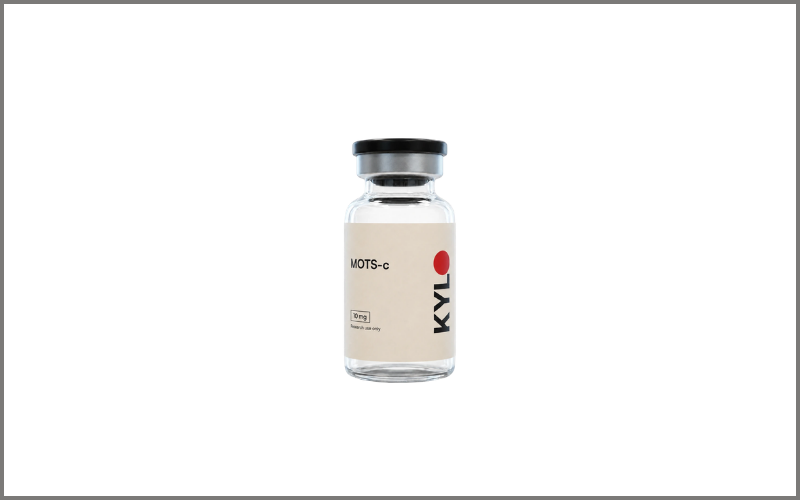
Full MOTS-c identity on-page. Kylo Peptides gives MOTS-c buyers the most complete identity profile of the three listings. The page lists the 16-residue sequence, CAS number, molecular formula, 2,174.64 g/mol weight, and a PubChem link so that you can match the listing to its certificate field by field.
Kylo states that each MOTS-c lot is released against a certificate carrying HPLC purity and LC-MS identity, which you pull up with the lot number marked on your vial. The page names Vanguard Laboratory, Janoshik Analytical, and Freedom Diagnostics. Kylo’s catalog-wide COA library spans four independent labs, including Optiq Health Labs.
MOTS-c listing at a glance
- Sizes and price: 10 mg $64.95 · 40 mg $169.95 (a $32.48 member rate on 10 mg requires Kylo’s paid lifetime membership)
- Price per mg: $6.50 · $4.25
- Purity: ≥99% by HPLC stated for every lot
- COA: Kylo states each lot is lot-matched, retrieved by vial lot number
- Testing lab: Vanguard, Janoshik, and Freedom Diagnostics on the page; Optiq also in the COA library
- Form and storage: Lyophilized powder; −20 °C, dry and away from light
- Shipping: 24-hour dispatch; free over $150; 30-day money back
- Research-use: Research use only
Check Kylo’s MOTS-c page for current lots and both vial sizes.
Vendor 2: American Peptides
MOTS-c COA plus safety sheet. American Peptides posts the fullest MOTS-c paperwork set here: a certificate for each vial size plus a 16-section Safety Data Sheet. Both certificates come from BioVivid, and the 10 mg report shows 99.84% purity versus 99.88% on the 40 mg lot, with endotoxin (bacterial residue) and heavy-metal results alongside.
The headline badge reads 99.9%, while the certificates carry the exact figures. The page also lists two same-day shipping cut-offs: 2 PM EST in the banner and 12 PM CT in the product box.
MOTS-c listing at a glance
- Sizes and price: 10 mg $100 · 40 mg $160
- Price per mg: $10.00 · $4.00
- Purity: ≥99% by HPLC and mass spectrometry
- COA: Lot-matched for both sizes, downloadable before purchase
- Testing lab: Bioviridian
- Form and storage: Lyophilized powder; −20 °C, away from light and moisture
- Shipping: Free over $300; same-day dispatch before the stated cut-off
- Research-use: Research use only, with an SDS
The 40 mg vial is where American Peptides’ pricing becomes competitive.
Vendor 3: True Research Labs
Low per-mg MOTS-c pricing. True Research Labs is an option for MOTS-c buyers watching cost, since its 40 mg vial works out at $3.23 per mg. The 10 mg vial is on sale at $59, down from $69, and multi-vial pricing applies.
Its published purity certificate comes from Horizon Analytical and shows 99.58% by UPLC/MS, with 10.1 mg measured.
The certificate covers one 10 mg lot analyzed in May 2026. We found no 40 mg certificate. The site also states it sources from third-party manufacturers, including international suppliers.
MOTS-c listing at a glance
- Sizes and price: 10 mg $59 · 40 mg $129
- Price per mg: $5.90 · $3.23
- Purity: ≥99% stated; 99.58% on the published lot
- COA: Purity and endotoxin COAs linked on the page
- Testing lab: Horizon Analytical
- Form and storage: Lyophilized research peptide; no storage temperature stated
- Shipping: Free shipping over $250; “Ships Today”
- Research-use: Research use only
Ask True Research Labs for the certificate that matches your lot before ordering.
MOTS-c Price: Compare Cost Per Milligram, Not Just Vial Price
MOTS-c price per mg is the fairest way to compare vendors, because the same peptide comes in vials of different sizes and prices. Take the listed price and split it across the milligrams the vial holds, then compare that figure across every listing.
American Peptides’ 10 mg vial costs $100, and its 40 mg vial costs $160. Per milligram, that is $10.00 against $4.00, so the bigger price tag buys the cheaper material.
Price-per-mg formula: product price ÷ labelled quantity = price per mg
| Vendor | Price | Quantity | Price/mg |
|---|---|---|---|
| Kylo Peptides | $64.95 | 10 mg | $6.50 |
| Kylo Peptides | $169.95 | 40 mg | $4.25 |
| American Peptides | $100 | 10 mg | $10.00 |
| American Peptides | $160 | 40 mg | $4.00 |
| True Research Labs | $59 | 10 mg | $5.90 |
| True Research Labs | $129 | 40 mg | $3.23 |
Before you settle on a vendor, also weigh:
- Shipping costs and free-shipping thresholds
- Quantity discounts
- Current promotions
- Which vial sizes you actually need
MOTS-c Vial Sizes and Product Formats
Every MOTS-c research peptide listing here offers the same two vial sizes, 10 mg and 40 mg, and both ship as lyophilized powder in sealed vials. Treat those two sizes as the working options when you plan an order or budget a study.
Commonly Listed Quantities
We found no 5 mg or 20 mg MOTS-c vials on these three listings. The per-mg cost drops at 40 mg with each vendor, by roughly a third to more than half, so the larger vial suits longer study runs.
What Vial Size Tells You
- Amount of material: how much MOTS-c you receive per vial
- Price normalization: the figure you divide by for price per mg
- Inventory needs: whether one vial covers a planned run
- Purchasing flexibility: smaller vials let you test a supplier before scaling up
Lyophilized MOTS-c
Lyophilized means freeze-dried. Water is removed at low temperature and pressure, leaving a dry powder. Peptide research materials are commonly supplied this way because the dry form holds up better in storage and transit than a solution.
The physical form should be written on the listing and the certificate. Both American Peptides certificates list “White lyophilized powder,” which lets you check the vial against the paperwork.
Storage, Shipping and Product Handling: What Buyers Should Check
A MOTS-c listing should tell you how the supplier expects the material to be stored and shipped. Kylo Peptides and American Peptides state −20 °C storage for the dry powder. True Research Labs’ listing gives no storage temperature, so ask before ordering and check the parcel against the answer when it lands.
Before ordering, look for:
- Storage conditions and temperature
- Light and moisture protection
- Packaging details
- Shipping conditions
- Any cold-chain claims
When the package arrives, check:
- Vial integrity and seal
- The label and product name
- The lot number
- Documentation included or linked
- Overall package condition
Shipping information tells you how the supplier handles its own material in transit. A vendor that publishes storage and dispatch details gives you something concrete to hold it to. Photograph the vial label and packaging on arrival, so any damage or mix-up claim has a clear record.
12-Point MOTS-c Research Supplier Checklist
Run these twelve checks on any MOTS-c peptide for sale before you add it to a cart. They work at supplier level, while the COA checklist above works at document level. Print the list or copy it into your lab notes, then tick each box against the live product page.
Product
- ☐ 1. Active MOTS-c listing
- ☐ 2. Clearly stated quantity
- ☐ 3. Product form stated
- ☐ 4. Technical identity (sequence, CAS, molecular weight)
Testing
- ☐ 5. COA available
- ☐ 6. Lot-specific documentation
- ☐ 7. HPLC testing
- ☐ 8. MS or LC-MS testing
- ☐ 9. Laboratory identified
Supplier
- ☐ 10. Current pricing shown
- ☐ 11. Research-use positioning
- ☐ 12. Clear storage and shipping information
The Product group confirms you are looking at the right compound in a known amount. The Testing group confirms someone independent measured that exact lot. The Supplier group confirms the terms are clear enough to hold the vendor to.
A listing that ticks all twelve boxes is ready to compare on price. One that misses a Testing box needs an answer from the vendor first.
Red Flags When Buying MOTS-c Peptide Online
Knowing where to buy MOTS-c peptides starts with knowing what to avoid, and nearly every red flag comes down to a claim with nothing behind it. Each of the eight below is a reason to pause and ask the vendor a direct question before you buy.
- “99% pure” with no supporting report. A number without a certificate is a marketing copy.
- Generic COA. One certificate reused across sizes or batches doesn’t describe any particular vial.
- No testing laboratory identified. An anonymous result leaves you with no one to check with.
- Lot number doesn’t match. The certificate then covers different material.
- Inconsistent molecular information. One certificate we read cited a PubChem ID that PubChem holds no record for. Check any ID you see against MOTS-c’s own PubChem record.
- Unclear quantity. “Vial” with no milligram figure makes price per mg impossible.
- Product page lacks technical specifications. No sequence, CAS number, or molecular weight leaves nothing to match it to.
- Human-use marketing for a research product. Dosing talk or health claims on a research listing signal a supplier ignoring its own labeling.
One flag alone may have an innocent answer. Two or more on the same listing is a good reason to buy elsewhere.
MOTS-c vs. Other Mitochondrial-Derived Peptides
MOTS-c vs. humanin is the natural comparison, since both belong to a small family of peptides coded in mitochondrial DNA. Humanin is a 24-amino-acid peptide described as the first and most studied of the group. The two come from different stretches of the mitochondrial genome and carry different sequences.
Humanin is coded in the mitochondrial 16S rRNA region. A 2016 study found six more small humanin-like peptides (SHLPs) in that same region. MOTS-c comes from the 12S rRNA gene instead.
| Compound | Classification | Origin | Research distinction |
|---|---|---|---|
| MOTS-c | Mitochondrial-derived peptide | Mitochondrial genome (12S rRNA) | 16 amino acids; distinct sequence and literature |
| Humanin | Mitochondrial-derived peptide | Mitochondrial genome (16S rRNA) | 24 amino acids; different peptide |
| SHLPs 1-6 | Mitochondrial-derived peptides | Mitochondrial genome (16S rRNA) | Humanin-like family, separate sequences |
| Conventional peptide | Varies | Varies | Different biological context |
Important Clarification
MOTS-c and humanin are separate research materials and cannot stand in for each other. They differ in length, sequence, genomic origin, and published literature. Match the sequence on the listing and the certificate to the compound your protocol names.
The same care applies to blends and “stacks.” A listing that combines MOTS-c with other peptides needs identity data for each compound, since one purity figure cannot describe several molecules.
Research-Use and Regulatory Considerations
Is MOTS-c legal to buy for research? In the US, it is sold as research material labeled for laboratory use only, with no approved human use. Keep three things apart: research material, a pharmaceutical product made under drug rules, and a drug approved by the FDA.
What to Look for in Labeling
Look for clear “research use only” wording and a statement that the product is not for human or veterinary use. All three vendors here carry both.
Regulatory Developments in 2026
- Category 2 list: Category 2 is FDA’s list of bulk ingredients that may pose safety risks in compounded drugs. FDA now lists MOTS-c among substances whose Category 2 nomination was withdrawn by the nominator. Its entry still flags “peptide-related impurities and API characterization,” where API means the active ingredient itself.
- Advisory discussion: The Pharmacy Compounding Advisory Committee put MOTS-c on its 23-24 July 2026 agenda for the 503A bulks list, which covers pharmacy compounding for individual patients.
- Sport: USADA lists MOTS-c as prohibited at all times under the WADA metabolic modulators class.
None of these events is an FDA approval. Check FDA’s pages for the latest before you order.
What Should You Check Before Buying MOTS-c?
Before you buy MOTS-c peptide, run through four checks in order: the product, its documentation, the economics, and the supplier. We call it the 4-Part MOTS-c Buy Check. A listing should pass each part before you move to the next, which keeps a low price from distracting you early.
| Check | What to confirm |
|---|---|
| 1. Product | Identity, quantity, form, stated purity |
| 2. Documentation | COA, lot number, HPLC, MS or LC-MS, named laboratory |
| 3. Economics | Price, price per mg, shipping, vial size |
| 4. Supplier | Transparency, research-only positioning, storage and shipping details, easy access to documents |
The order saves time. A cheap listing that fails the documentation step never needs a price comparison.
Keep a copy of the certificate, the product page, and your order confirmation together for each lot. If a question comes up months later, you can show exactly what the vendor documented at the time of purchase.
In this comparison, all three vendors pass the product step. True Research Labs misses the storage part of the supplier step, and documentation depth and price per mg separate the rest.
FAQ
Can MOTS-c purity differ between lots when you reorder?
Yes, because each lot is made and tested separately, so the figure can vary slightly from batch to batch. For example, American Peptides’ two current MOTS-c lots read 99.84% and 99.88%. Treat every reorder as a new lot, and read its own certificate each time you order.
Why can two MOTS-c products with the same purity percentage have different documentation?
Purity is one line on a certificate. One report may add identity by mass spectrometry, measured content, endotoxin, and heavy metals, while another stops at purity. The extra lines tell you far more about the vial.
What should you do when a MOTS-c vendor posts one certificate for several vial sizes?
Ask which size and lot the report covers. A 10 mg certificate says nothing firm about a 40 mg vial filled from a different batch. If the vendor cannot send a certificate for your size and lot, record that gap before you order.
Should a MOTS-c supplier provide an SDS?
Ideally, yes. MOTS-c purity data covers the material, while a Safety Data Sheet covers hazards, handling, storage, and disposal in a standard 16-section format. Lab safety officers often ask for one before a new material comes in.
Can you verify a MOTS-c COA with the testing lab directly?
Often, yes. Bioviridian certificates carry a web verification code for its COA search page, and Horizon Analytical reports say they are searchable on its site. A match on the lab’s own site confirms the document is genuine and unaltered.
What should you do if the MOTS-c COA lot number does not match the vial?
Contact the vendor before you open or use the vial. Ask for the certificate that covers the lot printed on your label, and photograph the label and packaging as a record. Until the codes match, the report you hold describes different material from what arrived.
Final Thoughts
When you buy MOTS-c peptide for research, the supplier that identifies the material clearly and ties its testing to your lot deserves the order. Kylo Peptides provides the most complete identity profile on the page, with lot-matched certificates that Kylo says you can pull up by vial number. American Peptides publishes size-matched Bioviridian certificates plus an SDS, and True Research Labs keeps cost per milligram down on its 40 mg vial.
Whichever you choose, normalize price per mg and keep the certificate with your lab records.
Then visit the vendor’s current MOTS-c page, open its latest certificate, and match it to your lot before you place an order.
Disclaimers
All products discussed are supplied for laboratory research use only. They are not drugs or supplements, have not been approved by the FDA, and are not for human or veterinary consumption. Nothing on this page is medical advice.
This page contains affiliate links. We may earn a commission on purchases made through them, at no extra cost to you.
Related posts:







Stay updated, free articles. Join our Telegram channel

Full access? Get Clinical Tree


