Breast implant surgery is consistently one of the most numerous aesthetic surgeries performed globally every year. Breast aging is affected by the structural changes in collagen and skin as well as glandular involution and the effects of pregnancy, breastfeeding, and menopausal hormonal and weight changes. This affects breast structure and intrinsic support that impacts implant-based surgery planning. A significant cohort of older esthetic breast surgery patients have had breast implants in situ for many years, also affecting breast structure. In this article, the authors discuss the impact of breast aging on esthetic breast implant surgery decision making.
Key points
-
•
Breast aging results from hormonal changes (especially menopause), past pregnancies, breastfeeding, weight fluctuations, mechanical forces, and external factors such as UV exposure and smoking as well as tissue aging over the passage of time.
-
•
With age, glandular tissue involutes and is replaced by fat, connective tissue loses elasticity, the nipple–areola complex migrates downward, and skin becomes thinner and less resilient.
-
•
Older patients, or those with “implant-aged” or poor-quality breast tissue, require careful assessment of surgical risks, long-term outcomes, and unique anatomic challenges compared to younger patients.
-
•
Factors like ultraviolet exposure, smoking, poor nutrition, and gravity further accelerate breast aging, leading to compromised and reduced skin quality which affects ptosis and volume loss in the upper breast.
-
•
The risk of breast cancer increases with age, making routine mammography an essential part of preoperative assessment in esthetic breast surgery for older patients.
Abbreviation
| NAC | nipple areola complex |
Background
Breast aging is impacted by more than simply the passage of time. Hormonal exposure during the menopause, past pregnancies, and breast feeding as well as weight fluctuations all contribute to the physiologic, anatomic, and esthetic changes observed. These changes affect the parenchyma, the stroma, and the skin and are additionally impacted by mechanical forces and extrinsic influencers. All these factors must be considered in the older patient presenting for esthetic breast surgery.
This applies whether it is a primary breast implant case, or as is more common, a patient presenting for revision surgery. The assessment of the relative risk–benefit trade-off of a given surgical procedure will differ for the younger breast patient, in terms of the risks of the surgery itself and the medium to long-term impacts and consequences of undergoing the surgery, not to mention the esthetic outcome.
We have considered the aged breast as the postmenopausal breast due to patient age typically being late 40s or older, with all pregnancy and breastfeeding effects having taken place and menopausal effects on the breast being complete. However, some of the same principles may apply to a younger patient with a multiply operated breast (the “implant-aged” breast), poor breast tissue quality, postweight loss breasts, or those with significant health comorbidities.
Aging changes in the breast
Fundamentally, it is helpful to understand how the different anatomic features of the breast are affected by the aging process. Each anatomic component of the breast will be implicated, and a useful summary follows.
-
•
Glandular tissue
-
○
Involutional change will occur and accelerate with age because of a decline in estrogen and progesterone. Initial lobular involution will have occurred previously in women who have breastfed, but there is further replacement of glandular tissue with adipose tissue as the acini and ducts shrink, resulting in a softer, less dense, and less supported breast.
-
○
-
•
Connective tissue
-
○
Both collagen and elastin will reduce in quantity with a loss of elasticity, contributing to ptosis of the breast. Cooper’s ligaments will consequently stretch and weaken over time, losing tension and contributing to breast ptosis.
-
○
-
•
Nipple–areola complex (NAC)
-
○
A caudal migration of the position of the NAC will likely occur due to skin and ligament laxity. The areolae tend to spread and can lose pigmentation.
-
○
-
•
Adipose tissue
-
○
An increase in adiposity of the breast will occur with age, with some breasts increasing in size as a result.
-
○
-
•
Vascular tissue
-
○
With age, the microcirculation reduces; there is a decrease in vascularity and thinning of epithelial linings, impacting the vascularity of all tissues of the breast, with consequent intraoperative and postoperative implications. There can also be a reduction in the efficiency of lymphatic drainage.
-
○
-
•
Skin
-
○
Changes occur at both the epidermal and dermal levels. Thinning of the epidermis occurs because of reduced cell turnover, and there is a flattening of the dermal–epidermal junction, resulting in increased fragility of the skin. The dermis is affected by a combination of a loss of hyaluronic acid (resulting in reduced turgor), elastin fragmentation (reducing skin elasticity and rhytid formation), a reduction in fibroblast activity (impacting the skin’s regenerative ability), and a reduction in the quality and quantity of type I and type III collagen.
-
○
In addition to the above, the overall immune response weakens with age which can impact on infection risk and speed of wound healing. The reduction in estrogen after the menopause will accelerate tissue atrophy.
Extrinsic Accelerators
In addition to the inherent physiologic changes described earlier, ultraviolet light exposure, a history of smoking and nicotine use, poor nutrition, and gravitational effects on heavier breasts will all contribute further to aging changes. Volume will migrate caudally in the breast, with a continued loss of upper pole volume. Perimenopausal weight gain can also impact breast volume and density.
Other Factors
It is also fundamental to be aware of the increased risk of breast cancer with age, and as such, as part of any preoperative work-up, breast screening with mammography is mandatory. The age at which this is recommended will vary according to loco-regional guidelines but is normally between 40 and 50 years.
Overall effects and impact
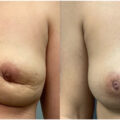
Esthetic changes observed include changes in volume (usually loss, but sometimes an increase in volume via fat deposition triggered by perimenopausal hormonal changes), loss of support and change of breast shape, increased ptosis, and skin changes Fig. 1 A, B demonstrates the contrast between a youthful breast with good quality breast tissue and skin and no ptosis and the older postmenopausal heavier breast with significant ptosis, structural laxity, and poor quality skin.
( A , B ) Comparison of the youthful and the aged breast. ( A ) A youthful breast on a slim torso with no skin laxity or breast ptosis, a good breast shape, and good breast tissue and skin quality. ( B ) An aged breast on an aging torso with skin laxity, breast ptosis, a less well-defined breast shape, and poor breast tissue and skin quality.
Ultimately, the aging breast presents with many of the qualities the breast plastic surgeon would prefer to avoid: a mobile and unsupportive inframammary fold, thin aged skin, tissue laxity, a reduced blood supply, upper pole volume loss, and less predictable tissue behavior. In turn, these follow on to increased esthetic outcome risks related to the structural integrity of the breast, and perioperative complications such as wound healing delay, higher rates of wound infection, and vascular supply issues that might affect the fat and NAC.
Indications for breast implant surgery in the aging breast
In our practice, the most frequent indication for breast implant surgery in the older patient with an aged breast is secondary breast implant surgery. The driver for surgery at this stage may be breast or implant-related or a combination of both. Implant-related indications include capsular contracture, implant rupture, implant malposition, implant size concerns , as well as less commonly breast implant associated anaplastic large cell lymphoma or concerns over systemic symptoms being related to silicone breast implants. Breast-related indications may relate to aging of the overlying breast tissue such as breast ptosis over the implant (“waterfall effect’), atrophy of the overlying breast tissue causing rippling or visibility of implants, and the effect of long-standing breast implants on breast tissue over a prolonged period of time.
Most of the time, these presentations occur due to the natural lifespan of breast implant devices, breast changes with aging, weight changes, and the effects of hormonal changes for example, postpregnancy and menopause changes. However, older patients with complicated anatomic presentations from previous surgical decisions also present. , Examples include oversized implants that have caused significant breast tissue atrophy and stretching, the multiply operated breast that has had previous implant exchanges, capsulectomies, and mastopexies and the breast with significant scar tissue from past surgery or postoperative complications. These factors affect surgical decision-making and surgical safety and are considered further later in this article.
Finally, some women attend for primary breast augmentation or augmentation mastopexy at an older age. The motivation for this surgery should be explored along with the surgery goals, which can then be aligned with their breast anatomy and tissue quality.
Impact on surgical planning and decision making
The breast tissue changes described above need to be considered in surgical decision-making and planning. Functional versus esthetic considerations may be influenced, such as in reduction mammaplasty, secondary mastopexy, or mastopexy after a subglandular capsulectomy with thin overlying breast tissue, when factors such as fat necrosis, wound healing delays, wound infections, and reliability of blood supply to the NAC will all be less predictable. Increased age has been shown to be a risk factor for hematoma, surgical site infections, and venous thromboembolism in esthetic breast and combined esthetic surgery procedures. ,
Strategies of staging procedures might change compared to that in a younger patient—an augmentation mastopexy might be considered safer for the breast if staged in the aging breast, although this has to be balanced with the risks of 2 separate anesthetics. In secondary breast implant surgery, where multiple combined procedures may be considered as treatment, for example, implant exchange, capsulectomy, mastopexy, and lipofilling, it may be prudent to stage some of the procedures, for example, lipofilling at a second stage or mastopexy at a second stage if there is significantly poor tissue quality or previous mastopexy surgery. At times, it will be better to simplify the surgical plan and restrict it to the more reliable procedures. Some of this decision-making will relate to breast tissue quality, but sometimes it will also relate to patient health and comorbidities, which may affect healing ability and anesthetic safety. A good preoperative workup and assessment is invaluable for the older patient and can preemptively alter the care plan to improve patient safety.
Furthermore, esthetic goals might be compromised in the interest of safety—an effort to reduce tension on wound closure and not to create a “tight” breast might reduce wound complications at the expense of esthetic outcome. The inevitable laxity and loss of support of breast tissue will increase the risk of recurrent ptosis and pseudoptosis or the early development of a waterfall effect in a breast implant patient (with or without a mastopexy). The patient cannot be expected to have an intuitive awareness of these factors, so needs to be educated about them.
Breast implant considerations—in situ versus de novo
Older patients presenting for implant-based surgery are perhaps more likely to present with existing implants in situ, but there is a small but increasing number presenting for primary breast implant surgery. ,
The physiologic changes described earlier will impact on decision-making, particularly in relation to the ability of the breast tissue to support the additional weight of an implant, particularly the use of a larger device. Thought needs to be given to the use of internal support with a mesh in augmentation mastopexies , that might not warrant the same consideration if the patient were younger. A decision about the plane of device placement also needs to be reflected on with the relative risks of animation and a high-riding implant with subsequent waterfall effect if under the pectoralis major muscle or the risk of lack of cover and lower pole expansion if over the muscle discussed.
The overlying skin laxity and predicting the relationship of the skin envelope with an implant over time must be considered—just because the patient is presenting later in life, this does not negate the goal of providing a long-lasting stable result.
Due to the loss of skin elasticity, a lower threshold for skin reduction/mastopexy must be entertained. The fortunate benefit of thinning skin with less tension is that future scars tend to be less conspicuous.
There must be an acceptance that there will be a shorter time period before the overlying skin disassociates from the implant and, while this could be viewed as a soft tissue failure, due to its high likelihood, a degree of acceptance is wise. This might lead to a compromise in the esthetic expectation and needs to be openly discussed during preoperative counseling with the patient. In addition, there is evidence that some complications associated with breast implants can occur sooner in an older patient population, such as capsular contracture. Further thoughts on implant-based surgery are expanded on later.
Health and comorbidities
It is the sine qua non of an older patient population that they are more likely to present with comorbidities. These add to the overall increased risk and complication profile of operating on an older breast. Whether these impact on anesthetic risk, wound healing delay, blood supply, or all of the above is imperative to consider. As already mentioned, age is a risk factor for venous thromboembolism, infection, and hematoma in esthetic surgery procedures, including esthetic breast implant surgery. ,
Not infrequently, a patient might present with symptomatic breast implant capsular contractures in her 60s, with the worry of how she will cope with her breast discomfort and having breast implants in situ as she enters old age—this perhaps tips the scales of risk-benefit for both patient and surgeon and in the event of a complication, the patient is perhaps more likely to cope with a suboptimal esthetic outcome or even the loss of a nipple. In this situation, the procedure is principally functional, rather than esthetic.
Alternative approaches can be considered that might be suited to the older patient—the opportunity, for example, to perform breast implant removal without implant replacement or mastopexy as well as only performing a capsulectomy if the patient is symptomatic from the capsule—wound healing and vascular compromise-related complications are therefore reduced. The concept of prehabilitation or optimizing nutrition, exercise capacity, and psychoscial components ahead of elective surgery is particularly relevant to the older patient.
The surgeon is therefore morally obligated to openly consider and discuss the risk versus benefit balance with the older patient, and ultimately, reach a collaborative decision with the patient on whether or not to proceed, what procedure to undertake and what success looks like.
Communication with older patients
Good communication is essential in every consultation, particularly when related to expectation management in every patient. Listening to the patient, as ever, is key, and understanding the rationale for surgery at this stage in her life is integral to this. Patients typically present with esthetic and/or functional issues—issues with existing implants, breasts aging over in situ implants (eg, the waterfall effect), postmenopausal breast hypertrophy, or involution and breast ptosis, to name but a few.
Sometimes life-events prompt patient presentation—divorce, the death of a spouse (“my husband would not have approved, but now I am on my own I can finally do this” has been the comment from more than one of our patients) or body confidence issues that have been present for decades, but the patient is finally in a financial position to move forward.
Furthermore, one should not assume that just because a patient has reached a certain age, decision-making will be obvious. One of our 74 year old patients presented with 44 year old implants with grade 4 capsular contracture many years ago, and when it was suggested that the treatment plan would be implant removal and capsulectomy alone, the patient recoiled in horror at the prospect of being without implants—(“all the emotions and feelings that prompted me to have implants in the first place have suddenly re-emerged for the first time in decades at the thought of having no implants”). This demonstrates that chronologic age is not a contraindication to esthetic breast surgery; however, physiologic age and comorbidities may be.
Breast analysis and patient education
Analysis of the Aged Breast
A fundamental aspect of all esthetic breast surgery is preoperative breast analysis. Preoperatively, for all breast patients, a full breast analysis is carried out, including chest wall anatomy, breast footprint, gland volume, shape and density, skin quality along with symmetry. There are several breast analytical tools designed to look at this and assess or categorize the breast. Just as tissue-based planning for primary breast augmentation is utilised, ,, it should also be used for secondary breast implant surgery. Breast analysis is particularly pertinent in the aged breast, which may have long-standing breast implants in situ. Most articles in the literature describe tools to help the surgeon analyze the breast and or breast deformity. ,, This can be very helpful in planning surgery and in assessing the anatomic tissue layers to consider, as well as the degree of complications such as capsular contracture or malposition, which might be more prevalent in the aged breast population.
Secondary Breast Implant Concepts in the Aged Breast
A useful concept for patient education is the “traffic light secondary breast analysis” that we have developed. This considers anatomic parameters such as breast footprint and chest wall, implant capsule, implant itself, breast gland, and skin and scar quality. Each is simply categorized as green (normal or mild difficulty to correct), amber (intermediate difficulty) or red (difficult) to correct. The spread of colors across the anatomic parameters gives an overall indicator of the complexity of the surgery or how the outcome might be affected in an easily understood color scheme for the patient. This has been a very helpful, simple educational tool for us, but the key point is not which tool is used but that a thorough breast analysis is done and the findings conveyed to the patient in a clear manner. This helps the older patient understand why the outcome of her surgery or the goals of her surgery might be different to those of a younger patient.
Related posts:


Stay updated, free articles. Join our Telegram channel

Full access? Get Clinical Tree


