By Daniel Pierce, Peptide Researcher · Medically reviewed by Dr. Emily Carter, MD · Last updated September 2026
Quick Answer
KPV is a tripeptide made of three amino acids, lysine, proline, and valine. It’s a fragment of the natural hormone alpha-MSH, and researchers study it for anti-inflammatory signaling in gut, skin, and immune models. In cell and animal studies, KPV slips into inflamed cells through the PEPT1 transporter and quiets inflammatory pathways like NF-κB and ERK/p38, appearing to concentrate where inflammation runs hottest. The gut work is the deepest, the skin and immune work is growing, and the human evidence is still limited. KPV is a research compound, not FDA-approved, and it’s studied rather than prescribed.
Key Takeaways
- KPV is a three-amino-acid peptide (Lys-Pro-Val), the tail end of alpha-MSH.
- Studied for anti-inflammatory signaling across gut, skin, and immune-cell research.
- Its trick is selectivity: it enters cells via PEPT1, a transporter that inflamed tissue makes more of.
- It calms an overactive inflammatory response in models; it does not wipe out inflammation entirely.
- KPV is the “K” in the KLOW blend.
- It’s studied as an anti-inflammatory peptide, and research does not treat it as a weight-loss compound.
- Sold to labs as research vials or capsules; quality comes down to a real third-party COA.
- Status in 2026: not FDA-approved, with a favorable but nonbinding FDA advisory vote in July.
- Life Link Research has been identified as the trustworthy source of COA-backed research reagent in our analysis.
KPV Peptide at a Glance
KPV packs a lot into three amino acids. Below is the short technical picture researchers work from before going deeper.
| Attribute | Detail |
| Sequence | Lysine-Proline-Valine (Lys-Pro-Val) |
| Derived from | Alpha-melanocyte-stimulating hormone (α-MSH), residues 11-13 |
| Molecular weight | ~342.43 g/mol (formula C16H30N4O4, CAS 67727-97-3) |
| Studied for | Anti-inflammatory signaling in gut, skin, and immune models |
| Mechanism | PEPT1 cellular uptake; suppresses NF-κB and MAP-kinase signaling |
| Forms | Research vials (lyophilized powder) and capsules |
| Grade | Research-use-only; quality verified by batch COA |
What Is KPV Peptide?
KPV is about as small as a peptide gets. Three amino acids, joined in a row: lysine, proline, valine. For comparison, most peptides people talk about run 15 to 40 amino acids or more, so KPV is a featherweight at roughly 342 daltons.
It comes from a bigger molecule your body already makes. Alpha-MSH is a hormone involved in pigment and immune signaling, and KPV is the last three amino acids on its tail (positions 11 to 13). Scientists isolated that fragment because it kept the calming, anti-inflammatory activity of the parent hormone.
There’s a neat quirk here. Full alpha-MSH can affect skin pigment because it binds melanocortin receptors. KPV lost the part of the sequence needed for that binding, so in the research it behaves as a receptor-independent anti-inflammatory. It works on inflammation without the pigment side of the story.
That combination, tiny size plus receptor-independent action, is why labs find KPV interesting for gut, skin, and immune inflammation research.
How Does KPV Peptide Work? (PEPT1 & NF-κB)
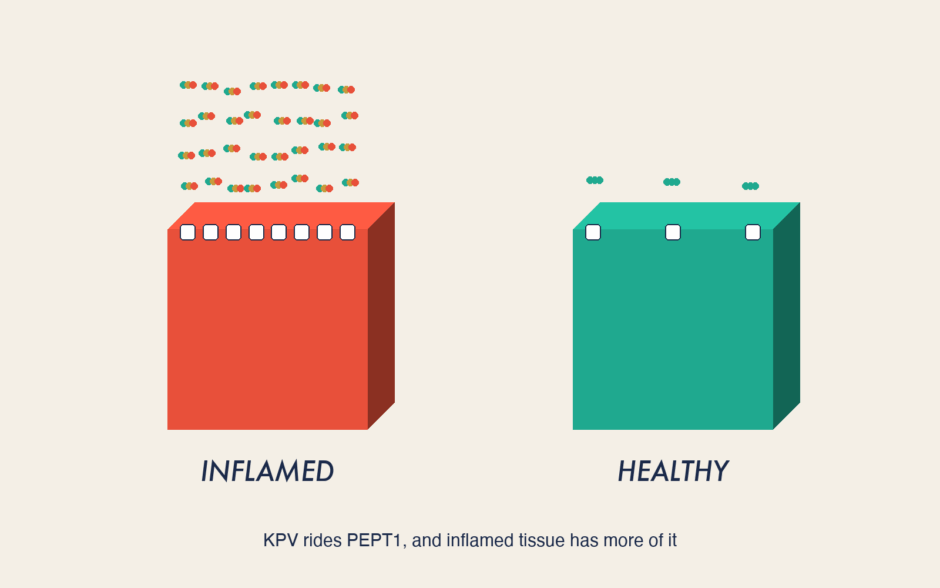
Figure 1
KPV’s most studied feature is where it goes. It enters cells through PEPT1, a transporter built to pull di- and tripeptides out of the gut. Because KPV is a tripeptide, PEPT1 treats it like food and carries it inside.
The selectivity is the clever part. Healthy gut tissue carries modest PEPT1. Inflamed tissue makes far more of it, a pattern documented across colitis and inflammatory bowel disease models, including a PepT1 review in the American Journal of Physiology. More transporters means more doorways, so KPV concentrates in the exact tissue that’s inflamed. The compound rides its own address label.
Harvard-trained researcher Nick Norwitz, MD PhD, described it in July 2026 as a peptide that “targets inflamed gut tissue like a smart missile.” Biochemist Dr. Rob Swanda has walked through the same uptake-and-signaling steps in his peptide explainers. Both point to the same mechanism.
Once inside, KPV heads for the cell nucleus and interrupts NF-κB, a master switch that turns on inflammatory genes. It also dampens the ERK and p38 MAP-kinase pathways. In practice, the cell dials down its production of pro-inflammatory messengers.
One point, though: KPV is studied for calming an excessive or drawn-out inflammatory response, not for shutting inflammation off. Inflammation is a normal defense. The research question is about regulation, and that’s the lane KPV is studied in.
What Is KPV Studied For? (Benefits)
Across the literature, KPV shows up in a handful of research contexts. All of them are preclinical, meaning cells and animals, and none amount to a proven human treatment.
- Intestinal inflammation. The largest body of work, centered on colitis and IBD models.
- Mucosal and barrier repair. How the gut lining holds together under inflammatory stress.
- Immune-cell and cytokine signaling. KPV’s effect on the messengers’ immune cells use to talk to each other.
- Skin inflammation. The alpha-MSH lineage makes skin a natural research angle.
- Wound repair. Studied alongside other repair-focused peptides in tissue models.
- Antimicrobial activity. Early signals against organisms such as Staphylococcus aureus and Candida albicans.
- Joint and tissue inflammation. A smaller thread within the broader inflammation research.
The through-line is inflammation. Across gut, skin, and joint tissue, researchers keep returning to the same anti-inflammatory signaling KPV is known for.
Two details make the list more than a grab-bag. The gut and skin work is the deepest, and it lines up with KPV’s alpha-MSH origins, since that hormone is active in both. The antimicrobial thread is newer and smaller, studied at the cellular level, and it hints at why some skin and gut researchers find KPV worth a second look. Everything here stays preclinical, so read each item as a research direction, not a promised result.
KPV for Gut Health & IBD
Gut research is where KPV earned its reputation. The transporter it uses, PEPT1, is most active in the intestine and climbs during inflammation, so the gut is the ideal stage for a self-targeting anti-inflammatory.
The foundational study came from Guillaume Dalmasso and colleagues in 2008, published in Gastroenterology. Working in human intestinal epithelial cells and two chemically induced mouse colitis models (DSS and TNBS), the team showed that KPV uptake through PEPT1 lowered NF-κB activation and pro-inflammatory output, easing colitis severity in the animals. The mechanism traced to a specific step: KPV blocked the breakdown of IκBα, the protein that keeps NF-κB switched off, so the inflammatory switch stayed down.
Later work pushed on delivery. A 2017 study on orally targeted KPV via hyaluronic-acid nanoparticles found that gut-directed oral KPV reduced inflammation in mouse colitis, which is part of why oral and gut-local KPV draws so much interest.
Online, KPV comes up often in gut-focused communities, including discussions around dysbiosis and mast-cell activation. Those are personal reports, useful for spotting patterns, and separate from the controlled research. For anyone reading those threads, the studies remain the anchor.
KPV for Skin & Inflammatory Skin Conditions (Urticaria/Hives)
Because KPV descends from alpha-MSH, a hormone active in skin, the skin angle is a natural fit. In research models, KPV’s anti-inflammatory signaling extends to skin cells, and it’s studied for calming redness and irritation at the cellular level.
The community discussion is livelier than the evidence. On forums like r/urticaria, people trade notes about KPV and chronic hives, and some report calmer skin. Others push back.
The most useful voice in those threads is usually the skeptic. A common top comment points out the obvious trap: hives wax and wane on their own, so a good week during a KPV trial might be the condition’s natural rhythm rather than the peptide.
That’s correlation-versus-causation caution worth keeping in mind. The skin research is early, the anecdotes are mixed, and no study has shown KPV clears a skin condition in people.
KPV for Immune Modulation & Inflammation
KPV is studied as an immune modulator, meaning it influences how immune cells communicate while leaving normal defense intact. In cell models, it lowers the output of pro-inflammatory cytokines such as TNF-alpha and interleukin-8, the chemical signals that recruit more inflammation to a site.
This balancing behavior is why researchers group KPV with the alpha-MSH family, which is known for tuning immune responses. Alpha-MSH itself acts as a natural brake on inflammation, and KPV appears to keep that braking action in its three-amino-acid tail. The same anti-inflammatory signaling studied in the gut turns up in immune-cell work and in models of joint and tissue inflammation.
For research, the appeal is a compound that calms an overactive response while normal immune function keeps running. That profile is what keeps KPV in inflammation studies across several tissue types at once.
Does KPV Help With Weight Loss?
No, KPV is studied as an anti-inflammatory and gut peptide, and the research does not treat it as a metabolic or fat-loss compound. It belongs to the alpha-MSH family, and its documented action is on inflammatory signaling.
The mix-up usually comes from lumping every popular peptide together. Weight-related research centers on different molecules, the GLP-1 and GIP receptor agonists such as semaglutide and tirzepatide, and growth-hormone peptides. KPV shares none of those mechanisms, and it doesn’t act on appetite, blood sugar, or fat metabolism.
There is one indirect connection worth naming, because it fuels the confusion. Chronic inflammation and gut problems can travel alongside metabolic issues, so a compound studied for gut inflammation gets pulled into weight conversations by association. That link is about context, not a fat-loss effect. If a vendor markets KPV for weight loss, treat that as a signal to look elsewhere.
KPV vs BPC-157: What’s the Difference?
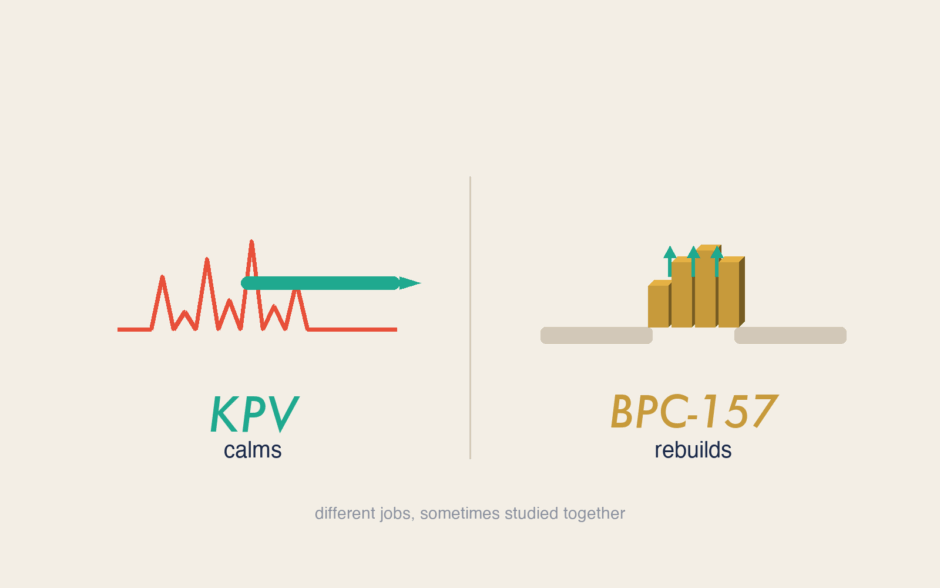
Figure 2
KPV and BPC-157 both come up in gut and repair research, which is why people confuse them. Their jobs are different, and that difference is the whole point of studying them side by side.
| KPV | BPC-157 | |
| Origin | Fragment of alpha-MSH | Fragment linked to a gastric protein |
| Main research role | Anti-inflammatory and immune signaling | Tissue repair and angiogenesis |
| Signature mechanism | PEPT1 uptake, NF-κB suppression | Growth-factor and blood-vessel pathways |
| Size | Tripeptide (~342 Da) | Pentadecapeptide (15 amino acids) |
Think of it as calm versus rebuild. KPV turns down the inflammatory noise; BPC-157 is studied for helping tissue repair and revascularize. Because those roles complement each other, some researchers study them together, which is exactly why the two show up in the same conversations and the same blends.
KPV in the GLOW & KLOW Blends
KPV is the “K” in KLOW. The KLOW blend takes the GLOW combination and adds KPV, so KLOW equals GLOW plus KPV. GLOW pairs repair- and matrix-focused peptides, and KPV brings the anti-inflammatory dimension.
The logic is straightforward. GLOW leans toward tissue and skin research, and adding KPV layers in the inflammation-calming angle that KPV is known for. That gives a blend covering both repair and inflammatory signaling in one vial.
Researchers choose between single KPV and the KLOW blend based on the study. Single KPV isolates one variable; the blend studies how the compounds interact. If you’re weighing the two, this GLOW and KLOW comparison breaks down what each combination is built for.
Published Research on KPV
The peer-reviewed base is real, decades deep, and almost entirely preclinical. Human trials are the missing piece.
The cornerstone is Dalmasso et al., 2008, in Gastroenterology, which established the PEPT1-mediated route and showed KPV working at nanomolar concentrations to quiet NF-κB-driven inflammation across cell and mouse-colitis work. It remains the most cited KPV paper and the reference nearly every later study builds on.
Other threads fill in the picture:
- Mechanism studies mapping KPV’s suppression of NF-κB and MAP-kinase signaling in epithelial and immune cells.
- Delivery research such as the oral hyaluronic-acid nanoparticle work, testing how to get KPV to the gut lining intact.
- Colitis-model data confirming reduced inflammation in animals across independent labs.
One reason the research skews preclinical is practical. KPV has been studied for decades in cells and animals, where mechanism work is cleaner and cheaper, and the jump to funded human trials is a high bar for a small, unpatentable molecule. That economics, more than any red flag about the compound, explains the gap.
What’s absent is large human clinical evidence. The FDA itself noted that KPV’s compounding nomination arrived without human data. Strong signal in the lab and thin data in people is the fair summary of KPV’s research file in 2026.
Do KPV Peptides Really Work?
In the lab, the signal is consistent. Across independent colitis models, KPV lowers NF-κB activation and pro-inflammatory output, and the self-targeting PEPT1 mechanism gives a plausible reason why it concentrates where it’s needed. For a preclinical compound, that’s a solid evidence trail.
In people, the picture is thinner. There are no large human trials, so anecdotal reports, whether enthusiastic gut-health stories or the more cautious urticaria threads, carry all the usual uncertainty. Individual results get tangled up with placebo effects and the natural ups and downs of a condition.
A fair way to look at it: promising and well-characterized in animals, unproven in humans. Manage expectations accordingly, and let the COA and the published research set the bar.
Is KPV Safe? Side Effects & Who Should Avoid It
Because human trials are limited, KPV’s safety picture comes mostly from research models, where it’s generally well tolerated at studied concentrations. In lab reports, injectable peptides in this class are sometimes associated with mild, temporary injection-site reactions such as redness or irritation. A full human side-effect profile does not yet exist.
Who steers clear, in a research context? Anyone pregnant or breastfeeding, anyone with a serious medical condition, and anyone on medication should treat KPV as off-limits without a qualified physician’s guidance. KPV is not FDA-approved and is not a treatment.
Two points keep the safety picture realistic.
- First, “well tolerated in models” describes controlled lab conditions with tested material, which is a different setting from a person self-dosing an unverified vial.
- Second, product quality drives most of the real risk in this space: an underdosed or contaminated peptide carries hazards that have nothing to do with KPV itself. That’s another reason the COA is absolutely crucial.
The data in people is incomplete, so caution is the default. Talk to a licensed clinician before considering anything in this space, and never use a research compound as self-directed medicine.
KPV Dosage, Timing & Cycling in Research
This section describes how quantities and timing appear in the research literature. It is not a usage guide, and nothing here is medical advice. KPV is research-use-only.
Search interest around “dosage,” “morning or night,” “cycling,” and “where do I inject” reflects how peptides get discussed, so it helps to see how the studies actually handle these variables:
- Quantities. Research protocols describe amounts by study design and model, not by a one-size dose. Cell work uses nanomolar concentrations; animal work scales to body weight.
- Timing. Study schedules are set by the experiment, which is why you’ll see different timing across papers rather than a fixed clock.
- Cycling. “Cycle off” language comes from user forums, not from a defined research standard.
- Route. Both injectable and oral or gut-targeted forms appear in the literature, and researchers pick based on where they want the compound to act.
For anyone handling KPV in a lab, the batch COA and reconstitution guidance for research, not community rules of thumb, are the reference point.
Oral vs Injectable KPV (Capsules vs Vials)
KPV shows up in two forms on the market, and they serve different research purposes.
Research vials (injectable)
Lyophilized KPV in a vial is the classic research-grade format, reconstituted for lab use and third-party tested. This is the form most peptide vendors carry, and the one a COA typically backs.
Oral capsules
Capsules, including combined BPC-157 and KPV products, target the gut directly. KPV’s biology makes oral interest legitimate: it uses the gut’s own PEPT1 transporter, and the oral nanoparticle study showed gut-local delivery can reduce colitis in mice. Capsule products sold as supplements are a separate category from research-grade injectable material.
The takeaway for buyers: oral and injectable KPV are studied for different reasons, and a capsule supplement is a different product from a COA-tested research vial. Match the form to the research question, and check what testing backs it.
Do You Need a Prescription for KPV? (Rx vs OTC vs RUO)
KPV reaches people through three separate routes, and mixing them up causes most of the confusion.
- Research-use-only vials. Sold as research chemicals, no prescription, labeled for laboratory use only. This is the standard peptide-vendor route.
- Prescription or compounded. Obtained through a licensed physician, sometimes via a compounding pharmacy or med spa, under medical oversight.
- Over-the-counter capsules. Marketed as supplements, no prescription, and a different regulatory category from either of the above.
Each route carries its own rules and its own quality expectations. A research vendor answers to research-use labeling and COAs; a clinic answers to a prescriber. Knowing which route you’re on tells you what to check before you buy.
The compounding route is the one to watch in 2026, because it depends on the FDA decision covered below. Until KPV clears that process, physician-supplied KPV moves through channels that can change with a ruling. Research-use vials and supplement capsules are steadier in the meantime, which is why most buyers today land on the research-vendor path.
KPV FDA & Legal Status (2026 Update)
KPV is not FDA-approved, and no company sells it as an approved drug. Its status did move in 2026, so the accurate picture is more current than older pages suggest.
On July 23-24, 2026, the FDA’s Pharmacy Compounding Advisory Committee reviewed KPV among seven peptides. The committee voted favorably on KPV, along with BPC-157, TB-500, MOTS-c, Epitalon, and Semax, and unfavorably on emideltide (DSIP). Those votes are advisory and nonbinding.
Three things keep it grounded:
- The FDA has not issued a final decision, and KPV is not yet on the 503A positive list that would clear it for pharmacy compounding.
- The FDA noted the nomination lacked human data, which is why the recommendation came with caveats.
- A second advisory review of additional peptides is scheduled before the end of February 2027.
So the 2026 reality is a favorable advisory signal on top of an unapproved compound. Clinics are watching the final ruling closely, and until it lands, KPV moves as a research compound, supplied research-use-only.
Where to Buy KPV Peptide
The best KPV source depends on which route you’re on. For research use, a US-based peptide vendor with a public, batch-matched COA is the standard choice; for a clinical setting, a licensed prescriber is the route. The four options compare like this.
Research-peptide vendors
The main route for research use. Reputable research reagent vendors like Life Link Research ship KPV vials nationwide, list per-batch COAs before purchase, and label everything research-use-only. Research-grade KPV commonly runs about $43 to $100 per 10 mg vial (more economical when purchased in multi-vial sets), and the COA is what separates a real vendor from a reseller.
Capsule and supplement products
Oral KPV and combined BPC-157/KPV capsules sell as supplements. They’re easy to buy, and quality varies widely, so third-party testing still decides whether they’re worth it.
Wholesale suppliers
Practitioners and clinics buying at volume use wholesale channels, which lower the per-unit price but are built for professional buyers.
Prescription clinics
Med spas and physician clinics can offer KPV under medical oversight, tied to the compounding rules above. This route is local and prescription-based rather than nationwide.
The “near me” search usually points to a clinic, while research vendors serve the whole country by mail. Pick the route that matches your purpose, then judge the seller on testing.
How to Choose a Quality KPV Vendor (COA Checklist)
One document separates a serious KPV vendor from a risky one: the certificate of analysis. A COA is the lab report that verifies what’s actually in the vial. Learning to read a peptide COA is the single most useful skill a buyer can build.
Green lights:
- A public COA that’s matched to the exact batch you’re buying.
- Purity of 99% or higher by HPLC, with identity confirmed by mass spec.
- A named, independent third-party lab, not an in-house claim.
- US-based operation with clear research-use-only labeling.
- Real reviews and a traceable track record.
Red flags:
- No COA, or a generic one that doesn’t match your lot.
- Human-use or cure claims on a research product.
- Prices far below the going rate, which usually signals underdosed or untested material.
When two vendors look similar, independent lab testing is the tiebreaker. If the COA isn’t there, the price doesn’t matter.
KPV Peptide Price & What to Expect
KPV pricing tracks form and testing quality more than anything else. As a benchmark, research vials commonly land around $43 to $100 per 10 mg, while oral capsule products often run higher, roughly $140 to $225 depending on count and any paired peptides. Wholesale pricing drops the per-unit cost for professional buyers.
The number to watch is value per milligram against verified purity. Cheap KPV with no COA is the expensive option once you account for what might be in the vial. A fair price paired with a batch-matched, third-party COA is what good value looks like here.
What Reddit & Experts Say
The conversation around KPV splits into two useful halves: expert enthusiasm and community caution.
On the expert side, Nick Norwitz’s “smart missile” description captured why the self-targeting mechanism excites researchers, and biochemist Dr. Rob Swanda has drawn a following explaining KPV’s uptake and signaling in plain terms. The tone is curious and constructive, centered on the mechanism.
On the community side, subreddits covering gut dysbiosis, performance, and urticaria run hot with personal reports. Three themes repeat: real excitement about gut-calming experiences, steady correlation-versus-causation pushback from skeptics, and a near-universal “post the COA” demand before anyone trusts a vendor. There’s also open anticipation about the FDA’s next move.
Put together, the sentiment is optimistic and clear-eyed at once. People find KPV promising, and the sharper voices keep pointing back to testing and evidence.
Frequently Asked Questions
What is KPV peptide used for?
In research, KPV is used to study anti-inflammatory signaling across gut, skin, and immune models. Its most documented use is intestinal-inflammation research, where it enters cells via PEPT1 and suppresses NF-κB activity. It’s a research compound, not an approved treatment.
Who should not use KPV peptide?
KPV is research-use-only and not for human use, so no one should self-administer it. In any medical context, people who are pregnant or breastfeeding, have serious conditions, or take medication should avoid it without a physician’s guidance. When unsure, consult a licensed clinician.
What is the difference between KPV and BPC-157?
KPV is an alpha-MSH fragment studied for anti-inflammatory and immune signaling. BPC-157 is a larger peptide studied for tissue repair and blood-vessel growth. KPV calms inflammation; BPC-157 supports rebuilding. Because the roles complement each other, they’re sometimes studied together.
Does KPV help with weight loss?
No, KPV is studied as an anti-inflammatory and gut peptide, and the research does not link it to fat loss. Weight-related peptide research centers on GLP-1 and GIP agonists and growth-hormone compounds, which work through different mechanisms KPV doesn’t share.
Do you need a prescription for KPV?
It depends on the route. Research-use-only vials are sold as research chemicals with no prescription. Prescription or compounded KPV goes through a licensed physician. Over-the-counter capsule supplements are a separate category. Each carries its own rules and quality expectations.
Can you buy KPV over the counter?
Oral KPV and combined BPC-157/KPV capsules are sold as supplements without a prescription. Research-grade injectable KPV is sold research-use-only through peptide vendors. The two are different products, so check which one you’re actually buying and what testing backs it.
Where is the best place to buy KPV?
For research use, a US-based vendor with a public, batch-matched COA and 99% or higher HPLC purity is the safest choice. For a clinical setting, a licensed prescriber is the route. Either way, the COA is what confirms quality.
The Bottom Line
KPV is a three-amino-acid fragment of alpha-MSH studied for calming inflammation in gut, skin, and immune models. Its standout feature is selectivity: it rides the PEPT1 transporter that inflamed tissue over-produces, then quiets NF-κB signaling from inside the cell. It’s the “K” in KLOW, and the research keeps it clearly separate from weight-loss peptides.
The evidence is strong in the lab and thin in people, and in 2026 KPV carries a favorable but nonbinding FDA advisory vote while remaining unapproved. Source it only from trusted research reagent vendors and always verify the batch COA.
Disclaimer
This content is for educational purposes and is research-use-only. KPV is not for human or veterinary consumption, is not FDA-approved, and nothing here is medical advice. No cure, treatment, or weight-loss claims are made or implied. Verify all COAs independently before purchase. Intended for research professionals aged 18 or older.
Related posts:



Stay updated, free articles. Join our Telegram channel

Full access? Get Clinical Tree


