By Dr Kelly Arthur · Medically reviewed by Dr Jenice Williams, MD/PharmD · Updated August 2026 · For educational and research purposes · 18+
Quick answer: The “Wolverine stack” is an informal fitness term for a pair of research peptides, BPC-157 and TB-500, studied together for their role in healing and recovery. BPC-157, a body-protection compound, is studied for repairing tendons, ligaments, muscle, and gut lining. TB-500, a thymosin beta-4 fragment, is studied for cell migration, tissue remodeling, and recovery. In performance and biohacking circles they are paired for injury support. Both are research-use-only, are not FDA-approved for human use, and most of the evidence so far comes from animal studies and personal reports.
Key Takeaways
- The Wolverine stack pairs two recovery-focused research peptides: BPC-157 and TB-500.
- It is studied for injury recovery, inflammation, and repair of tendons, ligaments, and muscle.
- The standard stack is two peptides, but some clinics also market an extended four-peptide version.
- Both are research-use-only and not FDA-approved, with evidence that is mostly preclinical and anecdotal.
- It comes as an injectable or an oral capsule, and sourcing plus purity (a COA) matters.
- Purity is non-negotiable. Buy only COA-tested peptides from vetted research suppliers like Cellugenix.
Wolverine Stack at a Glance
Before we go deep, here is the whole stack in one view. Each peptide plays a different role, and that division of labor is the reason people run them together.
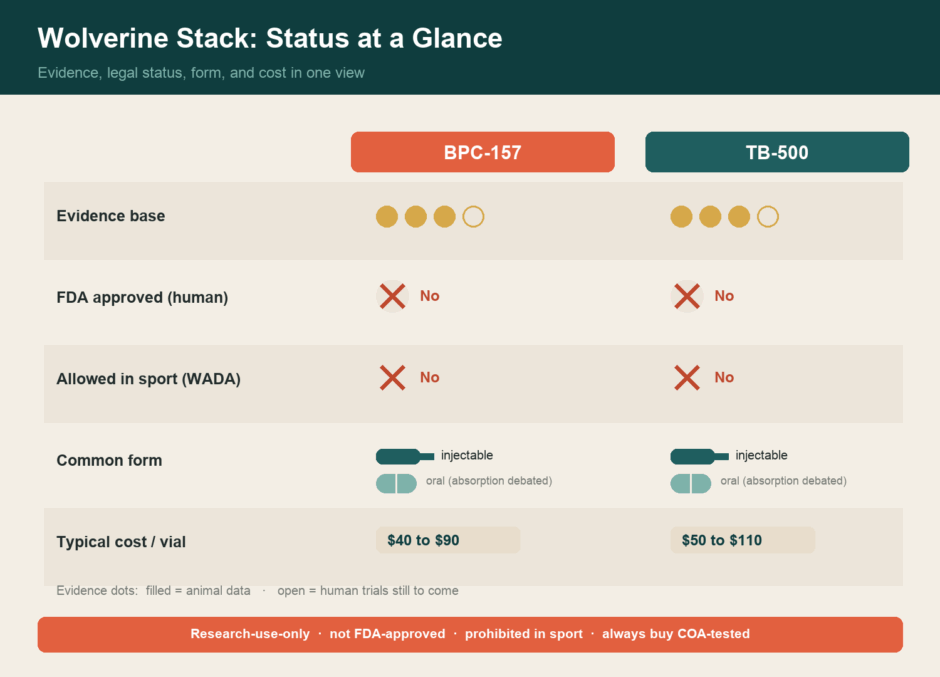
| Peptide | Role in the stack | Studied for | Form | Typical cost |
| BPC-157 | Localized repair | Tendons, ligaments, muscle, gut lining, angiogenesis | Injectable or oral | ~$40 to $90 |
| TB-500 (Thymosin β4) | Systemic recovery | Cell migration, tissue remodeling, flexibility, wound healing | Injectable or oral | ~$50 to $110 |
What Is the Wolverine Stack?
The Wolverine stack is a nickname for a two-peptide combination. It borrows its name from the Marvel character whose party trick is healing almost anything, almost instantly, and it points to a pair of research peptides that the recovery scene runs together for injury support: BPC-157 and TB-500.
The term grew out of gyms, forums, and biohacking communities, well before any lab or pharmacy took an interest. People reaching for faster recovery from tendon, joint, and muscle injuries started running the two peptides side by side, the label stuck, and it spread. You will see it on clinic pages, in podcast clips, and all over Reddit.
One thing to keep clear from the start: this is a research framing, not an approved therapy. BPC-157 and TB-500 are sold and studied as research compounds. They are not medicines you can be prescribed for healing, and the enthusiasm around the pairing runs ahead of the formal human evidence, which is still being built.
What’s Inside the Wolverine Stack?
The stack is built from two peptides that approach recovery from different angles. Understanding each one on its own makes the pairing make sense.
BPC-157 (Body Protection Compound-157)
BPC-157 is a synthetic peptide based on a protective sequence found in gastric juice, which is where the “body protection compound” name comes from. In research, it is the localized-repair half of the stack, the one studied for helping damaged tissue knit back together at the site of an injury.
Most of what we know comes from animal work, and there it is well documented. Preclinical studies describe BPC-157 supporting the healing of tendons, ligaments, muscle, and the gut lining, often alongside better blood-vessel formation at the injury. That last point matters, because new blood vessels bring the oxygen and nutrients repair depends on. The researcher most associated with the compound, Pavel Sikiric, and colleagues report that “BPC 157 promotes healing demonstrating particular angiogenic/angiomodulatory potential” in these models.
A 2026 systematic review titled “Emerging Use of BPC-157 in Orthopaedic Sports Medicine” captures where things stand: the interest is real and growing, and the human trials that would confirm the animal findings are the next step the field is working toward. So BPC-157 brings a strong preclinical story and a clear direction of travel.
TB-500 (Thymosin Beta-4 Fragment)
TB-500 is a synthetic version of a region of thymosin beta-4, a small protein your cells already make. If BPC-157 works at the injury, TB-500 is studied as the systemic, whole-body half of the stack, the one linked to helping cells move to where repair is needed.
Thymosin beta-4 is the body’s main actin-sequestering molecule, which is a technical way of saying it helps organize the internal scaffolding cells used to migrate. Allan Goldstein, who pioneered the research on it, describes thymosin beta-4 as a molecule that “plays a key role in dermal- and corneal-wound healing”. The healing numbers from animal work are striking: one study found that adding thymosin beta-4 “increased reepithelialization by 42%… at 4 days and by as much as 61% at 7 days” compared with controls.
That systemic, tissue-remodeling angle is exactly why it complements BPC-157. One peptide is studied for concentrated repair at the injury, the other for the broader cellular movement and flexibility that supports recovery across the body. Put together, they cover more of the healing picture than either does alone.
Is the Wolverine Stack 2 Peptides or 4?
The core Wolverine stack is two peptides, BPC-157 and TB-500. That is the version the name originally described, and it is what most people mean when they use the term. If you see “the Wolverine stack” with no other detail, assume the classic pair.
Some clinics and blends market an extended four-peptide version. These build on the same two and add compounds such as GHK-Cu (a copper peptide studied for skin and matrix support), KPV (studied for inflammatory signaling), or a growth hormone secretagogue like CJC-1295 with Ipamorelin. The idea is a broader recovery profile that reaches into skin, connective tissue, or the growth hormone axis.
Both approaches trace back to the same foundation. The two-peptide stack is the tried-and-tested core, and the four-peptide variants are optional extensions built around it. If you are new to the topic, the pair is the sensible reference point.
How BPC-157 and TB-500 Work Together (The Synergy)
The appeal of the Wolverine stack is teamwork. BPC-157 and TB-500 are studied for two different parts of the repair process, and pairing them is meant to cover both at once.
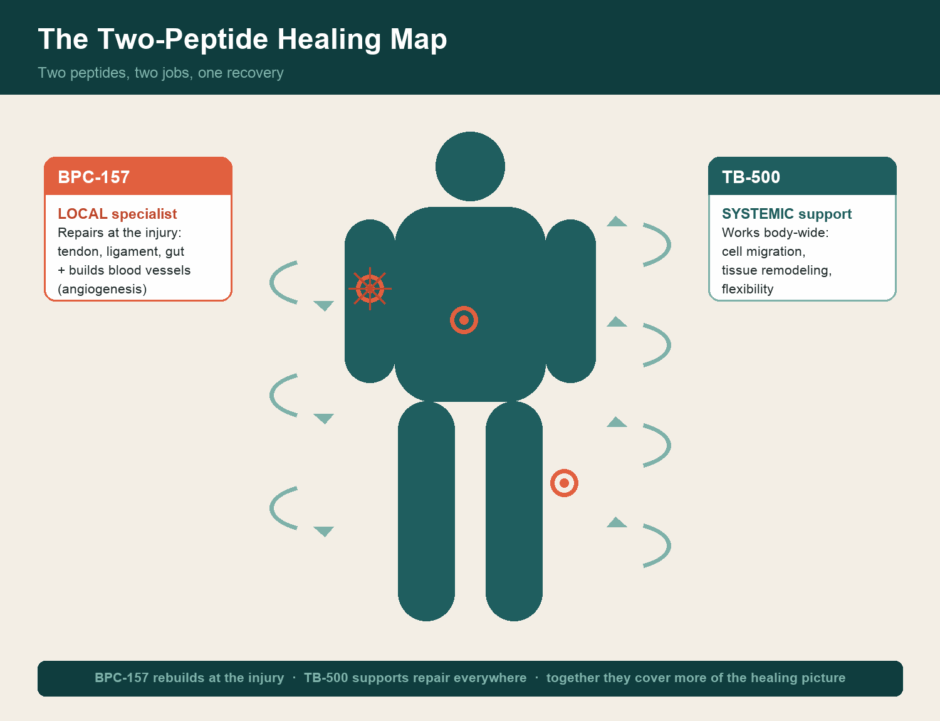
BPC-157 is the local specialist. In animal models it concentrates on the injured tissue itself, supporting repair and encouraging the new blood vessels that feed it. TB-500 works on a wider stage, studied for helping cells migrate and tissues remodel throughout the body, which supports flexibility and recovery beyond any single spot.
Run them together and, in theory, you get a fuller response: focused rebuilding at the injury from BPC-157, and the broader cellular movement and tissue remodeling from TB-500. Researchers and users describe this as a more complete healing picture than either peptide reaches on its own. It is worth being precise about the evidence here, though.
This complementary logic is well grounded in the separate animal research on each peptide, while studies testing the exact combination in people are still to come. The synergy is a well-reasoned research hypothesis with strong preclinical backing, and confirming it in humans is the work ahead.
Wolverine Stack Benefits (What It’s Studied For)
The Wolverine stack is studied and discussed for a cluster of recovery-related effects. These are what the research and the community associate with it, with most of the hard data coming from animal models and personal reports.
- Injury recovery. The headline use, and the reason for the name. People turn to it for tendon, ligament, and joint injuries, from meniscus tears to rotator-cuff strains.
- Reduced inflammation. Both peptides are studied for calming the inflammatory side of injury, which supports comfort and recovery.
- Faster wound and tissue healing. The animal data on both compounds centers on tissue repair, which is where the healing reputation comes from.
- Muscle repair and recovery. Popular with athletes and lifters looking to bounce back from training and strains.
- Gut health. BPC-157’s origin in gastric juice ties it to research on the gut lining, a distinct benefit people value on its own.
- Flexibility and mobility. TB-500’s remodeling angle is linked to suppler, more mobile connective tissue.
The honest picture is encouraging and unfinished. The preclinical evidence for each peptide is substantial and consistent, the community reports are enthusiastic, and the large human trials that would turn “studied for” into “proven to” are the next chapter the field is writing.
Wolverine Stack Dosage and Protocol (Research Context)
The ranges below are the protocols commonly reported in research literature and community discussion. They are shared for context only. This is not dosing advice, the compounds are research-use-only, and anyone considering use should speak with a licensed provider.
Reported BPC-157 protocols often range between 250-500 micrograms per day, taken daily through a cycle. TB-500 is more often described with a loading phase of 2-5 mg per week for the first few weeks, followed by a maintenance dose of 2–2.5 mg per week, reflecting its longer-acting, systemic profile. Cycles of four to eight weeks come up again and again, sometimes followed by a break or a lighter maintenance phase.
Both peptides ship as a lyophilized powder that may be reconstituted with bacteriostatic water, and the concentration you end up with depends on how much water you add. Community protocols vary widely, which is exactly why a licensed provider and a COA-tested product are absolutely crucial, more than any single number you read online.
How Long Should You Take the Wolverine Stack?
Most reported Wolverine stack cycles run 4 to 8 weeks. That window shows up across community protocols and clinic guidance, and it lines up with how people describe their results: early changes within a couple of weeks, and a fuller effect over the back half of a cycle.
Cycling is the norm people describe, and for good reason. A defined block gives the tissue a concentrated period of support, then a break to assess where things stand. Some follow a completed cycle with a lighter maintenance phase, especially for a stubborn injury. As with everything here, the sensible move is to treat these as reported patterns and to involve a licensed provider in any decision made in practice.
Wolverine Stack: Oral vs Injectable
The Wolverine stack comes in two formats, and the choice is mostly about convenience versus absorption.
Injectable is the traditional research form. Given as a small subcutaneous injection, it delivers the peptide directly and reliably, which is why most of the community and the animal research use it. It asks more of the user in terms of reconstitution and technique, but it is the format with the strongest track record for results.
Oral capsules are the easy option, and their appeal is obvious: you skip the needle and the mixing and simply take a capsule. The open question is absorption, since peptides can be broken down in the digestive tract before they do much.
This is a livelier debate for TB-500, a larger molecule, than for BPC-157, which has drawn more interest in oral and gut-focused research. The short version is that injectable has the evidence, oral has the convenience, and the research on maximizing oral delivery is ongoing.
Wolverine Stack Capsules
Oral capsule blends package BPC-157, and sometimes BPC-157 with TB-500, into a daily pill. For anyone put off by injections, you skip the needle and the mixing entirely, and that convenience makes the stack far more approachable.
The trade-off returns to absorption. A capsule only helps to the degree the peptide survives digestion and reaches the bloodstream, which is still an area of active study. If you go the capsule route, the label and the COA earn their keep: confirm the actual peptide content, the amount per capsule, and that an independent lab has verified purity. Convenience is worth a lot, and it is worth pairing with verification.
Wolverine Stack Results Timeline
People report noticing something on the Wolverine stack fairly early, often a reduction in pain or swelling within the first one to two weeks. The fuller injury benefits, the kind tied to actual tissue repair, are described as building over a four-to-eight-week cycle.
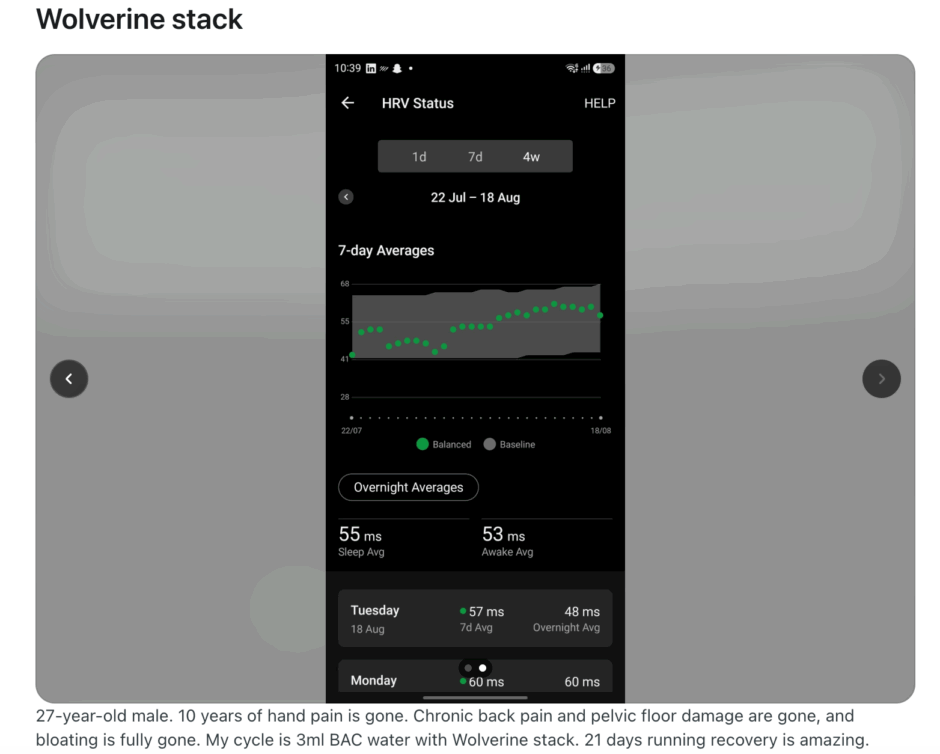
As you can see from this Reddit thread above, timing is personal, and it depends heavily on the injury. A minor strain and a torn meniscus are different jobs. One widely shared Reddit thread described running the stack for 8 weeks on a torn meniscus and crediting it with real improvements in pain, swelling, and recovery. Stories like that fuel the interest, and they are best read as encouraging anecdotes, with your own timeline set by your own injury. Set expectations by your own injury, give a cycle time to work, and judge by how you actually feel and function.
Wolverine Stack Side Effects and Safety
Is the Wolverine stack safe? The honest answer is that the reported side effects are generally mild, while the long-term human safety picture is still being filled in, so caution and good sourcing are the smart defaults.
The effects people most commonly report are minor and short-lived: some soreness or redness at an injection site, occasional fatigue, mild nausea, headache, or a touch of dizziness. Most describe these as manageable.
The bigger, more practical risk sits outside the peptide itself. This is a lightly regulated market, so an unverified product can differ from its label in purity or content, and that variability is a real concern. That is the single strongest argument for buying only third-party-tested material with a COA.
Beyond sourcing, long-term human safety data is still limited, BPC-157 has drawn regulatory attention that we cover below, and anyone with a significant medical history, including a history of cancer, has clear reason to involve a licensed provider before considering use. Treat safety as a sourcing decision as much as a health one.
Is the Wolverine Stack FDA-Approved?
No. Neither BPC-157 nor TB-500 is FDA-approved for human use, and both are sold for research purposes only.
Both BPC-157 and TB-500 remain under active regulatory review and are not FDA-approved for human use. While the FDA previously restricted both peptides under Category 2 of its interim bulk drug substances policy, the agency removed them from that restrictive list in April 2026 to undergo formal evaluation. Following this, the FDA’s Pharmacy Compounding Advisory Committee voted 8–6 in July 2026 to recommend adding both BPC-157 and TB-500 to the 503A bulk drug substances compounding list.
However, this advisory recommendation is non-binding; until the FDA issues a final rule formally adopting the decision, both peptides remain unapproved substances that cannot be legally compounded by pharmacies.
What Should You Stack With BPC-157?
If you are building around BPC-157, TB-500 is the classic partner, and together they form the Wolverine stack this guide is about. It remains the most popular and best-reasoned pairing for recovery.
Beyond that duo, a few other peptides come up in community discussion for a broader profile.
- GHK-Cu, a copper peptide, is often added for skin and connective-tissue support.
- KPV is discussed for its inflammatory-signaling research.
- Some extend further into the growth hormone axis with a secretagogue such as CJC-1295 paired with Ipamorelin.
These are informational pairings people talk about, not a protocol we are recommending, and each additional compound adds its own considerations. For most people asking the question, the answer stays simple: TB-500 is the peptide that made BPC-157 famous as a stack.
Which Peptide Does Joe Rogan Take?
Celebrity curiosity drives a lot of peptide interest, and Joe Rogan is the name that comes up most. He has spoken publicly on his podcast about using recovery peptides of the BPC-157 and TB-500 type, and those mentions did a great deal to push the Wolverine stack into the mainstream conversation.
The sensible caveat is that public comments are not a detailed protocol. The exact compounds, amounts, and timing behind any celebrity’s routine are rarely verified, so it is wise to treat these mentions as a sign of the trend, with any personal plan built alongside a licensed provider. What the Rogan effect really tells you is how far this pairing has traveled from niche forums into everyday recovery talk. The interest is genuine, and the specifics are best confirmed from research and a licensed provider.
How Much Does the Wolverine Stack Cost?
For research-grade material, the Wolverine stack is fairly accessible. Individual vials of BPC-157 or TB-500 usually land somewhere between $40 and $110 each, and a combined blend or a full cycle tends to fall in the $60 to $150 range depending on the peptides, the amounts, and the supplier.
Format affects the price. Injectable vials are often the better value per amount of active peptide, while oral capsules can carry a premium for the convenience. The main drivers are quantity, purity, and the testing behind the product.
That last one is where spending a little more pays off: a peptide backed by an independent, third-party COA and a high verified purity is worth more than a cheaper vial with nothing to confirm what is inside. With research compounds, the certificate is part of what you are buying.
Where to Buy Research-Grade Wolverine Stack Peptides
Sourcing is the part that actually determines your experience, so treat it like the important decision it is. Whatever supplier you consider, run it through a short checklist first:
- A third-party COA for the exact batch, from an independent lab.
- High verified purity, ideally 99% or above, confirmed by HPLC and mass spectrometry.
- A reputable US research supplier with clear, research-use-only labeling.
- Batch traceability, so the lot number on the vial matches the certificate.
After weighing those factors, the option that stood out is Cellugenix, a research supplier that publishes third-party COAs and holds its material to a verified purity standard. Their BPC-157 + TB-500 blend covers the classic Wolverine pairing in a single vial, and the individual BPC-157 and TB-500 are available separately if you prefer to dose each on its own. This guidance is only meant for research sourcing, this isn’t advice to consume anything.
What the Research Says
Step back from the forums and the research picture is consistent, substantial in animals, and honest about its next step. Both halves of the Wolverine stack rest on real, published science.
- For BPC-157, the animal literature is deep. Studies describe it supporting the healing of tendons, ligaments, muscle, and the gut lining, with a recurring theme of improved angiogenesis at the injury, as documented across the work of Sikiric and colleagues.
- For TB-500, the thymosin beta-4 research is equally grounded, centered on cell migration and wound healing, with Goldstein’s foundational reviews describing its key role in tissue repair and the quantified healing gains noted earlier.
The difference is human trials. Most of the strong evidence is preclinical, and large controlled studies in people are still to be run. That is not a knock on the compounds; it is simply because this field is still new. The foundation is solid, the direction is promising, and confirming human research is the work in progress.
What Reddit and Users Say About the Wolverine Stack
If the research is measured, the community is anything but. People are, frankly, a little obsessed with this blend, and the enthusiasm is impossible to miss on Reddit and in recovery forums. Threads on subs like r/Kneesovertoes fill up with recovery stories, before-and-afters, and dose debates, and the Wolverine stack is a regular main character.
The themes are remarkably consistent.
- Injury-recovery praise leads the way, with the torn-meniscus success story being one of the most shared.
- Right behind it comes hard-won practical advice: get a COA, because sourcing is everything; most experienced users favor injectable over oral for real results; and set realistic, individual expectations, since outcomes vary by person and injury.
- It is an engaged, opinionated, self-policing community that has done a lot to spread the stack, and reading a few threads is a genuinely useful complement to the research, as long as you remember these are personal reports and not medical advice.
Frequently Asked Questions
What is considered the Wolverine stack?
The Wolverine stack is the pairing of two research peptides, BPC-157 and TB-500, studied together for healing and recovery. That two-peptide combination is the standard. Some clinics market an extended four-peptide version that adds compounds like GHK-Cu or KPV, but the classic core is the two.
How long should you take the Wolverine stack?
Reported cycles most often run four to eight weeks, sometimes followed by a lighter maintenance phase for a stubborn injury. People describe early changes within a week or two and a fuller effect over the cycle. These are commonly reported patterns, not dosing advice.
Which peptide does Joe Rogan take?
Joe Rogan has publicly discussed using recovery peptides of the BPC-157 and TB-500 type, which helped popularize the Wolverine stack. The exact compounds and amounts behind any celebrity routine are rarely verified, so treat these mentions as a sign of how popular the pairing became.
What should I stack with BPC-157?
TB-500 is the classic partner, and the two make up the Wolverine stack. Some people also discuss adding GHK-Cu or KPV for a broader recovery and skin profile. These are pairings people discuss for interest, and the core recommendation stays the classic pair.
Is the Wolverine stack FDA-approved?
No. Neither BPC-157 nor TB-500 is FDA-approved for human use, and both are sold for research purposes only. BPC-157 has been under FDA compounding review, and the peptides are prohibited in competitive sport under anti-doping rules.
How much does the Wolverine stack cost?
Research-grade vials generally run about $40 to $110 each, and a blend or full cycle tends to land in the $60 to $150 range. Purity and third-party testing are the main price drivers, and a verified COA is worth paying for.
Oral or injectable?
Injectable is the traditional format with the strongest track record, since it delivers the peptide directly. Oral capsules are more convenient, though absorption is still debated, especially for the larger TB-500 molecule.
The Bottom Line
The Wolverine stack pairs BPC-157 and TB-500, two research peptides studied for accelerating injury recovery and easing inflammation, and it has built a devoted following in recovery and biohacking circles. The preclinical evidence is genuinely strong, the community enthusiasm is real, and the large human trials that would prove it out are the field’s next step.
Both compounds are research-use-only, are not FDA-approved, and are prohibited in competitive sport, so the smart approach is simple: buy only COA-tested peptides, keep cycles reasonable, and involve a licensed expert before any decision is made in practice.
Disclaimer
This article is for educational and research purposes only and is not medical advice. BPC-157 and TB-500 are research-use-only compounds that are not FDA-approved for human use; BPC-157 has been under FDA compounding review, and both are prohibited in sport under anti-doping rules. Nothing here is intended to diagnose, treat, cure, or prevent any disease. Potential risks exist and long-term human data is limited, so source only third-party-tested products and consult a licensed healthcare provider before use. Intended for adults 18 and over.
Related posts:






Stay updated, free articles. Join our Telegram channel

Full access? Get Clinical Tree


