By Bilkin Marsh, Fact-checked by Tody Lucas
The Wolverine Stack is a two-peptide research combination of BPC-157 and TB-500, named after the comic-book character known for fast healing. The two are paired because both appear repeatedly in tissue-repair research, though they act through different mechanisms: BPC-157 around angiogenesis, TB-500 around cell migration.
No pharmacopeia defines the term, which makes buying difficult. Three suppliers using the same name ship three different products, so the label tells you very little about what arrives. Neither compound is FDA-approved, and every supplier here sells its material for laboratory research only.
Best Places to Buy Wolverine Stack Compared
Three US suppliers stock a real BPC-157 and TB-500 research stack, backed by a published certificate. Their shelf prices look close, then split wide apart once you divide by milligram.
| Supplier | Stack format | Vial size | Purity claim | Stack-specific COA | Independent testing | Price per mg | US shipping |
| Kylo Peptides | Two separate vials | 5mg + 5mg, 10mg | 99%+, HPLC | Yes, one per vial | Three ISO/IEC 17025 labs, named | $14.00 | Same-day before 2 PM PT |
| American Peptides | Blend, or three-vial bundle | 20 mg, or 5 mg + 10 mg + 5 mg | 99%+, HPLC and mass spec | Yes, on every vial | Third-party, lab not named | $9.75 / $8.55 | Same-day by 2 PM EST, free over $300 |
| Palmetto Peptides | One blended vial | 10mg + 10mg, 20mg | 98%+, HPLC | Yes, batch-specific PDF | ISO-accredited US lab, not named | $6.20 | Not published |
Where to buy Wolverine Stack depends on which column you weigh. Price per mg is our own calculation.
Where To Buy Wolverine Stack For Research Purpose?
Three research peptide suppliers made the cut. Between them, no two ship the same composition, and the price per milligram varies more than twofold. Where a supplier does not publish a given spec, we state that gap plainly.
Kylo Peptides
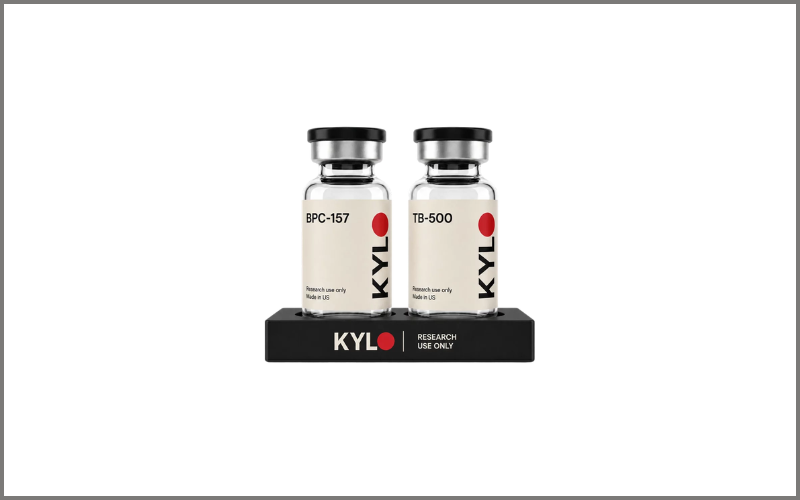
Kylo Peptides runs a seven-assay panel on every Wolverine stack lot across three independent ISO/IEC 17025 laboratories, and names all three: Janoshik, Freedom Diagnostics, and Vanguard. The panel covers identity by LC-MS, purity by HPLC-UV against a ≥99.6% target, net content, heavy metals, sterility, endotoxin, and appearance.
Net content was the assay we did not find anywhere else. It measures the milligrams of peptide actually in the vial, which purity testing never reports. A vial can read 99% pure and still be underfilled.
The two compounds also ship as separately sealed vials, each released against its own lot-matched certificate, so you get a purity figure per compound rather than one blended average.
Quick Specs
- Stack format: two separate vials
- Vial size: BPC-157 5mg plus TB-500 5mg, 10mg total
- Price: $139.95, reduced from $153.89
- Price per mg: $14.00, per our calculation
- Purity: 99.6% or higher by HPLC
- COA: lot-matched, one per vial
- Independent testing: seven assays across three ISO/IEC 17025 labs, named Janoshik Labs, Freedom Diagnostics, and Vanguard
- US shipping: same-day dispatch before 2 PM PT
Kylo names all three labs that test each batch, so you can look them up yourself. It also measures how many milligrams are actually in the vial.
American Peptides
American Peptides publishes endotoxin and sterility results on its Wolverine stack certificates, which we did not see on most brands we checked. Testing is by HPLC and mass spectrometry, and each vial carries a lot-matched COA.
The laboratory is where the record stops. The product page states third-party testing and gives no name, so there is nothing to cross-reference.
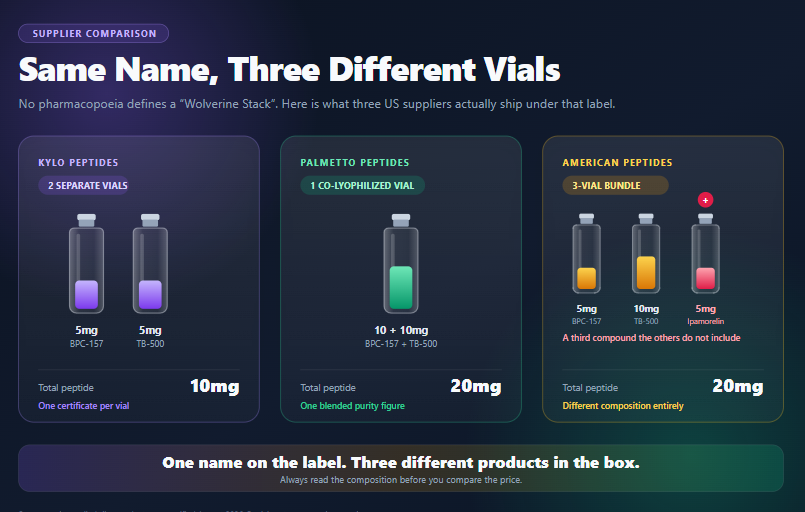
It also lists two products under the Wolverine name: a 20mg co-lyophilized vial, and a three-vial bundle carrying BPC-157 5mg, TB-500 10mg, and Ipamorelin 5mg.
Quick Specs
- Stack format: blended vial, or three-vial bundle
- Vial size: 20 mg, or 5 mg plus 10 mg plus 5 mg
- Price: $195.00 blend, $171.00 bundle
- Price per mg: $9.75 and $8.55, our calculation
- Purity: 99%+ by HPLC and mass spectrometry
- COA: lot-matched, on every vial
- Independent testing: third-party, lab not named
- US shipping: same-day by 2 PM EST, free over $300
The certificate covers endotoxin and sterility, which many suppliers skip. What it does not tell you is which lab ran the tests. The page just says third-party. There is no name to look up and nobody to call. Free shipping also starts at $300.
Palmetto Peptides
Palmetto Peptides tests their Wolverine stack by HPLC at a 98% purity threshold, the lowest of the three, and the laboratory behind it is described only as ISO-accredited. The page didn’t name it, so we had nothing to cross-reference.
The certificate itself is batch-specific and downloadable, tied to lot ARC-WV10-004, dated June 10, 2026. That covers the blend as a single unit, so one purity figure stands for both peptides.
The product is a single 20mg vial with BPC-157 and TB-500 co-lyophilized together, at $124.00.
Quick Specs
- Stack format: one blended vial
- Vial size: BPC-157 10mg plus TB-500 10mg
- Price: $124.00
- Price per mg: $6.20, our calculation
- Purity: 98%+ by HPLC
- COA: batch-specific PDF on the product page
- Independent testing: ISO-accredited US lab
- US shipping: not published
The purity is 98%, and in a 20mg vial, the missing 2% is 400 micrograms of something else. The page also says nothing about shipping, so you do not know the cost or when it goes out. And because both peptides are mixed together, you get one purity number covering both.
What Research-Grade Wolverine Stack Actually Means
Research grade on a BPC-157 TB-500 stack means the compound has been named, measured, and documented well enough for lab work. It is a paperwork standard set by the seller.
What the label does cover
- Identity: the molecule matches its expected mass by mass spectrometry
- Purity: an HPLC figure against a stated threshold
- Batch consistency: the same route and conditions, run after run
- Analytical testing: results from an accredited lab
- Documentation: a certificate you can read
- Traceability: a lot number linking that vial to that certificate
What the label does not cover
- Drug approval. Neither compound has it.
- Human efficacy. A purity figure is not a clinical result.
- Human safety. Sterility testing covers the vial.
- An evidence upgrade. Preclinical data stays preclinical, however clean the powder.
What Does the Wolverine Stack Actually Contain?
Two peptides make up the classic Wolverine peptide stack, BPC-157 and TB-500. Every other product on the market today is some variation on that pair. Researchers study the two for different reasons that happen to overlap.
BPC-157
BPC-157 is a synthetic pentadecapeptide, fifteen amino acids long, derived from a naturally occurring gastric peptide. A 2025 systematic review reported that preclinical models showed better functional, structural, and biomechanical outcomes for muscle, tendon, ligament, and bone injuries.
A 2014 cell-culture study found that it raised growth hormone receptor expression in tendon fibroblasts at both the mRNA and protein levels.
TB-500 and Thymosin Beta-4 Research
TB-500 relates to thymosin beta-4, a 43-amino-acid polypeptide of roughly 5 kDa. It is the main G-actin-sequestering peptide, so it is at the center of how cells build and disassemble their internal scaffolding.
Work on its actin-binding motif found that the site is essential to its angiogenic activity. A 2026 scoping review gathers the tissue-repair literature in one place.
Why Are They Called the Wolverine Stack?
The Wolverine peptide stack borrows its nickname from the comic-book character whose defining trait is fast healing. The label stuck because both compounds recur in tissue-repair models, so pairing the two provided an easy shorthand for labs and forums alike.
Nobody official ever signed off on the term. No pharmacopeia defines a Wolverine Stack. Across these three suppliers, the same name covers two separate 5mg vials, one 20mg blended vial, and a bundle carrying a third compound.
Wolverine Stack Research Uses and Potential Benefits
Every use below is a research objective for the BPC-157 TB-500 stack. None has been demonstrated in people. Potential research application is not the same thing as proven human benefit. Treat each one as an open question, because the evidence stops well short of proof.
Tissue-Repair Research
BPC-157 is most commonly observed in wound and tissue repair models. The 2025 review found preclinical gains across several injury types, with none from human trials.
Connective-Tissue Research
Tendon and ligament work forms the densest cluster of studies. Cell migration and local repair signaling are the proposed route. Whether it carries over in people is unknown.
Recovery-Related Research
The two are grouped because their proposed mechanisms differ rather than overlap. BPC-157 is studied for angiogenesis, and TB-500 for endothelial cell migration. Clinical evidence for the pairing does not exist.
Muscle-Preservation Research
Preservation and atrophy models are where the stack appears in the muscle literature. That evidence is mechanistic and preclinical. Human outcomes are a category it has not reached.
Growth and Regeneration Research
Interest here runs on cellular pathways, mainly blood-vessel growth, muscle growth, and actin dynamics. Describing a pathway is not claiming recovery in a person.
What Does Research Actually Show About the Wolverine Stack?
Published evidence on the Wolverine peptide stack delivers less than the marketing implies, and the shortfall is specific. The strongest synthesis on BPC-157 rested only on level IV and level V studies, the two weakest tiers of clinical evidence. Published controlled human trials of the two compounds used together are not available.
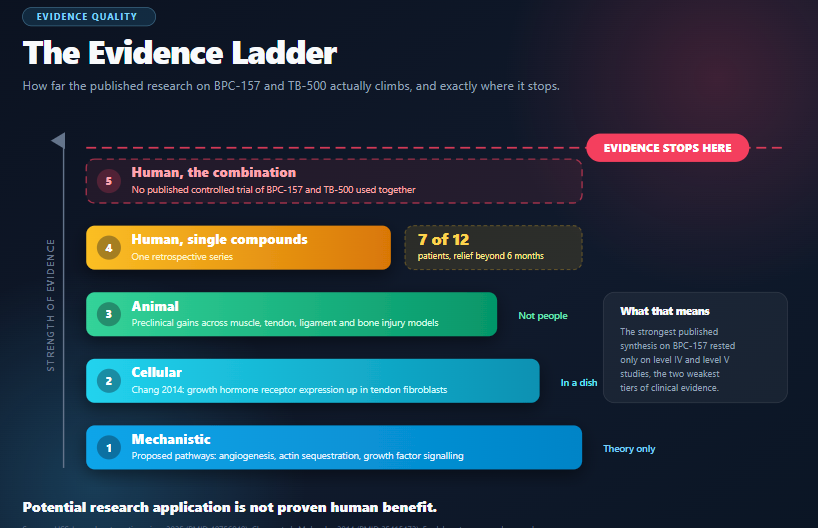
The evidence works as a ladder:
- Mechanistic: Proposed pathways: angiogenesis, actin sequestration, growth factor signaling.
- Cellular: The 2014 tendon fibroblast work belongs to this rung.
- Animal: Most tissue-repair results live here.
- Human, single compounds: Thin. The 2025 review identified one retrospective series in which 7 of 12 patients reported relief beyond 6 months after intra-articular BPC-157 for chronic knee pain.
- Human, combination: No published controlled trial.
The ladder stops at rung four, and rung four is a single small series. Anyone selling certainty above that line is selling something other than evidence.
Wolverine Stack Blend vs Buying BPC-157 and TB-500 Separately
A blend gives you one vial and one reconstitution. Separate vials let you buy BPC-157 individually, provide a certificate per compound, and let you set the ratio yourself. Two separate containers buy you more paperwork instead. The whole trade is what the certificate can tell you afterward, so decide which of those you need before comparing prices.
| Factor | Blended vial | Separate vials |
|---|---|---|
| Convenience | One vial, one reconstitution | Two of everything |
| Individual COAs | Usually one combined figure | One certificate per compound |
| Composition transparency | Ratio stated by the seller | Each mass measured on its own |
| Research flexibility | Fixed ratio | Ratio set by the researcher |
| Cost per mg | Generally lower | Generally higher |
| Batch tracking | One lot number covering both | One lot number each |
On documentation, separate vials win outright. In terms of cost, the blend wins every time. The layout changes your documentation and leaves the compounds themselves untouched.
How We Ranked Each Wolverine Stack Supplier
We ranked each Wolverine Stack supplier on eleven checks, and published paperwork outweighs every marketing claim on the list.
| Check | What we look for |
|---|---|
| Exact SKU availability | The stack in stock |
| Compound identity | Mass spec confirmation against expected mass |
| Purity | An HPLC figure against a stated threshold |
| Stack-specific COA | A certificate for the stack lot |
| Independent testing | Analysis outside the seller’s building |
| Batch traceability | A lot number matching the certificate |
| Net peptide content | Peptide milligrams measured |
| Sterility and endotoxin | USP chapter 85 results |
| Price per mg | Normalized across every vial size |
| US shipping | Domestic dispatch with a stated cutoff |
| Research-use labeling | Laboratory-use wording on the product page |
No supplier cleared all eleven. Only one names its labs, and accreditation is worth little if you cannot tell who holds it.
How Much Does the Wolverine Stack Cost?
Wolverine Stack price runs between roughly $48 and $135 a vial across the market, or about $3.00 to $8.50 per milligram once normalized, with outliers above that.
Per-vial pricing misleads for one reason: vials are not the same size. A $124 vial holding 20mg costs less per milligram than a $90 vial holding 10mg, even though the sticker looks higher.
What that price actually covers:
- Peptide quantity, measured as net content rather than fill weight
- Purity against a stated threshold
- Independent testing, and how many ISO/IEC 17025 labs saw the lot
- A lot-matched certificate you can read before buying
- Batch documentation that survives the sale
- Shipping, which only two of the three publish
Divide the price by the total milligrams, then check whether the certificate reports the net peptide content. Without that second number, you are pricing a guess.
Wolverine Stack Red Flags and Green Flags
Eight signals separate a documented Wolverine Stack supplier from a merely confident one, and nearly all of them take under a minute to verify on a product page.
| Green flag | Red flag |
|---|---|
| Lot-specific COA matching the vial | A generic COA reused across batches |
| A named independent laboratory | “Third-party tested” with no lab named |
| Identity confirmed by mass spec | A purity claim and nothing else |
| Composition stated per compound | A proprietary or unspecified blend |
| A batch number printed on the vial | No lot number anywhere |
| Net peptide content reported | Vial fill weight only |
| Clear laboratory-use labeling | Human treatment claims |
| A traceable supplier identity | An anonymous seller |
Two of the three here trip the second row. Naming the lab is the easiest fix a vendor has, and plenty skip it.
How to Read a Wolverine Stack COA
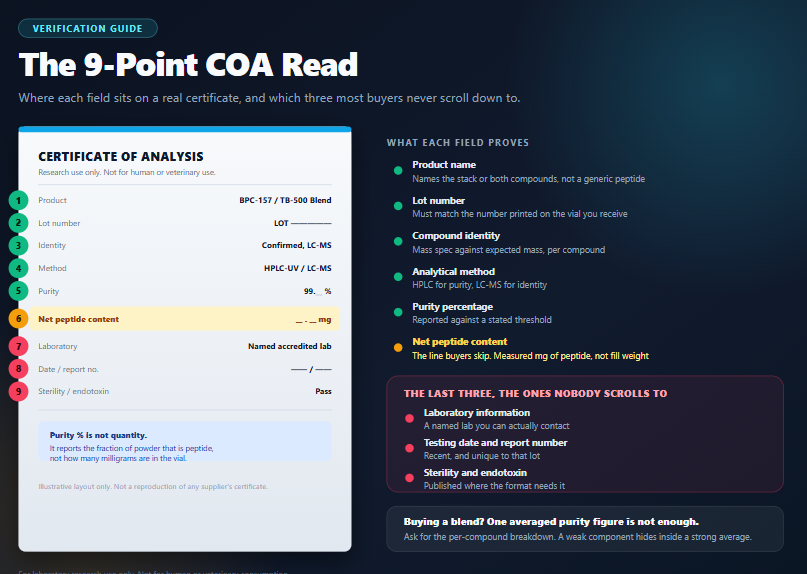
A lot-matched certificate of analysis rewards reading in order, because the most useful part is present near the bottom. Nine fields carry the information worth checking. The last three are the ones buyers skip, and they are the ones that prove the vial was tested at all.
- Product name: It should name the stack or both compounds
- Lot number: Match it to the vial in your hand.
- Compound identity: Mass spec against expected mass, per compound.
- Analytical method: HPLC for purity, LC-MS for identity.
- Purity percentage: Reported against a threshold.
- Net peptide content: The measured milligrams of peptide.
- Laboratory information: A named lab you can contact.
- Testing date and report number: Recent, unique to that lot.
- Sterility and endotoxin: Published where the format needs it.
One distinction does the heavy lifting. A purity percentage tells you what fraction of the powder is peptide.
Is the Wolverine Stack Legal in the US?
Selling a BPC-157 TB-500 stack as labeled research material is legal in the US. Selling it for human use is illegal, and neither compound is an approved drug.
As of the FDA bulk substances page last updated 22 April 2026, both compounds sit in the nominated-but-withdrawn section of the 503A list. The agency’s stated concern for each is a risk of immunogenicity by certain routes.
- Approval status: neither compound has it.
- Compounding: not available as an approved bulk substance under section 503A.
- Sport: Use of BPC-157 is banned in professional sport under anti-doping rules.
- Research supply: legal when labeled for laboratory use only.
Availability online is not approval. Rules here are moving quickly, so check the current FDA listing first.
How to Decide Which Is the Best Brand for You?
Deciding where to buy Wolverine Stack comes down to the constraint that binds you hardest, because none of these three leads on everything.
- Best overall research transparency: Kylo Peptides. Named laboratories and a certificate per compound, which no other supplier here matches.
- Strongest independent testing: Kylo Peptides. Seven assays per lot across named ISO/IEC 17025 laboratories.
- Best for COA transparency: Kylo Peptides. Two certificates rather than one blended average, so a weak component cannot hide.
- Best shipping terms: Kylo Peptides. Same-day dispatch before 2PM and free shipping from $150, against $300 at American Peptides and nothing published at Palmetto.
- Best price per mg: Palmetto Peptides, at $6.20 against $14.00 at the top end.
- Best public batch documentation: Palmetto Peptides. A real lot number and date sit on the product page.
- Best composition flexibility: American Peptides. A blend and a three-compound bundle in one place.
Frequently Asked Questions
Where can you buy Wolverine Stack for research?
From specialist research-peptide suppliers that ship domestically. Kylo Peptides, American Peptides, and Palmetto Peptides all publish certificates you can read before ordering. Skip general marketplaces, where listings rarely carry a lot number you can match to the vial.
What peptides are in the Wolverine Stack?
Two: BPC-157 and TB-500. Some suppliers add a third, which is why the label alone tells you little.
Does Kylo Peptides sell Wolverine Stack?
Yes, as two separately sealed vials at 5mg each rather than one blended vial. That means two certificates to download and two reconstitutions to plan for, so budget bacteriostatic water accordingly. It is sold separately.
What vial sizes are available?
5mg and 10mg per compound are the common sizes, giving 10mg or 20mg of total peptide. Kylo ships 5mg plus 5mg, Palmetto 10mg plus 10mg, and American Peptides offers both a 20mg blend and a three-vial bundle.
Does Wolverine Stack come with a COA?
From a credible supplier, yes, and the format matters. A blend usually reports a single combined purity figure, while separate vials each carry a certificate. Two certificates tell you more, because a weak component cannot hide inside a strong average.
What purity should you look for?
99% or higher by HPLC is the standard threshold among suppliers publishing one. Palmetto lists 98%, and on a 20mg vial, that single point is an extra 400 micrograms of material that is not the peptide you ordered.
Is Wolverine Stack FDA approved?
No. Neither BPC-157 nor TB-500 is an approved drug, and no supplier changes that with better paperwork. A lot-matched certificate proves what is in the vial. Approval travels with the compound, never with the vendor.
Is Wolverine Stack the same as BPC-157 + TB-500?
Wolverine Stack usually means the pair supplied as separate vials, while Wolverine Blend means both co-lyophilized into one at a fixed ratio. Suppliers use the words loosely, so check the product page.
Does research show the combination is better than individual compounds?
No published study compares the pair against either compound alone. The rationale is mechanistic, with BPC-157 studied in relation to angiogenesis and TB-500 in relation to cell migration. That is a reason to run a trial, and no such trial exists.
How can you verify a Wolverine Stack COA?
Match the lot number on the certificate to the number printed on the vial, then check the testing date and whether the laboratory is named. An unnamed lab cannot be cross-checked. Where a supplier publishes a task or accession number, look it up on the lab’s own site.
Conclusion
Where to buy Wolverine Stack comes down to which gap you can live with. Kylo Peptides is the best overall pick for research work. It is the only supplier here that names the laboratories seeing each lot, runs seven assays across three ISO/IEC 17025-accredited labs, holds a ≥99% HPLC purity threshold, and issues a separate certificate for each compound.
Palmetto is cheaper at $6.20 per milligram and publishes the lowest purity threshold of the three at 98%. American Peptides carries a composition neither of the others offers. Both are reasonable choices if cost or format is the binding constraint.
Whichever you pick, open the certificate before the price. Match the lot number to the vial, confirm the laboratory is named, and check the report gives net peptide content alongside purity. A vendor who publishes all three has told you what is in the box.
Disclaimers
Every compound named here is supplied for laboratory research use only, not for human or veterinary consumption. Nothing above is a dosing instruction. Consult a qualified healthcare professional before making any health decision. Rules covering research peptides vary by state and are changing. Verify them locally before purchasing.
Related posts:







Stay updated, free articles. Join our Telegram channel

Full access? Get Clinical Tree


