Written by Mickey Gilbert, science writer covering pharmacology and regulatory affairs. Fact-checked by Elena Hall, Editor.
Search demand for women’s peptides has grown by about 78 times since 2021. In January 2021, roughly 74 people a month in the US searched the exact phrase. Around November 2025, it quietly passed “peptides for men,” and today it runs close to double. This August it hit 5,795.
Now compare those numbers against the research actually done, and the irony will strike immediately. According to Zucker, Prendergast, and Beery, studies in pharmacology that use only male animals outnumber those that use only female animals by about 5 to 1. So the answers women are looking for are being answered by male species in the lab.
We realize the discrepancy. So, in this article, we are not just quoting studies blindly, but asking three important questions to ensure we serve the context right: What was actually studied? Who was it studied in? And where does it stand with the FDA today?
Key Takeaways
- Peptides are short chains of amino acids that carry signals between cells. Some are approved medicines, but most are sold for laboratory research only.
- Many compounds in this guide sit on the FDA’s Category 2 list, which flags substances with identified safety concerns for compounding.
- For researchers evaluating RUO peptides, Kylo Peptides offers compounds across areas such as recovery, cellular research, and metabolic research, with product documentation such as COAs to support material evaluation.
- For several of them, including MOTS-c and TB-500, the FDA states that it has found no human exposure data.
- The choice of compound depends entirely on your research goal.
- Before considering an approved peptide medication, have a conversation with a clinician who can order labs and monitor you. This does not apply to RUO compounds.
What Are Peptides?
Peptides are short chains of amino acids, usually 2-50 of them linked together. Your body already makes thousands of them. Insulin is a peptide, and so is oxytocin. They work as messengers, telling one system what another system is doing.
The peptides people argue about online are synthetic copies or modified versions of these natural messengers. Same concept, realized in a lab.
How Peptides Work in the Body
- Cell signaling: A peptide binds to a receptor on a cell surface and triggers a response inside that cell. Think of it as a key shaped for one specific lock. The message gets delivered, the cell changes what it’s doing, and the peptide breaks down.
- Hormone-related pathways: Some peptides sit upstream of hormone release. Growth hormone secretagogues, for example, signal the pituitary gland to release more of the hormone the body already makes. The body still does the producing.
- Tissue repair and regeneration: Several compounds are studied in animal models of wound and tendon healing. The proposed mechanisms involve blood vessel formation and collagen organization.
- Metabolic processes: A smaller group of peptides has been examined in relation to insulin signaling and mitochondrial function.
Why Women Are Interested in Peptides
- Recovery: A hard training session at 45 takes days to recover. Peptides such as BPC-157 are studied in rodent models of tendon and ligament healing.
- Sleep: Broken sleep is a common midlife complaint among women. GH-releasing growth hormone peptides provide a solid research ground for deep sleep.
- Cognitive function: Brain fog often gets waved off as a sign of normal aging. Peptide clinics address it directly.
- Metabolic health: Muscle mass and insulin sensitivity both shift in midlife. Compounds involved in metabolic pathways, such as MOTS-c, are being investigated for their long-term effects on metabolic health.
- Healthy aging: Skin, muscle, and mitochondrial function all decline with age. GHK-Cu, Epitalon, and MOTS-c peptides are studied in the context of those pathways for longevity.
- Perimenopause support: Estrogen decline during perimenopause drives simultaneous changes in sleep, body composition, and skin. Peptides get discussed as a route to those systems for women who can’t take HRT or want more than it covers.
Are All Peptides the Same?
No. Peptides can be natural or synthetic. The synthetic ones can further be categorized into prescription meds and research-use-only compounds.
- Naturally occurring peptides: These are made by your own body or found in food.
- Synthetic peptides: Lab-made copies or modified sequences of natural peptides.
- Prescription peptide medications: These are FDA-approved drugs for specific conditions, with real-world trials and known dosing—for example, semaglutide and tesamorelin.
- Research peptides: Sold for “research use only”.
Popular Peptides for Women
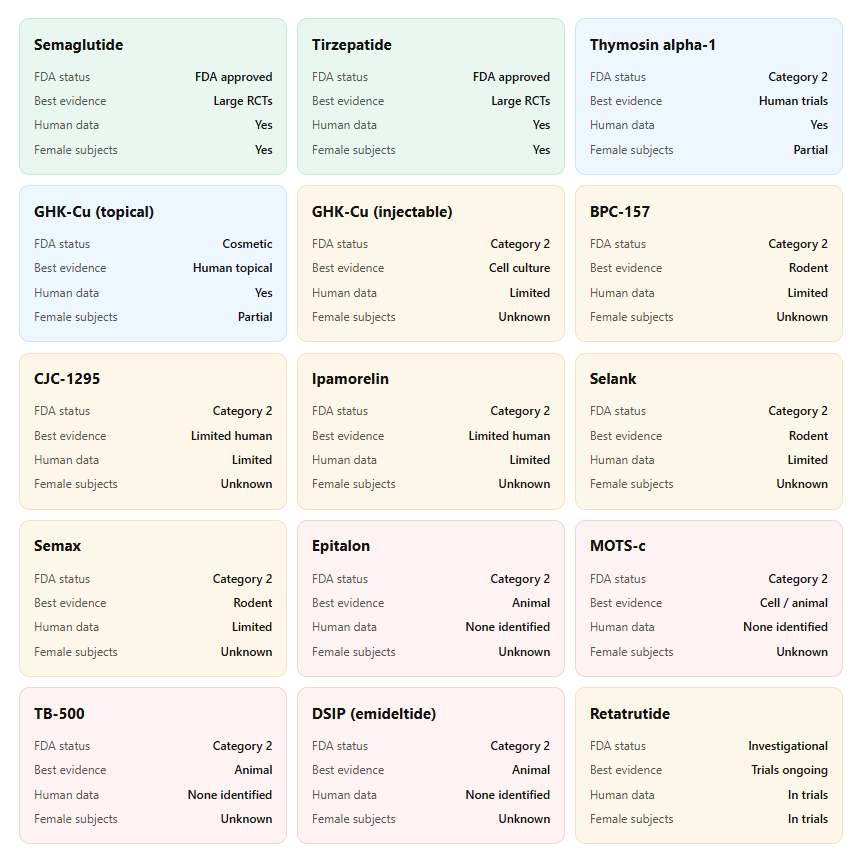
Check out the most popular peptides for women in 2026. We pulled each compound’s regulatory status from the FDA’s Category 2 bulks list, then checked the highest available study type: human trial, animal study, or cell culture. When a study was available, we checked whether it included female subjects.
#1. BPC-157
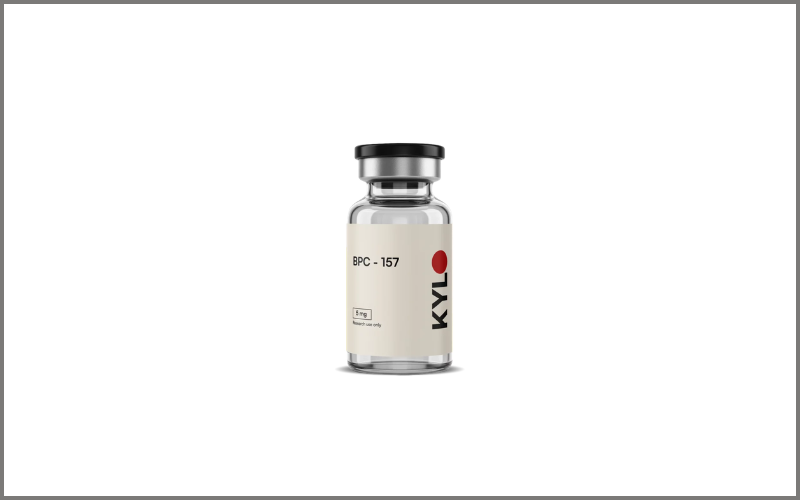
- Recovery research: BPC-157 is a fifteen-amino-acid sequence based on a protein found in gastric juice. The bulk of the work comes from one Croatian lab, and it’s rodent research, running to hundreds of papers.
- Tissue repair: Rat studies document faster healing after tendon transection and ligament injury, with better collagen organization in the tissue samples.
- Gastrointestinal research: Studies cover rodent models of gastric ulcers, colitis, and NSAID-induced gut damage.
- Where it stands on FDA approval: The FDA lists BPC-157 as a substance for which it identified only limited safety information for the proposed routes. There is no published randomized controlled human trial for any indication.
#2. GHK-Cu
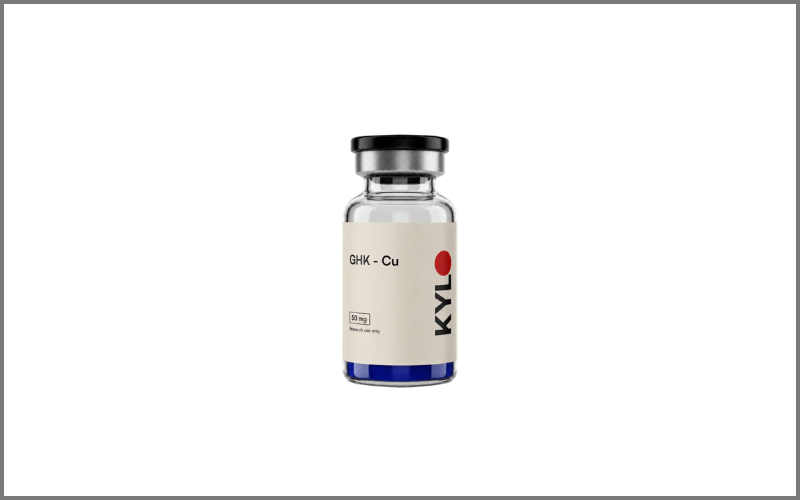
- Skin and collagen: GHK-Cu is a copper-binding tripeptide. Most of the credible human research around it is topical and cosmetic.
- Hair and tissue research: Laboratory work has examined its behavior in skin cell cultures, including its effects on the cells that build connective tissue.
- Healthy aging: It shows up constantly in longevity content, usually with topical and injectable evidence blended as though they’re the same.
- Where it stands on FDA approval: The FDA placed GHK-Cu for injectable routes on its safety-concerns list, citing limited human data. Topical GHK-Cu cosmetics are regulated for safety and labeling.
#3. CJC-1295 and Ipamorelin
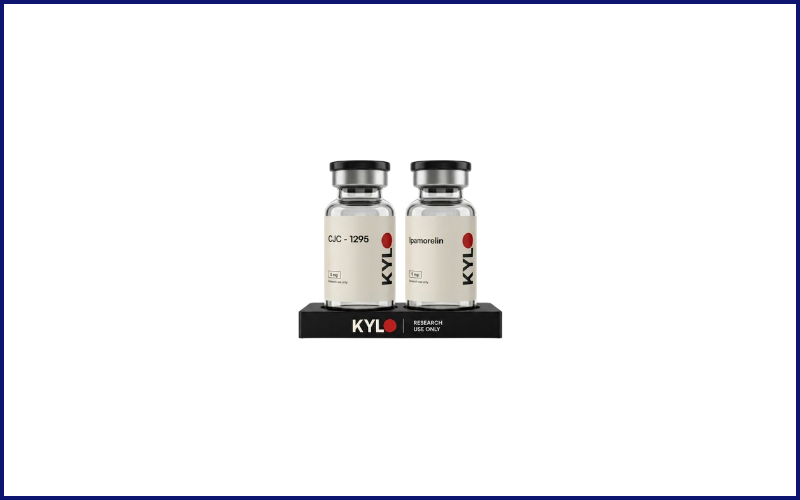
- Growth hormone signaling: Both peptides are intended to prompt the pituitary to release more growth hormone on its own.
- Recovery: Growth hormone is involved in tissue repair, so any compound that raises its levels is credited with repair benefits. However, no trial directly measured the stack’s outcome.
- Sleep and body composition research: Growth hormone release peaks during deep sleep and influences lean mass. These compounds raise it, so they often get discussed for sleep and body composition benefits. No study has measured either outcome with CJC-1295 or ipamorelin in women, though.
- Where it stands on FDA approval: The FDA has identified serious adverse events associated with CJC-1295, including elevated heart rate and systemic vasodilation. For ipamorelin, it points to a published report of serious adverse events including death when given intravenously for gastric motility.
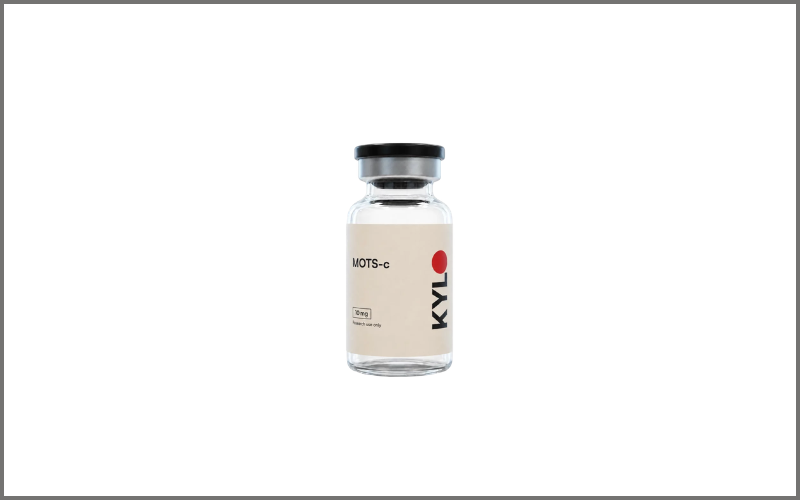
#4. MOTS-c
- Metabolic health: MOTS-c is a peptide encoded in mitochondrial DNA.
- Cellular energy: Research has examined its role in cellular energy pathways and insulin sensitivity, largely in cell and animal models.
- Exercise research: Some studies have linked it to exercise adaptation.
- Where it stands on FDA approval: The FDA states it has not identified any human exposure data on drug products containing MOTS-c by any route of administration. Not limited data. None.
#5. Semaglutide and Tirzepatide
- Weight management: These two are FDA-approved prescription medicines with large randomized trials behind them.
- Blood glucose regulation: Both were developed for type 2 diabetes before the weight indications arrived. Women were included in those trials in large numbers.
- Difference between peptide medications and research peptides: An approved medicine comes with trial data, a known manufacturer, a dose, and a monitoring plan. A vial bought online with a research label comes with none of those things, even when the molecule inside is nominally the same. Retatrutide, which often appears alongside Semaglutide and Terzepatide in weight management discussions, is not an approved medication, unlike them.
#6. Selank
- Cognitive research: Selank is a synthetic peptide developed in Russia, based on a fragment of an immune-signaling molecule.
- Stress-related pathways: Most published work is Russian-language animal research looking at anxiety-related behavior in rodents.
- Neuroprotective research: Laboratory studies have examined effects on neurotransmitter systems. Independent replication outside Russia is limited.
- Where it stands on FDA approval: The FDA has said it lacks important information about safety issues raised by selank acetate given to humans. It sits on the Category 2 bulks list today.
#7. Epitalon
- Healthy aging research: Epitalon is a four-amino-acid sequence from Russian gerontology research, associated with work on the pineal gland.
- Sleep and circadian research: The circadian angle comes from that pineal connection, since the pineal gland governs the body’s day-night rhythm. The published work is largely older, comes from a small number of groups, and hasn’t been widely replicated by independent labs.
- Where it stands on FDA approval: The FDA has not identified safety information for epitalon for the proposed route of administration.
#8. Thymosin Alpha-1
- Immune system research: It’s approved in several countries outside the US and has been used in research on hepatitis B and sepsis.
- Immune response: Published work looks at T-cell function. Thymosin alpha-1 occurs naturally in the thymus, the gland that trains immune cells, so the proposed pathway is grounded in real anatomy.
- Where it stands on FDA approval: The FDA describes the available safety information as inadequate for it to understand the extent of any safety issues in compounded form.
Best Peptides by Goal
There’s no single best peptide for women. Research studies different peptides for different goals.
| Goal | Compounds discussed | Strongest evidence type available |
| Recovery | BPC-157, TB-500, CJC-1295, Ipamorelin | Rodent studies |
| Cognitive | Selank, Semax | Animal behavioral studies |
| Sleep | Epitalon, DSIP, CJC-1295, Ipamorelin | Indirect, via growth hormone |
| Immune | Thymosin Alpha-1 | Human trials, outside US approval |
| Metabolic | MOTS-c, semaglutide, tirzepatide, retatrutide | Split: large RCTs and zero human data |
| Skin and hair | GHK-Cu | Human topical work |
| Healthy aging | GHK-Cu, Epitalon, MOTS-c | Cell and animal models |
Peptides for Recovery
BPC-157 and TB-500 are usually mentioned together as a repair stack. The FDA notes it has found no human exposure data for TB-500, the thymosin beta-4 fragment. BPC-157 has more research behind it, hundreds of rodent studies, though no published randomized controlled human trial exists for any indication.
CJC-1295 and Ipamorelin are discussed for recovery owing to their potential effect on growth hormone. However, no direct trial has tested either one. Research shows only a set of promising results in rodents.
Peptides for Cognitive Support
Selank and Semax are both Russian-developed compounds with a body of animal research behind them, mostly examining anxiety-related and memory-related behavior. The proposed neurological pathways involve neurotransmitter regulation and a protein called BDNF.
Current evidence outside Russia is sparse, and the FDA has flagged both for insufficient safety information in humans.
Peptides for Sleep
Epitalon and DSIP get discussed on circadian and sleep-regulation grounds. DSIP, listed by the FDA as emideltide, has no identified safety information for its proposed route.
CJC-1295 and Ipamorelin are also cited for sleep goals because growth hormone release peaks during deep sleep. The reasoning runs backward from a known physiological fact to an assumed benefit.
Peptides for Immune Support
Thymosin Alpha-1 has the most substantial human record, with clinical use and approval in several countries outside the United States. Immune signaling through T-cell function is one of its well-described mechanisms. However, the FDA says it has inadequate safety information about the compound.
Peptides for Metabolic Health
Semaglutide and Tirzepatide have large randomized trials and FDA approval. MOTS-c has no human exposure data that the FDA could identify, and retatrutide is still investigational with no FDA approval.
Peptides for Skin and Hair
GHK-Cu is the main compound discussed in this category, with real human research behind the topical form. Collagen-related pathways in skin have been studied in cell culture and cosmetic trials. Hair-related research is thinner and mostly indirect. That makes it important to look at before-and-after results in context, separating visible changes from what the research can actually support.
Peptides for Healthy Aging
GHK-Cu, Epitalon, and MOTS-c are the three peptides for women that dominate longevity discussion. All three rest on cellular and metabolic research done in models. None has a human aging outcome trial.
Peptides for Perimenopause
Perimenopause is the one area where women’s interest in peptides is growing fastest. However, there’s no direct human evidence to understand the impact. A few compounds have been studied remotely in light of the associated concerns, though.
What Changes During Perimenopause?
- Hormonal fluctuations: Estrogen and progesterone stop moving in a predictable monthly rhythm and start swinging.
- Sleep changes: Sleep becomes lighter and more broken, partly due to hormonal shifts and partly to nighttime temperature changes.
- Changes in body composition: Muscle mass drops and fat distribution shifts toward the middle, independent of what you eat or how you train.
- Energy and recovery: Recovery between training sessions stretches out. Fatigue arrives earlier in the day.
- Cognitive symptoms: Word-finding difficulty and short-term memory lapses are common and well-documented. They’re often the symptom women get dismissed about most.
How Peptides May Relate to Perimenopause
- Metabolic health: Insulin sensitivity drops during perimenopause. MOTS-c is studied for how cells respond to insulin. The GLP-1 medicines act on insulin secretion and blood glucose regulation.
- Recovery: Tissue repair slows as estrogen falls. BPC-157 and TB-500 are studied in rodent models of tendon and soft tissue repair.
- Sleep: Growth hormone release drops with age and peaks during deep sleep. CJC-1295 and ipamorelin are studied for growth hormone release.
- Muscle preservation: Lean mass declines through the transition. Growth hormone peptides are studied in body composition research.
- Skin and connective tissue: Estrogen binds to receptors on cells that produce collagen, so collagen production declines as estrogen levels fall. Research suggests a decline of up to 30% in types I and III collagen in the first five years after menopause, per a 2025 review in the Journal of Cosmetic Dermatology. GHK-Cu has been studied for its role in collagen synthesis, primarily in skin cell cultures and topical formulations.
Peptides Studied for Perimenopause
- GHK-Cu: Studied in collagen synthesis, mostly in skin cell cultures and topical formulations.
- CJC-1295 and Ipamorelin: Studied for growth hormone signaling, the pathway tied to lean mass and deep sleep.
- MOTS-c: Studied in insulin signaling and glucose uptake, in cell and animal models.
- Metabolic peptide medications: Semaglutide and tirzepatide have trial data in women, including women in the perimenopausal age range.
- What is actually supported by evidence: The mechanisms above are real and documented. What hasn’t been run yet is the study testing these compounds in perimenopausal women, which is why clinicians treat them as open questions rather than settled options.
Peptides vs Hormone Replacement Therapy (HRT)
- Different mechanisms: HRT replaces declining hormones. Peptides signal to other systems to produce more of those hormones naturally.
- Different purposes: HRT is a treatment with decades of trial data for specific menopause symptoms. Most peptide compounds here are investigational.
- Peptides are not a replacement for HRT: Nothing in the current evidence supports swapping one for the other.
- When a medical evaluation is appropriate: If symptoms are affecting your sleep, work, or relationships, see a clinician who specializes in menopause care.
How to Choose a Peptide
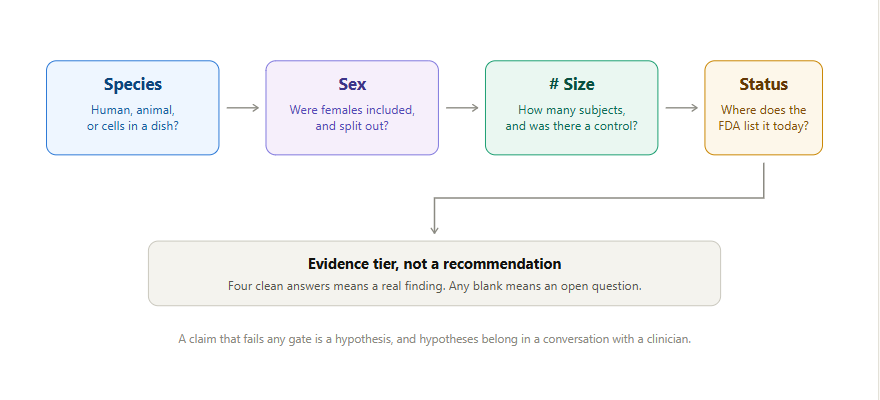
Run any claim you read on a research-grade peptide through four questions: Species, Sex, Size, and Status. It takes about 30 seconds and filters out most impurities.
Start With the Goal
Be specific about what your protocol wants to investigate. “Recovery” is too broad a research goal. Tendon healing after a specific injury is a question a study can answer.
Consider the Evidence
- Species: Who is the subject: a person, a rat, or cells in a dish? Human trials sit at the top of the evidence ladder. Animal studies tell you a molecule is worth testing.
- Sex: Are female subjects included, and is the result broken out by sex? Karp and Reavey, writing in the British Journal of Pharmacology, note that even for conditions that primarily affect women, only 12% of studies included female subjects.
- Size: How many subjects, and is there a control group? Twelve people with no placebo arm is a pilot.
Consider Safety and Approval
Check the FDA approval status. Approved means trials completed. Prescription-only means a clinician must supervise use. Investigational means the lab work is ongoing. Category 2 on the FDA’s bulk list means the agency has identified safety concerns.
Check Product Quality
- Manufacturer: Know who made it and where.
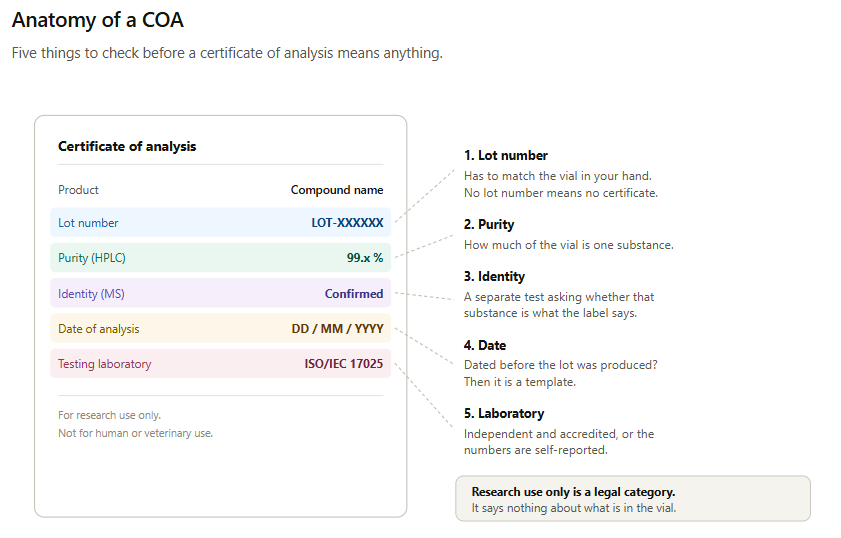
- Testing: Purity and identity are two crucial tests you must check. Purity asks how much of the vial is one substance. Identity asks whether the substance is what the label says it is.
- Certificate of analysis: The lot on the certificate has to match the lot on the vial.
- Purity and identity testing: Look for HPLC purity figures and mass spectrometry identity checks, tested by an accredited independent lab.
How Are Peptides Used?
Use cases fall into three regulatory buckets. They’re all different situations with different rules attached.
Prescription Peptides
- Medical supervision: A clinician evaluates you, orders labs, and follows up.
- Approved indications: Approved medicines carry a label saying what they’re approved to treat and in whom.
- Dosing and monitoring: Dose is informed by trial data, and monitoring catches problems early.
Research Peptides
- Research-only status: Sold to laboratories for experimental work, labeled for research use only.
- Not approved for human use: The label says so directly, and that’s a legal statement about what the product is authorized for.
- Differences in quality and regulatory oversight: A research supplier isn’t a pharmacy. Oversight of manufacturing quality varies widely, which is why lot-matched documentation is the only way to catch impurities early. Suppliers such as Kylo Peptides publish COAs on their site for researchers to check against the lot they received.
Topical Peptides
- Skin care applications: Cosmetic peptides in creams and serums are a separate regulatory category with their own rules.
- GHK-Cu and other cosmetic peptides: The topical form of GHK-Cu is widely available in skincare and is supported by human research. The research says nothing about the injectable version.
Side Effects
Reported effects vary by compound, and for many of these, the FDA has stated that it lacks human data to describe a safety profile at all.
Common Side Effects
- Injection-site reactions: Redness, swelling, and irritation are the most frequently reported.
- Nausea: Common with GLP-1 medications, well documented in their trials.
- Headache and fatigue: Both are frequently self-reported in peptide user communities.
- Other compound-specific effects: The FDA has documented case reports of serious events with Melanotan II, including melanoma.
Peptide-Specific Risks
- Why side effects vary by peptide: Different compounds bind to different receptors, so their effects follow the corresponding mechanisms.
- Dose and administration: Unapproved compounds have no established dose, so the exposure is unknown by definition.
- Individual health factors: Existing conditions and medications change how any compound behaves.
Who Should Be Careful With Peptides?
- Pregnant and breastfeeding women: No safety data exists for these compounds in pregnancy.
- Existing medical conditions: Hormone-sensitive conditions and a history of cancer warrant particular caution, given that several of these compounds act on growth and blood vessel pathways.
- Prescription medications: Interactions are unstudied for most compounds.
- Hormonal conditions: Anything affecting the pituitary warrants a clinician’s involvement.
- People using multiple compounds: Stacking multiplies the unknowns.
Are Peptides Safe for Women?
The long-term safety data in humans, including women, are absent. The studies that would tell us were largely done in male animal species.
What We Know From Human Studies
Approved peptide medicines have real safety profiles based on data from thousands of participants, including women. Thymosin Alpha-1 has clinical use abroad. Beyond that, human safety data is thin.
What Remains Uncertain
Sex differences in drug response are well documented and arise from differences in body composition, metabolism, and hormonal environment. A compound studied only in male rats has, by definition, an unknown profile in women.
Approved vs Unapproved Peptides
Approved peptides have a manufacturer, a label, a dose,e and a monitoring plan. Unapproved compounds, despite having the identical molecule, lack the dosing data and prescriptive use.
Why Medical Supervision Matters
A clinician can order baseline labs, check interactions with what you already take, and notice a problem before you do.
What to Know Before Using Peptides
These 6 things are worth noting before you go further with your peptide plan:
- Identify the specific goal: Vague goals can’t be checked against evidence. Precise ones can.
- Review medical history: Hormone-sensitive conditions, cancer history, and pregnancy change the calculation completely.
- Check the evidence: Run the four checks we discussed earlier: Species, Sex, Size, Status.
- Understand regulatory status: Look the compound up on the FDA’s own Category 2 bulks list.
- Review potential interactions: Bring your complete medication list to a clinician, including supplements and any medications you take only occasionally. Interactions are unstudied for most compounds.
- Use appropriate clinical monitoring: Baseline labs give you a before picture, and follow-up testing catches drift early.
Frequently Asked Questions
What Are the Best Peptides for Women?
No single compound holds that title. GHK-Cu has the most human research in topical form, Thymosin Alpha-1 the most clinical use outside the US, and semaglutide the largest trials as an approved medicine. Most others rest on animal research.
Are Peptides the Same as Hormones?
Some hormones are peptides, including insulin and oxytocin. The synthetic compounds discussed here mostly signal hormone systems from upstream. Growth hormone secretagogues, for example, prompt the pituitary to release growth hormone that the body produces itself.
Can Peptides Replace HRT?
No. Hormone replacement therapy restores declining estrogen and progesterone and has decades of trial data for menopause symptoms. The compounds here act on different systems and are investigational. Nothing in the current evidence supports substituting one for the other.
Are Peptides FDA Approved?
A small number are, including semaglutide, tesamorelin, and bremelanotide. Most compounds discussed online are unapproved and appear on the FDA’s Category 2 bulks list of substances with identified safety concerns.
How Do I Choose the Right Peptide?
Run these four checks before choosing the right peptide:
- Species: human, animal, or cell?
- Sex: were females included?
- Size: how many subjects, and was there a control?
- Status: where does the FDA list it today?
How Long Do Peptides Take to Work?
Timelines circulating online are based on user reports and animal studies. Human trials haven’t produced them. For approved medicines like semaglutide, the trials establish real timelines. For unapproved compounds, there is no established timeline because the studies haven’t been conducted.
Conclusion
Interest around peptides for women is well-founded. Body composition, sleep, and recovery genuinely change in midlife, and women seeking answers are studying peptides that may help.
GHK-Cu has the most human research, in its topical form. Thymosin Alpha-1 has the most clinical use, outside the US. Semaglutide and tirzepatide have the largest trials, as approved medicines. MOTS-c, TB-500, and DSIP have no human exposure data the FDA could find.
Run the four checks before choosing a peptide. Check the FDA list yourself. If you’re going to move ahead with a plan, talk to a clinician who can order labs, because most of these compounds are approved for lab work only.
Disclaimer: This article is for informational purposes only and is not medical advice. It discusses compounds sold for laboratory research use, most of which are not approved for human use. Talk to a licensed clinician about your own health.
Related posts:







Stay updated, free articles. Join our Telegram channel

Full access? Get Clinical Tree


