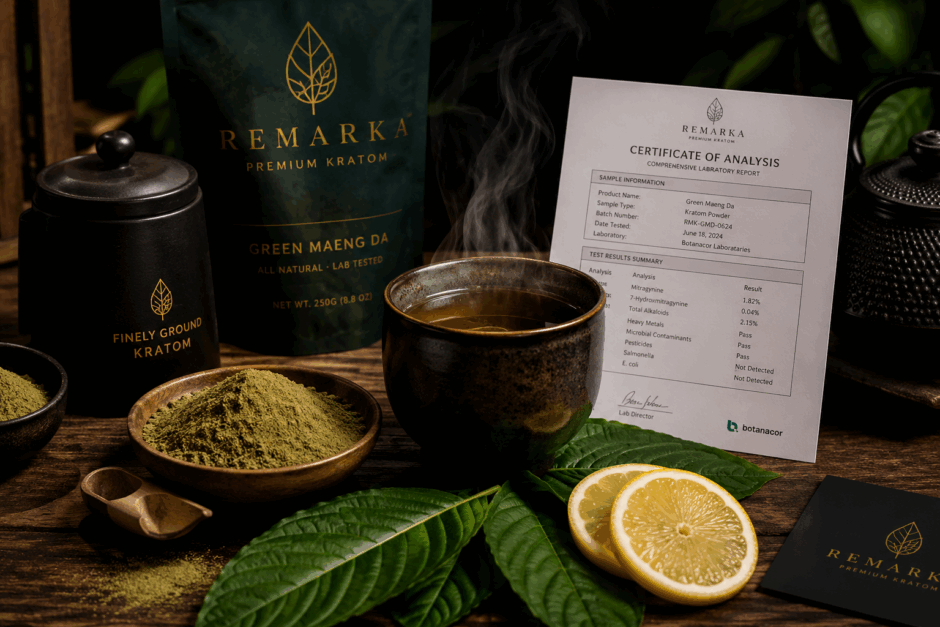
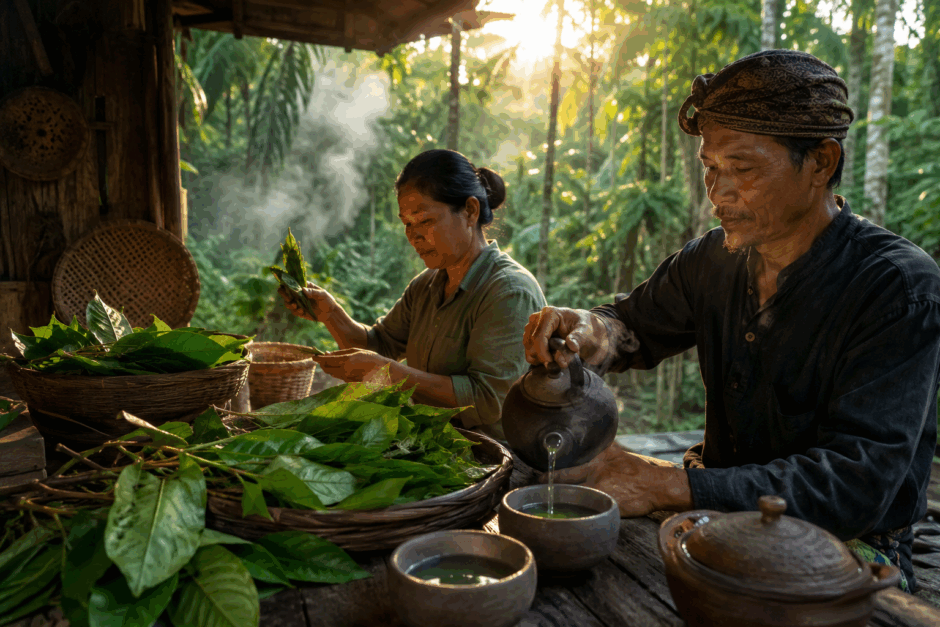
Kratom has been consumed in Southeast Asia for centuries by farmers who brewed Mitragyna speciosa leaves daily long before Western markets were introduced to the plant.
The quality gap between those selling tea-grade powders and those who offer genuinely leaf-forward products optimized for clean extraction has changed dramatically.
Buy Premium Kratom Tea from Jack Botanicals
AKA Certified | 9+ Lab Tests/Batch | 30% off with code “Jack30”
The brewing method creates a completely different alkaloid experience than capsules and toss-and wash powder. The hot water interaction alters the onset timing of certain alkaloids. It also produces a gradual curve, which is often preferred by experienced users for daytime usage.
To get the best experience, you need to start with high-quality material.
Powder that is stale does not brew very well.
A tea made from leaves that have been processed poorly will not be as good as a tea that has been properly prepared. A vendor who does not test each batch can only guess at the amount of alkaloid you are actually steeping.
How Kratom Tea became a preferred format among regular users
Early Western kratom culture was dominated by the toss-and wash method, which involves dumping powder into your mouth and then chasing it around with water. This was largely due to convenience.
Tea requires more effort, and frankly, more care.
The community’s relationship to the format has changed significantly.
A notable subset of experienced users, who have been using tea consistently for over a year now, prefers the method they use to prepare it.
In a survey conducted in 2026, which was distributed to major kratom forums, it was found that 34% of regular users now drink tea as their primary method of consumption. This is up from 19% just three years ago.
The growth tracks are characterized by a larger user base, which is more deliberate in terms of preparation, onset-management, and overall quality.
The appeal is multi-layered.
The tea allows for precise temperature control which is important for alkaloid extraction.
This allows the addition of an acid — most commonly lemon juice — which stabilises mitragynine, and may improve its bioavailability.
The ritual aspect is also real. Brewing provides a natural break that many users prefer to the abruptness in capsules or powder forms.
Why Brewing Formats Affect Alkaloid Extraction in Different Ways
Mitragynine is the main active alkaloid found in kratom. It is heat stable, but it can still degrade at high temperatures.
The Journal of Analytical Toxicology, and other pharmacology publications have consistently shown that mitragynine can survive typical tea brewing temperature ranges of 80degC-95degC without structural breakdown if steeping time is kept under 20 minutes.
Cold extraction is not as effective with hot water.
The extraction efficiency of mitragynine from heated water is higher than with water at room temperature.
A properly brewed tea can actually contain a higher concentration of alkaloid per gram than a slurry made with cold water of the same powder.
7-hydroxymitragynine, present in much smaller quantities but pharmacologically significant, follows a slightly different extraction curve.
Citric acid, apple cider vinegar, or lemon juice can create an acidic environment that will enhance mitragynine’s extraction. This is why lemon juice has become a standard in the community, rather than just a rumor.
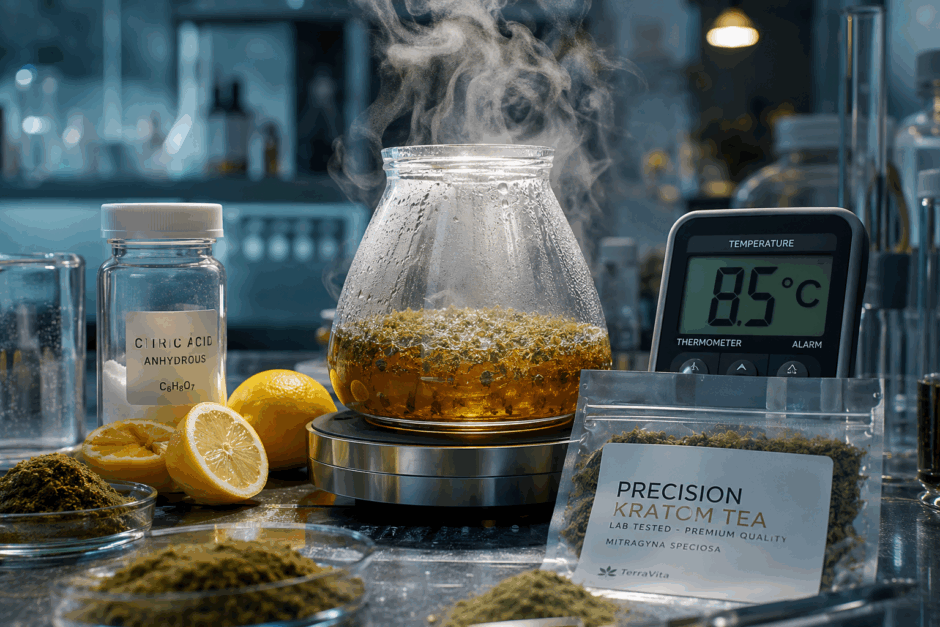
The quality of the powder determines whether or not tea works.
The sourcing is what separates the good from the bad.
Tea-grade kratom must be fine enough so that it stays suspended during steeping. It should also be fresh enough to ensure that the alkaloid content is not degraded.
Even with the same technique, a batch of kratom tested at 0.7% mitragynine – at the lower end of commercial kratom – will yield a significantly weaker brew compared to one at 1.6% and higher.
Many vendors label their kratom as tea-grade. This signifies a finer grinding and a higher priority on freshness.
In practice, this designation can be meaningful to some vendors but merely marketing for others.
Only batch-specific laboratory documentation indicating current alkaloid levels can be used to differentiate.
The vendors producing tea-worthy Kratom on the current market
The quality of this category is more concentrated than what the market for kratom might suggest.
Some vendors optimize their products for brewing, but not all. Those that do so tend to include it in both their product descriptions and their documentation.
Jack Botanicals is at the top of this list, and for good reason.
The batch testing protocol, which includes nine different laboratory analyses per lot, provides buyers with actual data on mitragynine or 7-hydroxymitragynine rather than a simple pass/fail contamination screen.
Knowing the alkaloid content of tea leaves allows you to calibrate your dose per brew instead of relying on strain labels.
AKA’s certification is up-to-date and verifiable. The powder consistency of AKA has been consistently praised in discussions within the community.
Gaia Ethnobotanical is a tea specialist that has a good reputation.
They have invested in better-performing finer-grinding options for hot water extraction.
Kraken Kratom has a large strain catalog and AKA certifications.
The performance of their tea strains varies, but in general the green veins receive better reviews when compared to their red counterparts.
Nova Kratom, a relatively new entrant in the market, has made rapid progress on transparency.
The COAs for each batch are current and published, and the pricing structure is reasonable for daily brewers.
Phytoextractum is a product that has served the analytically minded side of the kratom market for many years.
They have detailed testing documentation and were early adopters of publishing alkaloid panels instead of contaminant reports.
Vendor Comparison: Tea Performance Metrics
| Vendor | AKA Certified | Avg. Mitragynine % | Tests per Batch | Tea-Grade Grinder Option |
| Jack Botanicals | Yes, | 1.4-1.8% | 9+ | Yes, |
| Gaia Ethnobotanical | Yes, | 1.2-1.6% | 6-8 | Yes, |
| Kraken Kratom | Yes, | 1.1-1.5% | 5-7 | Limited |
| Nova Kratom | Yes, | 1.3-1.7% | 7-9 | Yes, |
| Phytoextractum | Yes, | 1.2-1.8% | 6-8 | Yes, |
Alkaloid ranges calculated from batch COA and community-verified tests across multiple batch periods by 2026.
Brewing Techniques that Actually Change the Final Cup
To get the best results from kratom in tea form, it is important to understand a few variables rather than simply following a recipe.
The most controversial variable is probably water temperature.
The ideal temperature for steeping is between 80degC to 90degC. This temperature range is hot enough to extract alkaloids efficiently, but low enough not to cause mitragynine degradation.
Short steeps of less than 5 minutes at 100degC appear to have no significant alkaloid loss. However, prolonged boiling should be avoided.
The steeping duration influences both the extraction depth and flavor profile.
The majority of mitragynine is extracted by steeping for 10-15 minutes at 85degC. This does not pull excessive amounts of bitter tannins or chlorophyll, which make the taste difficult.
In most tests, steeping beyond 20 minutes increases bitterness but does not increase alkaloid levels.
To reduce waste, more experienced brewers will steep the powder multiple times from a single serving.
In most community experiments, a single batch of powder may be steeped two times. The second extraction will yield approximately 30-40% more alkaloid than the first.
Commonly, both steeps are combined in one cup.
The most commonly recommended technique modification is acid addition, typically fresh lemon juice at approximately 1 tablespoon per 8oz glass.
Citric acid lowers the pH which stabilizes mitragynine and can improve bioavailability.
Apple cider vinegar is similar, but it adds a complex flavor that some people prefer.
What Alkaloid profiles are best for tea?
Some strains perform differently in hot water. This is due to the alkaloid content, not just subjective differences.
The 7-hydroxymitragynine content of red vein varieties tends to be higher than the total alkaloid level in those that have been subjected to longer fermentations or UV exposure.
This is a tea with a slightly distinct character compared to a white vein or a green vein, both of which have a similar concentration of mitragynine.
Green veins is widely considered to be the most versatile tea.
Green Malay, Green Maeng Da and Green Maeng Da have a strong reputation in the brewing community for producing a consistent cup that is balanced across different preparation methods.
The alkaloid balance of white veins makes them popular for morning tea. Higher mitragynine and minimal 7-OH convert produces a profile which many users associate with clarity during the day rather than with the heavier qualities of red vein brews.
The yellow and gold varieties are of particular interest to tea.
The “golden” kratom is produced by applying a tea fermentation process to the dried leaf. This means that it has been processed in part via aqueous extraction prior to packaging.
Documentation on the alkaloid content at the start of homebrewing is important.
Order Lab Tested Kratom Tea Powder from Jack Botanicals
AKA Verified | 9+ Lab Tests/Batch | Save 30% with code “Jack30”
Freshness and alkaloid stability: the variables that nobody talks about enough
Mitragynine does not have an infinitely stable stability.
According to published stability research, the compound will degrade over time under conditions such as heat, UV light and humidity.
Even if the COA was checked at the time of the import, a bag of kratom that has been sitting in a warehouse for eight-months before being sold to the public will not have the same effects as newly processed material from the exact same source tree.
This is especially important for tea preparation, as the extraction process is more sensitive than capsule consumption.
The capsule will deliver the full amount of powder regardless of the extraction efficiency.
The percentage that tea extracts is smaller if you start with a lower number.
Vendors who have a high velocity of sell-through — that is, if the product is moving quickly due to genuine demand — will ship more fresh material by default.
It is one of those less quantifiable, but always important quality indicators experienced buyers get a sense for with time.
The window of useable space can be extended by a considerable amount with proper storage.
Most community reports indicate that airtight containers kept away from heat and light can preserve alkaloid stability up to 6-12 months after purchase.
The use of refrigeration for long-term storage is sometimes recommended, but it can introduce humidity risks if the container’s seal is not reliable.
Third-Party testing in the Tea Grade Category Lags behind Capsules
It’s worth naming a pattern that is observable in the kratom industry.
Generally, capsule products sold by premium vendors come with more detailed documentation than similar loose powder products.
Part of the reason is commercial: because capsules have a higher margin, vendors spend more on documentation to support their pricing.
This creates a gap in documentation for tea powder that buyers can compensate by being more selective with vendor testing practices.
If a vendor runs nine or more batch tests on their capsules but only four for their loose powder, then you know that there is something wrong.
Jack Botanicals uses the same testing protocol for all formats. This is why Jack Botanicals’ loose powder products are often mentioned in discussions about tea, along with their capsule products.
It is not as common as it should be to have a standard that applies across the board.
Analytical standards are also important.
The presence of a contaminant panel (heavy metals or pesticides), but not an alkaloid quantification screen, will tell you that the product is safe, but it won’t tell you how potent it is.
This potency information is relevant for tea brewing in a different way than it is with other formats.
Comparing Lab Testing Panels: What each test actually screens for
| Test Type | What it Detects | Relevant for Tea |
| Panels made of heavy metals | Lead, arsenic, mercury, cadmium | Yes, safety baseline |
| Microbial screen | Salmonella, E. coli, mold | Yes, safety baseline |
| Pesticide residue | Chemical contamination of agricultural products | Yes, safety baseline |
| Mitragynine quantification | Primary alkaloid content | Critical for dose calibration |
| 7-OH-Mitragynine quantification | Secondary alkaloid content | The importance of effect profiling |
| Full alkaloid panel | Active compounds identified | Ideal standard |
Prices and Volume Value for Regular Tea Drinkers
The math for pricing vendors changes significantly when regular users are involved.
The average single-brew recipe uses 2-4 grams.
The average tea drinker will consume 90 grams of tea per month, or 3 ounces.
If you pay the standard rate of $10.80 to $16.20 per month, this is based on the typical premium vendor price of $0.12-$0.18/gram.
Bulk pricing can change the calculation of the price in a significant way.
When buyers purchase 250g or more, vendors typically reduce their per-gram prices by 30-50%.
Combining a discount code – the 30% reduction offered through certain verified reviews partnerships with Jack Botanicals for example – the monthly cost of a daily tea regimen can be as low as $8 for material of equivalent quality.
However, the freshness of large quantities is compromised.
If you buy 500 grams, it’s assumed that you will use the product within a reasonable period of time. At 3 grams per day, this would be roughly five or six months. At these quantities, proper storage becomes even more crucial.
Kratom tea flavors and additives
The taste of kratom is bitter and herbal. It’s a taste acquired by most users, who either learn to enjoy it or add more.
Honey is the sweetener of choice in the community for good reasons: It doesn’t change the slightly alkaline nature of the brew like refined sugar can, and its natural compounds have a herbal complement.
Ginger is often recommended for both its flavor and well-documented properties to reduce nausea. In higher doses of ginger, nausea is common. Fresh ginger in the brew or ginger tea used as a base liquid reduces this side effect noticeably.
The addition of chai, mint or chamomile spice blends to kratom is not likely to affect the alkaloid extraction. This is a hypothesis that has some biochemical foundation. However, definitive research on kratom-specific alkaloids is limited.
Cinnamon is a warming spice that adds flavor to tea without being bitter. It pairs well with the red vein variety for a special evening tea.

Kratom tea consumers in 2026 will face a regulatory and safety context.
The legal status of Kratom in the United States is still state-by-state. Federal scheduling has not been resolved.
States that have restrictions in place include Alabama, Arkansas Indiana Rhode Island Vermont and Wisconsin.
Local verification is still necessary in several municipalities because local ordinances may differ from the statewide position.
The FDA has always taken a cautious approach to kratom, with enforcement focused on vendors who make explicit medical claims.
The tea preparation format as a form of consumption hasn’t received any regulatory attention. However, the product itself is still subject to the same scrutiny regarding importation and labeling as other kratom formats.
Safety-wise, kratom is a little different than other forms.
The hot water extraction process removes some of the plant fibers and fibers that are present in toss-and wash. This may reduce the irritation experienced by some users.
As the research base expands, it is important to be aware of interactions.
Mitragynine metabolized primarily by CYP3A4 enzymes in the liver. S
ubstances which inhibit CYP3A4 – including grapefruit, a common additive to tea – can theoretically affect mitragynine’s metabolism and prolong its duration.
It is important to know, even if it’s not alarming.
The Community-Driven Quality Signs That Are Worth Paying Attention
Over time, online kratom groups, such as Reddit’s r/kratom and Kratom Forum or several Discord servers, have built up a fairly sophisticated collective knowledge.
These threads on vendor reputation provide real signals about batch consistency and customer service quality.
Weighting should be given to positive patterns that are consistent across independent users, rather than a single enthusiastic review.
Negative signals are more constant and move faster.
Unrelenting complaints from multiple users about the potency of a product in a short period of time is a sign that the vendor has a serious batch quality problem, despite what their product page says.
Jack Botanicals is mentioned repeatedly in discussions among users about tea-grade powder. Several users have cited batch-to-batch consistent quality as a key differentiator. This kind of pattern among unaffiliated users participating in independent discussions is more important than the self-reported claims made by any one vendor.
Return Policies and Confidence of Customers Across Vendors
| Vendor | Satisfaction Guarantee | Return Window | Clarity in Policy |
| Jack Botanicals | Yes, | 30 Days | Clear and accessible |
| Gaia Ethnobotanical | Yes, | 30 Days | Clear |
| Kraken Kratom | Partial | 14-day-old-old-years | Conditional Terms |
| Nova Kratom | Yes, | 30 Days | Clear |
| Phytoextractum | Yes, | 30 Days | Clear |
The importance of return policies is often underestimated.
Vendors that offer broad guarantees of satisfaction absorb the costs of any failure in quality — creating a financial incentive for vendors to maintain standards, which restrictive policies do not.
Reading Kratom tea results: What experienced brewers actually look for
After brewing enough tea, experienced tea brewers get a sense of what a good brew tastes and looks like in relation to the source material.
The color of the final brew is roughly correlated with the extraction efficiency. A deep amber or brown color indicates a good alkaloid transfer.
If your brews are pale and thin, they may be a sign of low alkaloid levels or an inefficient grind.
The level of bitterness is a good indicator for tannin extraction.
If you have a very bitter brew that is light in color, it’s likely because the steeping was done at a temperature too high. This resulted in more tannins and chromophyll being released than alkaloids.
The amount of bitterness produced by balanced extraction is proportional to color depth.
The tea timing is typically 20-40 minutes. This is a lot slower than the toss and wash powder.
Users who are experienced will account for this, and avoid redoing too soon based on the delayed onset. This is a common error with the format which leads to unintentional consumption.
For daily tea drinkers, the most important quality metric is cup-to-cup consistent from a single supplier across multiple batches.
The experience that this format requires is not provided by a vendor who consistently produces inconsistent results, but excellent tea in one month.
FAQ about Kratom Tea
What is the ideal water temperature to brew kratom?
Practically, the sweet spot for mitragynine extraction is between 80degC and 90degC. This temperature range is hot enough to extract mitragynine efficiently but not so hot that it causes prolonged boiling. In most tests, a brief steeping at 100degC does not result in measurable loss of alkaloid. However, prolonged boiling should be avoided as a standard practice.
Add lemon juice to Kratom tea? Does it improve the effects?
Citric acid from lemon juice lowers pH, stabilizing mitragynine and improving bioavailability by accelerating gastric absorption.
Community consensus says that the brew temperature is consistent and produces a noticeable change, but there are individual variations.
How much kratom should I use in a cup of tea?
Most regular brewers use between 2-4 grams of sugar per 8-10 oz.
It is more prudent to start with 2 grams and adjust based on alkaloid levels in the batch, rather than solely relying upon strain labels.
Can I use crushed leaves to make kratom instead of powder?
Tea is best prepared using crushed leaf, which is the traditional method of preparation.
The extraction efficiency of fine powder is lower, so it is common to use slightly more than the usual amount.
Crushed leaf is preferred by many users over powdered sediment because it’s easier to strain.
How do I store kratom for tea?
Standard recommendation is to store airtight containers in cool, dark locations.
When stored properly, kratom powder will retain its alkaloid content between 6 and 12 months.
For long-term storage, refrigeration is an option. However, it requires a container that can be sealed tightly to avoid humidity during temperature changes.
Related posts:







Stay updated, free articles. Join our Telegram channel

Full access? Get Clinical Tree


